We timed every meeting in a two-week sprint. Here's the real cost.
ESTIMATED TIME
10
mins

Written by
Rajveer Prasad
Published on
The hours in the room were never the expensive part. The bill you don't see is what those meetings do to the hours around them.
A team I worked with had the same argument every retro. Too many meetings. And every retro it went nowhere, because it stayed a feeling. "It feels like we're always in meetings." Feelings lose to "well, the ceremonies are in the Scrum Guide," and the calendar stays exactly as full as it was. So one sprint we stopped arguing about the feeling and actually added it up. Every meeting, every attendee, the whole two weeks.
The raw number was not even the shocking part. The shocking part was everything the raw number left out. Because once you count the real cost of a meeting, not just the time in the room, the bill roughly triples, and you finally understand why a team can spend most of its week in meetings and still feel like it never has time to think.
A meeting's real price is not the hour it takes. It's the two hours around it that it quietly ruins.
Start with the honest arithmetic
Let's just do the ceremony math first, because it's not even controversial. Take a standard two-week sprint. Sprint planning, call it a few hours. A daily standup, fifteen minutes, ten working days, so another two and a half hours. Sprint review, a couple of hours. Retro, an hour and a half. Backlog refinement across the sprint, an hour or two. Add it up and you're already near ten hours per person, per sprint, in scheduled Scrum events alone, before a single stakeholder sync, one-on-one, or "quick chat" lands on the calendar. And that's the disciplined version, run to time.
Ten hours out of a two-week sprint. Call it a full day and change, gone to ceremonies before any actual work or any other meeting. On its own, that's defensible. These events exist for good reasons. But here's the mistake almost everyone makes when they look at that number: they think that's the cost. The ten hours is not the cost. The ten hours is the visible tip of the cost.
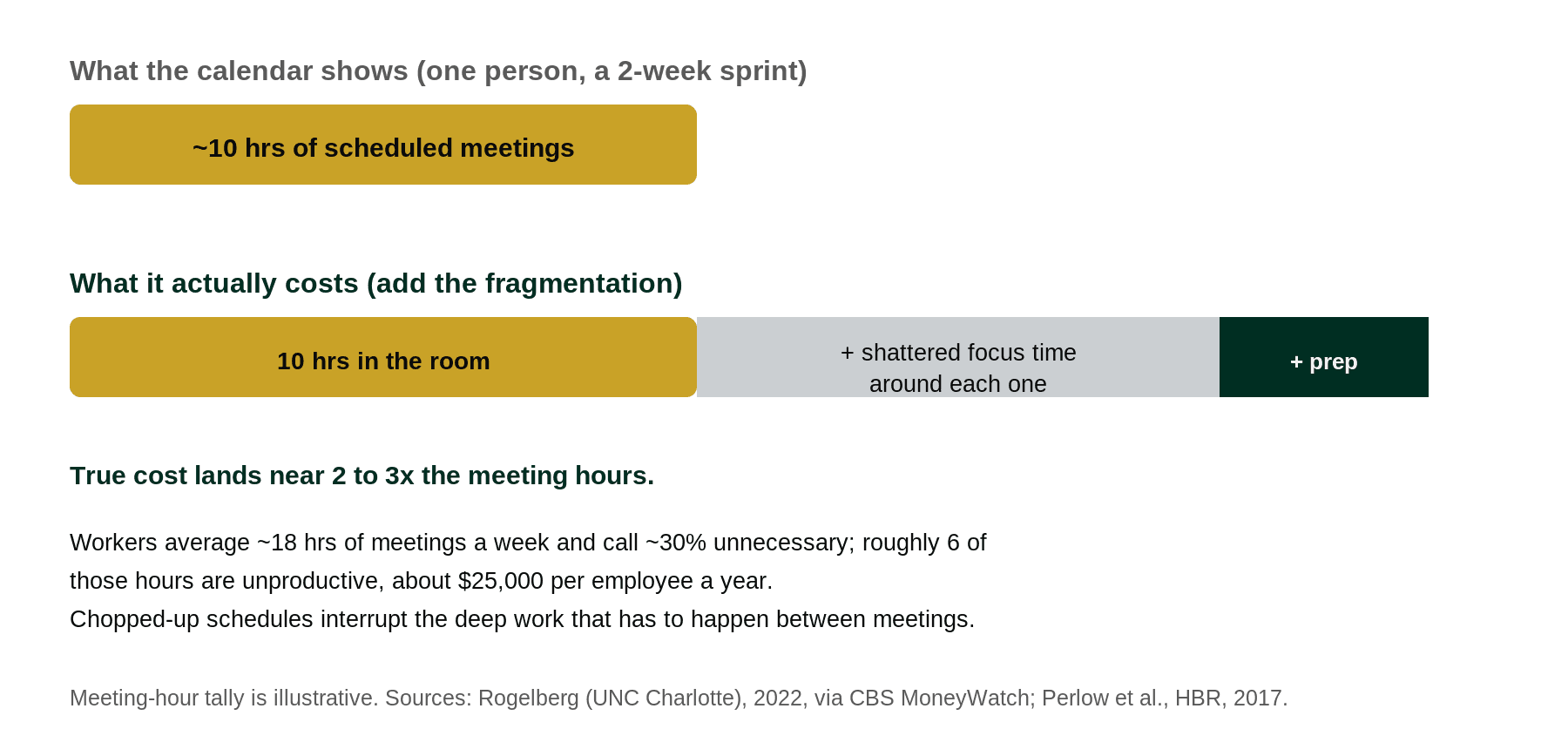
The calendar shows the hours in the room. The real bill adds the shattered focus time around each meeting, plus prep. It lands near two to three times the meeting hours.
The bill you can't see: fragmentation
Here's what the calendar hides. A one-hour meeting at 11am does not cost one hour. It costs the hour, plus the twenty minutes before it where you can't start anything deep because you know it's coming, plus the time after it to reload the complicated thing you were doing before you got pulled out. Deep work does not resume the instant a meeting ends. The context has to be rebuilt, and rebuilding it is slow.
This isn't a hunch. Harvard Business Review's research on meeting overload found executives now spend nearly 23 hours a week in meetings, up from under 10 in the 1960s, and named the exact damage: chopped-up schedules interrupt the deep thinking that real work requires, which is why people come in early, stay late, or use weekends just to find quiet time to concentrate {Perlow, Hadley & Eun, HBR, 2017}. Read that again. The meetings push the actual work into the margins of the day and the week. The hours in the room aren't just spent, they poison the hours around them for focused work.
So when we timed our sprint, the ten hours of meetings was really more like twenty-five to thirty hours of impact per person, once you honestly counted the fragmentation on either side of each one and the prep beforehand. A day of meetings on paper was most of a productive week in practice. That is the real cost, and it never shows up on anyone's calendar, which is exactly why the retro argument never went anywhere. You can't win an argument against a number nobody's counting.
And a third of it, you didn't need
Now here's where it goes from expensive to maddening. Not all of those meetings were doing anything. When researchers actually measured this, the picture was brutal: workers average around 18 hours of meetings a week and rate about 30% of them unnecessary, with roughly six of those hours flatly unproductive, adding up to something like $25,000 in wasted cost per employee every year, and around $100 million a year for a company of 5,000 {Rogelberg, UNC Charlotte, 2022}. A third of the most expensive thing on your calendar, doing nothing.
And the reason those meetings survive is the part that should sting, because it's not efficiency, it's fear. The same research found that 53% of workers still feel compelled to attend meetings they consider unnecessary, and that people quietly multitask through about 70% of the ones they think are pointless {Rogelberg, UNC Charlotte, 2022}. Read that honestly. Half the room is there because declining felt rude or risky, and most of them aren't even paying attention. That recurring sync that's been on the calendar for a year, that nobody would defend if asked directly, that everyone half-attends with their camera off? It's not a meeting. It's a standing tax that everyone pays and no one voted for.
The steelman, because meetings aren't the enemy
Let me argue the other side properly, because the dumb version of this post is "meetings bad, cancel everything," and that's wrong and it causes real damage. Meetings are how coordination happens. A team that cancels its planning, its retro, and its syncs in the name of focus time doesn't get a calm, productive team. It gets a team that's blocked in the dark, making the same mistake in five directions, discovering in week two that half of them built the wrong thing. The cost of no coordination is higher than the cost of meetings, and it's worse because it's invisible until the demo. Some of those ten hours are the best-spent hours of the sprint. The daily standup that catches a blocker early pays for itself ten times over.
So the argument is not "fewer meetings." Dogmatic meeting-slashing is just the mirror image of dogmatic meeting-keeping, and both skip the actual work. The argument is that meetings are one of the most expensive things a team owns, two to three times more expensive than they look, and almost nobody prices them honestly or audits them at all. You wouldn't let a third of your budget run on autopilot with no one checking if it produced anything. Your calendar is a budget. Run it like one.
Audit the calendar like it's money
Here's the practical move, and it's the reason to time your own sprint. Once you can see the true cost, you can spend it deliberately. Take every recurring meeting on the team's calendar and run each one through two questions: does it actually need live interaction, and does it produce a real decision or outcome? Those two questions sort everything.
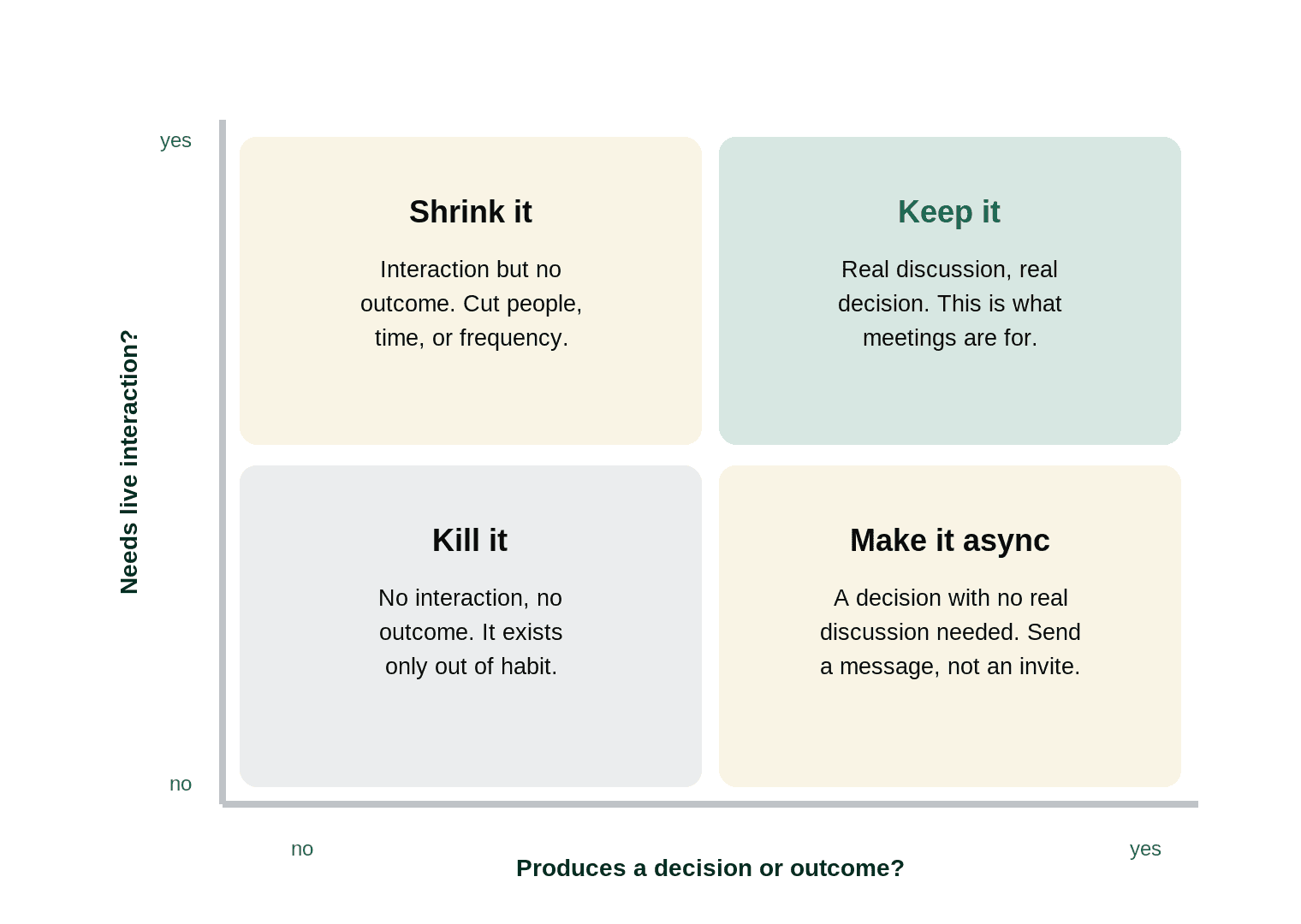
Two questions, four verdicts. Most calendars are full of the bottom-left and bottom-right, running on habit.
A meeting with real discussion and a real decision, keep it, that's what meetings are for. A meeting with interaction but no outcome, shrink it: cut the invite list, halve the time, or drop the frequency. A decision that needs no real discussion, make it async: that's a message, not a meeting. And a recurring event with no interaction and no outcome, the one running purely on habit, kill it, and watch how long it takes anyone to notice. Rogelberg's own fix is a good tell here: make every meeting agenda a question to be answered, and if you can't name the question, you don't need the meeting.
The team that timed its sprint didn't declare war on meetings. It killed two standing ones outright, made a third async, and tightened the rest. It got back the equivalent of most of a day per person per sprint, and, more importantly, it got that day back in unbroken blocks, which is the only kind of time deep work can actually use. The lesson wasn't that meetings are bad. It was that they'd been paying a huge, invisible bill for years and calling it "just how the sprint works." Count it once, honestly, and you'll never look at your calendar the same way again. The most expensive thing on it was the thing nobody was pricing.
Sources
Leslie A. Perlow, Constance Noonan Hadley, and Eunice Eun, "Stop the Meeting Madness," Harvard Business Review, July to August 2017 (executives average nearly 23 hours a week in meetings; chopped-up schedules interrupt deep work).
Steven G. Rogelberg (UNC Charlotte), "The Cost of Unnecessary Meeting Attendance," 2022 survey of 632 workers, reported by CBS MoneyWatch (about 18 hours of meetings a week, ~30% unnecessary, ~$25,000 wasted per employee a year, 53% attend unnecessary meetings anyway).

Subscribe to the Newsletter
Join our growing community and get alerted first on our every article.
*By subscribing, you agree to send your information to our Company who agrees to use it according to their Terms and conditions and Privacy Policy
About the author
With 20 years guiding high-stakes Agile transformations, I turn theory into action at Oaktreeuni—mentoring aspiring Scrum Masters to think critically, adapt fast, and lead beyond frameworks. The payoff? You step into a high-paying Scrum Master or Agile PM role already equipped to excel.
What is the real cost of a meeting?
More than the time in the room. A meeting fragments the focus time around it, since deep work can't resume instantly afterward. Counting that, plus prep, a meeting's true cost is often two to three times its scheduled length.
How do you reduce meetings on an Agile team?
Audit every recurring meeting with two questions: does it need live interaction, and does it produce a decision? Keep the ones that do, shrink or make async the ones that don't, and kill the ones running purely on habit.
← Previous post
Great delivery people work themselves out of a job. On purpose.
Next post →
Nobody is 25% allocated: the real math of splitting people across projects

Keep reading
Newest on the blog


Comments