How to tell a stakeholder 'not yet' and keep their trust
ESTIMATED TIME
11
mins

Written by
Rajveer Prasad
Published on
A refusal ends a conversation. A deferral starts a debt. Here's how to defer a request so the relationship gets stronger, not weaker.
Rajveer
A sales director corners you after the Wednesday review. She wants a change to the pipeline dashboard, and she wants it this sprint. It's not a crazy ask. It's real work, it has real value, and it's sitting behind six other real things.
You've got about ten seconds to answer, and most people reach for one of two bad options.
Option one: cave. Squeeze it in, blow up the sprint, and teach her that pressure works on you. Option two: the vague deflection. "We'll get to it." "It's on the backlog." "Soon." She nods, walks away, and starts drafting the escalation email in her head, because she's heard "it's on the backlog" before and she knows where backlogs go to die.
There's a third answer. It's the one senior delivery people use, and it's two words long: not yet. But those two words only work if you understand what they actually are. They're not a softer no. They're a promise with a date on it.
Stakeholders don't hear "not yet." They hear "never, politely."
Here's the uncomfortable truth. Your stakeholder has been told "later" by every team she's ever worked with, and most of those laters never arrived. So when you say "not yet," she doesn't hear sequencing. She hears the opening move of the same disappearing act, wrapped in nicer language.
That's the real problem you're solving in this conversation. Not the request. The pattern.
A refusal ends a conversation. A deferral starts a debt, and a debt is only worth something to the person holding it if they believe it'll be paid. So your job isn't to soften the no. Your job is to make the deferral believable, and then to make it come true.
Which means "not yet" isn't a sentence. It's a small contract with four parts.
The four parts of a "not yet" that holds
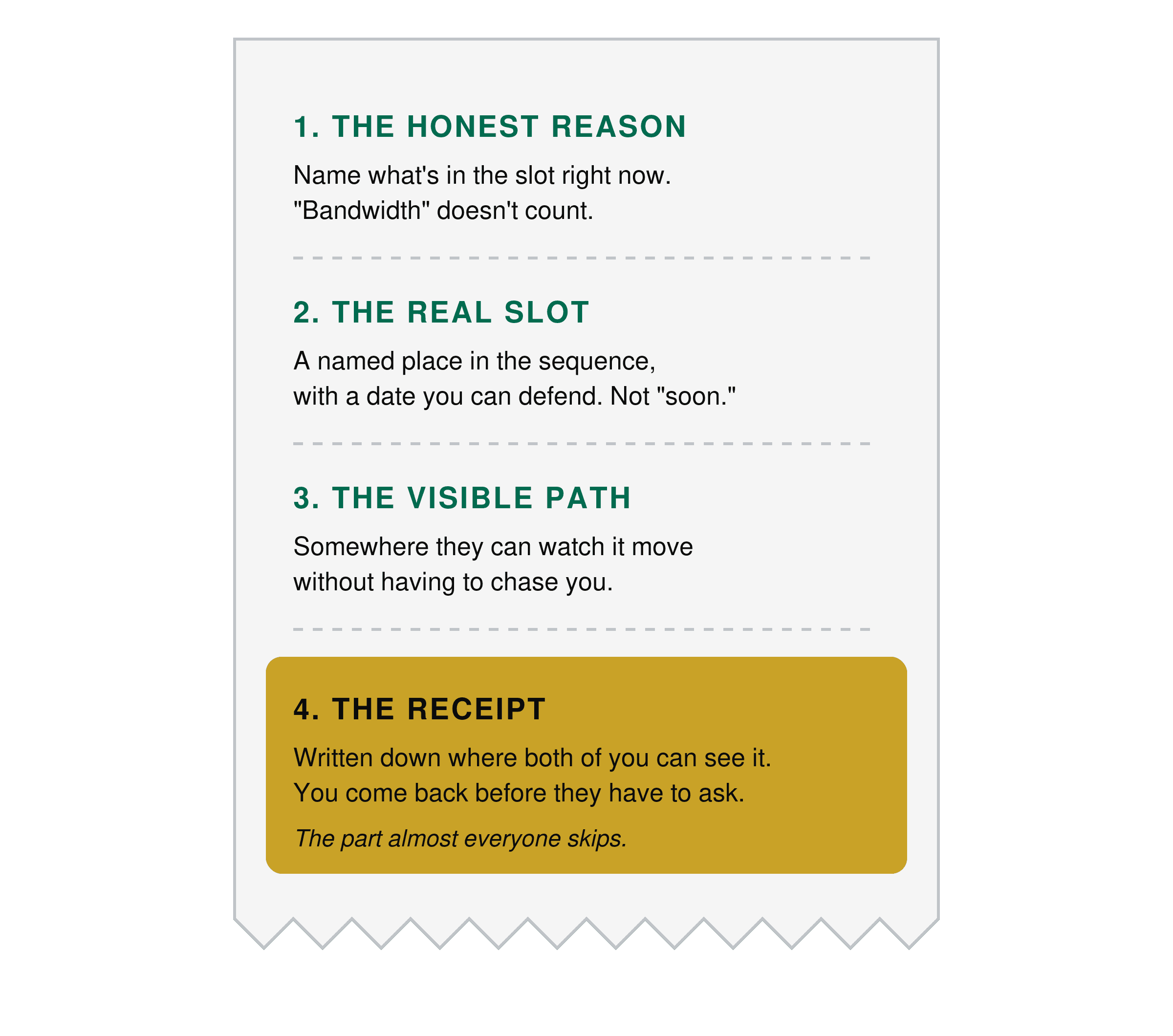
The honest reason. Tell her what's in the slot she wants. Not "we don't have bandwidth." Bandwidth is what people say when they don't want to explain themselves, and every stakeholder knows it. Say the real thing: "The next two sprints are carrying the invoicing migration, and it has a regulatory date." Now she isn't being brushed off by a vague wall. She's looking at a real tradeoff, and most stakeholders can respect a tradeoff they can actually see. The ones who can't were never going to be satisfied by "soon" either.
The real slot. "Soon" is not a slot. "After the migration ships, first week of March" is a slot. The moment you name a place in the sequence, the request stops being rejected and starts being scheduled, and those are two completely different emotional events. One is a door closing. The other is a ticket number.
Careful, though. A slot you can't defend is just a lie with a date attached. Give the slot you actually believe, with the same honesty you'd bring to an estimate. If the truth is "March, unless the migration slips," then say exactly that, out loud, now. Conditions stated up front read as competence. Conditions revealed later read as excuses.
The visible path. Show her where the request lives and where she can watch it move. A ticket she can open. A roadmap column with her item in it. If she can check status without asking you, she never has to chase you, and every chase you prevent is trust you keep. Chasing is corrosive on both sides: she feels ignored, you feel nagged, and the request gets heavier every time it changes hands.
The receipt. This is the part almost everyone skips, and it's the part that does the compounding. Write the commitment down where both of you can see it. Then come back before she has to. When March gets close, you go to her: "You asked for the dashboard change in January. It's next. Still the right shape, or has the quarter changed what you need?"
You kept the receipt, and you paid it without being chased. Do that twice and something quietly changes in how this person treats every date you give her afterward.
Run the play: the whole script in forty seconds
Here's the entire thing, in the hallway, before her coffee goes cold:
"I'm not going to squeeze this into the sprint, and I want to give you the real reason instead of saying bandwidth. The team's carrying the invoicing migration through February and it has a compliance date, so anything that displaces it puts that date at risk. Your dashboard change is real and it's next in line: first week of March, unless the migration slips, and if it slips I'll tell you before you have to ask. It's on the roadmap here, and I'll come back to you at the end of February to confirm before we start."
Now put the weak version next to it: "Yeah, it's on the backlog, we'll try to get to it soon."
Same decision. Same sprint. Same amount of work done for her this month, which is none. One of them builds a reputation and the other one spends it.
Notice what the strong version never does. It doesn't apologize. It doesn't ask permission to have a sequence. And it doesn't pretend her request is a problem. The request is fine. It's just not next, and you said so like someone who runs the order of work instead of someone hiding behind it.
Trust is a ledger, and every deferral is an entry
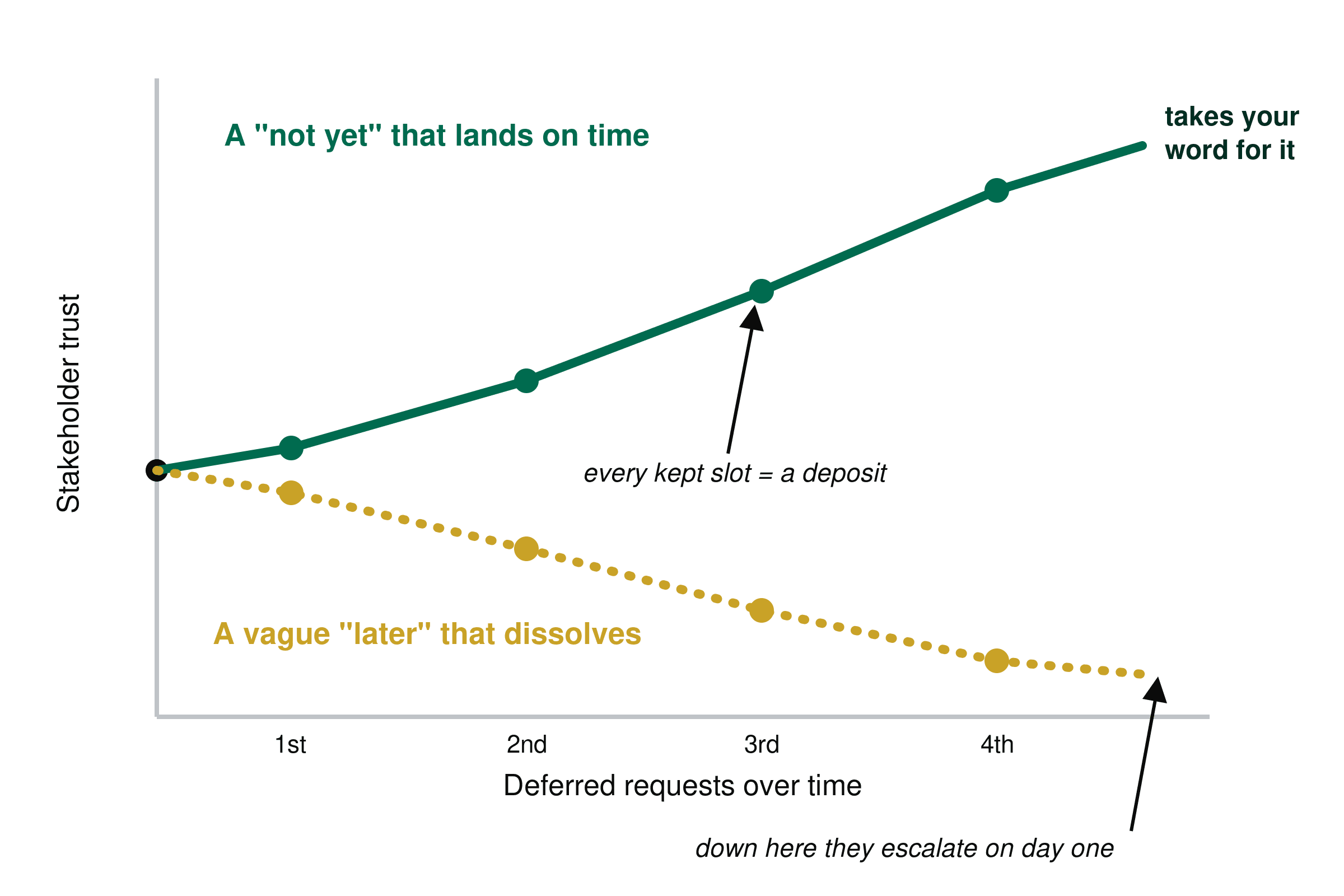
Here's the translation worth memorizing. When a stakeholder pushes hard against your "not yet," she's usually not arguing about capacity. She's testing whether your "not yet" means anything. The real question underneath is: are you a person whose later actually arrives?
Every kept deferral is a deposit. Every vague later that dissolves is a withdrawal, and the account can absolutely go negative. You can tell when it has. Stakeholders start inflating urgency because they've learned that normal requests get buried. They escalate on day one instead of day thirty. They go around you to your manager. None of that is them being difficult. That's them adapting, rationally, to a person whose laters don't land.
Now flip it. After two or three kept not-yets, the same stakeholder starts accepting your sequencing on your word. She stops copying your manager. She brings you the real priority instead of three inflated ones, because she trusts that a queue position from you is worth something. And on the day you have to deliver an actual no, or a slipped date, you'll be spending credit you saved, not credit you never had.
Trust isn't built in the big moments. It's built in the boring follow-through on small promises nobody would have remembered except you.
When "not yet" is the wrong call
Scope this honestly, because a tool this useful gets overused.
If the request is never going to make the cut, "not yet" is a lie with better manners. Parking a dead request in a fake slot buys you a quiet month and costs you the relationship the day the truth surfaces. Say the real no, with the real reason. It stings once instead of festering for a quarter.
If the request is small enough that deferring it costs more than doing it, just do it. A ten-minute config change doesn't need a queue position and a ceremony.
"Not yet" is for the middle: real work, real value, genuinely intended, honestly sequenced. That's most of what crosses your desk, which is exactly why this skill pays so well.
Go pay one receipt this week
Somewhere in your backlog is a request you deferred vaguely. You know the one. The stakeholder has stopped asking about it, which feels like relief and is actually damage. They haven't forgotten. They've concluded.
Go back to them this week, unprompted. "You asked for this in May. Here's where it sits, here's what's ahead of it, and here's the slot I can actually defend. You didn't chase me, so I came to you." Then watch what that one conversation does to the temperature of the relationship.
And keep the story. When an interviewer asks how you manage competing stakeholder demands, the strong answer isn't a prioritization framework. It's "here's a request I deferred, here's the reason I gave, here's how I kept it visible, here's when I delivered it, and here's what that stakeholder trusted me with afterward." Kept receipts, told plainly. That's what experienced sounds like.
Say "not yet" like it's a promise. Then keep it like one.

Subscribe to the Newsletter
Join our growing community and get alerted first on our every article.
*By subscribing, you agree to send your information to our Company who agrees to use it according to their Terms and conditions and Privacy Policy
About the author
With 20 years guiding high-stakes Agile transformations, I turn theory into action at Oaktreeuni—mentoring aspiring Scrum Masters to think critically, adapt fast, and lead beyond frameworks. The payoff? You step into a high-paying Scrum Master or Agile PM role already equipped to excel.
Q1: Is saying 'not yet' the same as saying no to a stakeholder?
No. A no closes the request. A 'not yet' is a sequencing promise: the request is real and scheduled, with a named slot, a visible path, and a follow-up you initiate.
Q2: What if I can't give the stakeholder an exact date?
Give the slot you can defend plus its condition: 'first week of March, unless the migration slips, and I'll tell you first if it does.' A conditional date you keep beats a firm date you break.
Q3: What if the slot slips?
Tell the stakeholder before they have to ask, give the new slot, and say what moved. A deferral that slips loudly and early keeps trust; one that slips silently destroys it.

Keep reading
Newest on the blog


Comments