Great delivery people work themselves out of a job. On purpose.
ESTIMATED TIME
9
mins

Written by
Shikha Prasad
Published on
The instinct is to stay a little bit needed. It feels like job security. It's the exact thing that caps your career.
A mentee said something to me last month that I have heard, in some form, from almost everyone I have coached.
She had done beautiful work. She had taken a team that depended on her for every decision and slowly taught them to make those decisions themselves. She wrote things down. She trained the person who could cover for her. And then, sitting across from me, she said, a little quietly: "But now I'm kind of worried. If they can run all this without me, what do they need me for?"
I understood the fear completely, because I spent the first few years of my own career quietly protecting against exactly it. And I want to tell you what I told her, because it is one of the most important and least obvious things about a delivery career.
The instinct to stay a little bit needed is the instinct that keeps you small.
The trap that feels like safety
Here is how it happens, and it is so gentle you barely notice. You are good at your job. People come to you with questions and you answer them, because you know the answer and it's faster. There's one process only you really understand. There's a relationship only you can smooth over. A report that would fall apart if you were out for a week.
None of this is scheming. Most people don't consciously make themselves indispensable. It just accretes, one small held thing at a time, and it feels good, because being needed feels like being valued, and being valued feels like being safe. So you keep the knowledge in your head instead of in a document. You answer the question instead of teaching the person to answer it. You become, without ever deciding to, the single point of failure. And a single point of failure feels secure right up until you realize what it has actually cost you.
Because here is what it costs. If the team cannot function without you, you cannot leave. Not for a promotion, not for a better project, not even for a vacation without your laptop. You have built a cage and mistaken it for a throne. Every hour the team spends needing you is an hour you spend doing the thing you have already outgrown, instead of the next thing that would grow you. You didn't make yourself safe. You made yourself stuck.
What the job actually is
The whole point of a delivery role, done well, is to build something that runs. A team that surfaces its own blockers. That makes good calls without waiting for you. That handles conflict like adults instead of routing every tension through you. If you're a Scrum Master or a delivery lead, your success is not a team that needs you. It's a team that has grown past needing you.
Which means the healthiest version of this job has a strange shape. The better you do it, the less visibly necessary you become. Your involvement is supposed to go down over time, not because you're slacking, but because the team's capability is going up. Those two lines are supposed to cross. When they cross, that is not a warning sign. That is the finish line of the thing you were hired to do.

The healthy shape of the work: as the team's capability rises, their need for you falls. The crossing is the win, not the risk.
The reframe that changes everything
So let's go back to my mentee's fear: if they can run without me, what do they need me for? The fear assumes that your value is the answering. That you are worth keeping because you are the one holding all the threads. But that's backwards, and any manager worth working for knows it's backwards.
Your value was never the holding. It was the building. And a person who can build a team that runs without them is far more valuable than a person who is merely essential to one team, because the builder can do it again. Give them the stuck team, the new group, the project that's on fire, and they'll do the same thing: take chaos and turn it into something that stands on its own. That is a rare and portable skill, and it is exactly what gets you handed bigger, harder, more interesting things.
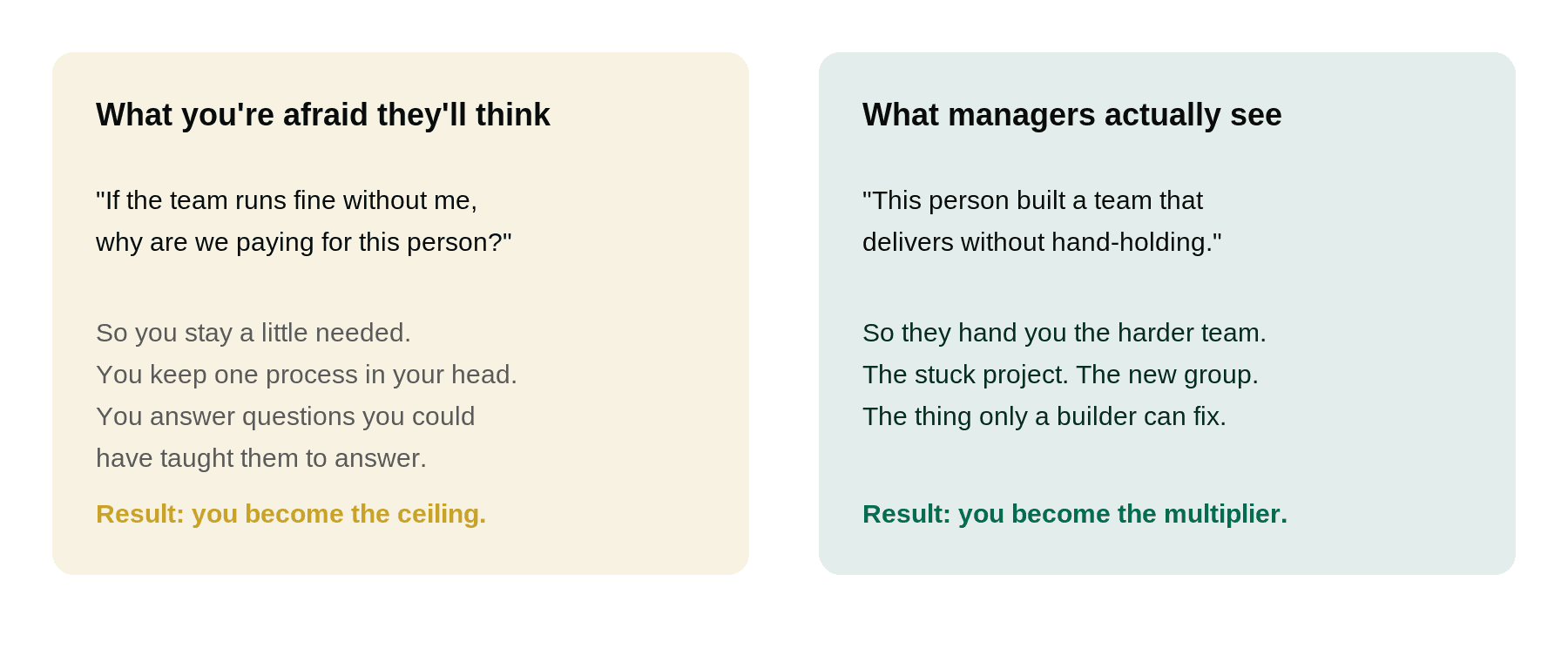
Same fact, two readings. One makes you the ceiling on the team. The other makes you the person who multiplies teams.
I have watched this play out both ways, many times. The person who stays indispensable to one team gets quietly trapped there, passed over for the stretch role because they can't be spared. The person who works themselves out of a job keeps getting a new, harder job, because they've proven they can leave a team better and standing than they found it. One of them protected their position. The other one built a career. The irony is that the one who was willing to make themselves unnecessary is the one nobody wants to lose.
How to do it on purpose
This isn't passive. Working yourself out of a job is an active practice, and you can start it in any role, even a first one. It looks like a few deliberate habits, repeated until they're just how you work.
Put knowledge where the team can reach it, not just in your head. When someone asks you a question you've answered before, resist the fast path of just answering, and instead help them find the answer so they own it next time. Train your own backup before anyone asks you to. Document the one process that would break if you vanished. And every so often, ask yourself an uncomfortable, clarifying question: if I were out for two weeks with no laptop, where exactly would this team get stuck? Then go fix that spot, on purpose, so it isn't you.
If you're new and worried this is only for people with power, it isn't. The strongest interview stories a junior can tell are built from this exact move: "I noticed the team kept coming to one person for a certain approval, so I documented the criteria and now anyone can do it." That is a real, specific, buildable rep, and it signals something senior about how you think. You don't need a title to start making yourself the kind of person who leaves things better and standing.
The quiet confidence underneath it
There's a deeper thing here, and I'll name it because it's the part that actually frees you. The urge to stay indispensable comes from a scarcity fear: that your worth is fragile, that it lives in this one team's need for you, and that if that need disappears, so do you. Working yourself out of a job requires the opposite belief. That your value travels with you. That you can walk into the next mess and build again. That you are not the scaffolding, you are the builder, and the builder is never out of work.
My mentee got it, eventually. A few months later her team was humming along without her constant input, and instead of being sidelined, she got pulled onto a struggling program that badly needed someone who could bring order to it. She was nervous, and then she wasn't, because she realized she already knew how to do the only thing that mattered: make herself unnecessary, kindly and deliberately, and move on to the next thing that needed her more.
Build the team that doesn't need you. Then go find the one that does. That's not you working your way out of a job. That's you finally doing the whole job.

Subscribe to the Newsletter
Join our growing community and get alerted first on our every article.
*By subscribing, you agree to send your information to our Company who agrees to use it according to their Terms and conditions and Privacy Policy
About the author
I believe the strongest tool and flex each of us has is our belief. When we truly believe in something, we align our mindset, energy, and actions with the right effort and guidance. That is when achieving almost anything becomes possible. This is how I help mentees at OAKKTREEUNII move into Software and Project Management careers for better pay, better confidence, and better work-life balance.
Won't I be replaceable if my team doesn't need me?
The opposite. A person who can build a team that runs without them can do it again, which is a rare, portable skill managers hand the harder problems to. Indispensable to one team is what traps you.
How do you make a team more self-sufficient?
Put knowledge where the team can reach it, teach people to find answers instead of answering for them, train your backup early, and fix the spots that would break if you were out for two weeks.

← Previous post
How to say 'I don't know' to an executive and stay credible
Next post →
We timed every meeting in a two-week sprint. Here's the real cost.

Keep reading
Newest on the blog


Comments