Leading a team that's scared AI will take their jobs
ESTIMATED TIME
11
mins

Written by
Shikha Prasad
Published on
You can't reassure the fear away, and you can't pretend it isn't there. Here is what actually helps a team that has gone quiet.
It came out as a joke, the way these things usually do.
We were in refinement, sizing a story, and one of the developers said, half smiling, "Why are we even estimating this? In a year the AI will just write it." A couple of people laughed. Then the room went a little too quiet, a beat too long, and we moved on to the next ticket. But I had heard the thing under the joke, and so had everyone else.
For weeks I had felt it without naming it. Standups a little flatter. People less willing to commit to anything that stretched past this sprint. A quiet, careful energy, like a team walking on a floor they were not sure would hold. I had been telling myself it was just a hard quarter. It wasn't. My team was scared, and the fear had a name none of us were saying out loud.
If you lead delivery right now, some version of this is in your room too. And most of the advice you will get about it is useless, because it comes in two flavors, and both of them fail.
The two things that don't work
The first is cheerful reassurance. "Don't worry, AI won't replace you, it'll just be a tool." I have said versions of this. It lands like a manager reading from a card. Your team is not scared because they lack a comforting sentence. They are scared because they have watched the news, watched their own tools get eerily good, and done the math in the dark. A breezy "you'll be fine" tells them you either haven't thought about it as hard as they have, or you have and you're managing them. Neither builds trust.
The second is the opposite: pretending nothing is happening. Keep the sprints moving, keep it professional, don't bring up the scary thing because that would just make it worse. This is worse. Fear does not disappear when you refuse to look at it. It goes underground and runs the team from there. It shows up as people quietly protecting themselves, sandbagging estimates, going silent in retros, updating their resumes on their lunch break. An unspoken fear doesn't get smaller. It just gets to work without supervision.
A fear you name in the room stops running the room from underneath it.
What the fear actually is
Here is what I learned the slow way. The reason the fear is so heavy is that it is vague. "AI is going to take my job" is not a thought you can do anything with. It is a fog. It has no edges, no next step, no version where you win. So it just sits on the chest of everyone in the standup, private and enormous and unanswerable.
The most useful thing a leader can do is not make the fog feel better. It is to turn the fog into questions. Because a question, unlike a fog, has an answer, or at least a next move. And the moment a scared person has a next move, they are a different person. They stop bracing and start working the problem.
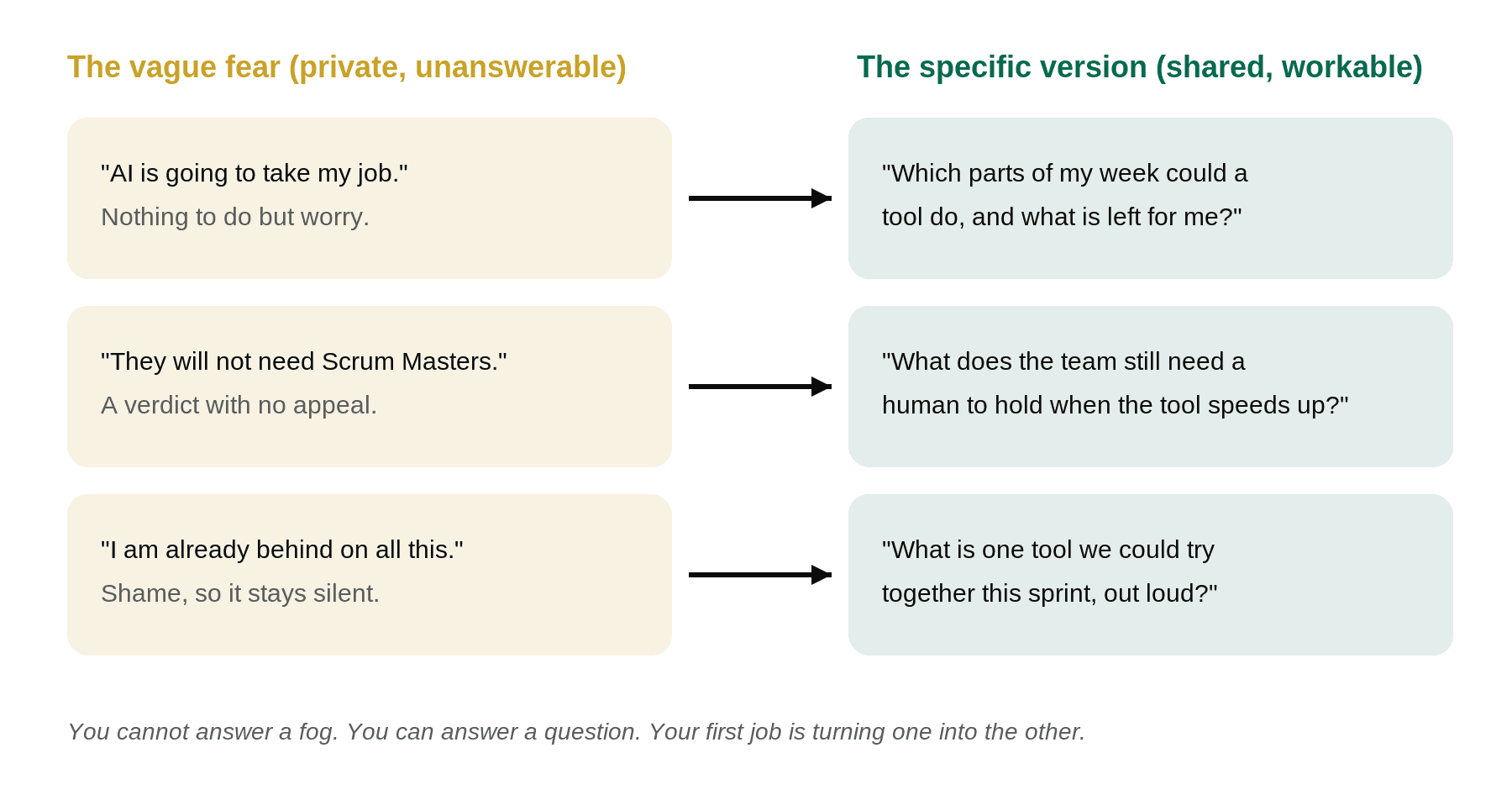
The whole shift in one picture: take what can't be answered and turn it into what can.
So when someone on my team said "they won't need Scrum Masters," I stopped trying to argue them out of it. Instead I asked, out loud, in front of everyone: okay, let's actually look at it. What in our week could a good tool genuinely do faster? And what is left over that still needs a person in the room? We wrote both lists. The first list was real and a little uncomfortable. The second list was longer than anyone expected, and it was full of exactly the work they were best at. The fog lifted, not because I promised anything, but because we could finally see the shape of the thing.
Four moves that actually help
I don't have a framework I trust for much in this space, because it's all new and anyone who tells you they know how this plays out is selling something. But I do have four moves I have watched work, in real rooms, with real scared people. They are not a script. They are a posture.
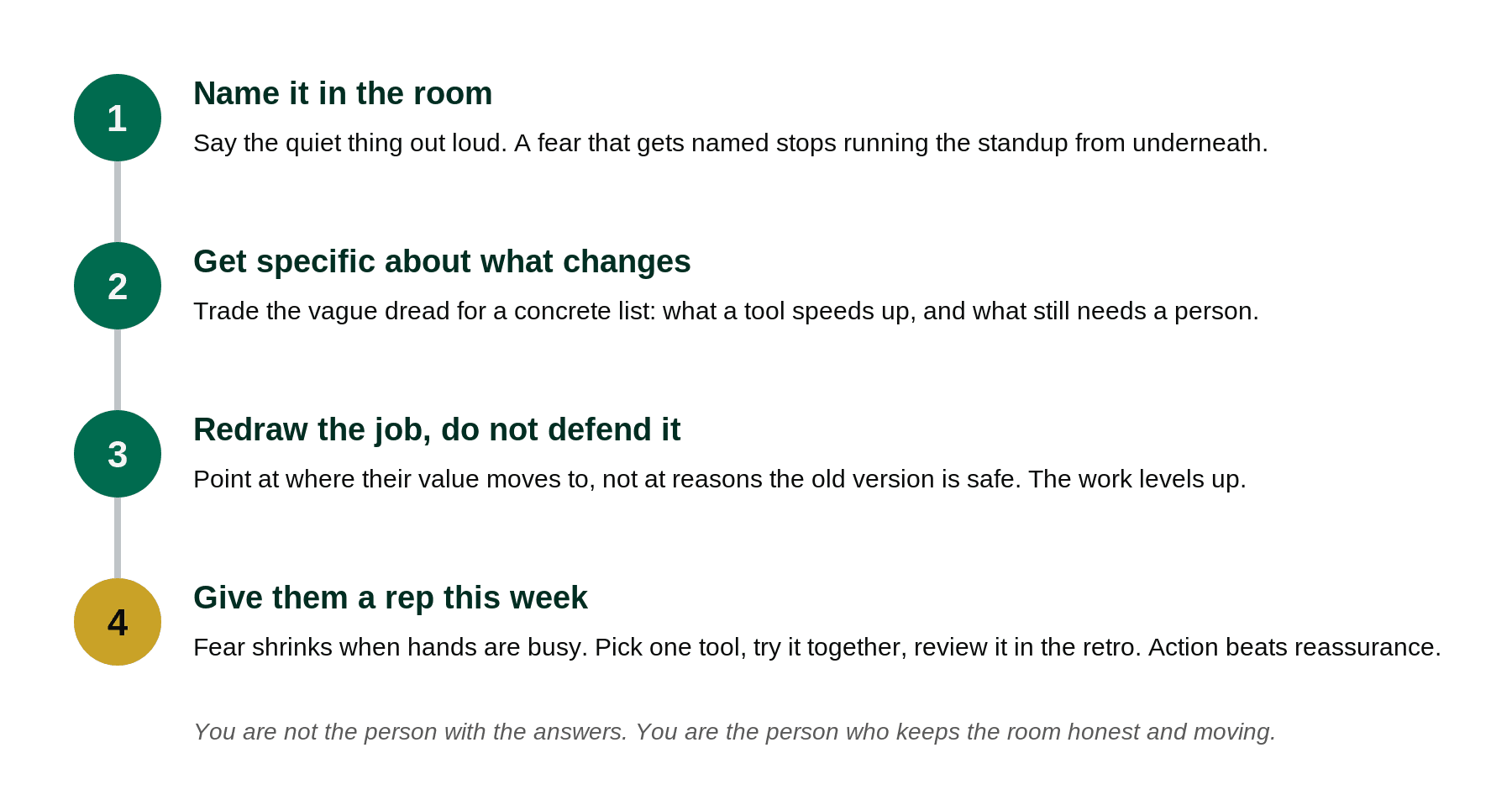
Not answers. A way to stand in the room so the team keeps moving instead of bracing.
Name it, then get specific
Say the quiet thing first. "I know some of us are wondering what this means for our jobs. Let's not pretend we're not." You will feel the room exhale. Then move fast from the feeling to the specifics, because specifics are where fear loses its power. What exactly is changing in how we work this quarter? What is genuinely uncertain, and what is just noise? Vague dread is unbearable. A concrete, honest list of what's shifting is something a team can stand on, even when the list is not all good news.
Redraw the job, don't defend it
This is the one that separates a leader who helps from one who accidentally makes it worse. When your team is scared, the instinct is to defend the old version of their job: to list all the reasons a human is still needed to do exactly what they do today. Don't. That is a losing argument and, worse, it teaches them to cling to the part of the work most likely to change.
Point forward instead. When a tool takes the typing, the drafting, the first pass, the value of a delivery person moves up, not away. It moves toward the judgment calls, the messy human coordination, the reading of a room that no model can do, the decision about what is actually worth building. Show them where their value is going, and you turn a threat into a promotion. The work is leveling up. Help them level up with it, instead of guarding the rung they're standing on.
Give them a rep this week
The single fastest way I have found to shrink this fear is to put people's hands on the thing. Fear thrives in the abstract and dies in the concrete. So we picked one tool and used it together, in the open, on real work, that same sprint. We were clumsy with it. We found where it was genuinely useful and where it confidently made things up. We talked about it in the retro like adults.
Something changes when a team stops imagining the technology as a faceless force that arrives to replace them, and starts experiencing it as a slightly annoying, sometimes helpful tool they are learning to steer. The person who has used the thing is far less afraid of it than the person imagining it. Action beats reassurance, every time. You cannot talk someone out of a fear this size. You can only walk them through it, one small real rep at a time.
What your steadiness is actually for
There is a quiet weight to leading right now, and I want to name it, because nobody tells you about it. Your team is watching you for a signal, the way people always watch the person in front when the ground shifts. Not for false confidence. For steadiness. For proof that someone is looking directly at the scary thing and has not fallen apart.
You don't have to have the answers. You genuinely can't, and pretending otherwise will cost you. What you can be is the person who keeps the room honest and keeps it moving: who names what's real, refuses to lie about it, and points the team at the next concrete thing they can actually do. That is the whole job in a moment like this. Not a shelter from the weather. A steady hand while everyone learns to work in it.
My team is still doing the work. Better than before, honestly, because we stopped spending energy on a fear we would not look at. The AI conversation didn't go away. It just stopped running the standup from underneath. That is what leading through this looks like. Not making the fear vanish. Making it something the team can hold, together, in the light.

Subscribe to the Newsletter
Join our growing community and get alerted first on our every article.
*By subscribing, you agree to send your information to our Company who agrees to use it according to their Terms and conditions and Privacy Policy
About the author
I believe the strongest tool and flex each of us has is our belief. When we truly believe in something, we align our mindset, energy, and actions with the right effort and guidance. That is when achieving almost anything becomes possible. This is how I help mentees at OAKKTREEUNII move into Software and Project Management careers for better pay, better confidence, and better work-life balance.
How do you lead a team that's afraid of AI?
Name the fear openly, turn the vague dread into specific questions the team can answer, point to where their value is moving rather than defending the old job, and get them hands-on with a tool this sprint.
Should a manager talk about AI job fears directly?
Yes. An unspoken fear runs the team from underneath, showing up as silence and self-protection. Naming it in the room is what lets people exhale and start working the problem.

← Previous post
How to tell a stakeholder 'not yet' and keep their trust
Next post →
How to say 'I don't know' to an executive and stay credible

Keep reading
Newest on the blog

Comments