How to say 'I don't know' to an executive and stay credible
ESTIMATED TIME
10
mins

Written by
Rajveer Prasad
Published on
The fear is that admitting it makes you look small. The truth is that how you say it decides whether you gain their trust or lose it.
The first time an executive asked me a question I couldn't answer, I panicked and did the worst possible thing. I made something up.
It was a steering meeting, the room had a lot of senior people in it, and the director turned to me and asked why a particular date had slipped. I didn't actually know yet. But some frightened part of me had decided that "I don't know" was not an acceptable thing to say in that room, so I strung together a plausible-sounding answer built on a guess. He nodded. And then he asked one follow-up question, a specific one, and the whole thing came apart in about ten seconds, in front of everyone.
Here's what I learned that afternoon, and it took me a while to really believe it. The "I don't know" was never the thing that would have hurt me. The bluff was. And most people have this exactly backwards, which is why they keep reaching for the bluff and quietly damaging the one thing they most need with senior people: to be believed.
Executives don't need you to know everything. They need to trust what you tell them. Those are very different things, and only one of them is survivable.
Why the bluff is the real risk
Think about what an executive is actually doing when they ask you something. They're not usually testing your knowledge. They're gathering information to make a decision, often with money or reputation attached, and they're deciding, in the background, how much to weight what you say. Every answer you give is also a data point about how reliable you are as a source.
So when you bluff, you're not just risking that one answer. You're gambling your reliability as a whole. Because senior people, the good ones anyway, have sat through thousands of these conversations, and they have a finely tuned instrument for detecting the sound of someone talking confidently around a hole in their knowledge. Maybe they catch it right then, with a follow-up, the way that director caught me. Maybe they catch it later, when your confident answer turns out to be wrong. Either way, the lesson they file away is the expensive one: I can't fully trust what this person tells me. And once someone senior thinks that about you, every future answer, including the true ones, gets a mental asterisk.
A single honest "I don't know" costs you nothing like that. It's a small, contained thing. The bluff, when it fails, and it eventually fails, contaminates everything.
But 'I don't know,' on its own, isn't enough
Now, I don't want to swing you to the other mistake, because there is one. Standing in front of an executive and just saying "I don't know," full stop, and then looking at them, is also not good. It's honest, but it's a dead end. It hands them nothing. It makes them do the work of figuring out what happens next, which is your job, not theirs. Do that a few times and you look less like a liar and more like someone who isn't on top of their own area.
The credible move is not the bare admission. It's what you build on top of it. "I don't know" is only the first line of a four-line answer, and almost all of the credibility lives in the three lines that follow it.

The full shape of a credible answer. The admission is line one. Lines two through four are where you earn the trust back and then some.
Watch what that structure actually does. The honest part protects your reliability. Then you offer what you do know, which shows you're not lost, just precise about the edge of your knowledge. Then you name how you'll close the gap, which turns a hole into a plan. And then you commit to a time, which is the part that quietly signals seniority, because it means you own the follow-through, not them. Delivered that way, "I don't have that exact number" doesn't read as a weakness at all. It reads as someone careful enough to know the difference between what they know and what they're guessing, which is exactly the person an executive wants feeding them information.
The quick decision in the moment
When the question lands and your stomach drops, you have about two seconds to choose a path, and it helps to have already decided how you'll choose. It comes down to one quick sort: do you know part of this, or none of it?
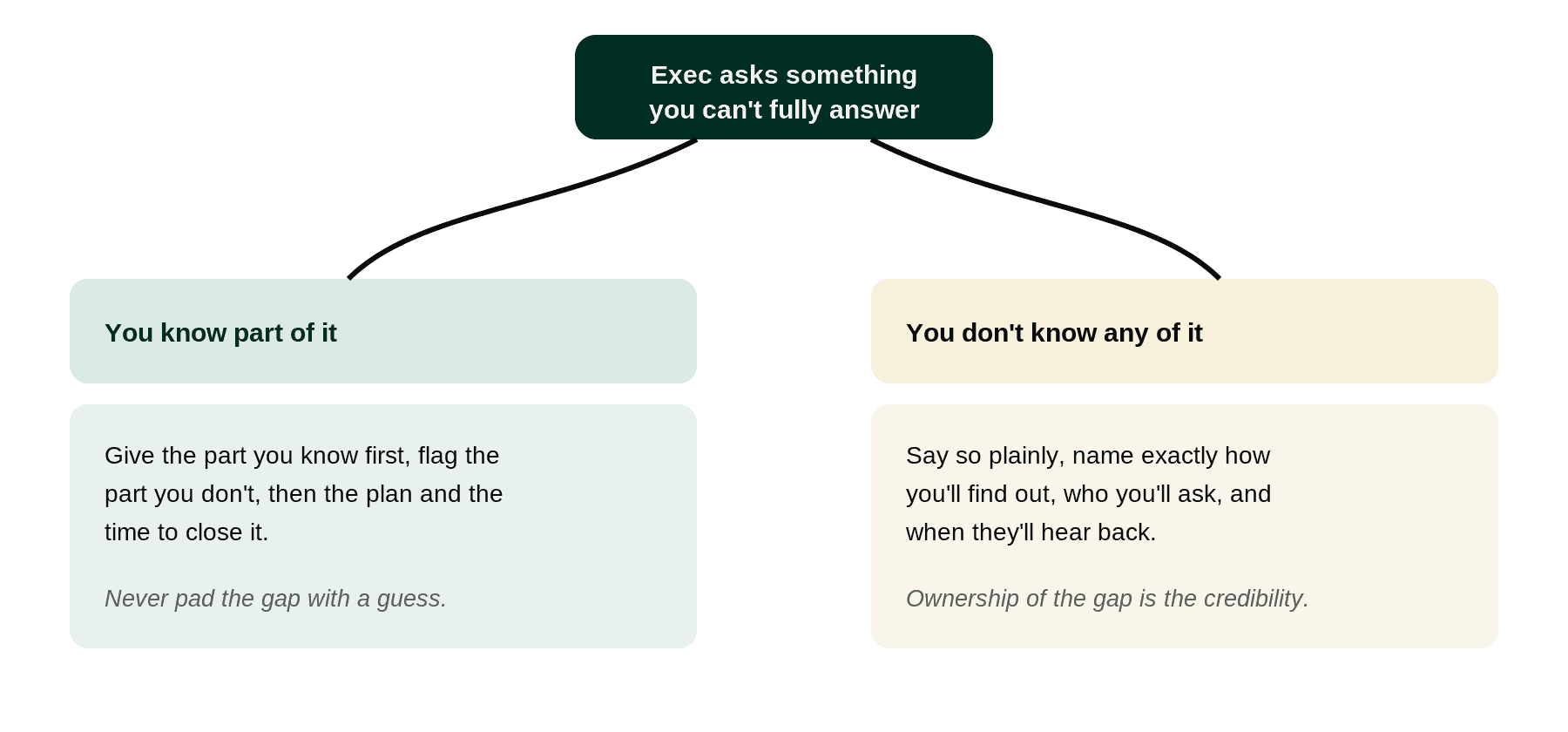
The two-second decision. Either way, you never fill the gap with a guess, and you always own how it gets closed.
If you know part of it, lead with the part you know, clearly, then draw a clean line around the part you don't and say how you'll get it. "Adoption is up in two of the three regions, I have those numbers. The third I need to confirm before I quote it, I'll have it to you this afternoon." That's a strong answer. It's specific, it's honest about its own edges, and it moves.
If you genuinely don't know any of it, say so plainly and immediately, then pivot the entire weight of your answer onto the plan. "I don't have a read on that yet. Here's how I'll get one: I'll talk to the data team this afternoon and come back to you by tomorrow morning with a real answer." You have converted the thing that scared you, the not knowing, into a small demonstration of ownership. That is the whole trick. You cannot control whether you know the answer. You can always control whether you own getting it.
The one rule underneath all of it
There's a single line that holds this whole thing together, and it's worth saying flatly, because it's the part fear will try to talk you out of in the moment. Never, ever fill the gap with a guess dressed up as a fact. If you're estimating, say you're estimating. If it's a hunch, label it a hunch. "My rough sense, and I'd want to verify this, is around three weeks" is completely credible. "It'll be about three weeks," said with false confidence about something you don't actually know, is a small landmine you've just buried under your own reputation.
The reason this matters so much with executives specifically is that they act on what you say. Your guess doesn't stay a guess. It becomes a number in their head, then a number in a slide, then a commitment they make to someone above them. When it turns out to be wrong, it's not just your credibility that took the hit, it's theirs, and they will remember precisely whose confident answer put them there. Labeling your uncertainty isn't hedging. It's giving them the information they need to weight what you said correctly. That's a gift, and they know it.
What actually builds the reputation you want
Over a few years I watched the people who rose fastest in front of senior leaders, and almost none of them were the ones who always had an answer. They were the ones you could believe. When they said they knew, you knew it was solid. When they said they'd find out, they found out, and came back exactly when they said they would. Their "I don't know" was rare and clean, and it made their "here's the answer" worth more, because you'd learned that this person doesn't say things they can't stand behind.
That's the reputation worth building, and it's built one honest, well-structured answer at a time. So the next time an executive asks you something and you feel that drop, remember that the moment is not the threat you think it is. Don't reach for the bluff. Reach for the four lines. Tell them the honest part, tell them what you do know, tell them how you'll close the gap, and tell them by when. Then go do exactly that. You'll walk out of that room having lost nothing, and quietly gained the only thing that actually compounds in front of leadership, which is the sense that you can be believed.

Subscribe to the Newsletter
Join our growing community and get alerted first on our every article.
*By subscribing, you agree to send your information to our Company who agrees to use it according to their Terms and conditions and Privacy Policy
About the author
With 20 years guiding high-stakes Agile transformations, I turn theory into action at Oaktreeuni—mentoring aspiring Scrum Masters to think critically, adapt fast, and lead beyond frameworks. The payoff? You step into a high-paying Scrum Master or Agile PM role already equipped to excel.
Is it okay to say I don't know to a senior leader?
Yes, if you say it well. Bluffing is the real risk to your credibility. A clean I don't know, followed by what you do know, how you'll find out, and by when, actually builds trust.
How do you answer a question you don't know the answer to at work?
Never fill the gap with a guess dressed as a fact. Give the part you know, label what you're unsure of, and commit to how and when you'll close the gap. Owning the follow-up is the credibility.

← Previous post
Leading a team that's scared AI will take their jobs
Next post →
Great delivery people work themselves out of a job. On purpose.
Keep reading
Newest on the blog

Comments