Nobody is 25% allocated: the real math of splitting people across projects
ESTIMATED TIME
11
mins

Written by
Shikha Prasad
Published on
What the resourcing spreadsheet can't see, and what it quietly costs the people typed into it.
Three Augusts ago, I sat in a quarterly capacity-planning meeting and watched a business analyst get divided by four.
It took about ninety seconds. Her name went into the resourcing spreadsheet, and then her quarter did. Payments migration: 25. Vendor onboarding: 25. The reporting rebuild: 25. A compliance cleanup nobody wanted to own: 25. The total column turned green, because the formula checks exactly one thing. Does the row add up to 100?
It did. The cursor moved on to the next name.
Nobody in that room was careless. The demand was real, the headcount was frozen, and the spreadsheet offered a way to make four commitments fit inside one person. We took it. I helped take it. I want to walk you through the quarter that followed, because it permanently changed what I do in that meeting.
The quarter that green cell bought us
Everything slipped. Not spectacularly. Nothing crashed, nobody resigned, there was no single failure you could pin to a slide in a lessons-learned deck. The slippage was quiet and total. Requirements that needed three focused days took three fragmented weeks. Questions she used to answer from memory turned into "let me get back to you." Handoffs sat. Decisions queued up behind her calendar like planes circling a fogged-in runway.
And she apologized. Constantly. Four standups a day, and in every one she opened with some version of "sorry, I didn't get to it yesterday." By mid-quarter she was sending status notes at nine at night, because that's what conscientious people do when the math they've been handed doesn't work. They quietly donate their evenings to make the spreadsheet true.
Meanwhile, each of the four project managers saw the same thing from their side: a BA who was supposedly a quarter theirs, delivering what felt like a tenth. None of them could see the whole picture. Each one just saw their slice, underperforming.
The spreadsheet said she was fully allocated and doing fine. Reality disagreed. Reality got outvoted.
What context switching does between the cells
Allocation math rests on an assumption so quiet we forget it's there: that people divide the way money divides. Split a budget four ways and you get four smaller budgets that all still work. A dollar doesn't care where it was yesterday.
Attention cares. Every time a person crosses from one project to another, they pay to re-enter. They reload the context: where was I, what moved, which decisions changed while I was gone. They re-enter the conversations: the thread that carried on without them, the stakeholder who has now asked twice. They re-earn the momentum they had built the last time they were here. None of that appears in any cell, and all of it comes out of the 25.
This isn't a feeling. Researchers have been measuring it for decades. In controlled task-switching experiments, people lost time on every single switch and lost more as the tasks got more complex, and David Meyer, one of the researchers behind the work, has put the cost of those brief mental blocks as high as 40 percent of someone's productive time {APA, Multitasking: Switching costs}. Field research at UC Irvine that tracked office workers through their actual days found that when work got interrupted, getting back to it took an average of 23 minutes and 15 seconds {Gloria Mark, UC Irvine, Gallup interview}. The same research clocked those workers juggling an average of 12.2 separate working spheres in a single day {Gloria Mark, UC Irvine, Gallup interview}.
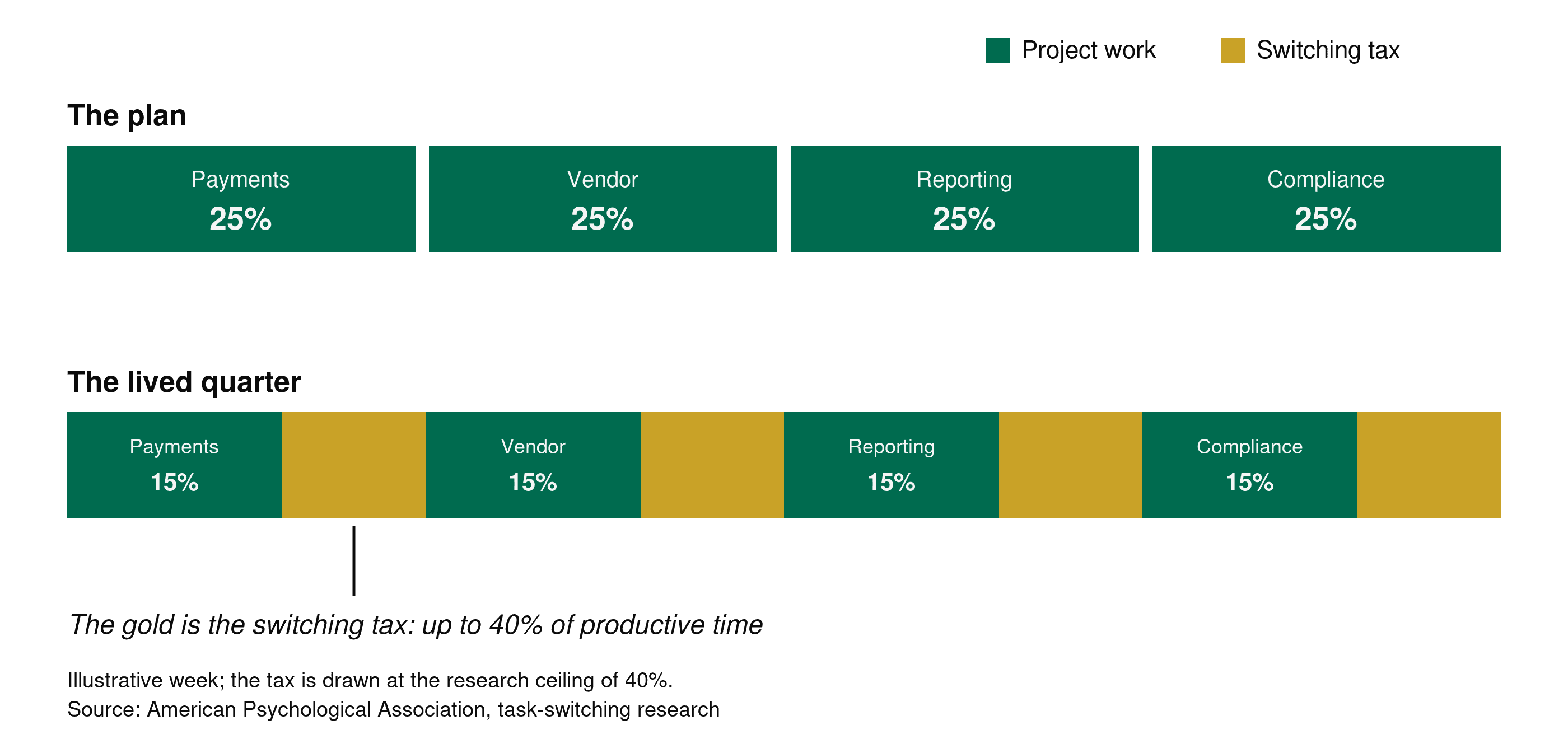
Now hold those numbers up against the 25/25/25/25 row. The plan needs her to make that crossing several times a day, every day, for a quarter. Every crossing has a toll. The tolls appear in no budget, so nobody planned for them, so they get paid out of the only two accounts she has left: delivery and evenings.
Four projects means four of everything
The switching tax would be bad enough on its own. But a project doesn't just take a share of your hands. It takes a full copy of your presence.
Four projects means four standups: twenty fifteen-minute meetings a week before a single piece of real work gets scheduled. Four planning cycles, which have a talent for landing in the same week. Four sets of stakeholders, each of whom deserves a considered answer and has no idea the other three exist. Four boards to keep honest, four channels to watch, four status reports due on Friday afternoon.
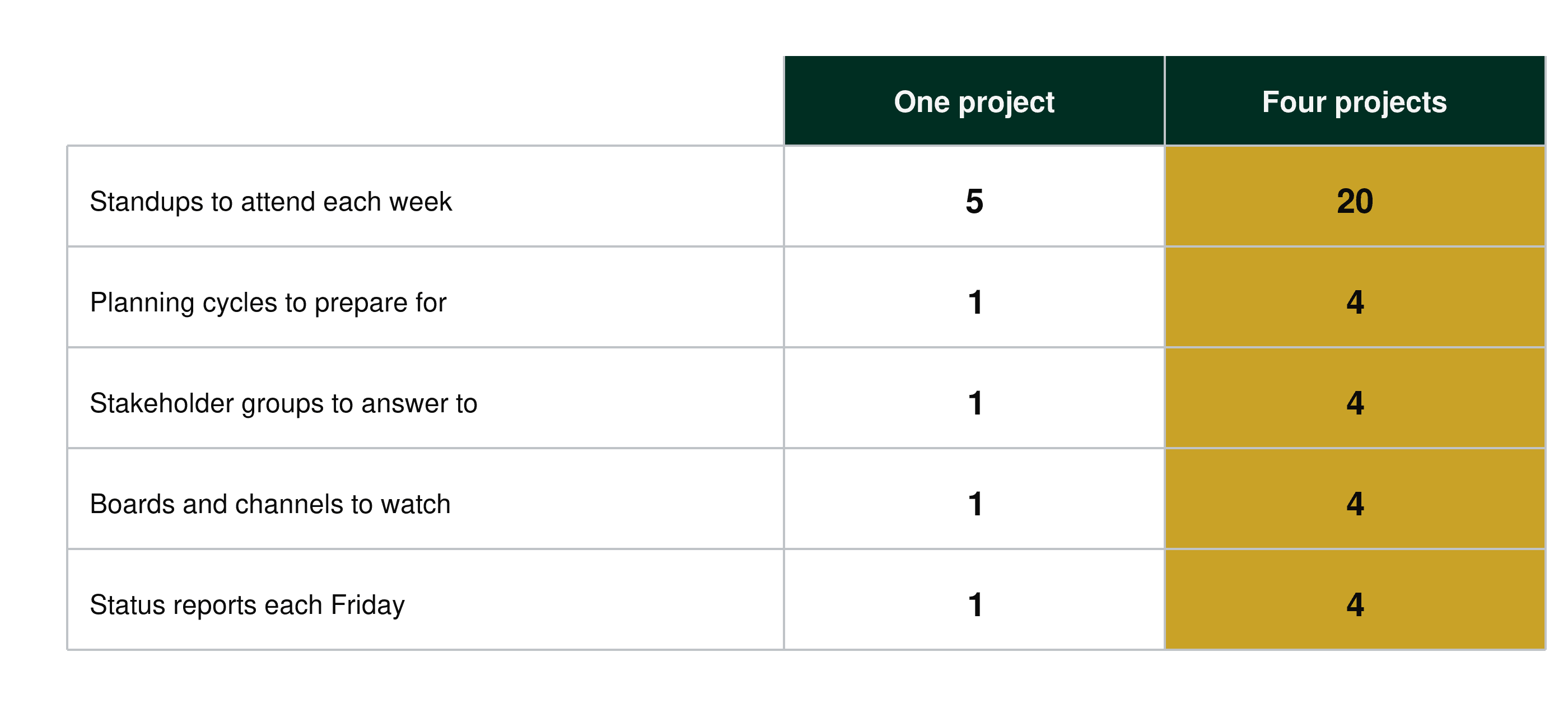
Notice that none of this overhead shrinks because someone is "only 25 percent allocated." A standup doesn't run at quarter length for the person who's a quarter assigned. You sit through the whole meeting, hold the whole context, carry the whole thread. Per person, the overhead of a project is close to fixed. Only the delivery scales down.
That's why working on four projects at once never feels like doing a quarter of each. It feels like doing four whole jobs badly, in the gaps between their meetings. The honest equation for a four-way split isn't 25 plus 25 plus 25 plus 25. It's four fixed overheads, plus a toll on every crossing, plus whatever is left for actual work. The spreadsheet books the leftovers as 100.
When the gap gets her name on it
Here's the part I still can't make peace with. When a plan assumes a fiction and the fiction under-delivers, the gap lands on the person, not on the plan.
Our BA's review that cycle included the phrase "struggled with follow-through." Nobody wrote "we sliced one human across four codebases, four stakeholder sets, and four planning rhythms, then measured her as if she had one job." The spreadsheet's error was recorded as her performance. And she believed it, which was the worst part. She had worked the nights, absorbed the apologies, and concluded that she was the problem.
The spreadsheet adds to 100. The human doesn't.
Read that gap generously and you will staff differently for the rest of your career. Read it lazily and you'll conclude you have an underperformer, put a capable person on a performance plan, and hand next quarter's four projects to the next name in the sheet.
How I sit in that meeting now
The defense of fractional staffing always sounds reasonable in the room. It goes something like this:
"We have four priority-one projects and one BA. The demand is real. A quarter of her time on each is better than three projects getting nothing. The numbers work."
That's the weak position, and notice that it isn't evil. It's just arithmetic about a creature that doesn't exist. Here's the counter I bring now. It accepts every constraint and changes only the shape:
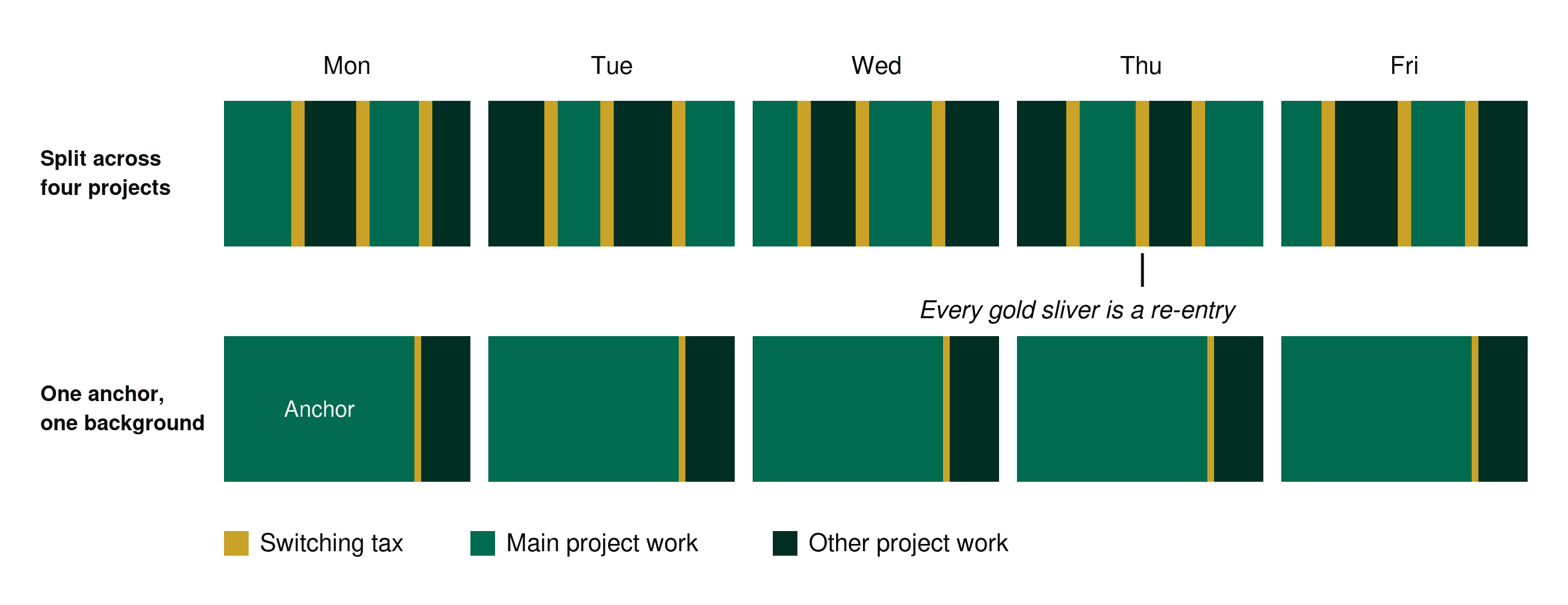
"Same BA, same four projects, same year. Give her one anchor project and one background project at a time, and sequence the rest. Payments gets her properly for six weeks instead of notionally for fifty. Every project ships later than the fantasy plan and earlier than the real one, because we stop paying the tax."
Sequencing over splitting. Same capacity, same demand. It just stops pretending the crossings are free.
If you're the delivery lead in that meeting, four moves:
Count the overhead out loud before you argue any theory. "This allocation gives her twenty standups, four planning cycles, and four stakeholder sets a week. Which should she drop?" Let the room do its own subtraction.
Propose a sequence, not a refusal. You aren't saying no to any project. You're saying not simultaneously. A queue isn't a rejection. It's a delivery order.
Protect one anchor per person. Everyone gets at most one main thing and one background thing. Background means it can sit for a day without anyone chasing it.
Make the tax visible in the plan itself. If leadership still insists on the split, write it into the sheet: book the person at 20/20/20 across three projects and label the missing 40 as switching cost. When the tax has a cell of its own, splits get rarer on their own.
The kindest plan is also the fastest one
I used to think pushing back on fractional allocation was me protecting my people from the business. One bad quarter taught me it protects the business just as much. The org that gives people one anchor ships sooner, forecasts more honestly, and writes far fewer unfair reviews. Focus isn't a perk you grant your team once demand calms down. Demand never calms down. Focus is how anything ships at all.
Our BA is doing well, by the way. Different program now, one anchor project, and the "follow-through problem" never appeared again. The problem was never in her.
It was in a cell that turned green.
Sources
American Psychological Association. "Multitasking: Switching costs.," 2006.
Gallup Business Journal. "Too Many Interruptions at Work?," Interview with Gloria Mark, University of California, Irvine. 2006.

Subscribe to the Newsletter
Join our growing community and get alerted first on our every article.
*By subscribing, you agree to send your information to our Company who agrees to use it according to their Terms and conditions and Privacy Policy
About the author
I believe the strongest tool and flex each of us has is our belief. When we truly believe in something, we align our mindset, energy, and actions with the right effort and guidance. That is when achieving almost anything becomes possible. This is how I help mentees at OAKKTREEUNII move into Software and Project Management careers for better pay, better confidence, and better work-life balance.
How much productivity does context switching cost?
Task-switching research summarized by the American Psychological Association estimates the brief mental blocks created by switching can cost up to 40 percent of someone's productive time, and UC Irvine fieldwork found interrupted work takes an average of 23 minutes and 15 seconds to get back to.
How many projects should one person work on at once?
One anchor project plus one background task. The anchor gets the focused hours, the background can wait a day without anyone chasing it. Beyond that, meeting overhead and switching costs grow faster than output.
How do you push back on being allocated to multiple projects?
Count the overhead out loud (standups, planning cycles, stakeholder groups), propose sequencing projects instead of splitting people, and if the split is forced, book the switching cost as its own line in the plan so the math stays honest.

← Previous post
We timed every meeting in a two-week sprint. Here's the real cost.
Next post →
Who owns the bug the AI agent wrote?

Keep reading
Newest on the blog


Comments