From Scrum Master to delivery lead: the jump nobody prepares you for
ESTIMATED TIME
10
mins

Written by
Shikha Prasad
Published on
The title looks like a natural next step. The seat is a different job. Here's what actually changes, and how to get ready before you leap.
Three weeks into my first delivery lead role, I sat in a steering meeting and answered a question the way a Scrum Master answers it.
The program director asked when the integration would land. I said the team's forecast put it in the last week of November, with some risk around the vendor's test environment.
He didn't even blink. "I didn't ask for the team's forecast. I asked when you're landing it."
I remember the heat in my face. Not because he was rude. Because he was right, and some part of me knew it. For years I'd been trained to say the team owns the forecast. It was the correct answer. It was practically a reflex. And in that room, with that title next to my name, it was no longer my answer to give.
Nobody had warned me. Not the job description, not the manager who promoted me, not a single certification I'd ever earned. I'd made one of the most common jumps in our field, and I'd made it blind.
The promotion that gets sold as "more of the same"
Here's why this jump catches good people off guard. It gets framed as continuity. You already know the teams. You already sit in the delivery meetings. You already track the dependencies. So the delivery lead role gets pitched as your current job, just bigger. More teams, more visibility, better pay.
On paper, that's true. Which is exactly the problem, because the paper describes the tasks, and the tasks do overlap. What changes is the position you occupy. Nobody writes that down.
A Scrum Master is deliberately positioned outside the outcome. You have no authority, on purpose. You improve the system, you surface the risk, you protect the team's focus, and the results belong to the team. That isn't a limitation of the role. It's the design. It's what lets everyone trust you.
A delivery lead is positioned inside the outcome. The date has your name next to it. When it slips, the question comes to you, and "the team is self-organizing" is not an answer anyone upstairs will accept twice.
Same room. Same board. Completely different seat.
What actually changes when you cross over
Three shifts do most of the damage if you're not ready for them.
Your problem space moves to the seams
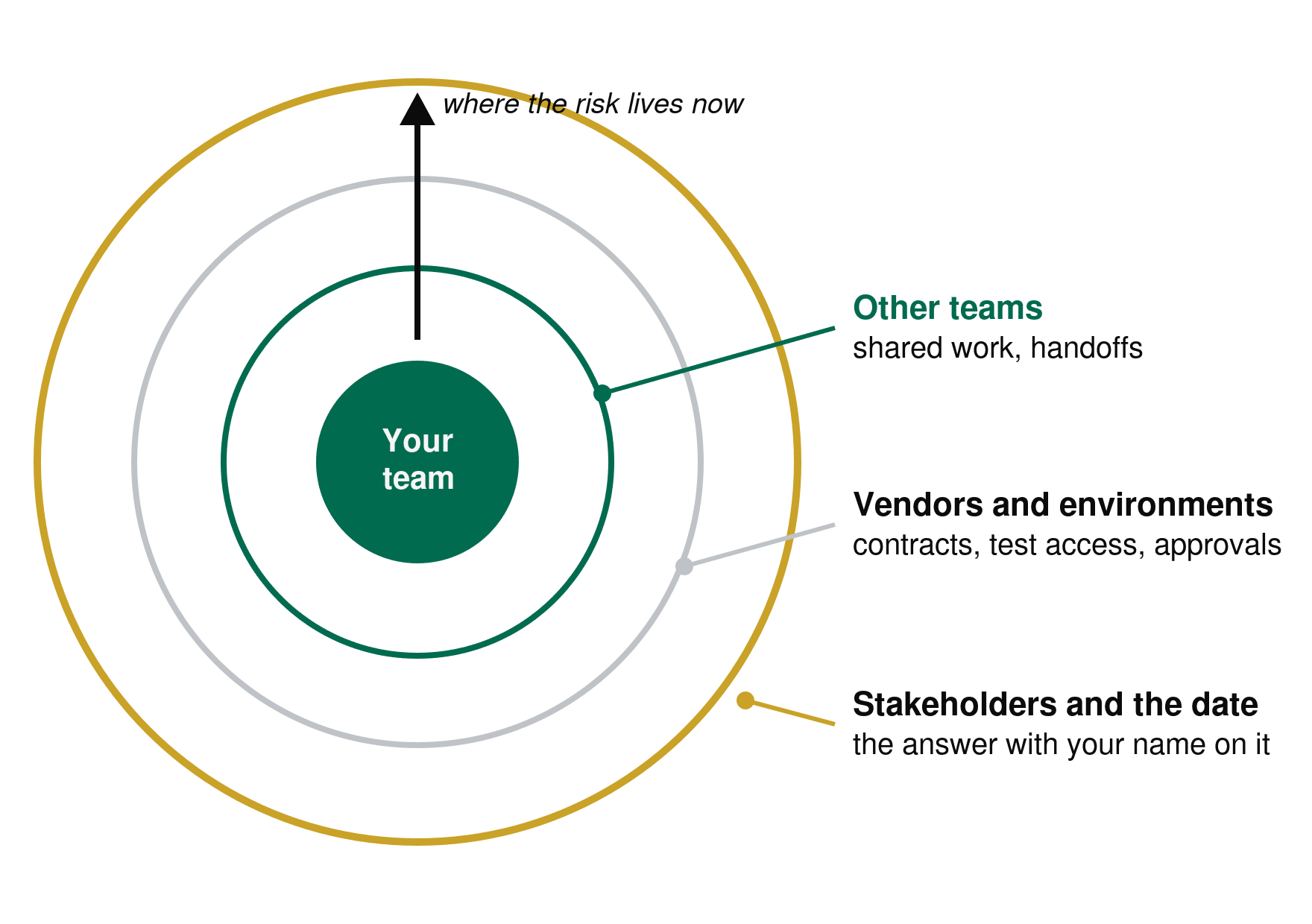
As a Scrum Master, your world lives mostly inside one team's walls: their flow, their standup, their blockers, their conflicts. As a delivery lead, almost nothing that hurts you lives inside a team. It lives between them. The API contract two teams understood differently. The vendor whose test environment opens three weeks after you need it. The security review nobody booked. The other program quietly holding your shared platform hostage.
Inside a team, problems announce themselves at standup. Between teams, problems hide until integration. Your job stops being "make this team's work visible" and becomes "make the gaps between teams visible before they become the date."
Your calendar tells the story before you do. Fewer retros and refinements, more vendor calls, environment negotiations, and awkward conversations with a peer whose priorities aren't yours. If your week still looks like a Scrum Master's week, you're probably standing in the wrong part of the system.
You lose your neutrality, and you don't get it back
This is the one that stings. The best thing about being a Scrum Master is that you're nobody's enemy. You don't own scope, you don't own the date, so you can ask honest questions and everyone can afford to answer honestly.
The delivery lead owns the date. So when you ask "how's it going," you're no longer a coach taking the temperature. You're the person whose plan the bad news lands on, and everyone in the room knows it. Teams feel that shift long before you do. Things people used to tell you freely, they'll now soften, delay, or route around you.
I watched it happen in my own first month. A developer who used to flag worries over coffee, casually and early, started saving them for the formal status update instead. Same person, same trust in me as a human. Different title on my side of the table, so the information arrived a week later and two shades greener than it really was.
You can't fix that by insisting you're still the same person. You fix it by being scrupulously safe to bring bad news to: thank the messenger, act on the risk, never punish the honesty. The openness the old title gave you for free, you now have to earn back on purpose.
Dates stop being weather and start being yours
I'll be honest about my Scrum Master years: the date was something that happened to us. Stakeholders set it, we forecast against it, and my job was to protect the team from the worst of it.
As a delivery lead, the date is yours. Not to hit at any cost. To own honestly: to build it from evidence, to defend it when it's right, and to move it early and loudly when it's wrong. The worst delivery leads treat the date as sacred and burn their teams to hit it. The best treat it like a live forecast they're personally accountable for keeping true.
When someone senior asks you for a date, here's the real translation: they're not asking for an estimate. They're asking whose name goes next to it. As a Scrum Master, you could pass that question along. Now you're where it stops.
The quieter truth: most of what you built comes with you
I know how the last section reads. Like everything you've practised is suddenly the wrong toolkit. It isn't.
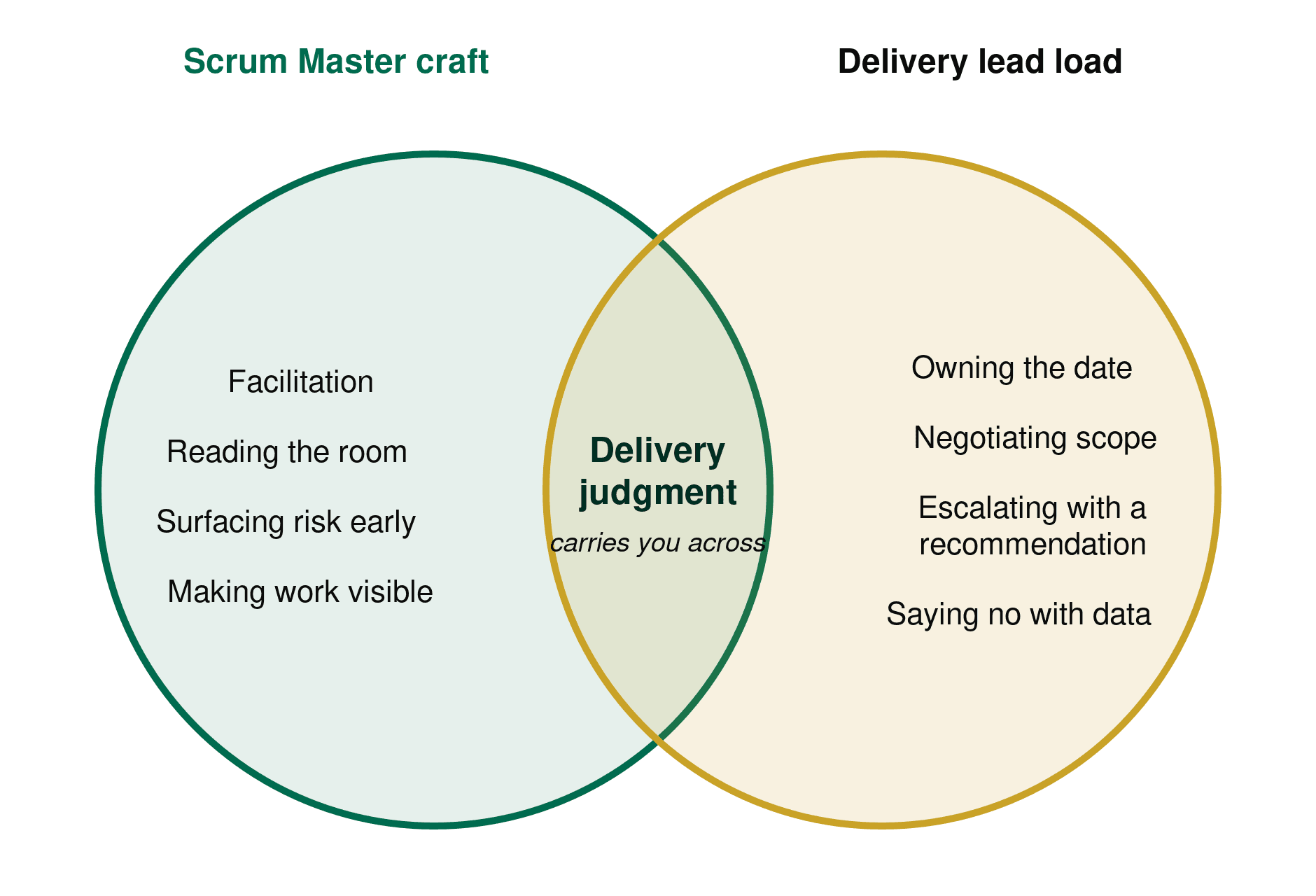
The overlap is real, and it's big. Facilitation, reading a tense room, surfacing risk early, making work visible, asking the question everyone's avoiding: those skills are the reason Scrum Masters make strong delivery leads at all. You've spent years watching how delivery actually behaves under pressure. That's the hard part, and you already have it.
What's new is a shorter list, but every item on it carries your name: standing behind a forecast, negotiating scope when the evidence says the date is wrong, escalating with a recommendation instead of just a flag, and saying no to a stakeholder with data instead of hoping someone else will.
Rehearse the jump while you still have the old title
Here's the usable part, and I wish someone had handed it to me a year before my jump. You can build every new muscle from inside the Scrum Master role, at a scale where mistakes are cheap.
Three reps, all real work, all available to you now:
Own one seam end to end. Pick a single cross-team dependency and follow it from agreement to delivery: the contract, the environment, the handoff, the chase. Don't facilitate it. Own it.
Put your name on one forecast. Take a slice of the release, build the forecast from the team's data, and present it as yours: "I'm confident in the 14th, and here are the two risks that would move it." Then live with being wrong in public, at small scale, and learn to update out loud.
Escalate with a recommendation. Next time you raise a risk upward, don't stop at raising it. Add "here's what I'd do, and here's what it costs." That one sentence is delivery lead work in miniature.
Six months of those reps and the jump stops being a leap. It becomes a step you've already walked in rehearsal.
The seat changes. Bring the judgment with you.
I told you about the heat in my face at that steering meeting. What I didn't tell you: it was also, strangely, the moment I started getting good at the new job. Once I understood that "when will you land it" was addressed to me, I started building answers that could survive it. Evidence under every date. Eyes on the seams. Escalations that arrived early, with options attached.
If you're eyeing this jump, you're not under-qualified. You're differently positioned, and position is learnable. The judgment you built watching teams under pressure comes with you. The neutrality stays behind. Trade it knowingly, and by the time the title changes, the job won't feel like a stranger.

Subscribe to the Newsletter
Join our growing community and get alerted first on our every article.
*By subscribing, you agree to send your information to our Company who agrees to use it according to their Terms and conditions and Privacy Policy
About the author
I believe the strongest tool and flex each of us has is our belief. When we truly believe in something, we align our mindset, energy, and actions with the right effort and guidance. That is when achieving almost anything becomes possible. This is how I help mentees at OAKKTREEUNII move into Software and Project Management careers for better pay, better confidence, and better work-life balance.
Is delivery lead a promotion from Scrum Master?
Usually it’s a step up in scope and pay, but it’s better understood as a change of position. You move from facilitating outcomes to owning them, including the dates. The skills overlap; the accountability doesn’t.
What does a delivery lead do that a Scrum Master doesn’t?
A delivery lead owns the delivery date and the forecast behind it, manages cross-team and vendor dependencies end to end, negotiates scope with stakeholders, and answers personally for the outcome, not just the process.
Can I prepare for a delivery lead role while still a Scrum Master?
Yes. Own one cross-team dependency end to end, publish a forecast with your name on it, and escalate risks with a recommendation attached. Those are the new muscles, rehearsed at a scale where mistakes are cheap.
Comments