Your RACI chart is where accountability goes to die
ESTIMATED TIME
7
mins

Written by
Rajveer Prasad
Published on
Nobody builds a RACI chart on a good day.
Think about when the last one you saw actually got made. It wasn't during a smooth quarter. It was after something fell through a crack. A handoff got dropped, an escalation turned ugly, two managers spent a week explaining to a director why the miss belonged to the other one's team. Then someone senior said the sentence that always comes next: "We clearly need to sort out roles and responsibilities."
So a workshop got booked. Two hours, a spreadsheet, four letters. People argued politely over who's Responsible and who's merely Consulted. Someone insisted their team be added to Informed on everything, just in case. By the end there was a grid with every cell filled in, and everyone left the room slightly relieved.
Notice what actually got produced. Not a way of working. A ceasefire.
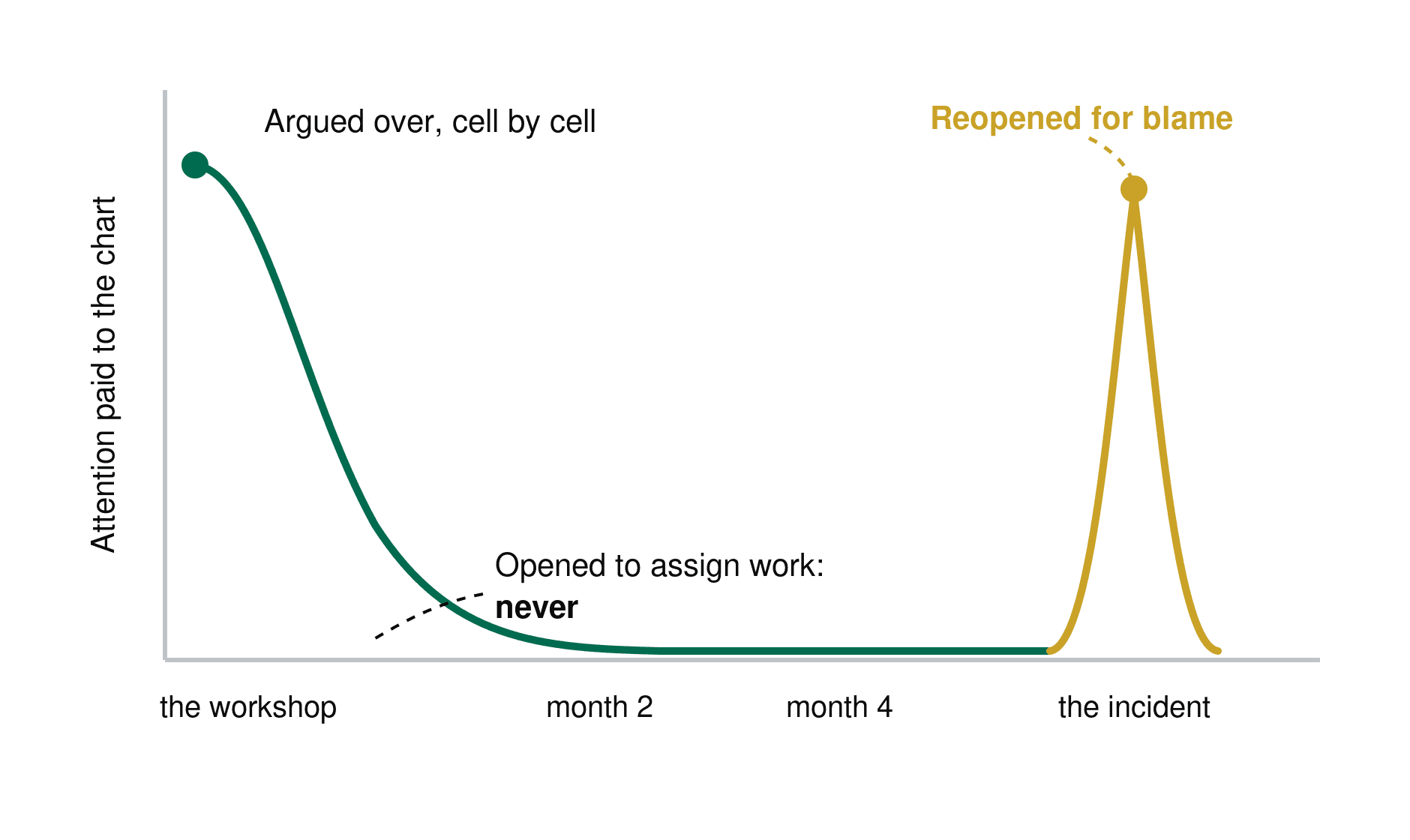
A RACI chart is a peace treaty, not an operating system. It gets written to end an argument, and it's genuinely good at that. But peace treaties have a predictable life cycle: negotiated, signed, filed. Nobody opens the treaty on a Tuesday morning to decide what to do next. They open it after the next war starts, to establish who broke the terms.
Every row has an A. No row has an owner.
To be fair to the model, it gets the most important thing right on paper. Accountable is supposed to be singular. One A per row. Whoever designed those four letters understood that ownership shared is ownership halved.
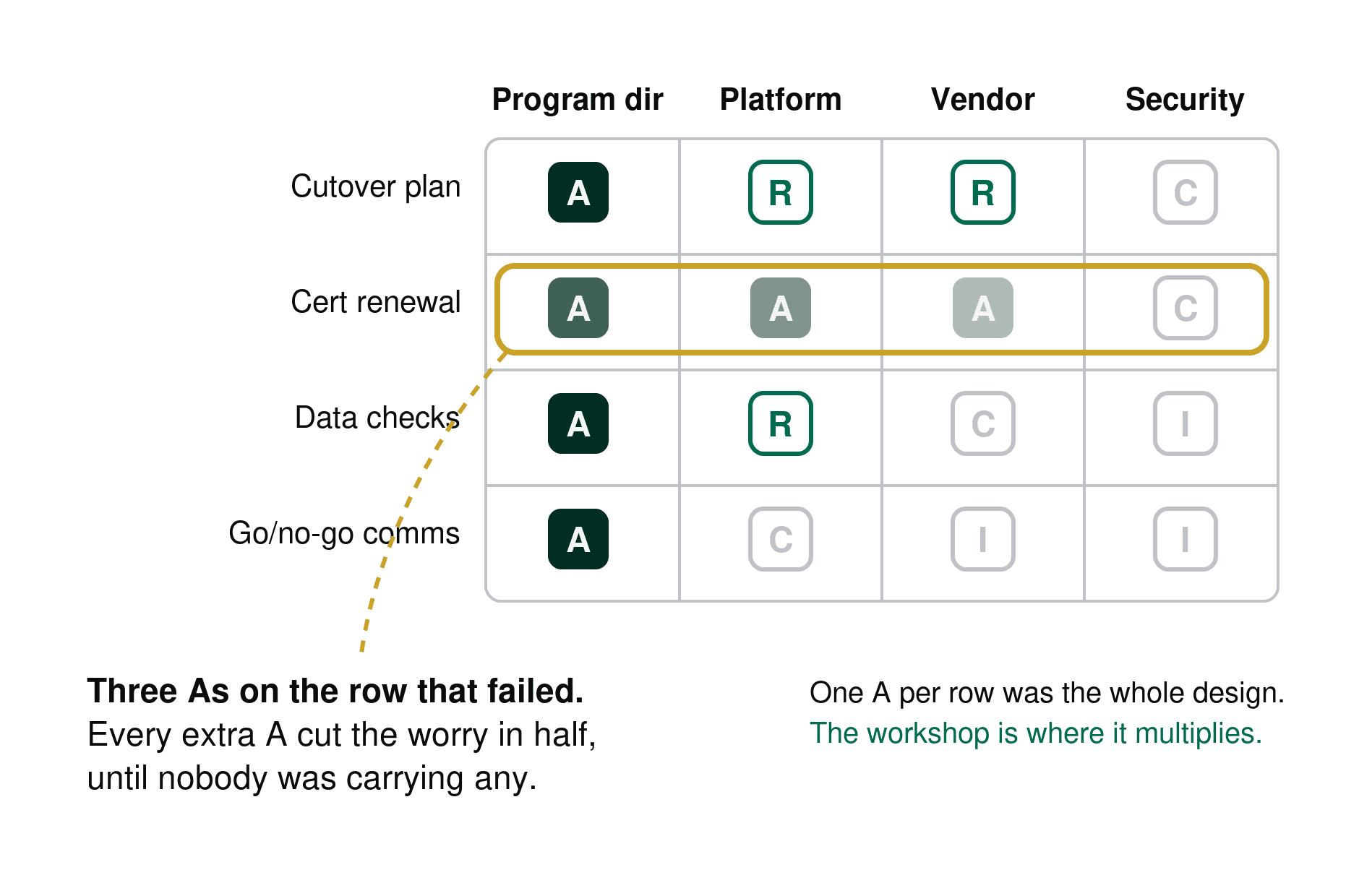
Then the workshop edits the design. Handing one person the A feels aggressive in a room full of peers, so the grid grows diplomatic. Two As on the risky rows, because "we're in this together." An A assigned to a team instead of a person, which sounds the same and means nothing. Somewhere near the bottom, a "shared accountability" footnote, which is a phrase that should set off a smoke alarm.
Accountability doesn't add. It divides. Give four people the A and each one carries a quarter of the worry, and a quarter of the worry rounds down to zero.
The other two letters decay even faster. Consulted quietly turns into insurance: "I did flag my concerns in the session," said three months later, with the meeting invite attached as evidence. Informed becomes the cc line, a place where information goes to be technically shared. The two columns designed to keep people close to the work end up being the columns people point at afterward to prove the work was never theirs.
Which tells you when the chart actually gets read. Twice. The week it's built, and the week something breaks.
The cutover with six Consulted and one expired certificate
A payments migration I watched up close had a beautiful RACI. Forty rows of laminated clarity. The cutover row alone: Accountable, the program director. Responsible, the platform team and the vendor's team. Consulted, six names across security, compliance, and architecture. Informed, half the company.
Keeping the old integration alive during the parallel run depended on one unglamorous task: renewing a TLS certificate. That task sat exactly between the two Responsible teams. Platform assumed the vendor had it, because the vendor owned the integration. The vendor assumed platform had it, because platform owned the environment. And the program director, holder of the A, was accountable for all forty rows, which in practice meant deeply involved in none of them.
The certificate expired on a Saturday. The parallel run died quietly, the data validation window collapsed, and the cutover slipped three weeks.
On the Monday call, the RACI went up on the big screen, and it performed its true function flawlessly. Every person in that room could point to their letter and show they'd done exactly what the letter required. The chart proved everyone innocent. The outage happened anyway.
What fixed it wasn't a better grid. Afterward, one platform engineer's name went against one sentence: renewals done by the 14th of every month, confirmed in the Monday review, and if it's slipping, she tells the room herself and brings the new date. No letter of the alphabet involved. A name, a consequence, and a date. That certificate hasn't expired since.
The strongest case for the grid
Before you shred every matrix in the building, here's the best version of the other side, because it's real and it deserves a straight answer.
RACI genuinely earns its keep at handoff-heavy interfaces. Where your delivery org meets a vendor, where engineering meets compliance, where three departments touch one regulated approval, "who signs and who executes" is a legitimate question with a non-obvious answer. Writing that down once beats rediscovering it every quarter. The chart is also a quiet gift for onboarding: a new joiner who reads a good one-page RACI learns the political geography of a program in ten minutes instead of ten weeks.
Notice what those two cases have in common. The chart is working as a record of a conversation. One page, written after ownership was genuinely settled, reopened whenever reality changes.
So the four letters were never the failure. The failure is treating the artifact as the accountability. A RACI chart can describe ownership that already exists. It cannot create ownership that doesn't. Most organizations deploy it for the second job, which is precisely the job it can't do.
One name, a consequence, a date
Here's what real accountability is actually made of, and none of it fits in a cell.
One name. A person, not a team, a role, or a function. Teams can do work; only a person can lie awake about an outcome. If the answer to "who owns this" starts with "the," you don't have an owner yet.
A consequence. Not a punishment. A natural stake: when this slips, you're the one who says so, out loud, to the people who care, with a new date and a plan. That sentence changes how someone tracks a deliverable in a way no letter of the alphabet ever has. People manage what they know they'll have to stand up and explain.
A date. Accountability without a date is a sentiment. "Priya owns the migration" is a mood. "Priya has the parallel run stable by the 14th, and flags it by the 7th if it's wobbling" is a commitment you can actually watch.
And all three have to live in the working rhythm, not in a file. Real ownership shows up where the work shows up: the name gets asked the question in the weekly review, the date sits on the board everyone already looks at, the flag gets raised in standup instead of in a postmortem.
There's a five-second test for whether you have any of this. Ask three people, separately, who owns a given outcome. If you get the same single name in under five seconds, three times, you have accountability. If anyone says "let me check the RACI," you have a document.
So here's the swap. Before you book the roles-and-responsibilities workshop, try to write one sentence per outcome that matters:
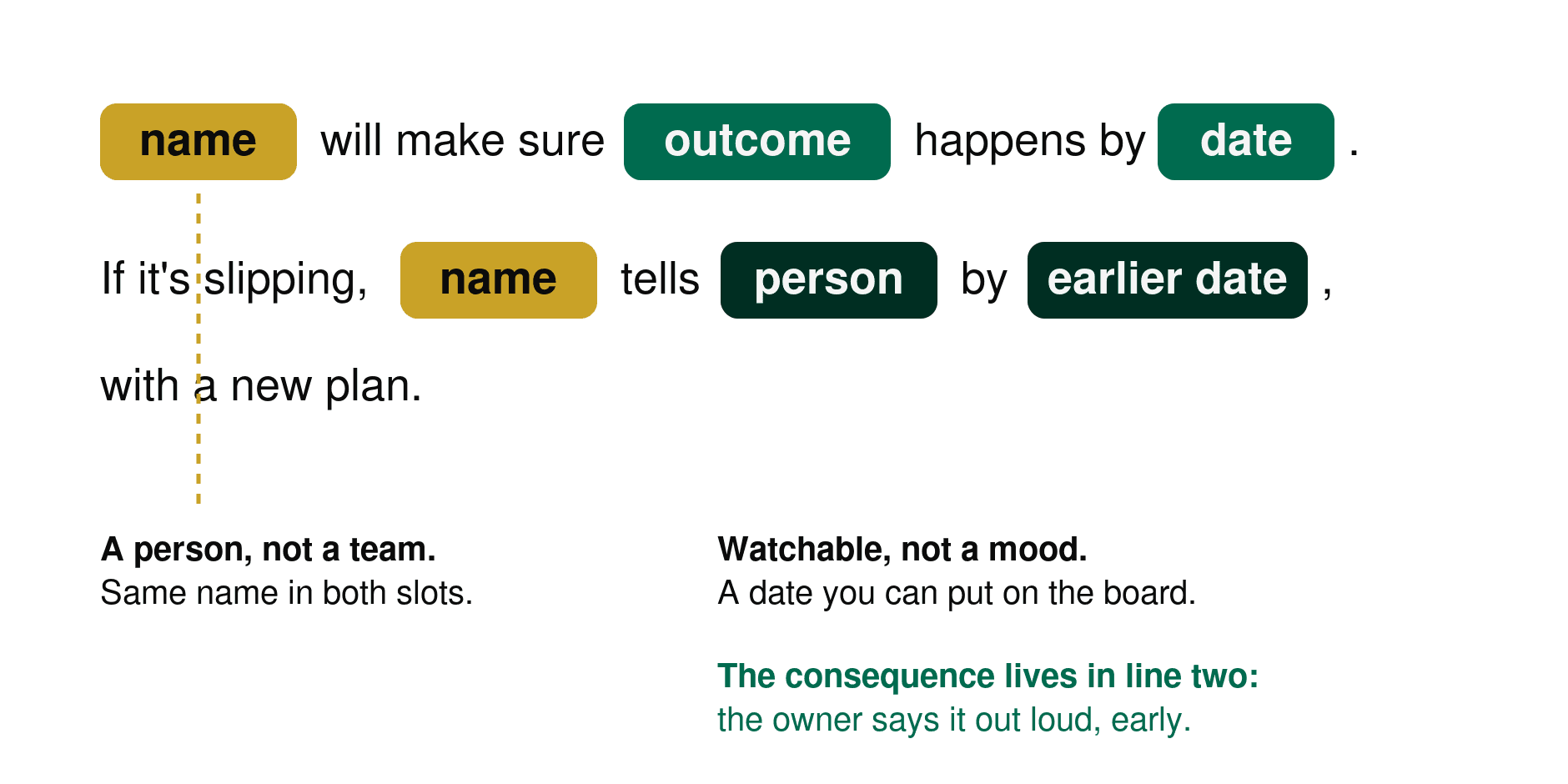
If you can fill that in, you may not need the workshop. If you can't, the matrix won't fill it in for you. It'll just spread the blank across four columns where it's harder to see.
What this sounds like when you're the one being interviewed
One last reason to care, beyond your current team. "Tell me about a time ownership was unclear" is a standard question for Scrum Masters and project managers, and it quietly sorts candidates into two piles. The weak answer describes a document: "We ran a RACI workshop and clarified roles and responsibilities." The strong answer describes behaviour: "I got one name against each of the three at-risk deliverables, made our Monday review ask those three people directly, and the misses stopped within a month."
One of those answers sounds like process. The other sounds like someone who's been in the room. And you don't need anyone's permission to start collecting the second kind of story. Pick one outcome on your current board that's drifting, and get one name, one consequence, and one date against it this week. That's a rep you can talk about for years.
The grid can stay on the wall. It makes a fine map of the peace. Just remember what it is. A treaty ends the fight. It has never once shipped anything.

Subscribe to the Newsletter
Join our growing community and get alerted first on our every article.
*By subscribing, you agree to send your information to our Company who agrees to use it according to their Terms and conditions and Privacy Policy
About the author
With 20 years guiding high-stakes Agile transformations, I turn theory into action at Oaktreeuni—mentoring aspiring Scrum Masters to think critically, adapt fast, and lead beyond frameworks. The payoff? You step into a high-paying Scrum Master or Agile PM role already equipped to excel.
Why do RACI charts fail?
Because they’re usually created to end a conflict, then filed. Accountability spread across several people diffuses into nobody’s, Consulted and Informed turn into cover, and the chart only gets reopened when something breaks. The artifact isn’t the accountability.
What should you use instead of a RACI chart?
One sentence per outcome that matters: a named person will deliver a specific outcome by a date, and if it’s slipping, that person flags it early to a named audience with a new plan. Then make that sentence visible in the team’s working rhythm: the board, the weekly review, standup.
When is a RACI matrix actually useful?
At handoff-heavy interfaces (vendors, compliance, cross-department approvals) and for onboarding new joiners. It works when it’s one page, written after ownership is genuinely settled, and revisited when reality changes. It records accountability; it can’t create it.
Comments