What product owners wish their Scrum Master understood
ESTIMATED TIME
7
mins

Written by
Shikha Prasad
Published on
Here's a conversation you're not in the room for.
Your Product Owner is venting to a friend about work. At some point the friend asks, "what's your Scrum Master like?" Your PO pauses, and what comes out is almost never "they run a tight standup." It's usually some version of "they're fine, but I wish they understood what my job actually is."
I've sat across from a lot of POs. When they trust you enough to be honest, the gap they describe is always the same. They don't need a better-run ceremony. They need a partner. And most Scrum Masters, through no fault of their own, were trained to deliver the first thing and never taught the second.
The scoreboard you're playing isn't theirs
Start with why the gap exists, because it isn't laziness and it isn't bad intent. You were handed a scoreboard. Standup on time. Board tidy. Velocity stable. Retro happened. Tick, tick, tick. Run those well and the certification tells you you're doing the job.
Your Product Owner is keeping a completely different scoreboard.
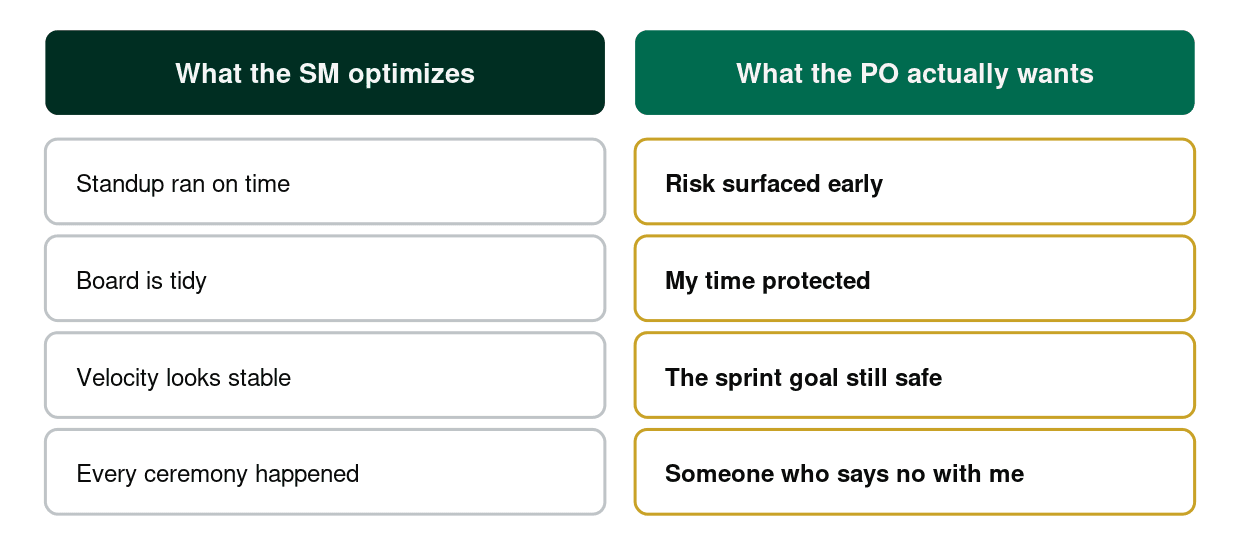
Look at those two columns. Almost nothing on the left shows up on the right. Your PO doesn't lie awake over whether the standup ran sixteen minutes. They lie awake over the feature that's quietly slipping, the stakeholder who's about to be surprised, the goal drifting while everyone stays busy. When you optimize the left column and report it proudly, you're answering a question they never asked. That's the whole friction, in one picture.
And notice it cuts both ways. The PO isn't right about everything either. But you're the one who's supposed to understand both scoreboards, because bridging them is the actual role. The PO owns the product. You own the system that delivers it. Knowing what they're really measured on is step one of doing your half well.
What it sounds like from the other chair
If you could hear what your PO actually wishes you understood, stripped of all the politeness, it would sound something like this.

Take the first one, because it's the one newer Scrum Masters get most wrong. Most POs are stretched thin. They're part-time on your team and full-time managing the stakeholders above them. So when your instinct in a moment of uncertainty is to schedule another meeting or add another ceremony, you're spending the one resource they have least of. The SM who hands a PO time back is worth more than the one who facilitates beautifully. Protect their calendar like it's part of the sprint, because it is.
The one about bad news is the one that quietly ends partnerships. POs do not hate problems. They manage problems for a living. What they hate is finding out about a slip at the sprint review, in front of stakeholders, when it's too late to do anything but absorb it. A blocker you surface on day two is something you and the PO solve together. The same blocker revealed on day nine is something that just made them look bad to their boss. Same fact, completely different relationship, decided entirely by timing.
And the last one, "we're on the same side," sounds obvious until you watch how often it breaks. The textbook splits your worlds cleanly: the PO owns the what, you own the how. In practice that tidy line turns into a border, and borders grow guards. The PO starts shielding priority calls from you. You start shielding process from them. The best Scrum Masters quietly rub the border out. They'll help shape a thin backlog item, suggest a way to slice scope, take a stakeholder conversation off the PO's plate. Not to take the PO's job. To share the weight of it.
The backlog one earns its own moment, because it's where you win the partnership or quietly lose it. Every PO is under constant pressure to let things in: a VP's pet feature, a "quick" ask from sales, a fire from support. Left alone, a backlog becomes whatever the loudest person wanted last week. A Scrum Master who helps the PO hold that line, who makes the org argue for priority instead of just injecting it, is doing the single most useful thing you can do for a product person. Refinement is table stakes. Defense is the job. Done well, the PO stops seeing you as overhead and starts seeing you as cover.
Process cop or delivery partner
Underneath all five is one choice you make a hundred times a sprint, usually without noticing. Are you the process cop, or the delivery partner?
Picture the most common test. A stakeholder drops new work into the middle of the sprint.
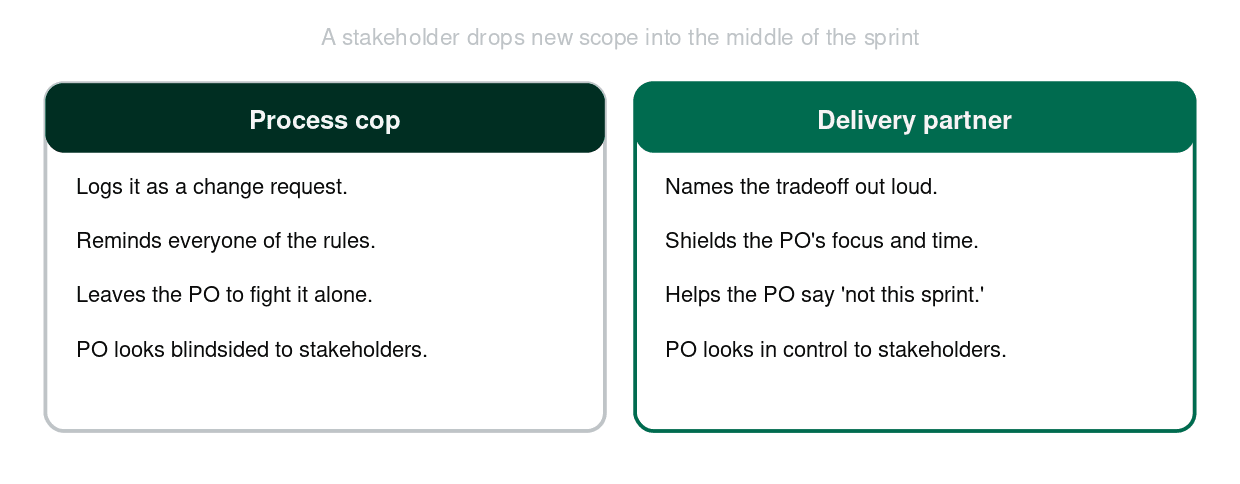
The cop logs it, cites the process, reminds everyone scope is locked, and considers the matter handled. Technically correct. Completely useless to the PO, who now has to fight that battle alone while you stand on procedure.
The partner does the harder thing. They name the tradeoff out loud, what comes out if this goes in. They take the heat off the PO's calendar so the PO can actually think. And they help the PO say "not this sprint" in a way that keeps the stakeholder relationship intact. Same situation. One of you made the PO's job harder. The other made the PO look like they had it under control.
I watched a Scrum Master do this perfectly once. A VP tried to wedge a "small" request into week two. Instead of quoting the process, she pulled up the sprint goal, showed him exactly which committed item would slip to make room, and asked which he'd rather have. He backed off in about ninety seconds. The PO didn't say a word in that meeting. Afterward she told me she would never let that Scrum Master go. That's the move. You don't block the stakeholder. You make the cost visible and hand the PO the win.
How to become the SM a PO fights to keep
This is fixable, it's fast, and almost none of it is glamorous.
● Ask the question that reframes everything. Once a week, ask your PO: what's the one thing about delivery that's keeping you up? Then make that your priority, not your ceremony schedule.
● Run refinement that ends in decisions, not discussion. A PO doesn't need a longer conversation about the backlog. They need to leave the room with fewer open questions than they walked in with.
● Give the heads-up before the surface. The moment you smell a risk, the PO hears it from you first, privately, with a suggested move. Never let a stakeholder brief your PO on your own team's problem.
● Shield the backlog. When the org tries to inject work, you're the one who slows it down, frames it as a tradeoff, and buys the PO room to decide. Be the bouncer, not just the host.
● Make them look good on purpose. Hand them the clean delivery story for their stakeholder update. Credit is cheap to give, and it buys an enormous amount of trust.
Why this is the most selfish thing you can do
None of that is in the framework. All of it is the job.
And here's the part that should matter to you selfishly. Your Product Owner is one of the most valuable references you will ever have. They sit next to product leaders, they get asked who's good, and a PO who would fight to keep you is worth more than any line on your resume. The Scrum Masters who get pulled up into bigger delivery roles are almost never the ones with the tidiest boards. They're the ones a PO described to a hiring manager as "get me someone like the one I had."
I have never once seen a Scrum Master land a glowing internal referral for a tidy Jira board. I've seen plenty earn one from a grateful product owner.
So stop running ceremonies at your Product Owner. Start carrying the weight with them. That's the whole job nobody put on the certificate.

Subscribe to the Newsletter
Join our growing community and get alerted first on our every article.
*By subscribing, you agree to send your information to our Company who agrees to use it according to their Terms and conditions and Privacy Policy
About the author
I believe the strongest tool and flex each of us has is our belief. When we truly believe in something, we align our mindset, energy, and actions with the right effort and guidance. That is when achieving almost anything becomes possible. This is how I help mentees at OAKKTREEUNII move into Software and Project Management careers for better pay, better confidence, and better work-life balance.
What do product owners want from a Scrum Master?
Protected time, risk surfaced early, a backlog shielded from the whole org, and a partner who helps them say no, not a process enforcer.
Why do Scrum Masters and product owners clash?
They keep different scoreboards. The SM optimizes ceremonies and tidiness; the PO cares about the goal, the risk, and how they look to stakeholders.
How can a Scrum Master support the product owner?
Give time back, surface bad news early and privately, frame scope changes as tradeoffs, and hand the PO a clean delivery story for their stakeholders.
Comments