How one team halved its cycle time without working harder
ESTIMATED TIME
8
mins

Written by
Shikha Prasad
Published on
The team wasn't lazy. That was the first thing everyone got wrong about them.
When I started sitting in on their stand-ups, they were the hardest-working group in the building. People stayed late. Nobody was coasting. And still, a feature that should have taken a week was taking the better part of a month to land in front of a real user. Leadership's read was simple, and wrong: the team needed to push harder.
I want to walk you through what we changed, because we cut their cycle time roughly in half, and not one person worked an extra hour to do it. If anything, they started going home earlier. Cycle time, if it's a new phrase, is just the clock from the moment work actually starts to the moment it's done and in someone's hands.
They were seven people, all good at their jobs, the kind of team that's competent and conscientious and somehow still underwater. If you've ever been on one, you know the feeling. You end the week wrung out and you would struggle to point at what actually shipped.
Busy was the problem, not the solution
Here's what was actually happening. Everyone had three or four things in progress at once. It looked productive. Every person was busy every minute. But busy people and finished work are not the same thing, and on this team they had quietly drifted apart.
When you start everything, you finish nothing on time. The work piled up in the in-between. A task would reach "ready for review" and sit for two days because the reviewer was buried under their own three half-done things. Another would wait on a question that took an afternoon to even ask, because everyone was heads-down. The team was a traffic jam where every single car had its engine running.
My favourite moment was a standup where a developer said, cheerfully, "no blockers," about a card that had not moved in four days. He wasn't lying. He genuinely wasn't blocked. He was just busy with two other things, and that card was patiently waiting its turn behind them. Nobody was blocked. The work was still stuck. That gap, between nobody-is-blocked and nothing-is-moving, is where most teams lose their weeks.
I've come to think of it as the difference between active and busy. Active means the work is moving. Busy means the people are moving. A team can be completely busy and barely active, and from the inside that feels identical to being productive, which is exactly why it's so hard to catch from your own chair.
We measured the wait, and it was embarrassing
So before we changed a single thing, we did one slightly painful exercise. We took five recently finished items and walked each one backwards, marking how long it spent being actively worked on versus how long it spent simply sitting there, waiting for a person, an environment, an answer, a review.
The average came out to about three days of actual work, spread across eighteen days of calendar. The other fifteen days were waiting.
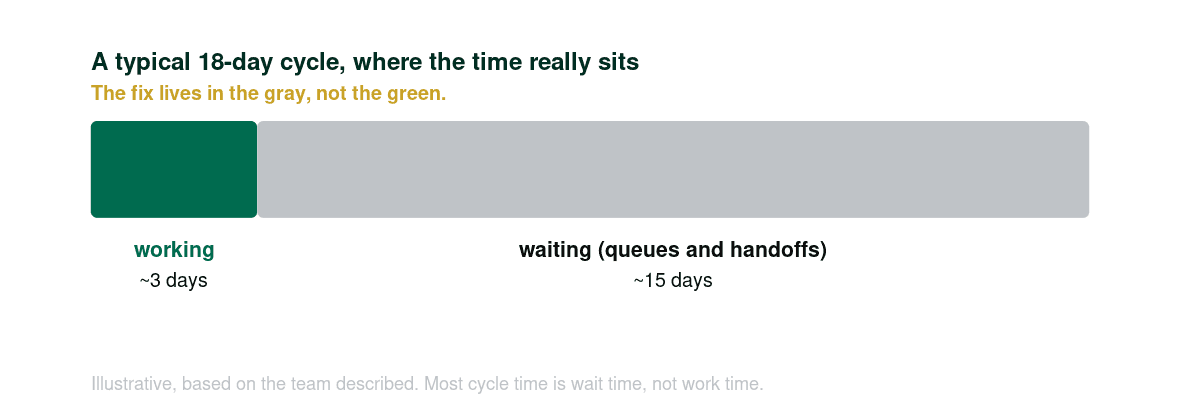
Nobody believed it until they saw it laid out like that. The work wasn't slow because the people were slow. It was slow because it spent most of its life parked. There's an old idea from queueing theory, Little's Law, that basically says the more things you keep in progress at once, the longer each one takes to get through. We didn't need the math. The board was the proof. You cannot fix parked work by telling people to drive faster. There was nothing wrong with the driving. There was a jam.
What surprised me most was the relief in the room when they saw it. They had been carrying a quiet shame about being slow. The chart handed them a different story: you're not slow, your system is. That reframe alone changed how willing they were to try something new.
Four boring changes
What we did next would not make a conference talk. That's the point.
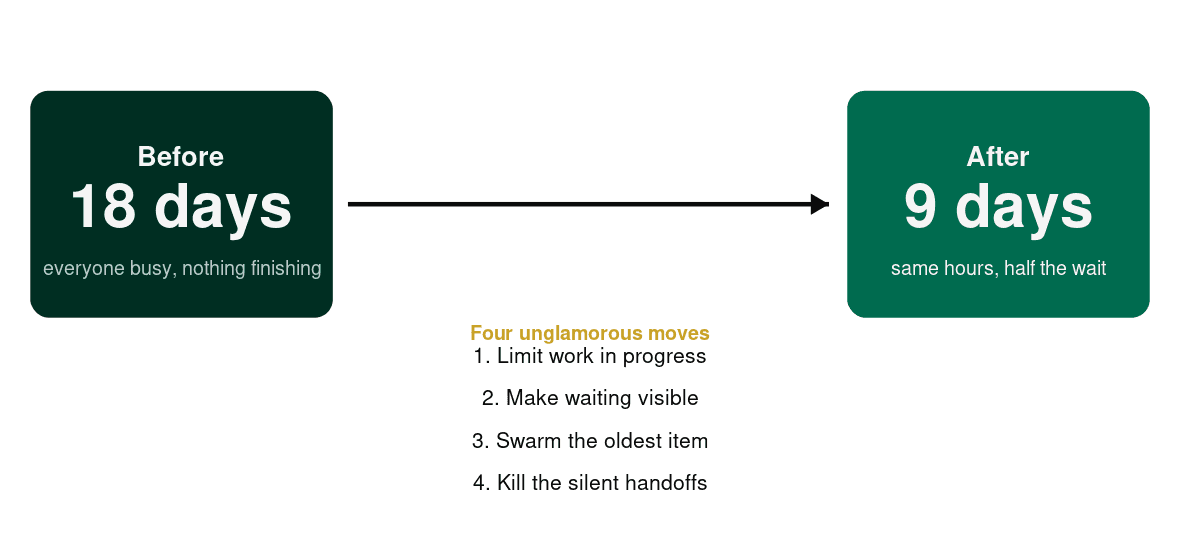
First, we limited work in progress. The team agreed that nobody would start a new item until something finished, and we capped how many things could be in progress at once. It felt wrong for about a week, because people are used to starting things to feel productive. Then the column started clearing. The strange part was how much calmer it felt. Finishing one thing fully before grabbing the next turns out to be less stressful than juggling four, even when juggling feels more productive.
Second, we made the waiting visible. We added a plain marker to anything blocked or sitting, with the date it stopped moving. Suddenly a card that had been quietly aging for four days had a number on it that everyone could see, and aging cards became the first thing we talked about each morning, not the last.
Third, we swarmed the oldest item. Instead of everyone guarding their own task, the rule became simple: the thing closest to done, or the thing stuck longest, gets help first. Two people pushing one card over the line beats four people each nursing their own.
Fourth, we killed the silent handoffs. The biggest waits lived at the seams, where work moved from dev to review, review to QA, QA to release. We didn't add a process. We just agreed that handing work off included a thirty-second message to the next person, so nothing sat in a queue that no one was watching.
None of these needed a tool, a budget, or permission from anyone above us. That mattered more than it sounds. The team could start on Monday, so they actually did.
The number nobody worked harder for
Within a few sprints, cycle time dropped from around eighteen days to about nine. Same team, same hours, same people, who were now slightly bored at five o'clock instead of slammed at seven.
Throughput went up as a side effect, which genuinely surprised leadership, because we had done the opposite of what they asked. We told a busy team to start less, not do more. But that's how flow works. When work stops waiting, it finishes sooner, and when it finishes sooner, the team can pull the next thing earlier. The speed came from removing delay, not from adding effort.
There was a quieter win, too. The team started trusting its own estimates again, because work stopped vanishing into the gaps. When a thing took nine days instead of disappearing for a month, planning got honest, and honest planning is its own kind of speed.
If your team feels exactly like this
Resist the urge to push. Do the backwards walk on five finished items first. I would bet you find what they found: most of your cycle time is wait time, and wait time is the cheapest thing in the world to cut, because nobody has to work harder to remove it.
Start there. Not with a new framework, not with a tool migration, just five finished items and an honest look at where their days actually went. The exercise takes about an hour, and it tends to end the same way every time, with a quiet room and a board that suddenly makes sense.
The other thing worth saying out loud: a fix that needs people to work harder isn't a fix, it's a loan. It holds until they burn out, and then you're slower than when you started. Cutting wait time is the rare improvement that costs the team nothing and hands them their evenings back.
And keep the before and after. "I cut our cycle time from eighteen days to nine by limiting work in progress and making the waiting visible, without anyone working more hours" is not a sentence from a course. It's a real result with real numbers, and it's exactly the kind of story that makes an interviewer lean in. You didn't manage a board. You made the work move.

Subscribe to the Newsletter
Join our growing community and get alerted first on our every article.
*By subscribing, you agree to send your information to our Company who agrees to use it according to their Terms and conditions and Privacy Policy
About the author
I believe the strongest tool and flex each of us has is our belief. When we truly believe in something, we align our mindset, energy, and actions with the right effort and guidance. That is when achieving almost anything becomes possible. This is how I help mentees at OAKKTREEUNII move into Software and Project Management careers for better pay, better confidence, and better work-life balance.
What is cycle time on an agile team?
The time from when work actually starts to when it is done and delivered. It usually includes far more waiting than active work.
How do you reduce cycle time without working harder?
Cut wait time, not effort: limit work in progress, make waiting visible, swarm the oldest item, and close the silent gaps at handoffs.
Does limiting work in progress actually speed up delivery?
Yes. Fewer items in progress means each one waits less and finishes sooner, which is the core idea behind Little’s Law.
Comments