Where Scrum Master jobs are actually growing in 2026
ESTIMATED TIME
12
mins

Written by
Shikha Prasad
Published on
Every few months the same headline makes the rounds. The Scrum Master role is dying. Agile is dead. The title is finished. It collects thousands of shares, a few hundred panicked comments, and moves exactly zero job-seekers any closer to a job.
Here's the thing nobody monetizes. The job boards don't trend. A spreadsheet of where delivery roles are actually posted will never go viral, because "demand is steady and unevenly spread" is a terrible hook. So the loud question wins, and it happens to be the wrong one.
The useful question isn't whether the role is dying. It's where the work is. And when you read the data instead of the discourse, the answer is more specific, more boring, and far more actionable than anything in your feed.
The role isn't dying. It's relocating.
Start with the unsexy baseline. Project management specialists, the occupation that absorbs most Scrum Master, delivery lead, and IT project manager work, held about 1,046,300 jobs in 2024, and the government projects roughly 78,200 openings a year through 2034, with the occupation growing 6 percent {BLS Occupational Outlook Handbook, 2024}. The median wage is $100,750 {BLS Occupational Outlook Handbook, 2024}.
Six percent isn't a boom. I'm not going to sell you a boom. But it's the opposite of a death, and there's a detail in those openings that matters more than the growth rate. Most of the 78,200 a year come from replacement, not expansion: people retiring or moving to other work {BLS Occupational Outlook Handbook, 2024}. For someone trying to get in, replacement demand is the good kind. It means seats keep opening whether or not the headcount is climbing.
A million-job occupation turning over tens of thousands of seats a year is not a graveyard. The role isn't vanishing. It's moving to addresses the discourse never mentions.
Look where the discourse never points
Ask a room of aspiring Scrum Masters where the jobs are, and almost all of them will say "tech companies." It's the single most expensive assumption in this field.
Look at who actually employs these specialists. Professional, scientific, and technical services is the biggest slice at 28 percent. Construction is right behind at 21. Manufacturing takes 7, administrative and support services 5, finance and insurance 4 {BLS Occupational Outlook Handbook, 2024}.
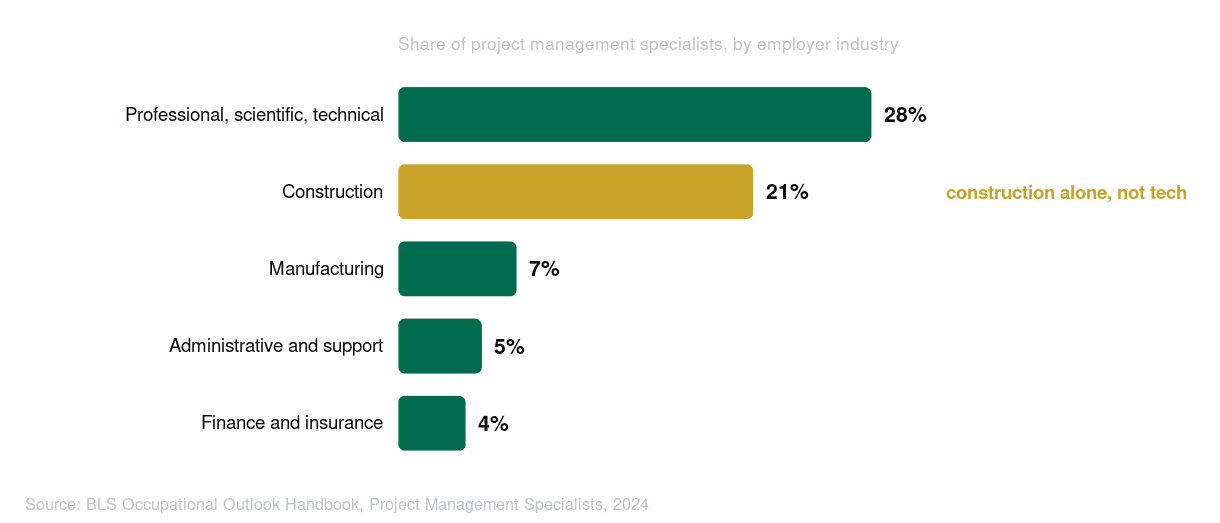
Read that again. Construction alone employs one in five. Add manufacturing, finance, healthcare systems, government contractors, and engineering firms, and the "tech company" you aimed every application at is a minority of the market. Software is loud about agile because software invented the vocabulary. It is not where most of the hiring lives.
That's the first correction, and it's free. A delivery person who only applies to software companies is fishing in the smallest pond and calling the empty bucket a dying industry. The construction firm building a hospital still needs someone to run the schedule, hold the dependencies, and manage the stakeholders. They may never say the word Scrum. They will absolutely pay for the work.
I watched this play out with someone who spent four months firing applications at startups and hearing nothing. He widened to healthcare, and a regional hospital network hired him in under three weeks to coordinate an electronic-records rollout. The work was pure delivery: competing departments, a vendor running late, a go-live date that could not move. Nobody in that building ever said the word sprint. He has never been busier, or more employable.
The number that beats the headline
Now geography, where the same mistake repeats at a larger scale.
Where are the most delivery jobs? Texas and California, at roughly 116,950 and 114,640 {BLS OEWS, May 2023}. Obvious. They're the biggest states. That fact is true and nearly useless, because everyone else is applying there too, and a big number of jobs inside a giant economy can still be a thin market for you.
The number that actually helps is the location quotient: how concentrated the role is relative to the size of the local job market. Above 1.0 means the role is denser than the national average. By that measure the leaders aren't the giants. Maryland sits at 1.93, Colorado at 1.72, Virginia at 1.57 {BLS OEWS, May 2023}. Drop to metros and Austin runs about 2.10, Washington DC 1.96, Denver 1.92 {BLS OEWS, May 2023}.
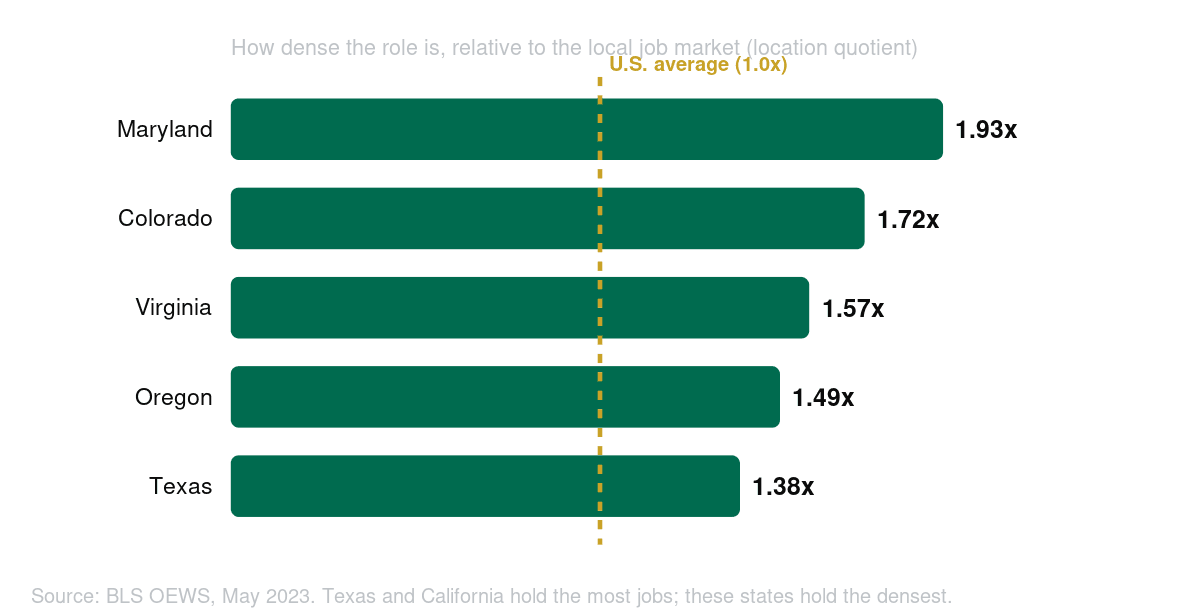
It's not a coincidence that those places run on federal contracts, defence, aerospace, and engineering. The density follows the industries that hire delivery people in bulk, which is the same point as before wearing a different hat. Density is what you want, because density is shots on goal. In a market where the role is nearly twice as concentrated as average, more teams already know what a delivery person does, more recruiters don't need the job explained to them, and more openings exist per cold email you send. A high location quotient is a market that's expecting you. A big raw count is just a crowd.
There's a pay wrinkle worth knowing, too. The densest markets and the highest-paying ones aren't always the same place. The top-paying metro for this work is San Jose at about $150,720 a year {BLS OEWS, May 2023}, which sounds great until you price a one-bedroom there. A less famous but highly concentrated market often wins once rent enters the math. Density buys you interviews. Cost of living decides what the offer is actually worth.
Yes, the layoffs were real
The honest counter deserves a straight answer. The "role is dying" crowd isn't hallucinating. Tech cut agile-coach and Scrum Master headcount hard through the downturn, and the pure ceremony-runner version of the job, the one whose whole value was booking the standup, is genuinely consolidating. If that's the job you trained for, the worry is rational.
And the titles really are scrambling. The same job now posts as delivery manager, technical program manager, agile delivery lead, or release train engineer, depending on who wrote the listing. That's a nuisance if you search for one exact phrase. It's an opening if you search for the work instead.
But notice what the industry data is quietly telling you. The work didn't evaporate. It redistributed into sectors that never put "Scrum" on the job ad: the engineering services firm, the construction GC, the bank's transformation office, the hospital network's PMO. Same skills, different letterhead, no hashtag. The title took the layoff. The work took a road trip.
None of this lets you coast on the framework. The roles that vanished were the ones that added nothing past running the ceremony. The roles that are growing want someone who improves flow, surfaces risk early, and holds stakeholders together when the plan moves. That's a higher bar than a certificate clears, and it's the exact bar that travels across every industry on that chart.
Point the search, not the panic
So here's what to do with this instead of refreshing the doom thread.
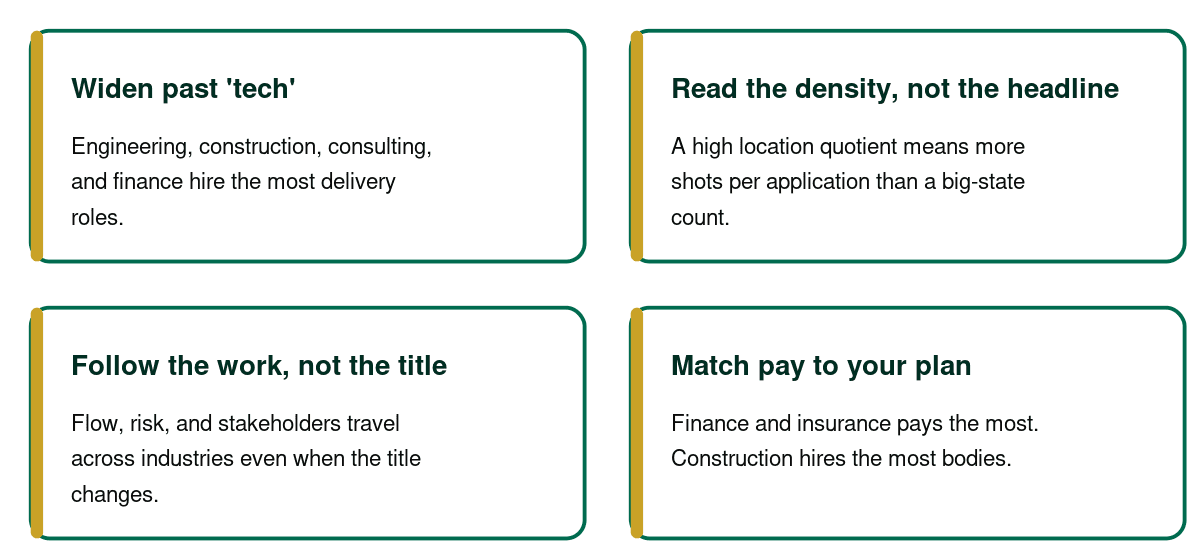
Widen the industries you apply to past software, because that's where four out of five of these jobs actually sit. Sort your target geography by concentration, not by the size of the state, and treat a high location quotient as a buy signal. Decide what you're optimizing for: finance and insurance pays the most for this work, a median of $111,350, while construction pays less, around $96,700, and hires far more people {BLS Occupational Outlook Handbook, 2024}. Then build evidence in the language of the work, not the framework, because flow, risk, and stakeholder trust read the same to a hiring manager in any of these industries.
The discourse will keep asking whether the role is dying, because the question prints engagement. Let it. You've got a better one. Not "is there work," but "where is it densest, who's hiring for it under a different name, and what do I need to show them." Aim there. The map is always more useful than the mood.
Practically, your next move isn't another course. It's a target list. Pick three industries off that chart that aren't software, find five companies in your metro hiring delivery people in each, and learn enough about one of those industries to speak its language in a room. That's a weekend of work, and it aims you at a market that's expecting you, instead of the one everyone else is crowding into.
Sources
U.S. Bureau of Labor Statistics, Occupational Outlook Handbook, Project Management Specialists (industry mix, growth, and pay), 2024.
U.S. Bureau of Labor Statistics, Occupational Employment and Wage Statistics, 13-1082 Project Management Specialists (state and metro location quotients), May 2023.

Subscribe to the Newsletter
Join our growing community and get alerted first on our every article.
*By subscribing, you agree to send your information to our Company who agrees to use it according to their Terms and conditions and Privacy Policy
About the author
I believe the strongest tool and flex each of us has is our belief. When we truly believe in something, we align our mindset, energy, and actions with the right effort and guidance. That is when achieving almost anything becomes possible. This is how I help mentees at OAKKTREEUNII move into Software and Project Management careers for better pay, better confidence, and better work-life balance.
Is the Scrum Master role dying in 2026?
No. The occupation that absorbs the work is projected to grow 6 percent through 2034 with about 78,200 openings a year. The ceremony-only version is shrinking; the delivery work is redistributing into other industries.
Which industries hire the most project and delivery managers?
Professional and technical services (28 percent) and construction (21 percent) lead, far ahead of any single tech category, per BLS 2024.
Comments