Credential inflation is a signaling game. Here’s how to read any certification.
ESTIMATED TIME
5
mins

Written by
Rajveer Prasad
Published on
Stop asking which badge makes you stand out. Inflation already answered that. Ask what a credential actually signals, and to whom.
You got certified to stand out. You don't. So now you're looking at the next tier, the advanced one, the professional one, the one with the longer acronym, quietly wondering if that's the badge that finally separates you from the pile.
It won't, and the reason has nothing to do with which certificate you pick. It comes from a fifty-year-old idea in economics that explains the whole game you're caught in. Once you see it, you stop chasing badges and start reading them, which is a much more useful skill and a far cheaper one.
A certificate is a signal, and signals follow rules
When an employer can't directly see whether you're good, and they can't, not from a resume and barely from an interview, they fall back on signals: proxies they hope correlate with the thing they actually want. This is the heart of signalling theory, the idea that got Michael Spence a Nobel. A degree, a certification, a portfolio, a referral. All of them are guesses the market makes at a quality it can't observe yet.
And a signal only carries information if it's costly, specifically, if it's harder for a weak candidate to send than a strong one. That's the entire mechanism. A thing that everyone can get with a weekend and a credit card tells the buyer almost nothing, because the people you'd want to filter out can clear it just as easily as the people you'd want to keep.
A credential is the market's best guess at the thing it can't see yet. The question is always how good a guess it is.
Why the signal keeps getting weaker
Here's the trap built into the whole system. When a signal works, when a particular cert really does help people get hired, word gets out, and everyone gets it. And the moment everyone has it, it stops separating anyone. It doesn't vanish. It sinks to the floor and becomes the price of admission. Now you need it just to avoid being screened out, but holding it tells an employer nothing about whether you're any good. That's credential inflation, and it's not a glitch. It's the predictable life cycle of any signal that works.
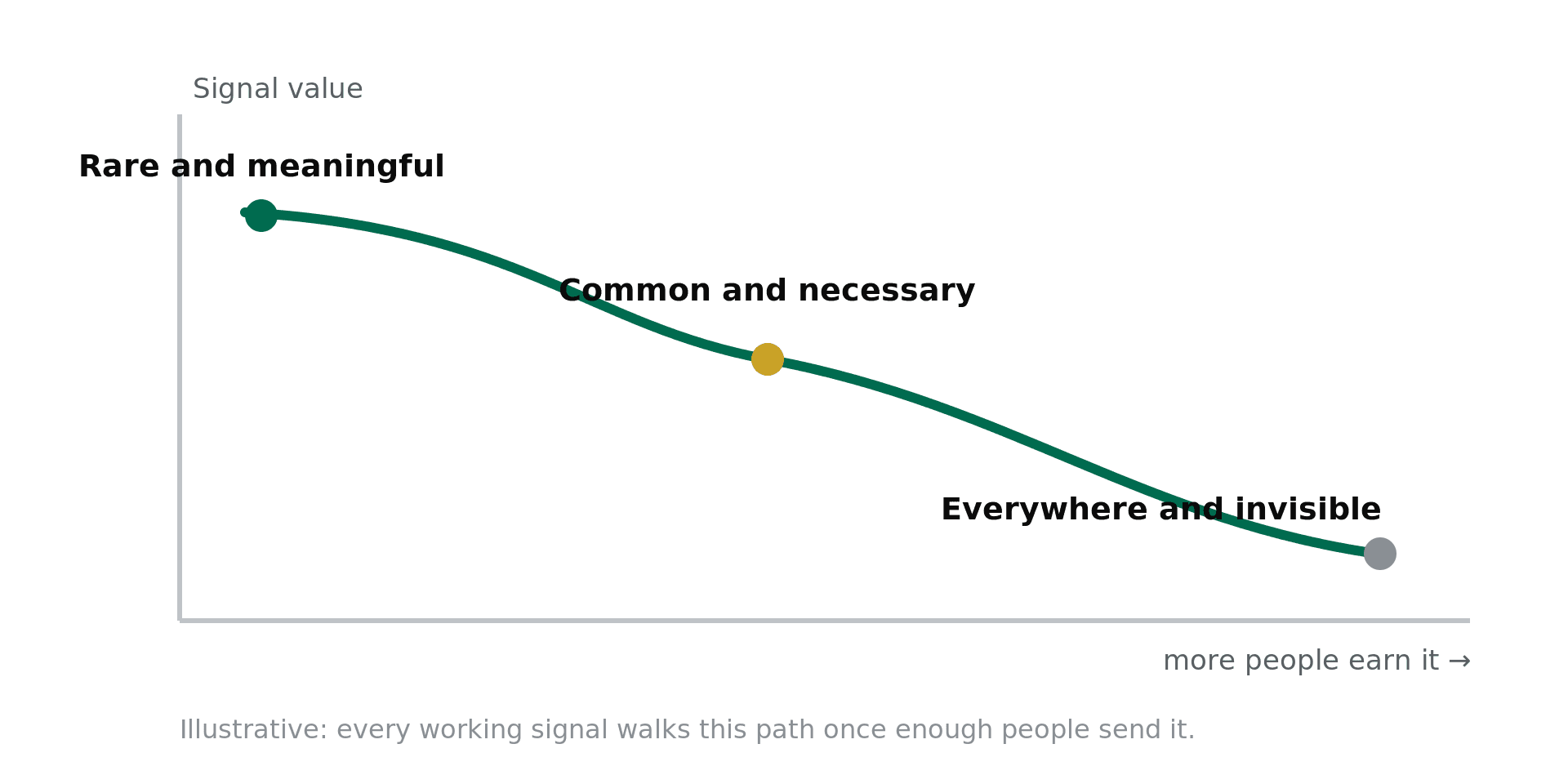
This is exactly why chasing the next badge to stand out is a losing move by design. The new, shinier cert is just earlier on the same curve. Rare and meaningful for a while, then common and necessary, then invisible, the same arc every working credential walks the second enough people send it. You can sprint up that curve forever and never get ahead of it, because the crowd is right behind you, buying the same thing.
You've watched this happen in real time. A foundational agile certificate that a decade ago was genuinely uncommon now shows up on nearly every junior delivery resume. It didn't get less true or worse designed. It just got common, and common is the whole story. The same letters that once made a recruiter pause now slide past unread, not because the holder learned less, but because the signal stopped carrying information the moment everyone in the queue behind them had it too.
Now the obvious objection: so certifications are worthless, then? No. Necessary is not the same as worthless. You usually do need the floor to get into the room, and walking in without the table-stakes cert can quietly cost you the screen. The error isn't getting the cert. The error is expecting a floor to lift you, when all a floor does is keep you from falling through.
How to read any certification
Once you see credentials as signals, you can evaluate any of them, including ones that don't exist yet, with three questions. Run any badge, course, or letters-after-your-name through these before you spend a month on it.
What does it actually cost to earn? Not the fee, the real effort. A cert you can pass with a weekend of cramming and a multiple-choice exam is cheap, which means lots of people clear it, which means it signals little. A credential that demands months of genuine work is a stronger signal precisely because fewer people can fake their way through it.
How many people already have it? Scarcity is most of a signal's value. The more common a credential is in your target roles, the closer it is to table stakes, and the less any single holder stands out by carrying it. If the job ad lists it as 'required,' that's your answer: it's a floor, not a flag.
What does it actually predict? Does holding it correlate with being good at the job, or just with being good at its exam? A lot of certifications test whether you can recite a framework, which is a measure of vocabulary, not judgment. Vocabulary gets you past a keyword filter. It does not survive a hiring manager who asks what you'd do when the framework breaks.
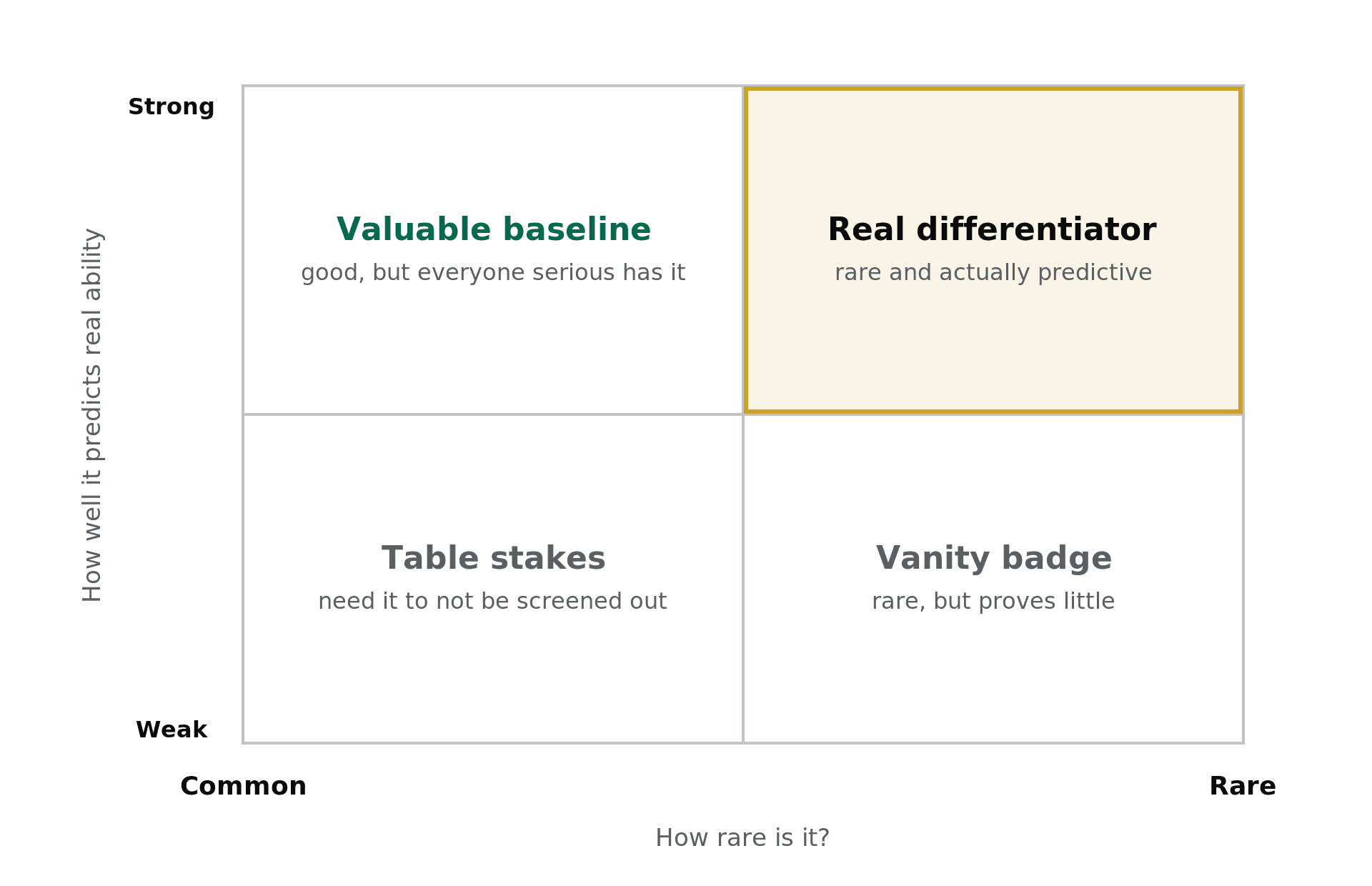
Plot a credential on those two axes, how rare and how predictive, and you can see what it actually is. Common and weak is table stakes: get it, don't expect it to do more. Rare but weak is a vanity badge: it impresses people who don't know the field and nobody who does. Common and strong is a valuable baseline worth having. And rare and strong, the top right corner, is the only square that genuinely sets you apart. Almost no certification lives there for long, because the instant one does, everyone rushes in and drags it back toward the middle.
The one signal that doesn't inflate
So if certs all drift toward the floor, what sits in that top-right corner and stays there? Evidence of real reps. A board you actually ran. A team you actually facilitated. A delivery story with a clear shape: what you noticed, what you did, what changed. This is the signal that resists inflation, and it resists it for the exact reason signalling theory predicts: it's genuinely expensive to send and genuinely hard to fake. You can't cram it in a weekend. You have to go do the work.
That's also why most people never send it. They stop at the cert because the cert is the easy, buyable signal, and they leave the expensive one on the table. Which is precisely what makes the expensive one scarce, and scarcity, remember, is most of a signal's worth. The cert gets you past the filter. The evidence is what gets you the offer, because it's the one thing in the stack the next applicant can't just go purchase too.
You can hear the difference in an interview. One candidate says the certificate taught them the events, the roles, the artifacts. Fine, and forgettable, because the next four candidates say the same words in the same order. Another says, 'I ran standups for a volunteer team for six months, and the thing nobody warns you about is how often the loudest blocker in the room isn't the real one.' That second sentence can't be bought, can't be crammed the night before, and can't be repeated by the person interviewing after them. That is what a signal that doesn't inflate sounds like out loud.
And to be clear, this is not a license to invent the reps. A fabricated story is a signal that fails the instant anyone checks it, which is the worst possible trade. The move is to go build a small, real version of the experience, a volunteer team, a side project run properly, one recurring meeting you actually own, and then talk about it like the professional you're becoming. Real, then framed honestly. That sequence never inflates.
So stop asking which certification will finally make you stand out. Inflation has already answered: none of them, not for long. Ask the better question, the one that actually thinks like the market instead of fighting it. What is the most expensive, hardest-to-fake signal I can honestly send? Then go spend your effort building that, and let the badge be what it is, a floor you clear on your way to the thing that actually separates you.

Subscribe to the Newsletter
Join our growing community and get alerted first on our every article.
*By subscribing, you agree to send your information to our Company who agrees to use it according to their Terms and conditions and Privacy Policy
About the author
With 20 years guiding high-stakes Agile transformations, I turn theory into action at Oaktreeuni—mentoring aspiring Scrum Masters to think critically, adapt fast, and lead beyond frameworks. The payoff? You step into a high-paying Scrum Master or Agile PM role already equipped to excel.
What is credential inflation?
When a credential becomes so common that holding it no longer signals anything. It shifts from a differentiator to a floor you need just to avoid being screened out.
How do you evaluate whether a certification is worth it?
Ask three things: what it really costs in effort, how many people already have it, and whether it predicts on-the-job ability or just exam performance.
What signal does not inflate?
Evidence of real, demonstrable experience. It stays valuable because it is genuinely costly to earn and hard to fake, so few people send it.
Comments