What a great Scrum Master looks like, for the manager deciding whether to hire one
ESTIMATED TIME
7
mins

Written by
Rajveer Prasad
Published on
Most of what you have read about hiring a Scrum Master was written for the person applying. This is written for you, the manager deciding whether you need one, and how you would tell a good one from an expensive one.
So let me start with the claim, and then defend it, because it explains almost every mistake I see managers make here.
A great Scrum Master's best work is invisible by design. The problems they solve never happen, so you never see them solved.
This is not a feel-good line. It is the central, awkward fact about the role, and if you don't hold it in your head the whole way through hiring, you will reliably pick the wrong person and then reliably cut the right one.
Why the good ones are hard to see
Think about what the role actually is when it's done well. A blocker gets cleared on Tuesday morning before it ever reaches your status report, so you never learn it existed. A brewing conflict between two engineers gets handled quietly over coffee, so it never becomes the thing that tanks a sprint. A stakeholder who was about to drop a last-minute demand gets redirected before the team even hears about it. A risk gets flagged in week one that would have detonated in week six.
Now notice what all of those have in common. When the job is done well, the evidence of it is an absence. Nothing broke. No fire, no drama, no heroic weekend recovery you can point at in an all-hands. Delivery just moved, steadily, and the team seemed calm, and you found yourself wondering, quietly, what exactly this person does all day.
Compare that to the person who runs a beautiful stand-up. You can see that. It's loud, it's legible, it happens on a schedule, and it feels like management. So here is the trap in one sentence: the visible version of the role and the valuable version of the role are almost opposites, and your instincts are calibrated for the visible one.
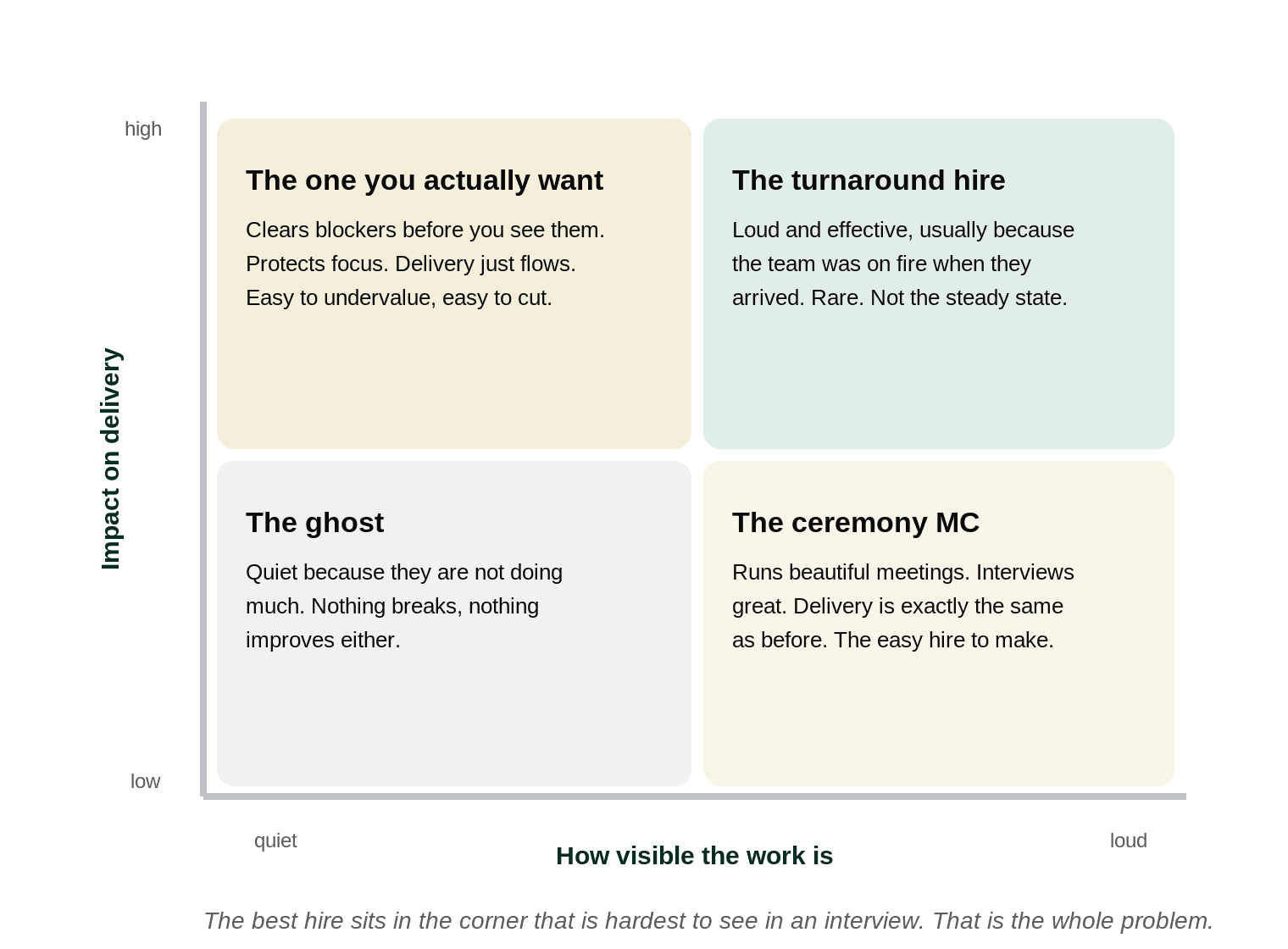
Two axes: how loud the work is, and whether delivery actually improves. The hire you want sits where it is hardest to see.
Maybe you don't need one at all
Before I tell you what to look for, let me argue the honest opposite, because it is a real position and you deserve it stated at full strength. Plenty of good teams run without a dedicated Scrum Master. A senior engineer facilitates, the team is disciplined, the product owner is sharp, and adding a process person would just add overhead and a meeting. Some of the loudest Scrum Masters are pure overhead wearing a lanyard. If that's your read, you are not wrong to be skeptical.
Here is where the skeptic's case actually breaks, though. It holds right up until the team hits friction it cannot resolve from inside itself: a cross-team dependency nobody owns, a stakeholder who keeps changing the goal, a conflict too tangled for a peer to touch, a delivery risk everyone can feel and nobody has the standing to name. A disciplined team handles the easy weeks fine. The question is who does the hard, unglamorous, political work in the weeks that aren't easy. If the answer is "my best engineer, instead of engineering," you are already paying for a Scrum Master. You're just paying in senior salary and lost code. So the real question is not whether you need the function. It's whether you want it done by someone whose actual job it is.
What a great one actually does
Strip away the ceremonies and a great Scrum Master does four things, none of which show up cleanly on a dashboard. They make the work visible, so problems surface while they're still cheap. They protect the team's focus from the constant pull of the wider org. They surface risk and conflict early, when it's a conversation instead of a crisis. And they steadily improve how the team works, so this quarter runs a little better than last.
Notice that not one of those is "runs the daily stand-up." Running ceremonies is the visible shell of the job. The job is what the ceremonies are supposed to produce: focus, flow, early warning, and a team that gets better at delivering over time. A person can run flawless ceremonies and produce none of that. A person can barely mention Scrum and produce all of it. You are hiring for the second person, and almost everything in a standard interview is built to reward the first.
How to actually test for it
If the good work is invisible, you cannot hire for it by watching a candidate perform confidence. You have to make them show you the thinking underneath, in the specific. Vague questions get vague, rehearsed answers. Concrete ones expose whether there is a real practitioner in there or just a well-studied vocabulary.
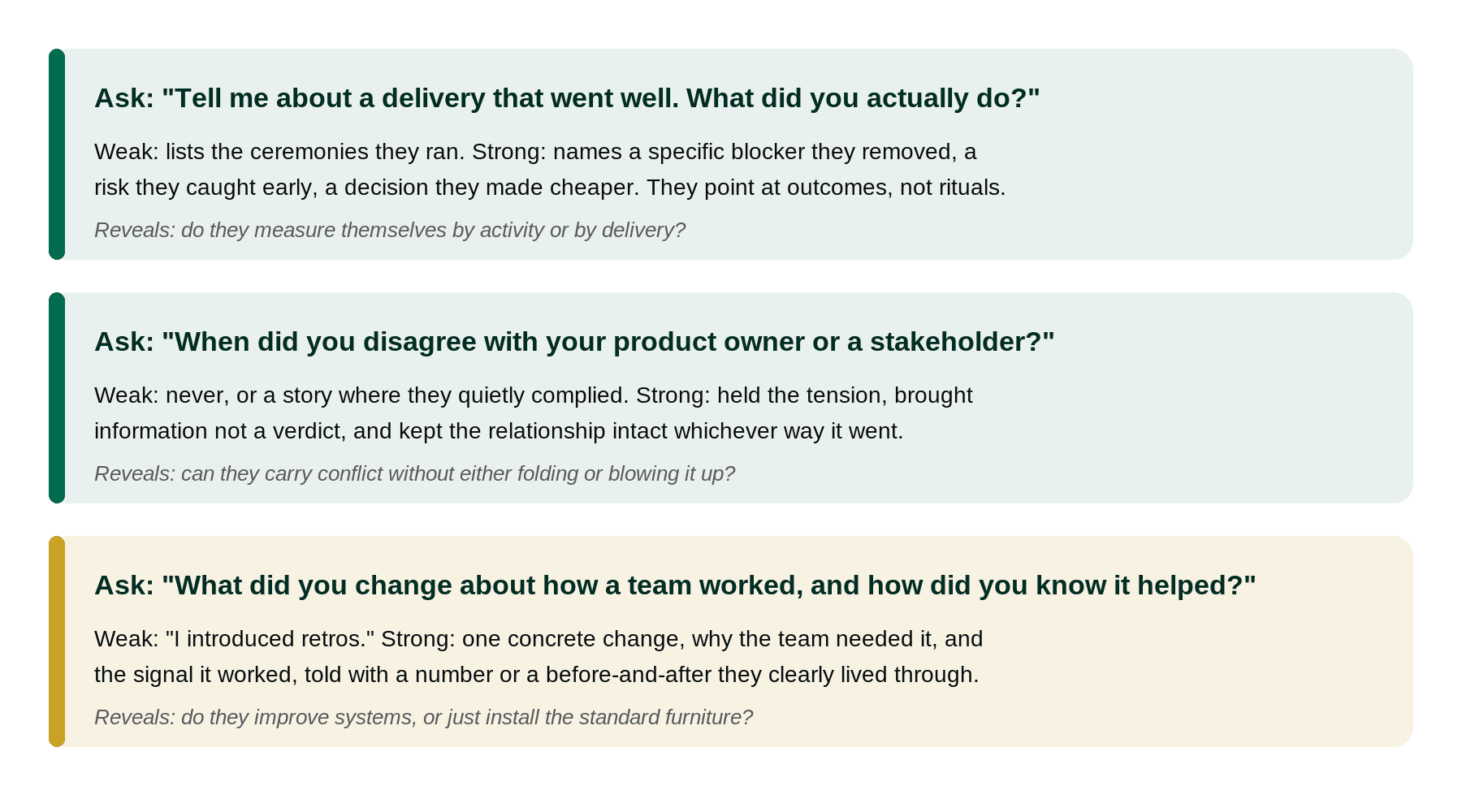
Three probes and what each one reveals. Listen for outcomes and specifics, not rituals and buzzwords.
Across all three, you are listening for the same tell. Does this person describe their work as a set of activities they performed, or as a set of outcomes they were responsible for? "I facilitated the ceremonies and kept the board updated" is the activity answer. "The team kept missing its commitments, I found we were starting five things and finishing none, so I got us to limit work in progress and our cycle time dropped" is the outcome answer. One person did the rituals. The other one changed how delivery worked. Only one of them is worth what you're about to pay.
And watch what happens when you ask about failure. A great one will tell you about a call they got wrong and what it taught them, without flinching, because they've been accountable for real outcomes and know that's just the texture of doing the work. The candidate who has only ever performed the role has no scar tissue, and it shows: every story is a success, every conflict resolved cleanly, every stakeholder eventually delighted. Real delivery does not sound like that. If it's all triumphs, you're hearing a highlight reel, not a career.
The mistake that comes after the hire
Say you get it right. You hire the quiet, effective one. Now the invisibility problem comes back around to bite you a second time, and this is where good managers lose good people. Six months in, everything is running smoothly. Delivery is predictable, the team is calm, the fires you used to fight have mysteriously stopped. And in the next budget crunch, someone asks what this person actually contributes, because from the outside it looks like nothing is happening. Nothing is happening. That's the contribution. You are looking at the result of the work and mistaking it for the absence of the work.
This is the same cognitive trap as maintenance, or security, or anyone whose job is to keep bad things from happening. Success looks like a quiet quarter, and a quiet quarter is easy to defund, right up until you do, and the fires come back, and you finally see in the negative space exactly what that person had been holding. If you take one thing from this: a Scrum Master who has made themselves look unnecessary has usually made themselves essential. Learn to read the quiet as the scoreboard, not as the problem.
Hire for the invisible work. Test for outcomes, not rituals. And once you've got someone doing it well, remember that calm is not the same as idle. The best one you can hire will spend their whole tenure making the case for their own value harder to see. That's not a bug in the role. It is the role.

Subscribe to the Newsletter
Join our growing community and get alerted first on our every article.
*By subscribing, you agree to send your information to our Company who agrees to use it according to their Terms and conditions and Privacy Policy
About the author
With 20 years guiding high-stakes Agile transformations, I turn theory into action at Oaktreeuni—mentoring aspiring Scrum Masters to think critically, adapt fast, and lead beyond frameworks. The payoff? You step into a high-paying Scrum Master or Agile PM role already equipped to excel.
What should I look for when hiring a Scrum Master?
Look for outcomes, not rituals: a candidate who describes blockers they removed, risks they caught early, and changes that measurably improved delivery, rather than the ceremonies they ran.
Do we even need a Scrum Master?
You need the function whenever a team hits friction it can’t resolve alone. If your best engineer is doing that work instead of engineering, you are already paying for a Scrum Master in a costlier currency.
Comments