You got the rejection. Here’s the 24-hour rule.
ESTIMATED TIME
6
mins

Written by
Shikha Prasad
Published on
You don't have to be fine about it, and you don't have to let it sink the week. There's a middle way, and it fits in a single day.
The email came in on a Thursday afternoon. "After careful consideration, we've decided to move forward with other candidates." It was the final round. She had liked them. She had let herself picture the desk, the commute, the first day. And now she was sitting in her kitchen reading the same three sentences over and over, feeling the floor tilt.
She messaged me an hour later, and underneath the disappointment was a second, quieter question, the one everyone asks: "How am I supposed to just shake this off and keep applying like nothing happened?"
You're not. That's the whole thing I want to tell you. The advice to "stay positive" and "onto the next one" is not just annoying, it's bad advice, because pretending a real disappointment didn't happen doesn't make it disappear. It just sends it underground, where it does more damage. But the opposite, letting one rejection swallow a week of your search, isn't the answer either. There's a rule that lives in the middle, and it has saved me more than once.
Borrowed from people who lose for a living
Athletes have a version of this, and they need it, because they lose constantly and have to be ready to compete again almost immediately. It's called the 24-hour rule. After a loss, you get 24 hours. You're allowed to be gutted. You replay it, you feel the sting, you let it matter, because it does. And then, when the 24 hours are up, you close the window. You take whatever you can learn from it into the next game, and you leave the rest on the field.
The genius of it is that it refuses both of the bad options. It doesn't tell you to suppress the feeling, which never works and just costs you more later. And it doesn't let the feeling run your life, replaying the loss for weeks until you can't step onto the field at all. It gives the disappointment a room, a real one, with the lights on and the door open. And then it gives that room a door that closes.
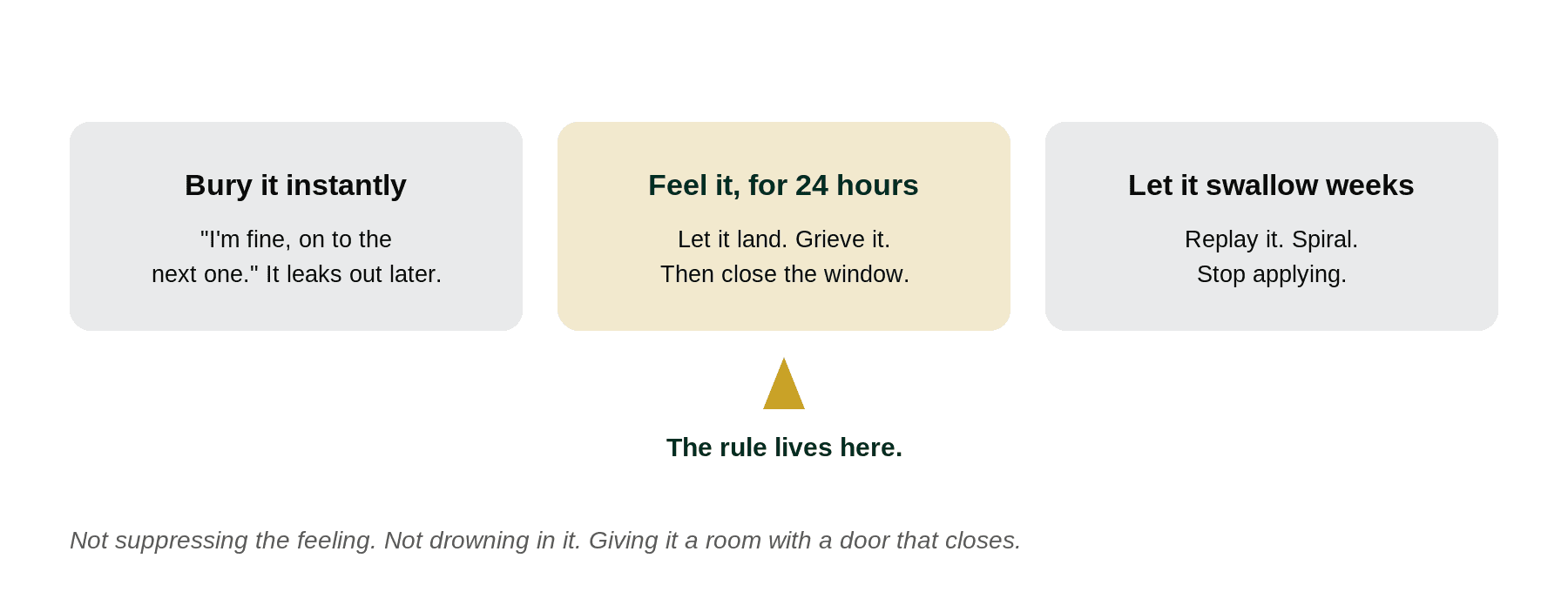
The two easy mistakes sit on the ends. The rule lives in the uncomfortable, healthy middle.
Hour zero to twenty-four: actually feel it
Here is the part people skip, and it's the part that makes the rest work. For the first 24 hours, you are allowed to be genuinely disappointed. Not "disappointed but grateful for the experience." Just disappointed. You wanted it, you got close, and it didn't happen. That's a real loss, and it deserves to be felt as one.
So feel it. Close the laptop. Tell someone who loves you. Go for the walk, or eat the comfort food, or sit with the heaviness for an evening without trying to talk yourself out of it. Do not open a job board. Do not send another application from that raw place, because applications sent from a place of "I'll take anything, please just want me" carry that energy and rarely go well. This day is not for the search. It's for you. You are not being weak or unprofessional. You're doing the thing that lets you come back steady instead of brittle.
What I've found is that when you give a feeling permission to exist, it moves through you faster than when you fight it. The disappointment you're allowed to feel for a day is far less dangerous than the one you deny and carry for a month. Naming it, out loud, to someone, takes a surprising amount of the weight off. That's not a soft nicety. That's how feelings actually work.
Before the window closes: take one thing
Somewhere in that 24 hours, usually near the end when the sharpest edge has dulled, do one small piece of work. Not a full post-mortem. Just this: separate the one thing worth learning from everything that was never yours to carry.
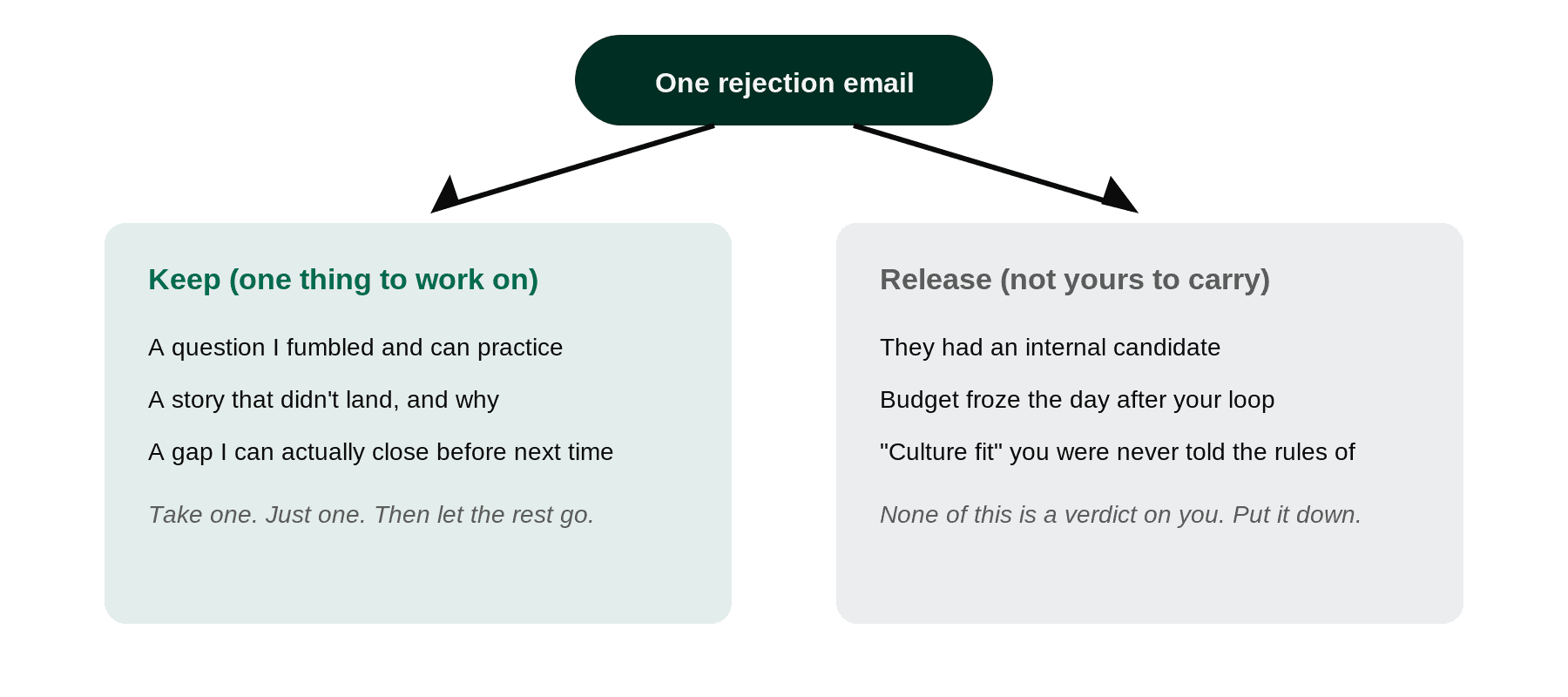
Sort the rejection into two piles. Take one thing from the left. Put the whole right pile down.
Because a rejection is not a verdict on you, even though it feels exactly like one. Most of what goes into a hiring decision has nothing to do with your worth. They had an internal candidate the whole time. The budget wobbled the day after your final round. Someone else had done the near-identical project last year and could start Monday. The mysterious "culture fit" whose rules you were never shown. You can drive yourself into the ground trying to learn a lesson from things that were never about you, and it's a trap, because there's no lesson there, only self-blame wearing the costume of self-improvement.
So take one real thing. Maybe there's a question you fumbled that you can genuinely practice. Maybe a story didn't land and you can see now why. Maybe there's a gap you can actually close before the next one. Take that one thing, write it down, and put it on your list. Then, deliberately, release the rest. It is not yours to carry into tomorrow.
Hour twenty-four: you're back in the game
When the day is up, it's up. This is the part that takes a little discipline, and it's what makes the whole thing a rule instead of just a nice idea. You close the window. You don't get to keep relitigating this one, replaying the interview at 2am, wondering what you should have said. That door is shut now, on purpose, so you can put your energy back into the search instead of into a loop that leads nowhere.
And here's the honest part: some rejections are bigger than others, and a really painful one might need a slightly longer window. The rule isn't a stopwatch to shame yourself with. It's a structure to lean on so a hard day doesn't quietly become a lost month. If you notice the disappointment isn't lifting at all, if the search has started to feel genuinely hopeless and heavy in a way that isn't shifting, that's worth taking seriously and worth talking to someone about, a friend, a mentor, or a professional. Looking for work over a long stretch is genuinely hard on a person, and needing support through it is not a weakness. It's just being human about something that is actually difficult.
Why the rule protects the thing that matters
The reason I hold onto this rule is that a job search is not won on any single application. It's won on your ability to stay in it, steady and whole, across many of them. The people who make it through are almost never the ones who never got hurt. They're the ones who learned how to get hurt and recover, again and again, without letting any single blow knock them out of the game for good.
The 24-hour rule is how you build that. It lets you be a full human who feels real disappointment, and it keeps that disappointment from compounding into something that stops you. You honor the loss, you take your one lesson, you set the rest down, and you show up tomorrow a little more practiced at the hardest skill in any long search, which is coming back.
So the next time that email lands, and it will, give yourself the day. Feel it fully, take your one thing, and then close the window. You're allowed to be sad about it. You're just not going to let it have more than a day. Tomorrow, you're back in the game, and you'll be more ready than the version of you that pretended it didn't hurt.

Subscribe to the Newsletter
Join our growing community and get alerted first on our every article.
*By subscribing, you agree to send your information to our Company who agrees to use it according to their Terms and conditions and Privacy Policy
About the author
I believe the strongest tool and flex each of us has is our belief. When we truly believe in something, we align our mindset, energy, and actions with the right effort and guidance. That is when achieving almost anything becomes possible. This is how I help mentees at OAKKTREEUNII move into Software and Project Management careers for better pay, better confidence, and better work-life balance.
How do you get over a job rejection?
Give yourself 24 hours to feel the disappointment fully, take one real thing you can learn from it, then close the window and release everything that was never about you. Don’t suppress it and don’t let it run for weeks.
Is it normal to feel devastated after a job rejection?
Yes. Getting close and missing is a real loss and it deserves to be felt. The 24-hour rule gives the feeling a place to exist so it doesn’t go underground or take over your whole search.
Comments