Half your org still runs waterfall? Deliver anyway!!
ESTIMATED TIME
10
mins

Written by
Shikha Prasad
Published on
Three weeks into a new role, a Scrum Master I was mentoring called me, deflated.
"I don't think this place is actually agile," she said. "Finance plans the whole year in one go. Procurement won't sign anything without fixed scope. The hardware team has a Gantt chart older than I am. Legal moves like it's underwater. How am I supposed to run a real sprint when half the org won't play?"
I told her the thing nobody had told me early enough. She wasn't describing a broken company. She was describing a completely normal one. And the sooner she stopped waiting for it to become "properly agile," the sooner she could actually start delivering inside it.
It's a call I now get some version of at least once a quarter, because almost every agile person hits this exact wall, and almost nobody is warned it's coming.
Hybrid isn't a failure state. It's the state.
Here's the reality the certification quietly skips. Most organizations are not agile, and they're not waterfall. They're hybrid, permanently, and on purpose.
That's not because they don't get it. It's because different parts of a business genuinely have different needs. Software changes cheaply, so it iterates. A regulated product launch, a signed vendor contract, a hardware run, an annual budget, none of those iterate cheaply, and pretending they do is how you get sued, fined, or fired. Waterfall didn't survive because everyone's a dinosaur. It survived because some work really is better with the plan locked up front.
Look closely at almost any "agile" company and you'll find waterfall holding up the load-bearing walls: the budget, the board commitments, the compliance calendar. The teams iterate. The enterprise plans. Both are true at the same time, and the friction between them is permanent furniture, not a bug waiting to be filed. If you're holding out for your whole org to convert before you can do your job well, you'll be holding out your entire career.
Stop trying to convert finance
The first mistake, and I made it, is treating the waterfall parts of the org as an enemy to convert.
You can spot this Scrum Master from a mile off. They show up to a finance review and explain why annual budgeting is un-agile. They lecture procurement about the cost of fixed scope. They treat every stage-gate as a teaching moment. They are, technically, often right, and they make enemies everywhere they go, because nobody asked to be re-educated by the new person, and "you're doing it wrong" has never once been a sentence that wins allies.
The other version gives up instead of crusading. They decide the org is hopeless, declare it "not really agile," and quietly check out, which is just cynicism wearing a methodology. Both of these people are useless to the organization, for opposite reasons. One won't stop fighting the system. The other stopped trying to deliver inside it.
Get bilingual
The Scrum Master who's actually worth their salary does something harder and a lot quieter. They get bilingual.
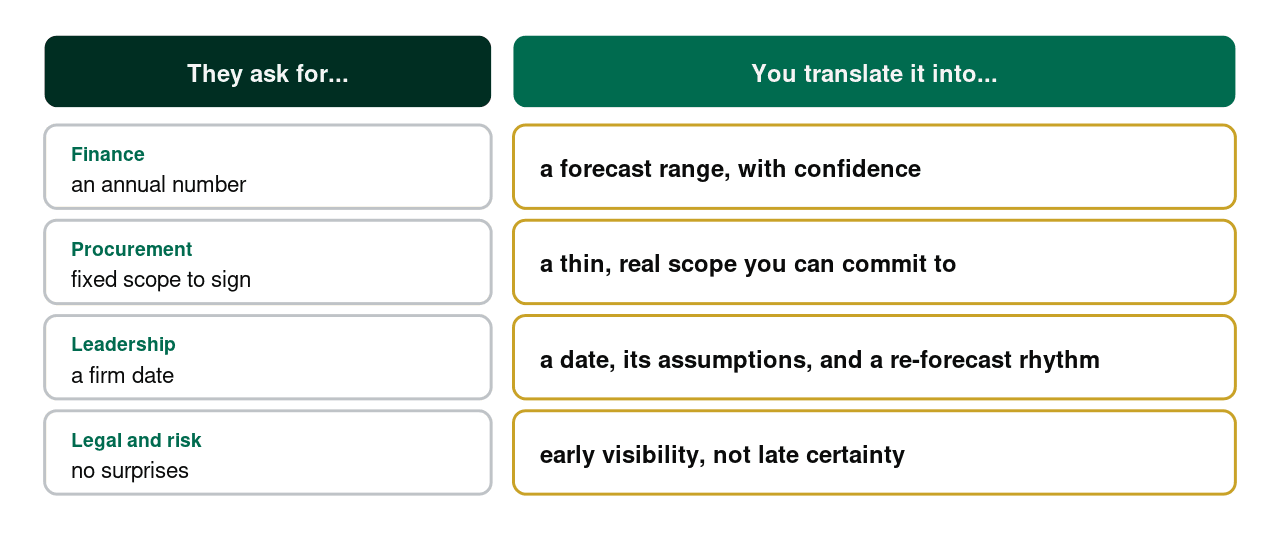
They stop trying to make finance speak agile, and they learn to speak finance. Finance asks for an annual number? You don't lecture them on the uncertainty of estimates. You hand them a forecast, a range with a confidence level, and you update it as you learn. Procurement needs fixed scope to sign? You don't refuse on principle. You help carve out a thin, real slice you can genuinely commit to, and keep the iteration for everything around it. Leadership wants a date? You give them a date, with its assumptions written down and a rhythm for re-forecasting when those assumptions move.
None of that is a betrayal of agile. It's the opposite. You're protecting your team's ability to iterate by giving the rest of the org the predictability it honestly needs, in the language it actually speaks. Translation isn't selling out. Translation is the whole skill.
There's one more piece of this that's pure logistics, and it bites the people who ignore it. The waterfall parts of the org move on long lead times. Procurement takes six weeks. Legal review has a queue. The hardware order has to be placed a quarter out. An agile team that only plans two weeks ahead will keep slamming into these slow gates and calling them blockers. They are not blockers. They're known facts you failed to plan around. The translator maps the long-lead dependencies early and pulls them forward, so the fast team and the slow org arrive on time instead of colliding.
Be the adapter, not the activist
The mental model that helped me most is to think of yourself as an adapter.
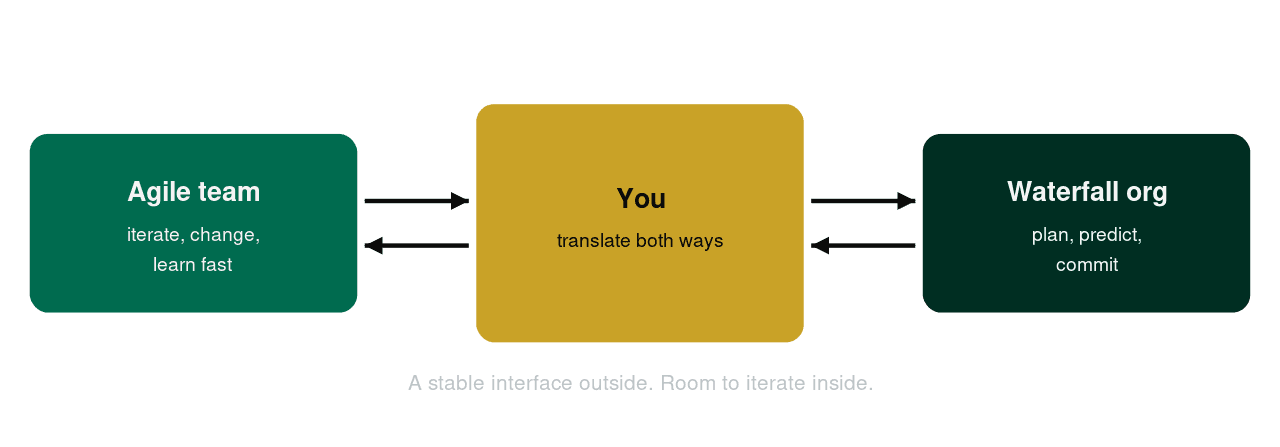
On one side, your team needs room to change its mind, learn, and adjust. On the other, the org needs a stable, dependable interface, a partner who shows up with a number and keeps their word. Your job is to sit in the middle and convert between the two, so the team stays genuinely agile inside while the org sees a calm, reliable partner outside.
That means absorbing some friction so your team doesn't have to. When procurement needs a commitment, you don't dump that pressure raw onto the team. You translate it into a scope they can hold, and you manage the boundary yourself. When the team learns something that breaks the original plan, you don't let it detonate a stakeholder relationship. You carry the new information across the seam early and calmly, in their language. You are the membrane, not the megaphone.
I watched this go right on a launch with a hard regulatory date, the least agile thing imaginable. Instead of fighting the date, the Scrum Master worked backwards from it, locked the handful of things that genuinely had to be fixed, and kept everything else iterative right up to the line. The team still shipped weekly. The regulators still got their certainty. Nobody had to choose between the two. That's the move. Not agile or waterfall, but the right one in the right place, held together by a person who can speak both.
Where to actually push for agile
None of this means roll over. There's a place for advocacy. It's just narrower and smarter than evangelism.
Push for iteration where it genuinely creates value: in discovery, in ambiguous work, in anything where learning is cheaper than guessing. And when you push, bring evidence, not ideology. "Here's a case where building it in slices saved us three months" beats "the manifesto says" every single time.
Be honest about the other direction too. Agile really is better for some work, and pretending otherwise to keep the peace is its own quiet failure. But "we can't be fully agile here" is not the same sentence as "we can't deliver here." Collapsing those two is exactly the mistake that left my mentee feeling stuck. The org wasn't stopping her from delivering. It was stopping her from delivering the one specific way she'd been taught was the only correct one. Those are very different problems, and only one of them is real.
The seam is where the work is going
She did fine, by the way. Better than fine. Within a few months she was the person finance trusted to give them a straight forecast and the person her team trusted to keep the chaos off their desks. She stopped describing the org as "not agile" and started describing herself as the one who made delivery work across it. That isn't a smaller version of the job. It's the senior version.
Here's what's actually true about where the work is heading. You're going to spend your entire career in hybrid organizations. The pure-agile shop is rare and getting rarer. The pure-waterfall one is dying. The future isn't one model finally winning. It's the seam between them, everywhere, indefinitely. The people who thrive there aren't the purists on either side. They're the translators. Learn to deliver across that seam without making it everyone else's problem, and you will never be short of work, because that, far more than running a clean standup, is the actual job.

Subscribe to the Newsletter
Join our growing community and get alerted first on our every article.
*By subscribing, you agree to send your information to our Company who agrees to use it according to their Terms and conditions and Privacy Policy
About the author
I believe the strongest tool and flex each of us has is our belief. When we truly believe in something, we align our mindset, energy, and actions with the right effort and guidance. That is when achieving almost anything becomes possible. This is how I help mentees at OAKKTREEUNII move into Software and Project Management careers for better pay, better confidence, and better work-life balance.
Can you be agile in a waterfall organization?
Yes, but not by converting everyone. You keep the team iterating inside while giving the rest of the org the predictability it needs, translating between the two.
What is a hybrid agile-waterfall environment?
An organization where some work iterates (usually software) and other work is planned up front (budgets, contracts, regulated launches). Most companies are permanently hybrid.
How do you deliver when half the company isn’t agile?
Stop trying to convert it. Speak each function’s language, map long-lead dependencies early, and act as a stable interface to the org while protecting the team’s flexibility.
Comments