Agile outside software: how a hospital team actually ran sprints
ESTIMATED TIME
7
mins

Written by
Shikha Prasad
Published on
The first thing the charge nurse said to me was, 'We don't write software. Why are we doing sprints?'
It was a fair question, and I didn't have a good answer ready. I'd been asked to help a hospital unit that was drowning in one specific problem: patients were medically cleared to go home but sat in beds for hours, sometimes a full day, waiting on paperwork, a pharmacy sign-off, a ride, a missing signature. Beds that should have opened for the next patient stayed full. Everyone could see it. Nobody owned it.
I walked in planning to teach them Scrum. I walked out having learned, the slow way, what agile is actually for, and why most of what I thought was 'agile' was just software costume.
The part that didn't survive contact with a ward
My first instinct was to bring the whole apparatus. Sprints, story points, a product owner, a backlog, the ceremonies. Within a week most of it looked ridiculous on a hospital floor, and the team was too polite to say so for about three days.
The moment it really clicked for me came mid-shift. I'd asked someone to move a card on our shiny new board, and she looked at me, then at the patient she was halfway through admitting, and said, gently, 'I will, once he's stable.' Of course. The board could wait. The person could not. A software team gets to treat the board as the work. Here the board was, at best, a quiet servant of the work, and never once the other way around.
Story points were the first to go. Asking a nurse to estimate the relative complexity of 'fix the discharge handoff' against 'reduce medication delays' in fictional units was a kind of theater nobody had time for. The word 'sprint' landed badly too, because to a team that runs codes and holds people's lives in their hands, a corporate fitness metaphor felt faintly absurd. And 'product owner' meant nothing until we stopped saying it and just admitted we meant the charge nurse, who already owned the outcome and always had.
Here's what I had gotten backwards. I'd been treating the ceremonies as the thing, and the principles as the wrapper. It's the other way around. The ceremonies are local dialect. The principles are the language.
What we kept, once we translated it
Once we stopped trying to make a ward look like a software team, the actual agile underneath translated cleanly, almost word for word.
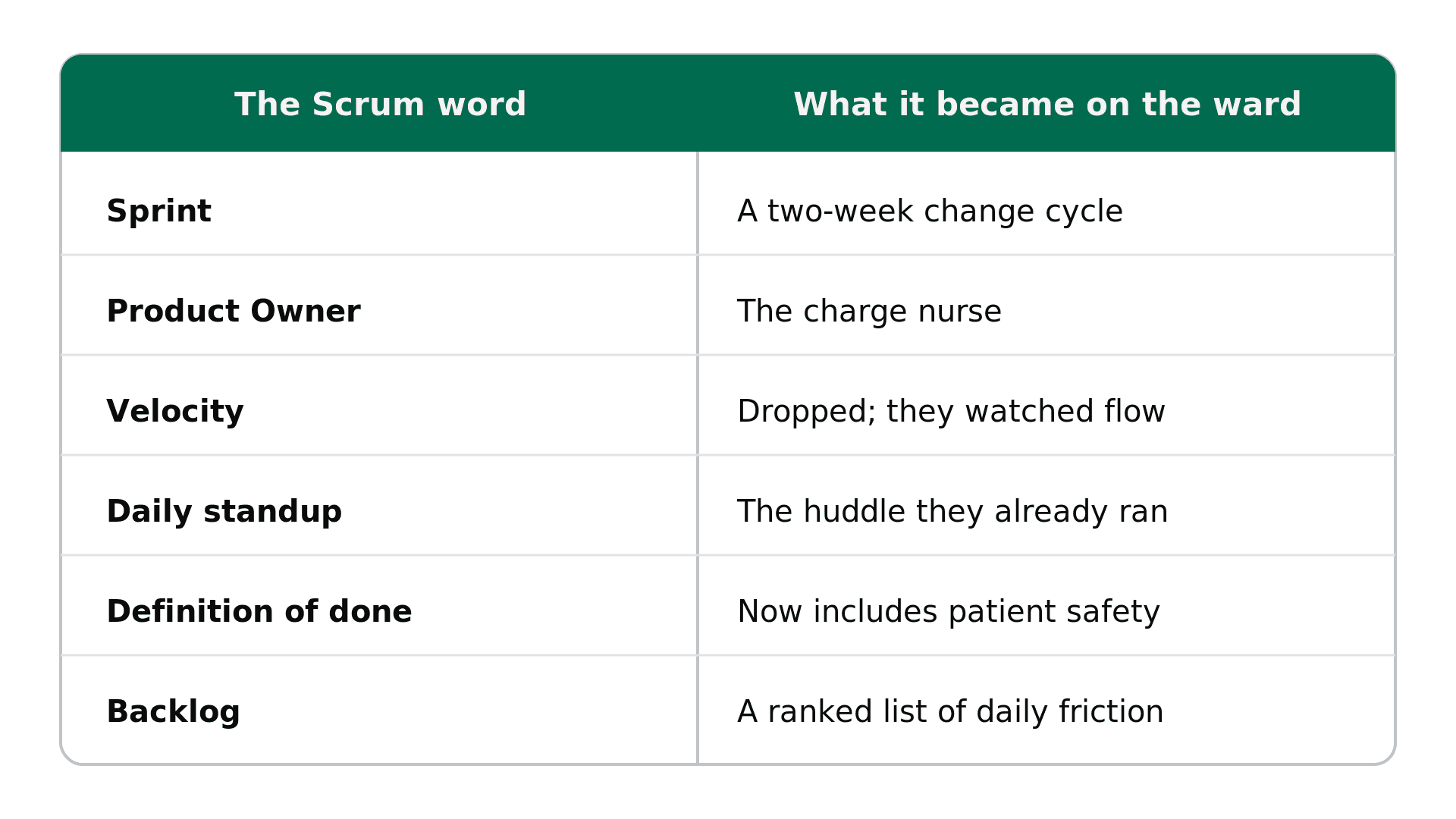
The daily standup was the easiest, because they already had one. Hospitals call it a huddle, and a good ward has run them for years: a quick morning gather to surface what's stuck and who needs help today. We didn't add a ceremony. We just gave the one they had a sharper question: not 'how is everyone,' but 'what's going to stop a patient from leaving on time today, and who can clear it.'
The backlog became a ranked list of the friction points slowing discharges, kept on a whiteboard everyone walked past. The definition of done quietly grew a clause it would never have in software: nothing counts as an improvement if it makes a patient less safe. And the sprint became, simply, a two-week window in which we'd try exactly one change and watch what happened.
The retro surprised me most. I expected resistance, one more meeting on an already overloaded team. Instead it became the part they protected. Fifteen minutes at the end of each cycle: what did we try, did it help, do we keep it or drop it. For a team used to having changes handed down from above, being asked 'what should we try next' and then watching their own answer actually happen wasn't a process. It was the first time in a long while that the floor felt like theirs to improve.
One change at a time, which is the whole secret
The instinct in a struggling team, any team, is to fix everything at once. Draw up the big new discharge process, roll it out on a Monday, announce it in a meeting, and hope. I've watched that fail in software and I watched its cousin fail here, in an earlier attempt before I arrived: a beautiful new protocol that nobody followed by week two because it changed nine things at once and no one could tell which ones helped.
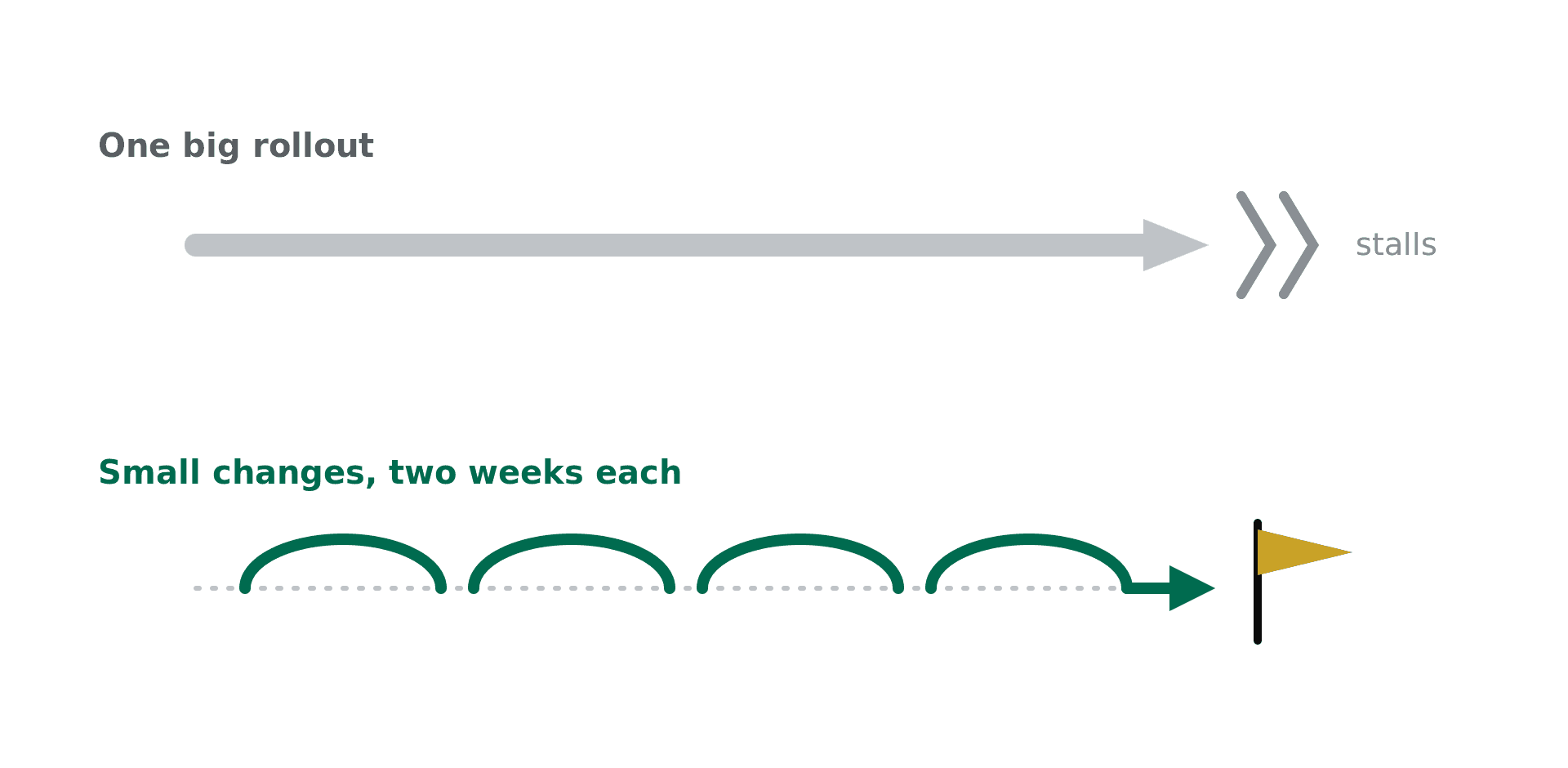
So we did the boring thing instead. One change per cycle. The first one was almost embarrassingly small: start the discharge paperwork the evening before a planned discharge instead of the morning of. That was it. Two weeks, one change, and we watched a single number, the time from 'cleared to leave' to 'actually left.'
There was a quieter reason small worked, beyond the clean measurement. This team had been burned by big rollouts before. They'd stopped believing that 'we're changing the process' meant anything would actually get better, because the last few times it hadn't. A small change you can watch work in two weeks rebuilds that belief in a way a grand plan never does. Trust, it turns out, also gets delivered in small batches.
It moved. Not dramatically, but visibly, and more importantly, everyone could see that it was that change that moved it, because it was the only thing we'd touched. The next cycle we added a pharmacy pre-check. The cycle after that, a standard text to families about pickup timing. Each one small, each one measured on its own, each one kept or quietly dropped at a short retro the team actually looked forward to, because for once their suggestions turned into changes they could see.
A few months in, the hours patients spent waiting after they were cleared had come down enough that beds were opening earlier and the floor felt less frantic. No grand transformation. Just a team that had learned to improve itself in small, safe loops, which is the only kind of improvement that tends to stick.
Why this matters if you're building a delivery career
You might be reading this thinking it has nothing to do with you, because you're aiming for a Scrum Master or delivery role on a software team, not a hospital ward. It has everything to do with you, and here's the honest reason.
If the only way you can run agile is by performing the software ceremonies, you don't actually understand it yet, you've memorized it. The person who can walk onto a ward, a marketing team, an operations group, or a construction project and see the real machine underneath, short cycles, a visible queue, one change at a time, fast feedback, a team that owns its own improvement, is the person who has understood the thing instead of the costume. That's also exactly what a good interviewer is probing for when they ask you to explain agile to someone who has never heard of it. They're listening for principles, not vocabulary.
And if you're switching into delivery from a non-software world, a clinic, a warehouse, a school, a charity, this is your unfair advantage, not your gap. You may have already run something agile without ever calling it that. A weekly huddle. A visible board. Small experiments. A team you helped improve a little at a time. That's real experience. It doesn't need a Scrum sticker on it to count. It just needs you to recognize it, and to learn to tell its story in the language of the work you're moving toward.
The charge nurse never did start calling them sprints. She called them 'our two-week try-somethings,' which is honestly a better name. And by the end she was the one defending the cadence when a manager wanted to skip a cycle and just roll out everything. She'd understood agile completely. She'd just never needed the word.

Subscribe to the Newsletter
Join our growing community and get alerted first on our every article.
*By subscribing, you agree to send your information to our Company who agrees to use it according to their Terms and conditions and Privacy Policy
About the author
I believe the strongest tool and flex each of us has is our belief. When we truly believe in something, we align our mindset, energy, and actions with the right effort and guidance. That is when achieving almost anything becomes possible. This is how I help mentees at OAKKTREEUNII move into Software and Project Management careers for better pay, better confidence, and better work-life balance.
Can agile work outside software?
Yes. Agile is short cycles, a visible queue, small changes, fast feedback, and a team that owns its own improvement. Those transfer to any domain; only the ceremonies need translating.
What parts of Scrum do not transfer to non-software teams?
Story points and velocity often don’t, and the literal vocabulary can feel out of place. The huddle, the ranked backlog, the retro, and the definition of done all transfer with light translation.
Does non-software agile experience count for a Scrum Master role?
Yes, if it’s real. A weekly huddle, a visible board, and small measured experiments are genuine reps. Recognize them and tell the story in delivery language.
Comments