How to brief an executive in ninety seconds, and survive the follow-up
ESTIMATED TIME
7
mins

Written by
Shikha Prasad
Published on
(TL;DR) The spoken update is a performance with a fixed shape. Lead with the answer, hold one point, make the ask, and stop.
You're item six on the steering committee agenda. The meeting is running long. The chair looks at the clock, then at you: 'We've got a couple of minutes, give us where you're at.'
Or it's less formal. A senior leader catches you by the coffee machine: 'Quick, where are we on the migration?'
Either way, you have somewhere around ninety seconds before they decide whether to keep listening, and most delivery people spend it the worst possible way. They start at the beginning. The background, the context, the journey so far, building carefully toward the point. By the time they reach it, the executive has glanced at their phone, or jumped in with the exact question the briefer was three sentences away from answering.
This isn't a confidence problem or a charisma problem. It's a structure problem, and structure you can fix. A ninety-second executive brief is a performance with a fixed shape. Learn the shape and you stop getting cut off, and you start sounding like someone who belongs in the room.
Executives don't listen the way you were taught to present
Here's the mismatch underneath the whole problem. You were probably trained to present bottom-up: lay the groundwork, walk through the analysis, arrive at a conclusion. It's how school rewarded you and how a good report reads.
Senior people process the opposite way. They want the conclusion first, then they decide how much of the reasoning they need. They're holding ten other things in their head and triaging which ones need their attention. So when you build up to your point, you're making them wait for the one piece of information they actually came for, and they will not wait. They'll interrupt to drag you to the top, and now you're flustered and off your script.
The fix is to flip the whole thing. Put the bottom line on top. Then let them pull the detail they want, instead of pushing all of it at them and hoping.
And the cost of getting this wrong isn't just an awkward minute. A muddled brief makes a healthy project sound shaky, because what an executive walks away with isn't your status, it's how in control you sounded delivering it. I've watched a perfectly on-track work stream pick up extra scrutiny, more check-ins, a nervous sponsor, all because the person reporting it buried 'we're fine' under four minutes of backstory. The work was fine. The signal wasn't, and the signal is what got remembered.
The ninety-second shape
Three beats, in this order, every time.
The headline. One sentence that answers the only question they're really asking: are we on track, off track, or at a fork. 'We're on track to launch on the 14th.' 'We'll hit the date, but the data migration is the one thing at risk.' 'We're at a decision point and I need ten minutes of yours this week.' That sentence does ninety percent of the work, so it goes first, not last.
The one thing. Not five things. The single risk, decision, or number that matters most right now, in plain language. If you find yourself reaching for a second and a third, you're presenting, not briefing. Pick the one that would change what they do next, and say only that.
The ask. What you need from them, or what happens next if you need nothing. 'I need you to unblock access to the test environment by Friday.' 'No action needed, I just wanted you to hear it from me before the report.' An update with no ask leaves them wondering why you spent their ninety seconds. Always close the loop.
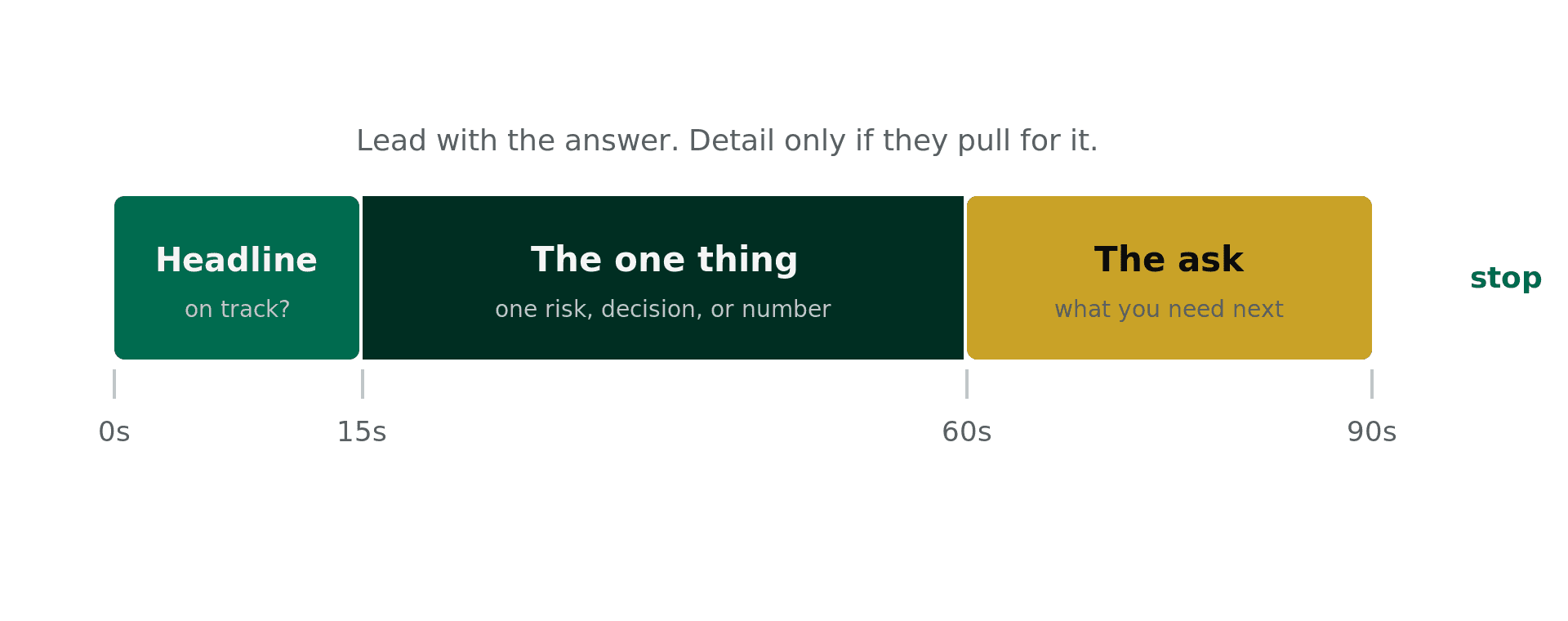
Then stop talking. This is the part people can't do. The silence after your ask feels like a vacuum you have to fill, so you keep going, adding detail nobody asked for and burying the clean thing you just said. Don't. The silence is the handoff. Let them take it.
Here's the same update both ways, so the gap is obvious. Bottom-up: 'So back in March we scoped the migration, then we hit some snags with the legacy data, the vendor was slow, we re-planned twice, and...' Three sentences in, the executive is reading email. Top-down: 'We'll hit the launch date. The one risk is the data migration, and I need test access by Friday to keep it on track.' Same facts, same project. Only one of them gets heard.
Reading whether to go deeper
Here's the move that separates the people who sound senior from the people who just memorized a template: after the headline, you read the room and let the executive set the depth. Their reaction tells you exactly how much more they want.

A nod and 'okay, what do you need' means they're satisfied. Give them the ask and stop. A question means they want exactly one layer deeper, so answer that layer and only that layer, not the whole appendix you prepared. Silence usually means they're thinking, so let them. The weak version of this dumps everything regardless of the signal. The strong version delivers the headline and lets the executive pull the rest, one layer at a time, until they have what they need.
Notice what this does to your own nerves, too. If you believe you have to say everything, ninety seconds feels impossibly short and you rush, which is exactly when you ramble. If you believe your job is the headline plus whatever they choose to pull, ninety seconds feels generous. The structure isn't only a courtesy to them. It's the thing that lets you slow down, because you've stopped trying to cram an entire presentation into a hallway.
Surviving the interrupting question
They will interrupt. Count on it. A senior person cutting in is not being rude, it's how they navigate, and it's actually useful information: it tells you exactly what they care about. The mistake is treating the interruption as a derailment and trying to get back to your narrative.
When you get cut off with a question, answer it directly first. The yes, the no, the number, the date, up front. Then one sentence of why, if it helps. Then return to your shape. What you never do is say 'I was just getting to that' or restart your story from the top. Answer, reason, return. The person who can take an interruption, give a clean direct answer, and calmly pick the thread back up looks more in command than the one who delivered a flawless uninterrupted monologue.
When they give you less than you prepared for
Sometimes you rehearse ninety seconds and get twenty. The chair says 'just the top line.' If your only version is the full ninety, you'll panic and ramble. So always have a ten-second version ready underneath it: the headline and the ask, nothing else. 'On track for the 14th, I just need test access by Friday.' Done. If you can't compress your update to one sentence and one ask, you don't understand it well enough yet to brief anyone on it.
That, in the end, is why this skill is worth building. The ability to compress live, under pressure, without losing the point, is one of the most senior-sounding things you can do in delivery, and almost nobody practices it. It's also the exact muscle an interviewer tests when they say 'walk me through a project,' watching whether you lead with the outcome or drown them in the timeline.
So here's the one prep move to take from all of this. Before any executive touchpoint, big or small, write down your single headline sentence and your single ask. If you can write those two lines cleanly, you're ready. If you can't, you're not, and ninety seconds in front of the wrong person is a bad place to find that out.

Subscribe to the Newsletter
Join our growing community and get alerted first on our every article.
*By subscribing, you agree to send your information to our Company who agrees to use it according to their Terms and conditions and Privacy Policy
About the author
I believe the strongest tool and flex each of us has is our belief. When we truly believe in something, we align our mindset, energy, and actions with the right effort and guidance. That is when achieving almost anything becomes possible. This is how I help mentees at OAKKTREEUNII move into Software and Project Management careers for better pay, better confidence, and better work-life balance.
How do you brief an executive quickly?
Lead with a one-sentence headline (on track, off track, or at a fork), give the single most important point, make a clear ask, then stop and let them pull more detail.
What is BLUF in communication?
Bottom Line Up Front: state the conclusion first, then the reasoning. Executives reason top-down, so the answer goes at the top, not the end.
What do you do when an executive interrupts your update?
Answer the question directly first, the yes, no, number, or date, then one sentence of why, then return to your structure. Never restart from the beginning.
Comments