Line up your references before you need them
ESTIMATED TIME
10
mins

Written by
Rajveer Prasad
Published on
The strongest reference isn't the most senior person who likes you. It's the person who can be specific on two days' notice.
One of my mentees made it to the final round for a project coordinator role this spring. Two interviews, then a panel, and every signal pointing the right way. On Wednesday the recruiter sent a short, cheerful email: congratulations, we're at the last step, can you share three professional references by Friday?
We got on a call that evening, and I watched her scroll through her phone the way you'd dig through a junk drawer. A manager from two jobs ago who might have changed numbers. A supervisor she hadn't spoken to in three years. A teammate she adored but had never actually asked. She sent two names the following Monday and a third on Wednesday, each with a small apology attached.
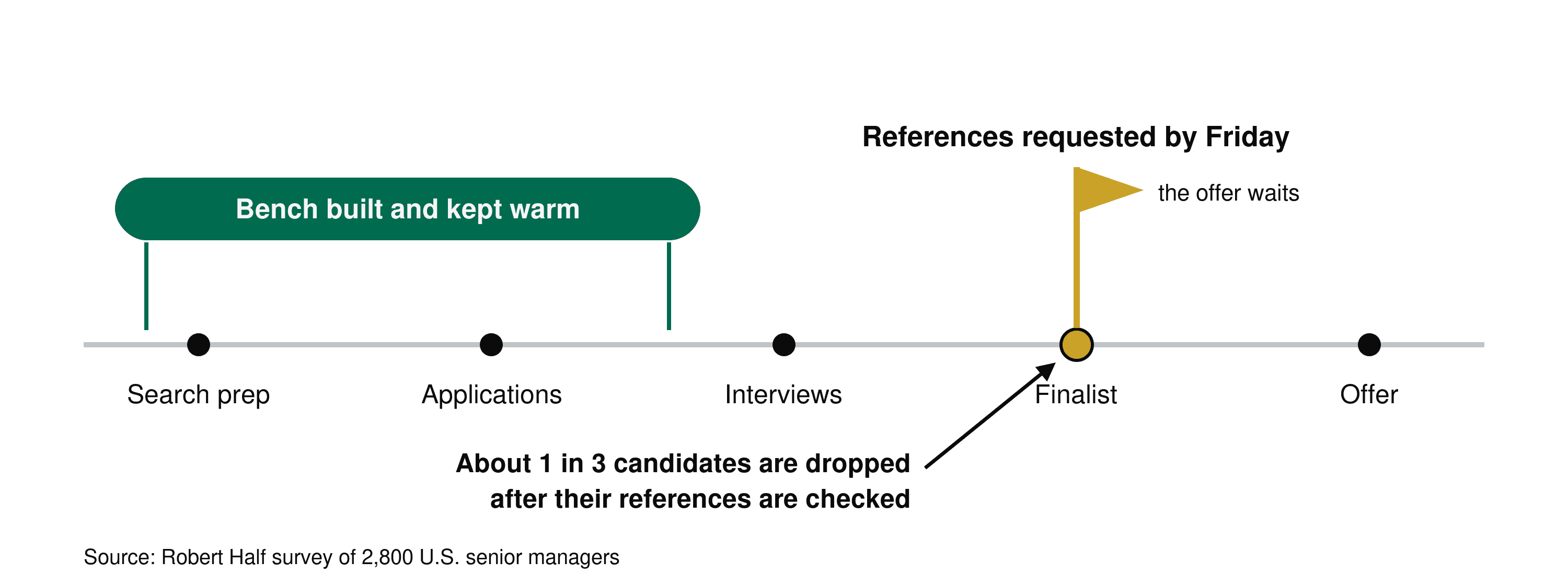
The offer didn't die. It stalled. And a stalled offer at the finalist stage is a fragile thing, because you're almost never the only finalist.
Here's what I've come to believe after watching this scene more times than I'd like: references aren't requested when you interview. They're built while you work. The Friday email is just the moment you find out whether you built them.
A formality, until you're one of two people left
Most of us treat professional references for a job the way she did, as paperwork for later. Something HR collects once the real evaluation is over.
The numbers tell a different story. In a CareerBuilder study, 80 percent of employers said they contact references, and 16 percent of those reach out before they've even interviewed the candidate {CareerBuilder / Harris Interactive, 2012}. Robert Half surveyed 2,800 senior managers and found they removed about one in three candidates (34 percent) from consideration after checking references {Robert Half, 2019}.
Sit with that second number. A third of the people who did everything right in the interviews lost the job at the step everyone calls a formality.
And the finding that should really change how we prepare: 62 percent of employers said that when they contacted a reference a candidate listed, the reference didn't have good things to say {CareerBuilder / Harris Interactive, 2012}. Not some hidden former boss the company dug up. A reference the candidate chose.
That's not a paperwork problem. That's a preparation problem, and it starts months before any Friday deadline.
What the person making the call is listening for
It helps to know what a reference check actually sounds like, because it's not "Is she good?"
A careful checker asks quieter questions. What did she actually do on that project, day to day? Walk me through a time something slipped on her watch. Would you hire her again? They're not collecting compliments. They're listening for two qualities: specific and current. Can this person describe real work, in real detail, that happened recently?
A cold reference fails that test even when they genuinely like you. Caught off guard, they reach for adjectives. Hardworking. Reliable. Great attitude. That's not disloyalty; that's what memory sounds like after three years. And here's the uncomfortable part: on the other end of the line, vague praise and careful praise sound exactly the same. The checker can't tell "doesn't remember the details" from "doesn't want to say," so they write down lukewarm and move on to the candidate whose references had stories.
Your reference liked you. The call still hurt you.
Your current project is writing your references
Now the reframe I offer every mentee who tells me they have nobody to list: if you're doing delivery work of any kind, you're generating references every week. You're just not collecting them.
The Product Owner whose blocked story you escalated on Tuesday and got moving by Thursday? That's a reference. The QA lead you coordinated with through a messy regression week, who was never once surprised because you kept her in the loop? Reference. The ops manager who got your clean handoff notes. The vendor contact who knows you as the one who closes loops. None of these people think of themselves as your references yet. They're simply people who watched you work a problem, up close, recently. Which is exactly who a checker wants on the other end of the phone.
You don't need fans. You need witnesses.
Three seats on the bench
When I help someone build a reference bench on purpose, we fill three seats, because each seat vouches for something the others can't.
A manager, current or recent, covers judgment and accountability. How you handled pressure, what they trusted you with, and the question every checker saves for the end: would you hire her again?
A peer covers the day to day. What you're like inside the work when nobody senior is watching, whether you share information or guard it, whether people quietly hope you'll be on their next project.
And a cross-functional partner or stakeholder, a PO, a QA lead, a business owner you delivered for, covers the thing delivery employers care about most: how you operate across team lines with no authority at all. For Scrum Master and project manager roles, this is the most persuasive seat on the bench. It is also the one almost nobody fills.

Three seats, three angles on the same person. When a checker hears the same qualities from a boss, a teammate, and a stakeholder, they stop wondering whether you coached anyone.
Keeping the bench warm without feeling fake
A bench only works if it stays current, and this is the part my mentees dread, because it sounds like networking. It's gentler than that. It's two honest habits.
Share wins. Twice a year or so, send a short note: here's what I've been working on, and here's how that thing we built together actually turned out. People love an ending. Most of us roll off a project and never hear how it finished.
Close loops. When you leave a project, thank people specifically, for the thing they actually did. When someone's advice works, go back and tell them it worked. You're not asking for anything, and that's exactly why it lands. You're keeping your work alive in their memory, so that if a call ever comes, they answer from memory instead of from adjectives.
The five minute brief that changes the call
When a real check is coming, the last move is a short brief for each person on the bench, sent before anyone dials. Three things.
The role, and what this employer cares about. "It's a Scrum Master role at a healthcare company. They asked me a lot about stakeholder communication and distributed teams." Now your reference knows which part of your work matters here.
The story to expect. "If they ask how I handle pressure, the UAT crunch we worked through in March is the example I gave in my interviews." You're not scripting anyone, and you shouldn't. You're pointing their memory at the right project, so their version and your version rhyme.
The logistics. Who's calling, roughly when, from which company. A genuine thank you. And an easy out if the timing is bad, because a reluctant reference is worse than a substitute.
That brief is the whole difference between the two calls an employer might hear.
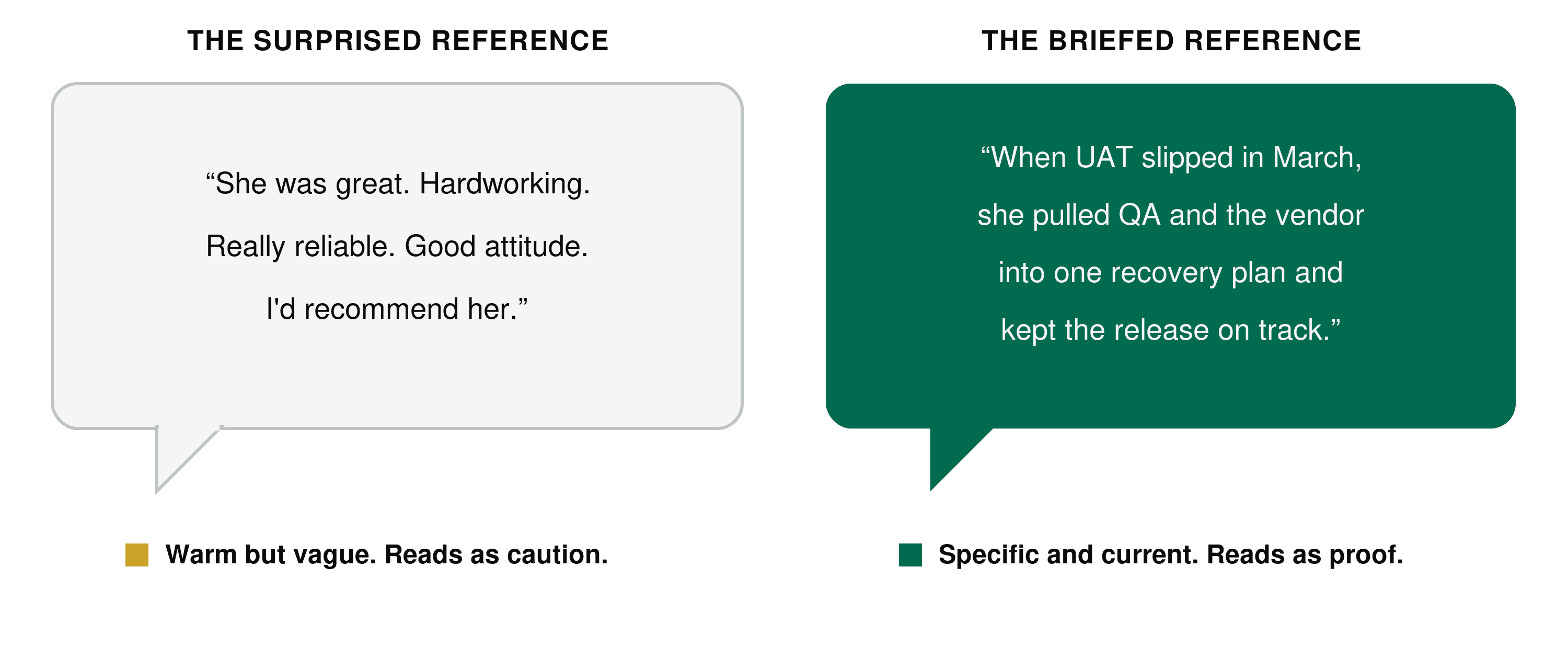
The briefed answer isn't fancier. It's specific and current, which is everything the checker was listening for.
Three names, one hour
My mentee did get the offer, a week late and, honestly, a little lucky. The first thing she did in the new role wasn't picking a desk plant. She opened a note on her phone, wrote three names into it, and she's been tending that list every project since.
That's the whole practice, and none of it needs a job search to be running. Build the bench while you work. Keep it warm with shared wins and closed loops. Brief it before anyone calls. Do that, and the Friday email stops being a scramble and becomes the easiest thing you send all week: three names, three warm people, one hour.
Line up your references before you need them. Future you, standing one step from an offer, will be so glad you did.
Sources
CareerBuilder, "Nearly Three-in-Ten Employers Have Caught a Fake Reference on a Job Application," (Harris Interactive survey), 2012.
Robert Half, "Here's How to Check References," (survey of 2,800 U.S. senior managers), 2019.

Subscribe to the Newsletter
Join our growing community and get alerted first on our every article.
*By subscribing, you agree to send your information to our Company who agrees to use it according to their Terms and conditions and Privacy Policy
About the author
With 20 years guiding high-stakes Agile transformations, I turn theory into action at Oaktreeuni—mentoring aspiring Scrum Masters to think critically, adapt fast, and lead beyond frameworks. The payoff? You step into a high-paying Scrum Master or Agile PM role already equipped to excel.
Who should you use as a professional reference for a job?
Fill three seats: a current or recent manager who can speak to your judgment, a peer who saw your day to day work, and a cross-functional partner or stakeholder, like a Product Owner or QA lead, who can vouch for how you work across teams. Recent and specific beats senior and distant.
What do employers actually ask during a reference check?
What you actually did on the project, how you handled specific moments like a slipping deadline, and whether the reference would hire you again. They listen for specific, current detail, not adjectives.
Should you tell someone before listing them as a reference?
Always. Ask permission first, then brief them before the call: the role, what the employer cares about, and the project story to expect. A surprised reference sounds vague even when they like you.

← Previous post
How to tell the story of a project that failed
Next post →
How to deliver bad news in a project update (and build trust doing it)

Keep reading
Newest on the blog

Comments