Your Team Has Copilot. Your Sprint Board Is Still Red.
ESTIMATED TIME
12
mins

Written by
Rajveer Prasad
Published on
AI didn't fix your delivery problems. It gave them a better excuse.
The developers have GitHub Copilot. The product manager has an AI that summarizes the backlog. The exec received a deck last Tuesday that ChatGPT assembled in six minutes. Everyone's doing AI now.
The sprint board still shows three items in "in progress" from eleven days ago.
I want to make a specific argument, and I want it to land cleanly: AI has become the best-dressed productivity theater in software delivery right now. Not because the tools are bad. Some of them are genuinely useful. But because the organizations deploying them, and the consultants selling them, have confused automating a step with fixing a system. Those are radically different things.
The Scrum Master and the IT Project Manager are the two roles most likely to see exactly where the seam is. They're sitting in the stand-ups, the steering committees, the escalations, the retros, the "why did this happen" conversations. They're watching the AI story up close.
Here's what they're watching.
Vibe Coding Is Just Bad Code With Better PR
Let's start with vibe coding, because it deserves to be said plainly.
Vibe coding is the practice of generating software by telling an AI what you want and shipping what comes out, without necessarily understanding the result. You feel out the shape of what you need, the AI fills in the detail, you move on. The velocity numbers look great.
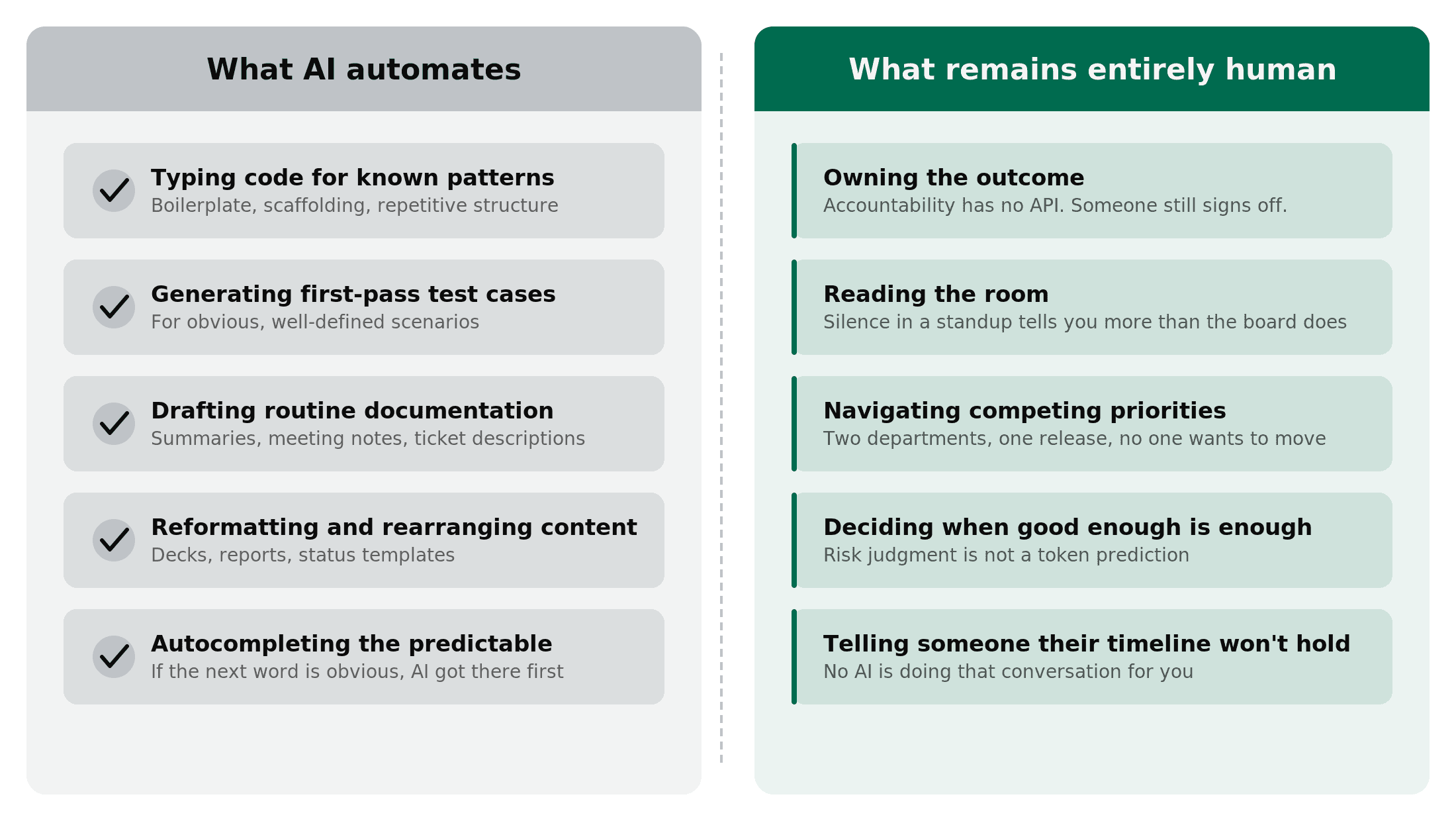
The case for it is real in a narrow band: boilerplate, scaffolding, obvious test cases, repetitive patterns you'd otherwise type for an hour. Yes, Copilot is faster than typing.
But "vibe coding" as a philosophy, as a development culture, is just technical debt with a PR team.
We already had a name for code written by someone who didn't understand what they were building. We called it a problem. We spent decades developing practices, code reviews, pair programming, architectural decision records, test-driven development, not as bureaucracy, but as answers to the very real cost of code that nobody understands when it breaks at 2am six months later.
Vibe coding didn't defeat that cost. It made it faster to accumulate.
The Scrum Master who has been in this role for more than two years has been in this retro before. "We moved too fast." "The code is harder to change than we expected." "We need to understand what we're building before we add more." The vocabulary now includes "the AI generated it" as an explanation for why nobody quite knows how the thing works. The pattern is identical.
The sprint velocity is up. The cycle time to understand any given bug is also up. The standup now regularly features: "I need to look into that one, the code is a bit... opaque."
The IT PM hears this and adds time to the next estimate. The developer calls this a win because the story was done in two days instead of five. The system, taken as a whole, is not moving faster.
What the IT PM Is Actually Counting
Here is a thing that should not be mathematically possible but is happening anyway: delivery teams that adopted AI tooling are often faster at development and slower at delivery.
This is not a paradox. It is a systems problem.
When you accelerate one stage in a pipeline without addressing the others, you create a larger queue at every downstream constraint. If code is being committed faster, and architectural review didn't speed up, and QA didn't speed up, and the UAT environment didn't get more capacity, and change advisory didn't get more availability, and user training didn't get faster, then all that happened is that the backlog of work waiting at those stages got bigger.
The IT PM has a word for this. Bottleneck. She's also watched the problem move from "not enough code" to "too much code to review safely." Which is progress in the same way that your train arriving early is progress when the platform is full and the doors are closed.
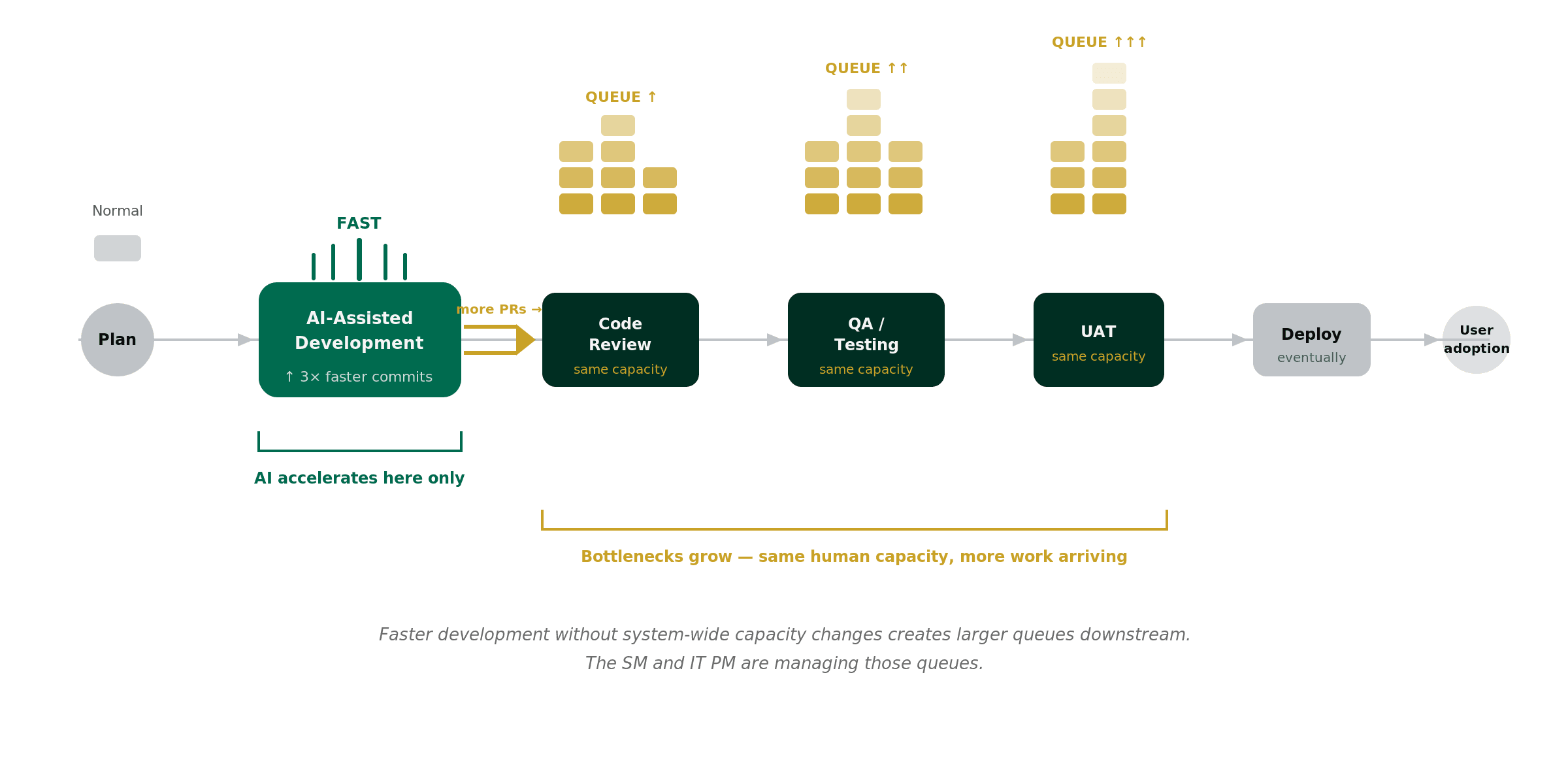
Here's what AI demonstrably accelerated: the typing.
Here's what it did not accelerate: understanding the system, catching the edge cases the obvious tests don't cover, aligning with the architectural intent, explaining the decision to the next person who touches it, handling the integration with the four legacy systems the new code connects to, managing the rollout, supporting the users, and owning what happens when something goes wrong.
The last one is the one that keeps the IT PM awake. Accountability has no API.
When the stakeholder asks who is responsible for the defect that went to production, "the AI generated that section" is not an answer she can give. The team owns the output. The team deployed it. The system failed. The PM is in the room explaining it.
AI accelerated the delivery of a thing the team doesn't fully understand into a production environment the PM is accountable for.
This is not transformation. This is risk relocation.
Where the Pressure Actually Went
Let's be precise: AI did not reduce the total work in software delivery. It redistributed it.
The work that genuinely got faster: writing initial code for known patterns, drafting routine documentation, generating first-pass test suites, summarizing meeting notes and tickets.
The work that got harder: validating output you didn't produce and can't fully audit, explaining AI-assisted decisions to stakeholders who expect human accountability, debugging code that was generated without the reasoning being explicit anywhere, and doing the change management for a team that is now committing code faster than the organization can absorb.
That last one falls squarely on the Scrum Master. Her team's velocity is up. The downstream teams, the legacy integration points, the operational teams, the end users, are running at the same speed they were before. The gap between "we shipped it" and "the business can use it" is wider than it used to be.
She's now doing more coordination, not less. More stakeholder translation, not less. More "here's what the team delivered and here's what that means for your process" conversations, not fewer.
The tools removed some friction from the development step. The human work that sits above, beside, and downstream of development is unchanged. In some cases it's heavier.
The Scrum Master is not running fewer impediment conversations. She's running more of them, about different impediments, at a faster cadence.
Nobody in the AI productivity keynote mentions this part.
The Gaps That Won't Be Automated This Decade
Here, for precision, is what AI cannot do in a real delivery environment:
It cannot tell your stakeholder that the date they were given is not achievable.
It cannot sit in a room with two departments who want contradictory things and find a path that preserves both the decision and the relationship.
It cannot notice that the team went quiet on Tuesday and something shifted in the dynamic.
It cannot read the subtext in "it's fine, we'll make it work."
It cannot decide whether this sprint goal is worth the technical cost of meeting it.
It cannot own an outcome.
It cannot tell you which risk is worth raising now versus which one to monitor. It can generate a risk register. Every risk on that list sits at the same priority level until a human with context decides otherwise.
The Scrum Master's job runs on trust, judgment, and reading the room. The IT PM's job runs on relationships, accountability, and knowing when the plan needs to change before anyone is formally telling you it's broken. None of that has been automated. None of it is close.
What has been compressed is the time available for the human work that used to happen naturally at the edges of the slower delivery pace. The code review conversation that turned into a thirty-minute architecture discussion. The pre-planning conversation that surfaced a dependency two sprints early. The space in which the human signal, the "something isn't right here," got time to be heard.
AI bought speed. It removed some of the slower moments that were doing useful work.
What the Smart Practitioners Are Actually Doing
None of this is an argument against using AI tools. That argument would be losing.
It's an argument against the belief that tooling is transformation. They are not the same thing, and the difference between them costs real teams real sprints.
The Scrum Masters and IT PMs who are navigating this well share something in common: they understand the delivery system well enough to know exactly what just got faster and what didn't. They're the ones who challenged the sprint commitment when it grew by 30% because "we have Copilot now." They're the ones who added an explicit quality gate back into the process when code velocity outpaced review capacity. They're the ones who had the conversation with the tech lead about what "done" means when the code is generated rather than designed.
They're also the ones who are telling leadership the true story: AI improved throughput in one stage of your delivery system. Your delivery system is not just that stage.
The fad version of AI adoption is: faster code, same results, everyone wins.
The actual version is: faster code, different constraints, new risks, and a set of human skills that are now more important than they were before.
That last part is the job.
The SM and IT PM are not competing with AI. They're managing what happens when the rest of the organization thinks it already won.

Subscribe to the Newsletter
Join our growing community and get alerted first on our every article.
*By subscribing, you agree to send your information to our Company who agrees to use it according to their Terms and conditions and Privacy Policy
About the author
With 20 years guiding high-stakes Agile transformations, I turn theory into action at Oaktreeuni—mentoring aspiring Scrum Masters to think critically, adapt fast, and lead beyond frameworks. The payoff? You step into a high-paying Scrum Master or Agile PM role already equipped to excel.
Is vibe coding a real problem in software teams?
Yes. Generating code you don’t fully understand trades short-term speed for long-term debt. The bugs still arrive, the architect still has questions, and the Scrum Master is still in the retro hearing "we moved too fast."
Is AI making the Scrum Master’s job easier?
It depends where you look. AI reduced some typing and documentation work. It increased coordination, change management, and quality oversight because development now moves faster than review and testing capacity.
What should an IT PM do differently because of AI?
Identify where the new bottlenecks are forming. AI accelerates code output. It doesn’t accelerate code review, QA, UAT, or user adoption. The PM’s job is to make those downstream constraints visible before they become escalations.
Comments