PMP, CSM, or SAFe? Start with the door, not the badge.
ESTIMATED TIME
11
mins

Written by
Rajveer Prasad
Published on
Why the “best certificate” question has a quieter answer in 2026: each one is cut for a different lane, and none of them gets you all the way in.
A mentee sent me a voice note last week that I’ve now heard, in some form, about a hundred times.
“I’ve saved up enough for one certificate. PMP, CSM, or SAFe. I just need to know which one is the best. Which one actually gets me hired in 2026.”
I could hear it under her words. She wanted me to name a winner. Pick the strongest badge, she pays for it, she studies, and the hiring problem’s solved. I get the hope. When you’re on the outside trying to get in, a single right answer feels like a door key someone’s hiding from you.
So here’s the honest version, and it’s gentler than the panic but harder than the shortcut.
You’re asking which badge is best. Hiring managers aren’t comparing your badges to each other. They’re comparing you to a specific job. And those aren’t the same question at all.
You’re picking a badge. They’re picking a lane.
When you line up PMP, CSM, and SAFe side by side, it feels like a ranking exercise. Bronze, silver, gold. Which one wins.
But a hiring manager almost never has all three on the desk at once, weighing them like cuts of a diamond. They’ve got one open role, with one job description, written for one kind of work. They’re reading your application to answer a much smaller question: does this person fit the lane this job sits in?
That reframe changes everything. The certificate isn’t a score. It’s a key, and keys are cut for specific doors. A beautiful key for the wrong door is still the wrong key. So the real first question was never “which cert is best.” It was “which door am I walking through,” and that one you can actually answer.
Let me walk you through the three doors, because once you see them, the choice mostly makes itself.
Three certificates, three different doors
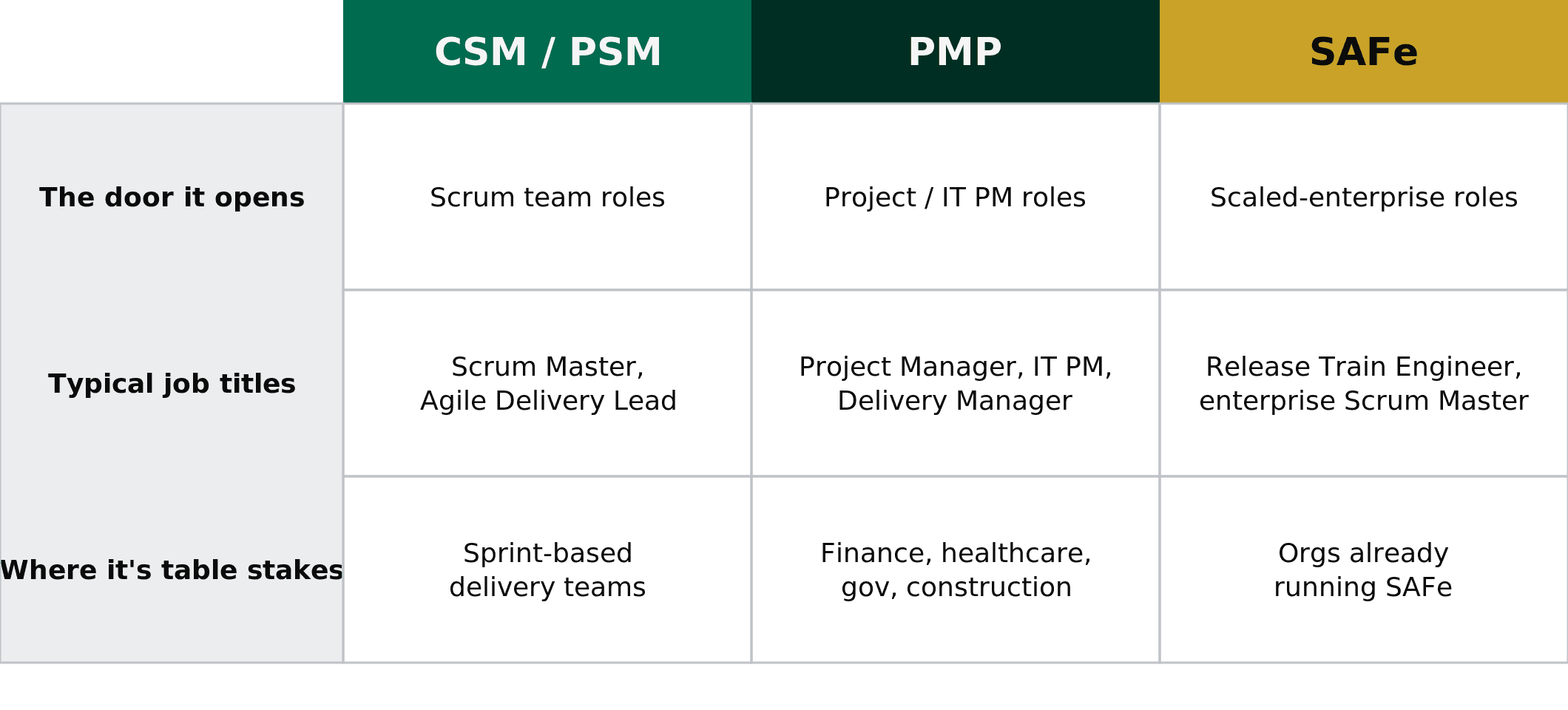
CSM (and PSM) open the Scrum team door. They’re the entry credentials for the Scrum Master and agile team lane: a delivery team running sprints, standups, retros, and refinement. If the roles you’re saving for say “Scrum Master,” “Agile Delivery Lead,” or “Agile Coach,” this is your door. CSM comes from Scrum Alliance, PSM from Scrum.org, and at entry level employers treat them as close cousins. Pick based on how you learn, not on a tier list.
PMP opens the project manager door. It’s the credential of the broader project management world: IT project managers, program coordinators, delivery managers, and the whole hybrid and traditional side of the house. If the postings say “Project Manager,” “IT PM,” or “Delivery Manager,” especially in finance, healthcare, construction, government, or anywhere with audits and regulators, PMP is the language they speak. It signals you can run a plan, a budget, and a schedule, not just a board.
SAFe opens the scaled-enterprise door. SAFe certifications matter most in large organizations that have already adopted the Scaled Agile Framework: many teams, release trains, program increments, the whole coordinated machine. If you’re aiming at “Release Train Engineer,” or at a Scrum Master role inside a big enterprise whose job ad is full of SAFe vocabulary, this is the key that fits. Outside those organizations it carries less weight, because the door it opens isn’t there.
Same person, same ambition, three completely different doors. The badge only helps if it matches the one you’re actually standing in front of.
What the badge actually buys you, and what it doesn’t
Here’s the part the brochures leave out, and it’s the part that matters most.
Even the right certificate, perfectly matched to your lane, doesn’t buy you the offer. It buys you past the first filter. That’s a real thing and worth the money, but it’s smaller than it sounds.
Most applications now meet software before they meet a person. The system scans for the keywords the role was written around. No PMP on a PMP-shaped posting, and you may never reach human eyes. So yes, the matched badge gets you through the keyword gate. It gets your resume into the “look at properly” pile instead of the silent reject.
Then a human picks it up. And a human isn’t asking “is this person certified.” Almost everyone in the pile is. A human’s asking “has this person actually done the work, or only studied it.” That second gate isn’t opened by the badge. It’s opened by evidence: a real board you ran, a blocker you cleared, a stakeholder you brought back to the table, an outcome with your fingerprints on it.
This is the frameworks-versus-reality line that runs under everything we write here. The certificate proves you know the vocabulary. The job tests your judgment. The vocabulary gets you in the room. The judgment gets you the offer.

The crowd is bigger than you think
It helps to see the scale, because it quietly explains why the badge alone can’t be the difference.
Start with the demand, since that’s the encouraging part. The Project Management Institute projects that the world will need up to 30 million more project professionals by 2035, against a workforce of roughly 40 million today {PMI, Global Project Management Talent Gap, 2025}. The World Economic Forum named project manager one of the faster-growing roles of the next few years in the same breath. The work is genuinely there. You’re not chasing a dying field. That part of the hope is real.
But look at the other side of it. Scrum Alliance alone serves a community of nearly 1.8 million certified professionals {Scrum Alliance, 2026}. Scaled Agile reports more than 2 million people trained in SAFe across over 20,000 organizations {Scaled Agile, 2026}. Add the millions who hold PMP, and a pattern shows up fast.

The certificate you’re about to buy, hundreds of thousands of other applicants already have. That’s not a reason to skip it. It’s the reason it can’t be your whole strategy. When a credential is that common, it stops being the thing that makes you stand out and becomes the thing that lets you in the door at all. The floor, not the ceiling. You still need the floor. You just can’t stop there and expect to rise.
So which one? Start at the job posting, not the brochure
Here’s what I told my mentee, and what I’d tell you.
Don’t start with the certificate. Start with twenty real job postings for the exact role you want, in the exact place you want to work. Read them like evidence, not inspiration. Which title keeps showing up. Which framework words repeat. Which certificate, if any, appears in the requirements again and again.
That tally is your answer, and it’s specific to your lane and your market, which is the only place the answer actually lives. If “Scrum Master” and “CSM or PSM” keep appearing, you’ve got your door. If it’s “IT Project Manager” and “PMP preferred,” you’ve got a different one. If every enterprise role you want is thick with SAFe language, the framework just told you what it wants.
Buy the certificate the door asks for. One, not three. Stacking all three to look serious is an expensive way to say you weren’t sure which job you wanted. Clarity reads better than a long list of badges, every time.
Pick the lane, then go earn the story
Then comes the part no certificate can do for you, and the part that actually moves the decision.
Go get one small, real rep in that lane. If it’s the Scrum door, facilitate standups and a retro for a real team, a nonprofit, a friend’s startup, a side project run with a proper board. If it’s the PM door, own one real plan with a budget, a timeline, and stakeholders who can change their minds on you. Do the work the badge claims you can do, on a small but real stage, so that when the interviewer reaches the second gate, you’ve got a true story waiting.
That’s the bridge. The certificate gets you through the keyword filter. The story gets you through the human one. You don’t fake the story. You go build a small, real version of it, and then you learn to talk about it like the professional you’re becoming.
So no, I’m not going to crown a best certificate. The best one is the key cut for the door you’re actually walking through. Find the door first. Buy that key. Then go make yourself worth letting in.
Sources
Project Management Institute, Global Project Management Talent Gap (2025): up to 30 million new project professionals needed by 2035 against roughly 40 million in the workforce today.
Scrum Alliance, official site (2026): community of nearly 1.8 million certified professionals.
Scaled Agile, official site (2026): more than 2 million professionals trained in SAFe across over 20,000 organizations.

Subscribe to the Newsletter
Join our growing community and get alerted first on our every article.
*By subscribing, you agree to send your information to our Company who agrees to use it according to their Terms and conditions and Privacy Policy
About the author
With 20 years guiding high-stakes Agile transformations, I turn theory into action at Oaktreeuni—mentoring aspiring Scrum Masters to think critically, adapt fast, and lead beyond frameworks. The payoff? You step into a high-paying Scrum Master or Agile PM role already equipped to excel.
Is PMP, CSM, or SAFe better for getting hired in 2026?
None is universally better. Each opens a different lane: CSM or PSM for Scrum Master roles, PMP for project and IT PM roles, SAFe for scaled-enterprise roles. Match the certificate to the job you actually want.
Should I get more than one certification?
Usually no. Pick the one the postings for your target role keep asking for. Stacking certificates rarely moves the decision; evidence of real delivery work does.
Does a certificate guarantee an interview?
No. A matched certificate helps you pass the keyword screen, but a human still decides based on evidence that you’ve done the work, not on the badge alone.

Keep reading
Newest on the blog


Comments