What to negotiate in your first delivery offer, besides the salary
ESTIMATED TIME
9
mins

Written by
Rajveer Prasad
Published on
The offer email lands. Relief first, then the advice everyone gives you: always negotiate. So you work up the nerve, ask for more base pay, and one of two things happens. They nudge it up a little, or they tell you this is the best they can do. Either way, you say yes, and you close the laptop thinking you negotiated.
You negotiated the one number that was hardest to move and least likely to matter in two years.
Base pay is the most visible part of an offer, which is exactly why it's the most defended. For a first delivery role, a Scrum Master, a project coordinator, an associate PM, the salary is set by a level, and a first role sits near the bottom of that level's band. There usually isn't much room there, and pushing hard on it gets you a few percent, sometimes a little tension, and not much else.
Meanwhile the levers that actually shape your next two years are sitting right there in the same email, and almost nobody asks for them. This is a coach's list of what those levers are, and how to ask for them so the offer gets better instead of awkward.
Why base pay is the worst thing to fixate on in a first offer
Think about where the real money in a delivery career actually comes from. It's not the raise inside one job. It's the jump between jobs, the second and third offers, and those are decided by what this first role does to your title, your skills, and your evidence.
So a first offer is less a pay-check and more a launchpad. The question that matters isn't 'can I squeeze another two thousand out of this one,' it's 'what will this role let me say, show, and be called when I go for the next one.' Optimize the launchpad, not the first month's deposit.
Here's the uncomfortable part: the few thousand you fight for in base is the cheapest thing in the offer. The expensive things are free to ask for, and you're walking past them.
The two kinds of levers
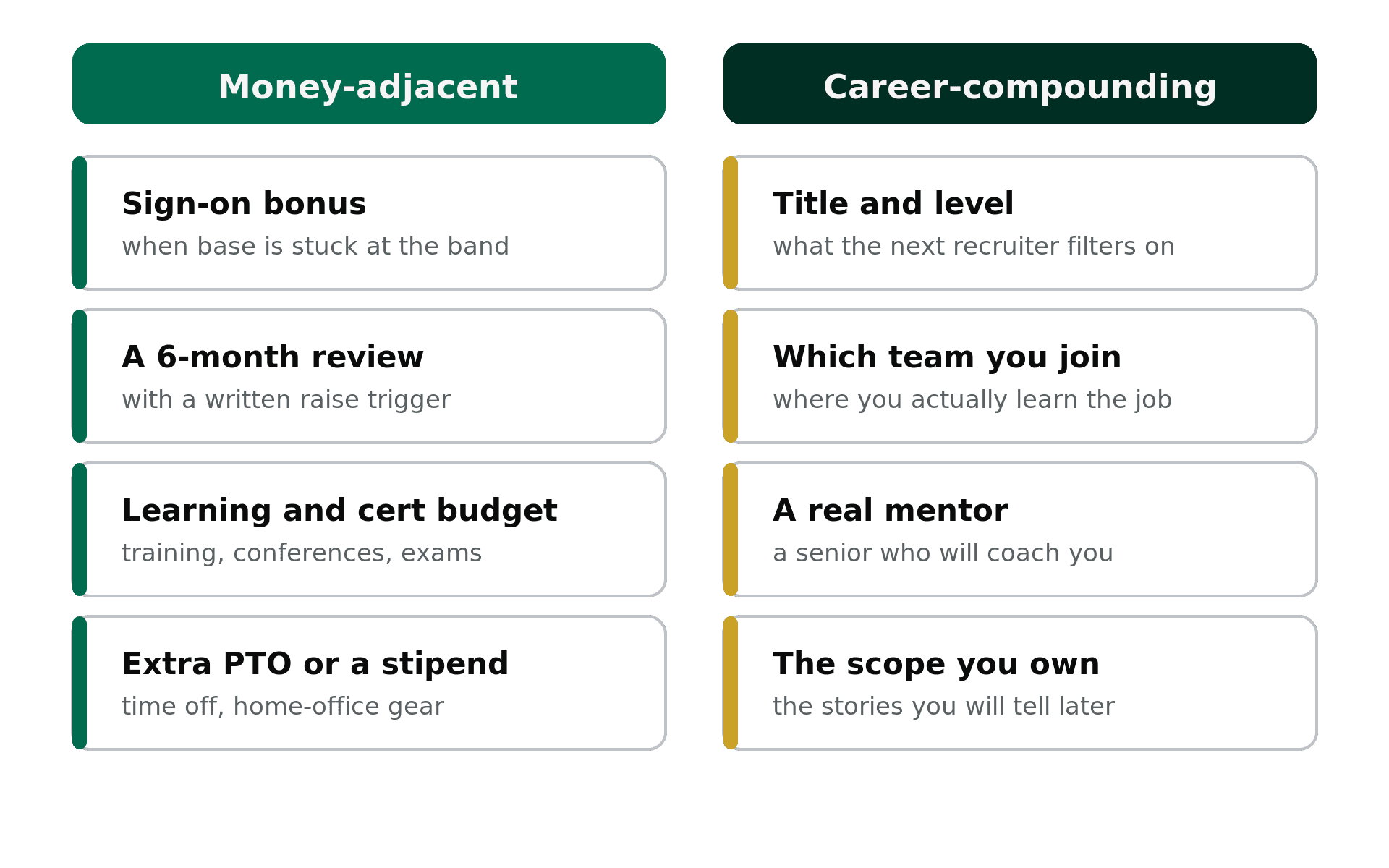
Everything you can negotiate besides base falls into two buckets. The first moves your total compensation without touching the band. The second changes what the role does to your trajectory. Both are usually more available than base, because they don't blow a hole in someone's salary structure.
Money-adjacent levers are the ones HR can say yes to without re-opening the band: a sign-on bonus when the base is capped, a written six-month review with a raise trigger instead of a vague annual one, a learning and certification budget, extra paid time off, a home-office stipend or better equipment. None of these change your level, so they're easier approvals, and several of them put real money or real value in your hands this year.
Don't underrate the learning budget in particular. If you're still building real delivery reps, a few hundred dollars a year for a course, a conference, or an exam isn't a perk, it's fuel for the exact thing that makes you hireable next time. A company that funds your growth is also telling you something about whether it plans to grow you. The answer to that question is worth more than the line item.
Career-compounding levers are the ones that change your next offer: your title and level, which team you actually join, whether you'll have a real mentor, and the scope you get to own. These rarely cost the company anything today, and they're worth more than almost any base bump over two years.
The lever almost nobody asks for, and it's the biggest
Title. Specifically, the title they put on you and the level behind it.
A year doing delivery work as a 'Scrum Master' opens doors that the same year as a 'Project Coordinator' or 'Associate' keeps shut, even when the work was identical. The next recruiter doesn't watch you run a standup. They read a title in a list and pattern-match. If the title undersells what you'll actually be doing, that's not a small cosmetic thing. It's the filter your next application has to survive.
So if the offer says coordinator but the job is clearly running ceremonies, surfacing risk, and protecting a team's focus, that's a fair, specific thing to raise: can the title reflect the actual scope. Pair it with the other quietly huge one, a written six-month review with the criteria spelled out, not a soft promise to 'revisit things later.' Soft promises evaporate when the manager who made them moves on. A written trigger doesn't.
I've watched two people take offers from the same company in the same month. One pushed for every dollar of base and got a small bump. The other accepted the base as offered but asked for the title to read Scrum Master instead of coordinator, plus a written six-month review. A bit over a year later, the second one had the title on every application, a clean story about owning a team's delivery, and a better next offer because of it. The first one had a slightly nicer first year and the same resume they started with. Same company, same start, two very different launchpads.
How to ask without torching the offer
Most people get the what wrong and the how worse. The fear is that asking for anything beyond yes makes you look greedy or difficult, so they either ask for nothing or dump a list of ten demands the moment they're scared. Both read as junior.
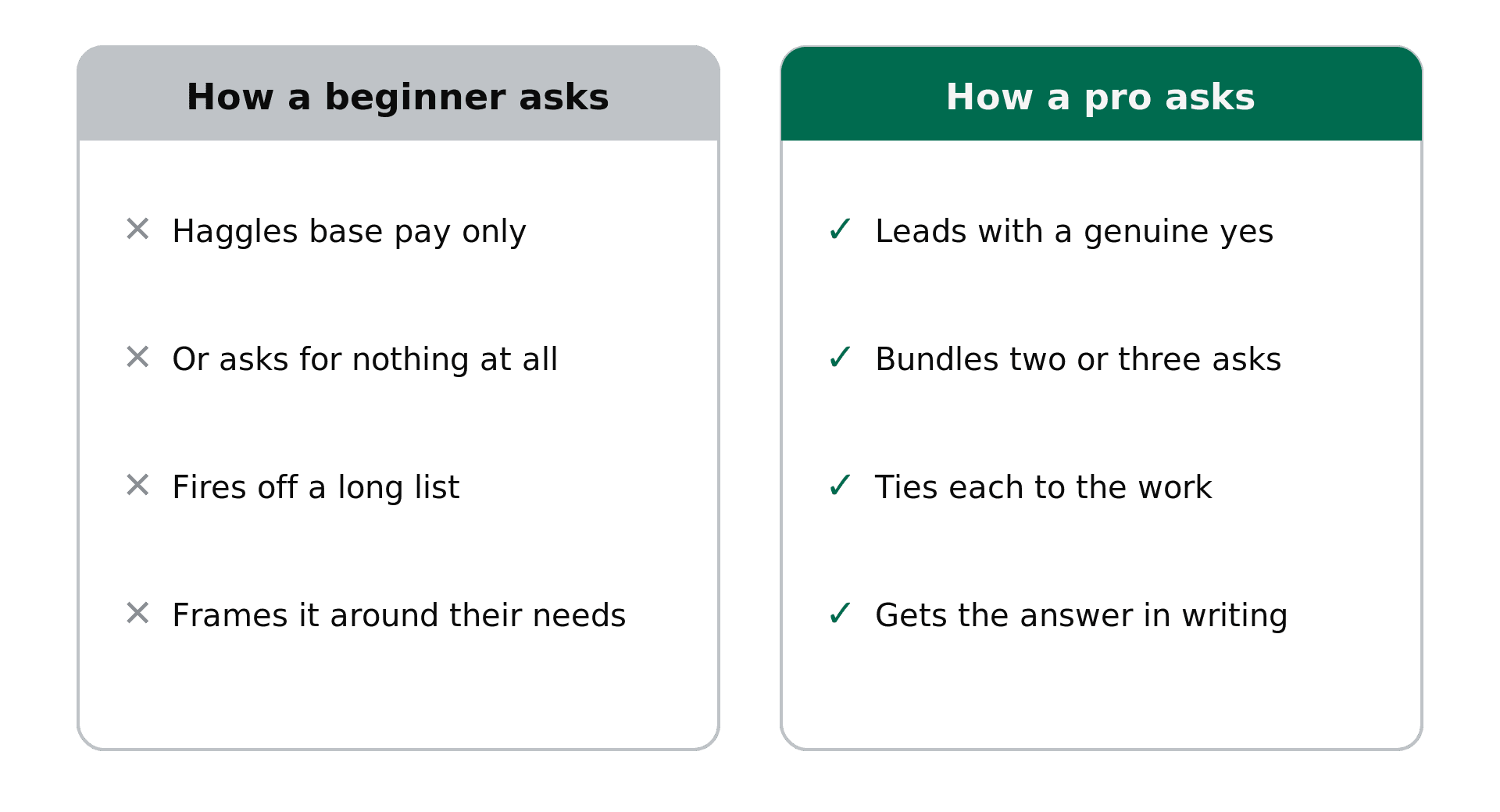
Here's the move that works, and it's a small one. Lead with a real yes: you're genuinely excited and you plan to accept. Then bundle two or three asks, not ten, and tie each one to the work rather than to your rent. 'I'd love the title to match the scope so it's clear internally and later' lands very differently from 'I need more money.' Put it in one calm written message so they can forward it and say yes without a meeting. Then stop.
If you want it as a formula, it's four parts. Accept in spirit, so they know the deal isn't at risk. Bundle two or three specific asks. Give each one a reason tied to the work, not your wallet. And put it in writing as a single message they can forward. Accept, bundle, justify, send. That order matters: the yes goes first so everything after it reads as a detail, not a demand.
Two or three asks, each reasonable, each explained, all in one note. That's it. You're not opening a fight. You're showing them you can make a clear, bounded request and live with the answer, which is most of the job.
The part they're quietly watching
Here's the thing nobody tells you about negotiating a first offer: it's a work sample. The way you ask is a live demo of how you'll handle a stakeholder six months from now when you need something and can't just demand it.
A clean, reasoned, well-bundled ask that respects their constraints is exactly the behaviour they want from a delivery person. Done well, negotiating doesn't lower their opinion of you. It raises it. The candidate who says 'whatever you think is fair' isn't being easy to work with, they're being invisible, and invisible is not the reputation you want to start with.
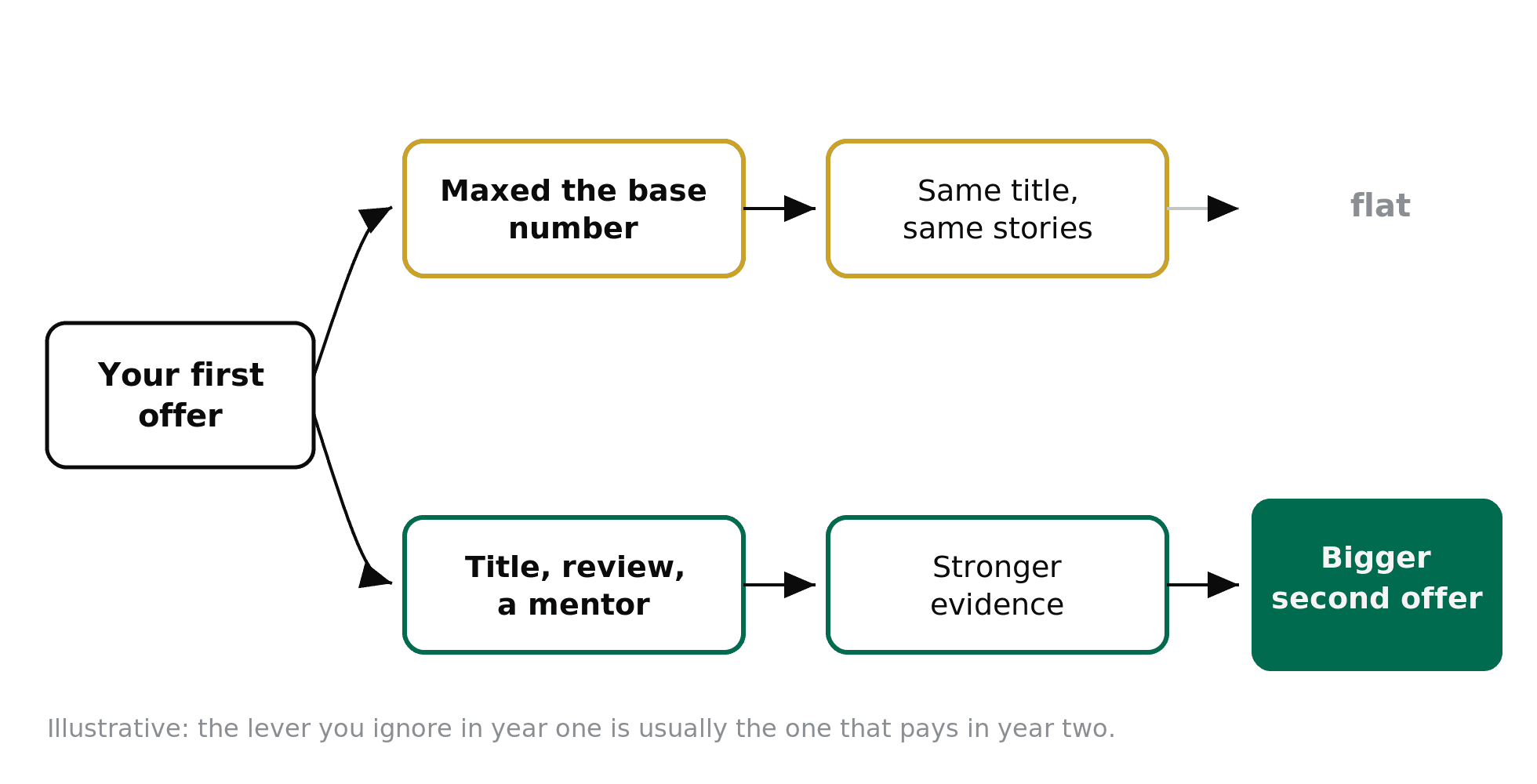
So, when the offer lands, take a breath before you reply. Pick two or three levers that compound, the title that matches the work, the six-month review in writing, the team with someone you can learn from. Ask once, cleanly, in a single note. Then take the role that makes your next offer bigger, not just this one. The base pay is this year's number. The rest is the next five.

Subscribe to the Newsletter
Join our growing community and get alerted first on our every article.
*By subscribing, you agree to send your information to our Company who agrees to use it according to their Terms and conditions and Privacy Policy
About the author
With 20 years guiding high-stakes Agile transformations, I turn theory into action at Oaktreeuni—mentoring aspiring Scrum Masters to think critically, adapt fast, and lead beyond frameworks. The payoff? You step into a high-paying Scrum Master or Agile PM role already equipped to excel.
What can you negotiate besides salary?
Title and level, a written six-month review with a raise trigger, a sign-on bonus, a learning and certification budget, which team you join, mentor access, scope, PTO, and equipment.
Should you negotiate your first job offer?
Yes, but bundle two or three reasonable asks tied to the work and send them in one calm written note. The way you ask is itself a signal.
Is title or salary more important in a first role?
Over two years, title and level usually matter more, because the next recruiter filters on title and your second offer is shaped by it.
Comments