How to tell the story of a project that failed
ESTIMATED TIME
11
mins

Written by
Shikha Prasad
Published on
The failed project is the most revealing story you can tell in an interview or at work. Told one way it sinks you. Told another, it's the strongest thing you'll say.
Every experienced delivery person is carrying at least one. A project that went sideways. The launch that slipped and slipped and then got quietly cancelled. The thing that shipped and nobody used. The one you still think about on the drive home sometimes.
And sooner or later you have to talk about it. An interviewer asks, "tell me about a project that didn't go well." A new manager asks about your last role. A colleague asks what happened with that thing everyone knows went wrong. And in that moment, a lot of good people reach for the worst possible version of the story, because the failure still stings and the instinct is to protect yourself.
Here's the thing I wish someone had told me earlier. The failed-project question is not a trap, and it's not looking for a project that secretly succeeded. It's one of the most useful questions anyone can ask you, because how you tell a failure reveals more about your judgment than any success story ever could. A success can be luck. How you metabolized a failure is all you.
Anyone can narrate a win. The failure story is where they find out who you actually are.
The three ways people wreck it
Before the good version, let's name the bad ones, because they're so common and so easy to fall into without noticing. When people tell a failure story badly, it's almost always one of three characters, and an experienced listener spots each one instantly.
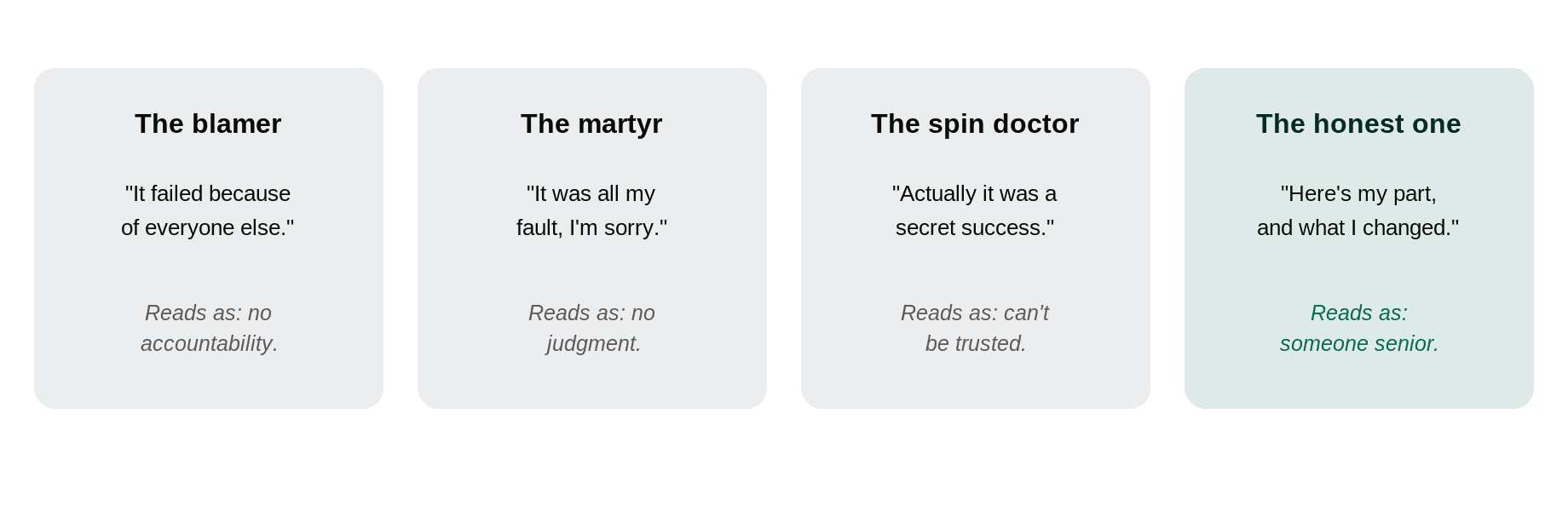
Three ways to tell a failure that quietly disqualify you, and the one that does the opposite.
The first is the blamer. "It failed because the stakeholders kept changing their minds, and the other team missed their deadlines, and leadership wouldn't give us resources." All of that might even be true. But a story where everything is someone else's fault tells the listener one thing: this person takes no accountability, and if I hire them, their next failure will also be everyone's fault but theirs. Even when you were genuinely dealt a bad hand, a story with no ownership in it reads as a red flag.
The second is the martyr, and it's the overcorrection. "It was completely my fault, I should have caught it, I let everyone down." This sounds humble, but it actually reads as poor judgment, because most project failures are not one person's fault, and someone who takes total blame for a complex, multi-cause failure either doesn't understand what really happened or is performing contrition. Neither is reassuring. And it can tip into a kind of self-flagellation that makes the listener uncomfortable and quietly doubt your steadiness.
The third is the spin doctor, and it's the one clever people fall into. "Well, it looked like a failure, but actually we learned so much and it was really a success in disguise." No. If it failed, call it a failure. The moment you try to reframe a genuine failure as a secret win, you tell the listener you can't be trusted to give them a straight assessment of anything, which for a delivery person is close to fatal. They will wonder what else you'd spin. Honesty about a real loss is worth more than any amount of polish.
The shape of a strong failure story
So what does the good version sound like? It has a clear shape, and the shape is what carries you safely through the hard middle without falling into any of those three traps. Four beats, in order.
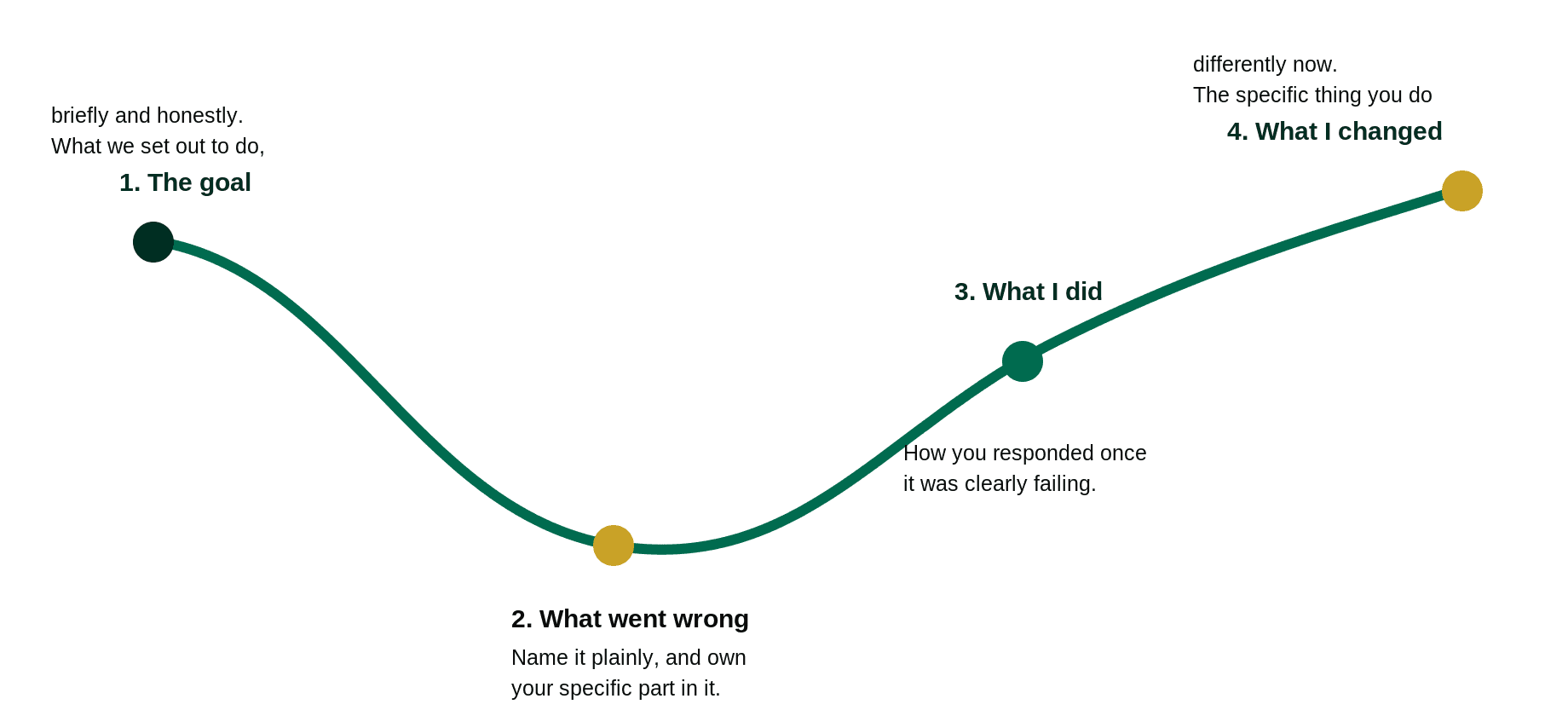
The arc of a failure worth telling. It dips honestly, then climbs to the thing you actually changed.
Start with the goal, briefly. What were you trying to do, and why did it matter. Keep this short, because it's just the setup, but it orients the listener and it quietly signals that you understood the point of the work. Then name what went wrong, plainly, and here is the crucial move: own your specific part in it, honestly, without either inflating it or dodging it. "The project slipped badly. Several things caused it, but my part was that I saw the dependency risk early and I didn't escalate it hard enough. I flagged it once and let it go when I should have made it loud." That single honest sentence does more for your credibility than anything else in the story, because it's specific, it's accountable, and it's proportionate. You owned your piece without pretending you controlled the whole thing.
Then, what you did. Once it was clearly going wrong, how did you respond? This is where you show you don't freeze or hide when things go bad. Maybe you called it early and helped the team have the hard conversation. Maybe you salvaged what could be salvaged. Even if the answer is "we couldn't save it, but I made sure we shut it down cleanly and the learnings were captured," that's the behavior of someone you'd trust in a crisis. And finally, what you changed. The specific thing you now do differently because of it. Not "I learned to communicate better," which is vapor, but "now I escalate a serious risk in writing, to the decision-maker, and I don't let it drop until someone with authority has actually responded." A concrete change is the proof the failure taught you something real.
Why the honest version is the strong one
Here's the part that surprises people. Told this way, a failure story often lands better than a success story, and it's worth understanding why, because it changes how you feel walking into the conversation. A success story mostly proves you can operate when things go well, which is table stakes. A well-told failure story proves something rarer and more valuable: that you can take a hit, stay accountable, act under pressure, and turn the loss into judgment you now carry. That's the profile of someone who gets more reliable over time, not someone who only works when the wind's behind them.
There's a Japanese craft, kintsugi, where a broken bowl is repaired with gold in the cracks, so the break becomes part of the object's beauty instead of something hidden. A good failure story is like that. You're not pretending the break didn't happen, and you're not gluing it back and hoping nobody notices the seam. You're showing them the repair, in gold, because the repair is the most valuable part. The break is what makes the object worth more, not less, if you had the skill to mend it well.
Choosing which failure to tell
One practical note, because people ask. When you get to pick the failure, don't reach for the trivial, safe one, the "failure" that's obviously not really a failure. Interviewers see that as its own kind of dodge. Pick a real one, something that genuinely went wrong and genuinely mattered, but one where you can honestly show the four beats: your real part, your real response, your real change. You want a story with enough weight that owning it demonstrates something, but enough distance that you can tell it steadily, without the wound still open in your voice.
And if you're early in your career and think you don't have one yet, look again, because you probably do, just at a smaller scale. The group project that fell apart. The event you helped organize that flopped. The volunteer initiative that didn't land. The scale doesn't matter. What matters is that you can tell it with the four beats, honestly, and show you're the kind of person who learns from a loss instead of hiding it. That skill, telling a failure well, is one of the quiet markers of someone who's actually ready to be trusted with real things. Because the people who can't talk honestly about failure are usually the people still afraid of it, and fear of failure is what makes people hide problems until they're catastrophes. Show them you can look at a loss straight on, name your part, and say what it taught you. That's not the story that sinks you. Told right, it's the one that lands you.

Subscribe to the Newsletter
Join our growing community and get alerted first on our every article.
*By subscribing, you agree to send your information to our Company who agrees to use it according to their Terms and conditions and Privacy Policy
About the author
I believe the strongest tool and flex each of us has is our belief. When we truly believe in something, we align our mindset, energy, and actions with the right effort and guidance. That is when achieving almost anything becomes possible. This is how I help mentees at OAKKTREEUNII move into Software and Project Management careers for better pay, better confidence, and better work-life balance.
How do you talk about a failed project in an interview?
Use four beats: the goal, what went wrong and your specific part, what you did in response, and what you concretely changed. Own your piece honestly without blaming everyone or taking total blame.
Should you admit a project failed in an interview?
Yes. Don't spin a real failure as a secret success, and don't pick a trivial fake failure. A real failure told with accountability and a concrete lesson is often stronger than a success story.

← Previous post
PMP, CSM, or SAFe? Start with the door, not the badge.
Next post →
Line up your references before you need them

Keep reading
Newest on the blog

Comments