Recruiters stopped posting the job. They're searching for you instead.
ESTIMATED TIME
10
mins

Written by
Shikha Prasad
Published on
The apply button is becoming the crowded side door. The main door opens from the other side, and most candidates have never checked whether theirs does.
Somewhere right now, a recruiter is filling a delivery role you'd be great at, and no posting will ever exist for you to find. She's not reading applications. She's typing a query: delivery lead, regulated industry, vendor management, within commuting distance or remote. A ranked list of profiles comes back. Yours either surfaces in that list or it doesn't, and you will never know the search happened.
That's the quiet shift in hiring, and it changes what a job search even is. The old model: companies announce openings, you respond. The emerging one: companies look, you get found. The posting is turning into the fallback channel, and the search is becoming the front door.
Strong claim, so let me scope it honestly and then defend it. This isn't the old "80 percent of jobs are hidden" folklore, which never had a real source behind it. It's two measurable trends crossing, and you can watch both of them move.
Two lines moving in opposite directions
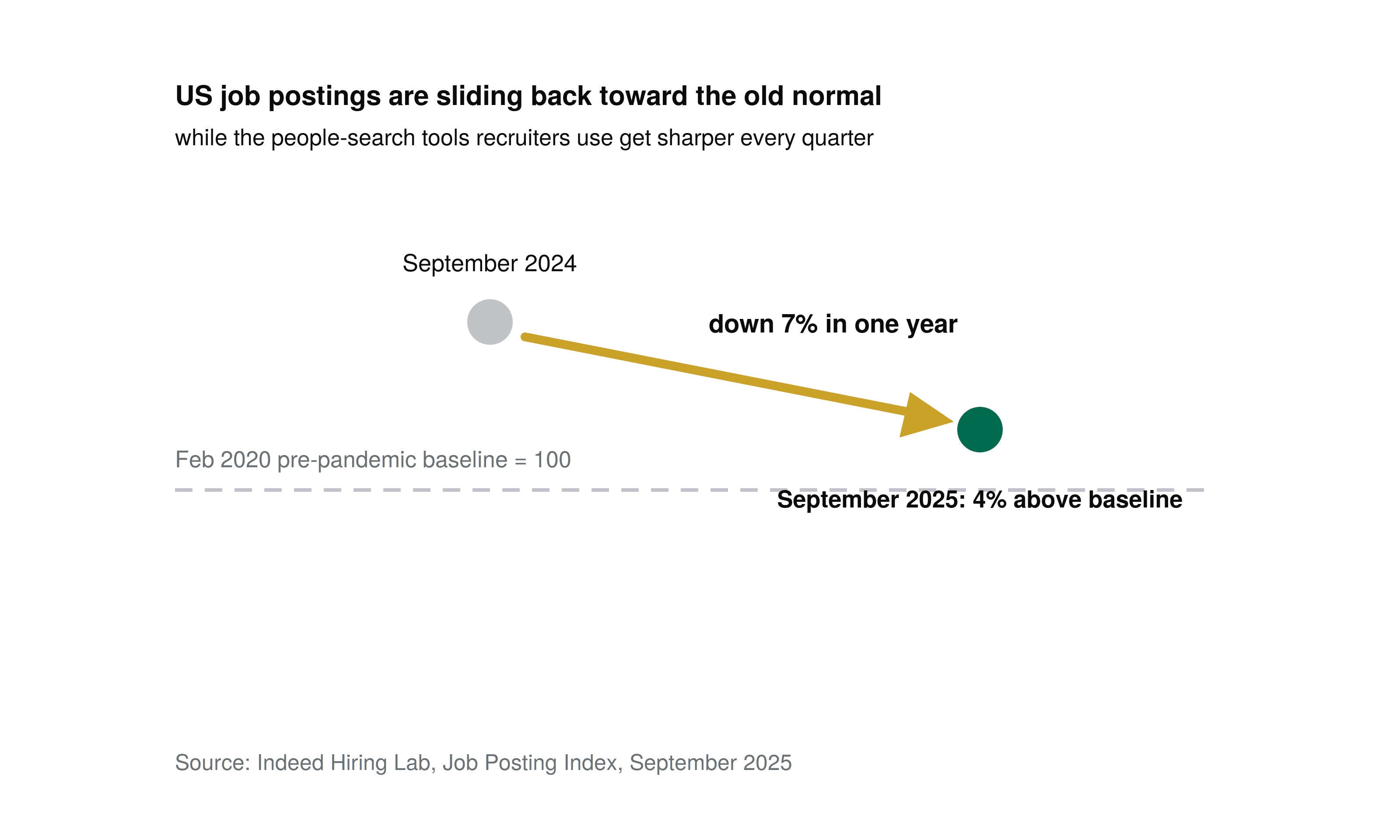
Line one: the posting channel is shrinking. Indeed's Job Posting Index sat just 4 percent above its February 2020 pre-pandemic baseline in September 2025, down 7 percent in a single year {Indeed Hiring Lab, 2025}. The pandemic-era posting boom is gone, and the trend has been one direction for three years. Fewer ads, and each surviving ad buried in more applications, because AI made applying nearly free. Any posted job now drowns in machine-polished resumes, which is precisely why reading them is such a miserable way to hire.
Line two: the search channel is getting sharp. LinkedIn's Future of Recruiting research found 37 percent of talent acquisition professionals already integrating or experimenting with generative AI {LinkedIn, 2025}, and the tooling they're adopting is built for finding, not filtering: natural-language people search, skills-matching, automated outreach. The same research found companies running the most skills-based searches were 12 percent more likely to make a quality hire, and those using AI-assisted outreach 9 percent more likely {LinkedIn, 2025}. Teams follow results. Results are on the search side.
Put the two lines together and the logic is hard to escape. Posting a job invites ten thousand strangers to claim they fit. Searching finds the thirty people whose history says they fit. One of these is a better product, and recruiting tools are an industry built on knowing it.
The uncomfortable arithmetic for you
Here's what that means, said plainly: your visibility now does a job your applications used to do. When hiring runs on queries, the candidates who exist in the index get opportunities the invisible ones never see. Not better candidates. Indexed ones.
The steelman first, because it's real: most hires still involve a posting somewhere in the process, referrals still beat everything, and nobody should put their job search entirely in the hands of being noticed. Applying still works, especially early-career, especially in volume-hiring markets. I'm not telling you to stop.
But the margin is where careers are made, and the margin has moved. The best roles increasingly get filled before the posting, or without one. And the filter that decides whether you're in that conversation isn't your interview skills or even your resume. It's whether a skills-based query returns you. A brilliant PM whose profile says "results-driven professional with a passion for excellence" is, to a search engine, nobody. The query was for "migrated a payments platform," and those words appear nowhere on their profile.
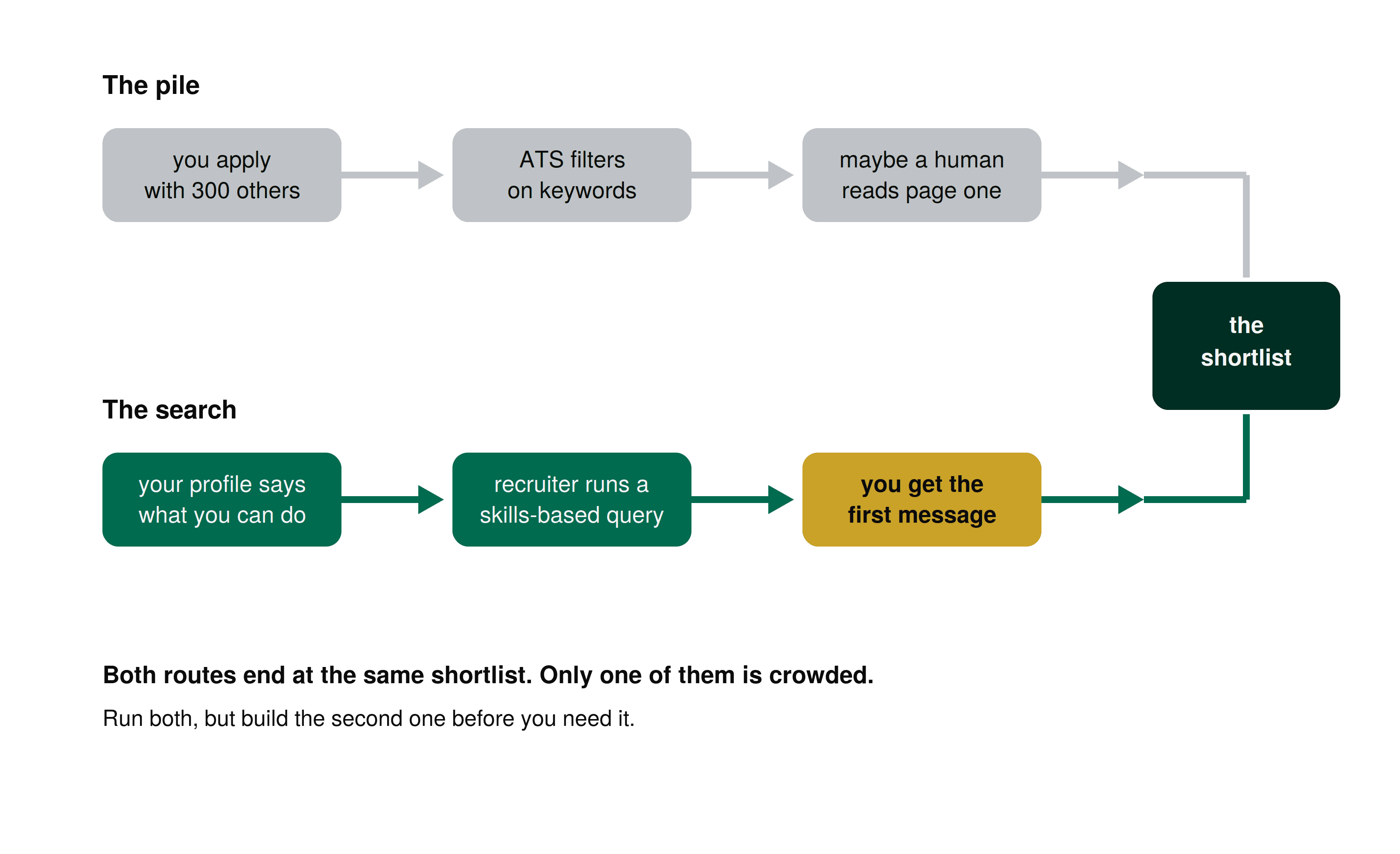
I saw the mechanism up close last spring. A hiring manager I know needed a project manager who'd done a core-system migration in insurance, a brutally specific ask. They never posted it. An internal recruiter ran searches for two days, came back with eleven profiles, and the role was offered inside three weeks, to a woman who, by her own account, "wasn't even looking." What made her findable wasn't luck. Her profile said, in plain nouns, exactly which policy admin system she'd migrated and when. Meanwhile, I'd bet money there were fifty equally qualified PMs in that city whose profiles said "experienced in digital transformation," and every one of them was invisible to that search. Same skills. Different words. Only one phone rang.
Notice also who didn't get a say: the applicant pile that never existed. Nobody was rejected, because nobody got to apply. That's what it means for the search to be the front door. The competition happened silently, in an index, before anyone knew there was a competition.
Making yourself findable, without becoming insufferable
The fix isn't personal branding, thought leadership, or posting motivational carousels. Search doesn't rank charisma. It ranks evidence. Four moves, one evening each.
Write your profile in query language. Recruiters search in nouns and verbs: tools, domains, outcomes. Go through your profile and replace every self-description with a thing you did: the platform you migrated, the vendor you managed, the release cadence you fixed, the budget you held. The test for every line: would this ever appear in a search query? "Passionate about agile transformation" never will. "Rolled out Jira and cut cycle time on a 40-person programme" might.
Cover the words for what you want next, honestly. Skills-based search matches what's written, so the skills you have but never wrote down don't exist. List the frameworks, the domains, the systems, the certifications, in the skills section and in the prose. Never claim what you haven't done; invisible truth is the problem here, not insufficient fiction.
Leave artifacts where search can see them. A write-up of how you ran a risky release. A sensible comment on a delivery problem. A portfolio page with a real risk register you built. Each one is another indexed surface that says practitioner, and together they're the difference between a name and a result.
Answer the first message like it matters, even when the role doesn't fit. Recruiters keep lists. A sharp, generous two-line reply to a near-miss outreach today is how you become the first search result they don't need a search for next quarter.
A small, unglamorous fifth: keep your job titles legible. If your company called you a "Delivery Ninja" or an "Agile Enablement Catalyst," translate it in your profile with the real title alongside, because nobody queries for ninjas. Search runs on conventional words. Save the creativity for the work.
None of this requires performing on social media. It requires describing your real work in the words the queries use. Boring, honest, and massively undersupplied. And if the word-matching feels like a game, remember what the words point at: real systems, real migrations, real outcomes. The profile only works because the work behind it is true. Which is also why this beats the application pile, where the words have detached from the work entirely.
The job search you're running either way
One more way to see it. You already have a searchable profile; everyone does. The only question is whether it's an accurate index of what you can do or an accidental one. Candidates spend forty hours polishing a resume that gets read for seven seconds, and zero hours on the surface recruiters query every day. That allocation made sense in 2015. It's upside down now.
There's a fairness argument buried in here too, and it cuts in your favour if you let it. The apply-and-pray channel rewards whoever games it hardest: volume applicants, keyword stuffers, the people with time to send three hundred applications. Search rewards something quieter: a specific history, described accurately. For a career switcher with real translated experience, or a practitioner who's done unusual things in unfashionable industries, that's the best news in years. You don't have to out-shout anyone. You have to out-describe them.
The posting era trained everyone to sprint when a door opened. The search era rewards the person whose door was already visible from the street. Spend one evening this week making your work findable. The next search is already running, and you don't get to know when it happens. You only get to decide whether you're in the results.
Sources
Indeed Hiring Lab, "September 2025 Labor Market Update," (Indeed Job Posting Index), September 2025.
LinkedIn Talent Solutions, "The Future of Recruiting 2025," 2025.

Subscribe to the Newsletter
Join our growing community and get alerted first on our every article.
*By subscribing, you agree to send your information to our Company who agrees to use it according to their Terms and conditions and Privacy Policy
About the author
I believe the strongest tool and flex each of us has is our belief. When we truly believe in something, we align our mindset, energy, and actions with the right effort and guidance. That is when achieving almost anything becomes possible. This is how I help mentees at OAKKTREEUNII move into Software and Project Management careers for better pay, better confidence, and better work-life balance.
Do recruiters really find candidates without posting jobs?
Increasingly, yes. Job postings have fallen back to near pre-pandemic levels while recruiting teams adopt AI-assisted, skills-based people search. Many roles are filled through sourced outreach before or instead of a public posting.
How do I show up in recruiter searches?
Write your profile in the language of queries: specific tools, domains, and outcomes rather than adjectives. List your real skills explicitly, keep titles conventional, and leave public artifacts of your work that search engines can index.
Should I stop applying to posted jobs?
No. Postings and referrals still fill most roles, and applying remains worthwhile. The point is to add discoverability: being findable costs a few evenings and keeps working while you sleep.

← Previous post
Which cost centre pays for your role? The question that predicts your next layoff
Next post →
Half your team uses AI every day. The other half is quietly falling behind.

Keep reading
Newest on the blog


Comments