Half your team uses AI every day. The other half is quietly falling behind.
ESTIMATED TIME
12
mins

Written by
Rajveer Prasad
Published on
The biggest skills gap on your team right now is invisible, compounding weekly, and nobody will mention it in standup. Coaching it closed is your job.
Run a quiet experiment this week. In your next refinement session, watch who turns a vague requirement into three solid acceptance criteria in four minutes, and who's still reformatting the ticket twenty minutes later. Then ask yourself honestly: is that a talent difference, or a tooling difference?
On more and more teams, it's tooling. Some of your people have quietly rebuilt how they work: drafts in seconds, test cases generated and then checked, meeting notes summarised before the meeting's even cold. The rest are working exactly the way they did in 2023. Same hours, same effort, shrinking relative output.
And here's the part that should bother you as a Scrum Master or delivery lead: this gap doesn't show up on any board you run. Velocity doesn't isolate it. Standup doesn't surface it. The people falling behind aren't blocked, so they never say they're blocked. It's a skills gap forming in silence, on your team, on your watch.
The numbers under the silence
The adoption data tells a very specific story: fast growth, split unevenly, and badly supported.
Gallup found that the share of US employees using AI at work frequently, meaning weekly or more, hit 19 percent in 2025, with any use nearly doubling in two years from 21 to 40 percent {Gallup, 2025}. But the growth isn't spread evenly. White-collar workers hit 27 percent frequent use, up 12 points in a single year, while production and front-line workers stayed flat at 9 percent {Gallup, 2025}. The gap tripled in a year, and the flat line shows no sign of moving by itself.

Inside knowledge-work teams, the same split hides in a different costume. Microsoft and LinkedIn's Work Trend Index found 75 percent of knowledge workers already using generative AI, and 78 percent of those users bringing their own tools to work rather than waiting for a company rollout {Microsoft and LinkedIn, 2024}. Adoption isn't a wave arriving together. It's individuals sprinting ahead alone, on personal accounts, with no shared playbook.
Now add the organisational vacuum. Only 22 percent of employees say their company has communicated a clear AI strategy, and barely 30 percent report any guidelines or policy at all {Gallup, 2025}. Leadership, in most places, has effectively said: figure it out yourselves. Half the team did. That's exactly how you build a two-speed team without ever making a single decision.
Why nobody on your team will raise this
You might think the market would fix this: laggards see the gains, copy the leaders, done. That's not what happens, and the reason is social, not technical.
The same Microsoft research found 52 percent of people using AI at work are reluctant to admit it on their most important tasks, and 53 percent worry that using it makes them look replaceable {Microsoft and LinkedIn, 2024}. So your strongest adopters hide their methods. Meanwhile, the people who haven't started are embarrassed to ask, because asking admits they're behind. The leaders go quiet, the laggards go quiet, and from the outside the team looks calm. It isn't calm. It's two groups both avoiding the same conversation.
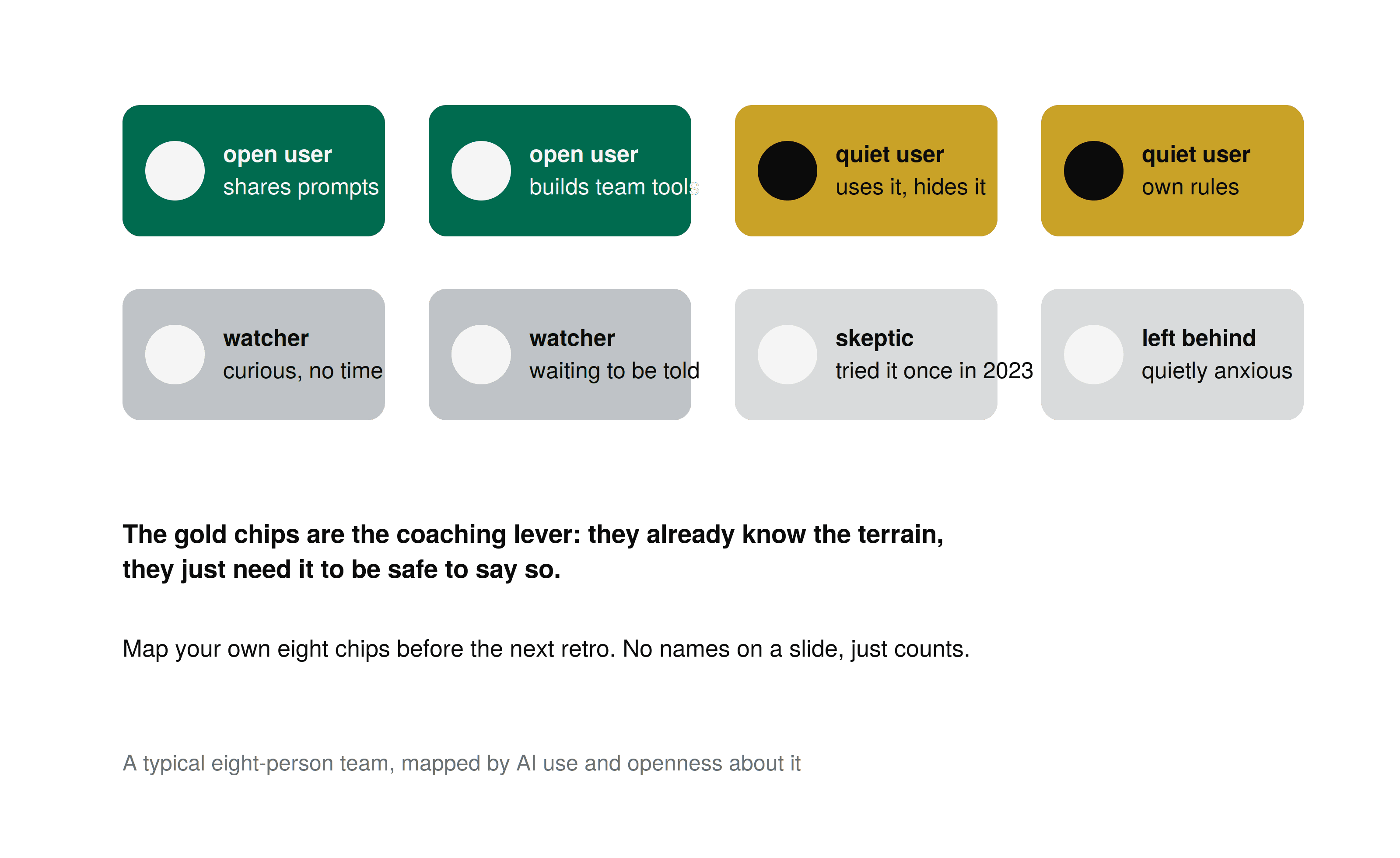
Map your own team against this honestly. Count, don't name: how many open users, how many quiet ones, how many watchers, how many genuinely left behind? If you can't fill in the counts, that's your first finding. You're running a team whose single biggest productivity variable is invisible to you.
This is a coaching problem, and it's yours
Nobody appointed you Chief AI Officer, and I'm not suggesting you play one. But developing the people around you is the actual job of a Scrum Master, and the senior version of every delivery role. A capability gap that's splitting your team is squarely in scope, the same way it would be if half your team couldn't write a user story.
Here's a coaching sequence that works, built from what the data says is actually broken: visibility, safety, and reps.
Week one: make usage speakable. Put ten minutes in the retro with one question: "what's one thing you've tried with AI this month, and did it work?" Go first, with something that failed, so the bar is honesty, not brilliance. The 52 percent hiding their usage are hiding because nobody made it normal. One round of this usually flushes out two quiet experts and a lot of relief.
Week two: pair across the gap. Take one open user and one watcher, give them a real task the team actually has, and an hour. Not a demo, a working session: the watcher drives, the adopter navigates. Demos impress; driving converts. Rotate pairs every sprint.
Week three: write the team's working agreement. One page, written together: what we use it for, what we always review by hand, what never goes into a public tool, and how we mention AI-assisted work in reviews. This replaces the missing company guidance that 70 percent of employees report, at the only level you control: your team.
Ongoing: put one experiment in every sprint. A standing improvement item: one workflow, tried with AI, results shared in the next retro, kept or killed on evidence. Small, boring, compounding. That's how the flat line starts moving.
Notice what's not on this list: mandates, tool evangelism, or shaming anyone who's behind. The left-behind half isn't lazy. Gallup's data says they were never given a strategy, guidelines, or time. Give them safety and reps, and most of them close the gap in a quarter.
One measurement rule keeps the whole thing honest: judge the work, never the tool. The moment "uses AI" becomes the thing you praise, people will perform usage instead of outcomes, and your skeptics will be right to dig in. What you're actually after is cycle time, quality, and calmer sprints. The tool talk is just how you get the knowledge moving.
What it looked like when one team said it out loud
A delivery manager I know ran the retro question on a team of nine. The result surprised everyone, including her. The team's quietest tester, a man who hadn't spoken first in a retro in a year, turned out to have built himself a test-case generator months earlier. He'd been sitting on it, half proud and half worried it made him look like he was cutting corners, since nobody had ever said whether this was allowed.
Two sprints later his workflow was the team's workflow, regression prep had dropped from a day to under two hours, and he was walking the two most anxious teammates through it in a weekly half hour he volunteered for. Nothing about his skill changed in those two sprints. What changed is that someone made it safe to show. That's the entire mechanism: the capability was already on the team, locked in one chair.
The two-speed team is a choice. So is the other kind.
One more reframe before you go. If you do nothing, your team still makes a decision about AI. It decides that capability is private property: the fast get faster alone, the slow stay quiet, and in a year you have a team whose internal gap is wider than the gap between your team and your competitors. No meeting was held, and that was still the outcome.
The alternative costs you ten minutes of retro time and a bit of social courage. A team that learns a capability together, out loud, with rules it wrote itself, isn't just faster. It's the kind of team people describe in interviews for the rest of their careers. You can be the person who built that, or the person who ran standups next to the silence.
And if you're reading this as the one who's behind: same advice, smaller scale. Pick one task you did yesterday, try it with the tool today, and tell one colleague what happened. The gap between you and your fastest teammate is not talent. It's about thirty honest hours of reps, and the first one is the only hard one.
Start with the retro question. This sprint, not next quarter. The gap is compounding while you schedule it.
Sources
Gallup, "AI Use at Work Has Nearly Doubled in Two Years," June 2025.
Microsoft and LinkedIn, "2024 Work Trend Index: AI at Work Is Here. Now Comes the Hard Part," May 2024.

Subscribe to the Newsletter
Join our growing community and get alerted first on our every article.
*By subscribing, you agree to send your information to our Company who agrees to use it according to their Terms and conditions and Privacy Policy
About the author
With 20 years guiding high-stakes Agile transformations, I turn theory into action at Oaktreeuni—mentoring aspiring Scrum Masters to think critically, adapt fast, and lead beyond frameworks. The payoff? You step into a high-paying Scrum Master or Agile PM role already equipped to excel.
What is the AI skills gap at work?
It's the widening difference between employees who use AI tools regularly and those who don't. Gallup found white-collar frequent use jumped to 27 percent in 2025 while front-line use stayed at 9 percent, and most companies offer no strategy or guidelines.
Why do employees hide their AI use?
Microsoft's Work Trend Index found 52 percent of AI users are reluctant to admit using it on important work, and 53 percent fear looking replaceable. Without team norms, both adopters and non-adopters stay silent, which widens the gap.
How can a Scrum Master help close the AI gap on a team?
Make usage safe to discuss in retros, pair adopters with non-adopters on real tasks, write a one-page team working agreement for AI use, and run one AI experiment per sprint with results shared openly.

← Previous post
Recruiters stopped posting the job. They're searching for you instead.
Next post →
A short history of the Scrum Master role, and where it's actually heading

Keep reading
Newest on the blog


Comments