Which cost centre pays for your role? The question that predicts your next layoff
ESTIMATED TIME
12
mins

Written by
Rajveer Prasad
Published on
Performance reviews tell you how you're doing. The general ledger tells you whether you'll be here in March.
Here's a question almost nobody can answer about their own job: which budget line pays your salary?
Not which team you're on. Not who you report to. Which line, on which spreadsheet, in whose P&L. If you don't know, I'd gently suggest that someone in finance does, and that their answer matters more to your career than your last performance rating.
The thesis of this post is simple and a little cold: layoffs are mostly a budget event, not a talent event. Companies don't fire people one by one; they cut lines on a spreadsheet, and everyone whose salary rolls up to that line goes with it. Which means the most useful thing you can know about your job security isn't how good you are. It's where you sit on the page.
The map finance actually reads
Every company runs two maps of itself. The org chart, which is the one employees study, and the cost structure, which is the one that decides things.
The org chart answers social questions: who do I report to, who do I escalate to, whose meeting is this. The cost structure answers the only question that matters in a downturn: what does this organisation pay for, and which of those payments would it most like to stop. People spend years mastering the first map and entire careers never once looking at the second. Finance looks at nothing else.
On the second map there are, crudely, two kinds of money. Money that's attached to revenue: the product people pay for, the teams that build and sell it, the capitalised programme the board already announced. And money that's classified as the cost of running the place: G&A, overhead, enablement, admin, and, uncomfortably often, the PMO and a lot of delivery roles.
When the budget tightens, these two kinds of money have very different experiences. Revenue-attached spend gets defended by name, in sentences with specific nouns: this product, this client, this launch. Overhead gets managed by percentage, in sentences with no nouns at all: a 15 percent reduction in operating expense. Nobody has to say your name to delete your role. They just have to round.
You can watch this logic in public. In 2024 alone, tech companies cut more than 150,000 jobs across 549 companies {Layoffs.fyi, via TechCrunch}. Intel's 2025 restructuring removed over 21,000 people, roughly a fifth of the company, in one announcement {Layoffs.fyi, via TechCrunch}. And when Amazon cut around 14,000 corporate roles in October 2025, the stated logic wasn't underperformance. It was structure: "reducing bureaucracy, removing layers," the need to run "with fewer layers and more ownership" {Amazon, October 2025}.
Read those announcements closely and you'll notice what's missing: individuals. The unit of the layoff is the layer, the function, the cost line. That's the whole point. A layoff large enough to move a share price can't be done name by name. It's done by category, and your category was set long before the cut, on the day someone decided which budget your role bills to.

"But they keep the best people." Do they?
The strongest counterargument goes like this: companies aren't stupid, performance data exists, and when cuts come they protect their stars. So be excellent and you're safe.
It's half true, and the half matters. Within a line that survives, performance decides a lot. If your team keeps eight of ten seats, the two who go are rarely random. Be excellent; it genuinely helps.
But performance only operates inside the budget decision. It doesn't get a vote on the budget decision itself. If the entire transformation office is cut, being the best person in the transformation office makes you the best person in a department that no longer exists. The star rating travels with the seat, and the seat was on the wrong page of the ledger. In many large cuts, the people deciding which lines go have never met anyone on those lines. That's not callousness. It's how you cut 14,000 roles in one quarter.
So yes, excellence protects you from the small cut. The big cut never asks.
I watched this distinction play out at a financial services firm during a restructure. Two project managers, similar experience, honestly similar quality. One billed to the central PMO, a shared-services cost line. The other billed to a regulatory programme with a hard external deadline and a named executive sponsor. The restructure took the PMO from twelve people to five, and she was gone in the first round, with a glowing final review in her inbox. He wasn't so much as mentioned, because cutting him meant a conversation about missing a regulator's date, and nobody in the room wanted to own that sentence. Same craft. Different line. Different year.
There's a second distinction worth knowing, because finance acts on it even when nobody explains it to you: run versus change. Run-the-business money keeps the lights on and gets squeezed a few percent at a time. Change-the-business money, the programmes and transformations where delivery people cluster, is discretionary by definition. It's the first thing paused when the forecast wobbles, which is why a transformation office can go from strategic priority to line item in a single board cycle. If your role lives in change money, your protection isn't the org's affection for you. It's whether your specific programme is one the executive team would be embarrassed to stop.
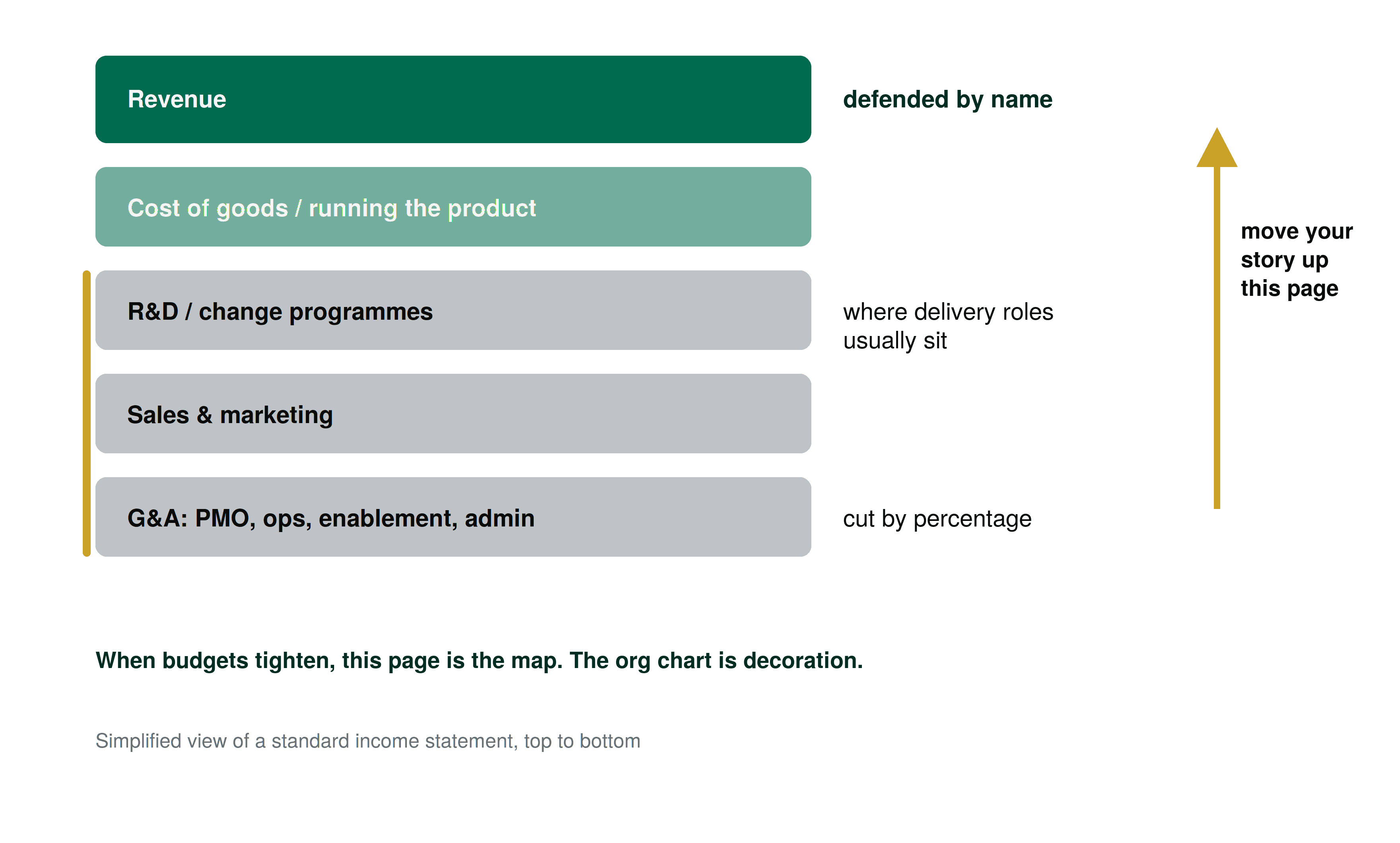
Moving your salary closer to the money
You usually can't change which cost centre you bill to. You can absolutely change how legible the connection is between your work and the money. Three questions to work through this month, not in a crisis.
One: find out where you actually sit. Ask your manager, or whoever owns your budget, two direct questions: which cost centre funds this role, and is our work treated as run-the-business or change-the-business? Asking signals more commercial awareness than most delivery people ever show, and the answer tells you your real exposure. If you're overhead in an org that talks constantly about efficiency, you now know what weather to dress for.
Two: attach your work to named revenue, in writing. Not "improved delivery processes." Instead: "ran the delivery of the client portal that holds the renewal with our second-largest customer." When a sponsor describes what they'd lose by cutting you, you want them armed with nouns. Budget defences are made of nouns. If nothing you do connects to a product, a client, or a committed saving a CFO would recognise, that's not a writing problem. That's a work-selection problem, and it has the same fix: volunteer toward the money.
Three: make someone with a P&L able to quote you. The test of your position isn't whether your manager values you. It's whether someone who owns revenue would notice your absence within a month, and could say specifically what broke. One sponsor who'd fight for you by name is worth more than five satisfied stakeholders who'd sign your farewell card.
None of this is a guarantee. Sometimes whole companies shrink, and no amount of positioning saves a role the strategy no longer needs. The claim here is narrower: in the common case, the ordinary budget-driven cut, your exposure is set by where your cost sits and how visible its connection to value is. Both of those are partly in your hands, but only before the cut, never after.
One caution on tone, because this can curdle into cynicism fast. None of this means gaming your way onto a protected budget while doing hollow work. The move is the opposite: do real work, then make sure the money it protects is written down somewhere a CFO will one day skim at speed. The work earns the defence. The writing makes the defence possible.
The delivery world spends enormous energy on being good at the job and almost none on being structurally hard to delete. Learn to read the second map. You're on it either way.
Sources
TechCrunch (figures from Layoffs.fyi tracking), "A comprehensive list of 2025 tech layoffs," 2025.
Amazon, "An update from SVP Beth Galetti on Amazon workforce reduction," October 2025.

Subscribe to the Newsletter
Join our growing community and get alerted first on our every article.
*By subscribing, you agree to send your information to our Company who agrees to use it according to their Terms and conditions and Privacy Policy
About the author
With 20 years guiding high-stakes Agile transformations, I turn theory into action at Oaktreeuni—mentoring aspiring Scrum Masters to think critically, adapt fast, and lead beyond frameworks. The payoff? You step into a high-paying Scrum Master or Agile PM role already equipped to excel.
What is the difference between a cost center and a profit center?
A profit center generates revenue the business can attribute to it, like a product line. A cost center supports the business without directly producing revenue, like admin, enablement, and often the PMO. In downturns, cost centers are typically reduced by percentage targets.
Are project managers and Scrum Masters usually cost centers?
Often yes: many delivery roles bill to overhead, G&A, or change budgets rather than to a revenue line. Exposure varies by company. Roles embedded in revenue-producing products are usually better protected than central pools.

← Previous post
You're accountable for things you don't control. Put that in writing.
Next post →
Recruiters stopped posting the job. They're searching for you instead.

Keep reading
Newest on the blog


Comments