How to build a community of practice people actually show up to
ESTIMATED TIME
10
mins

Written by
Rajveer Prasad
Published on
Forty invitees, a kickoff deck, a quiet death by meeting seven. What the community of practice that lived did differently.
The Scrum Master guild launched on a Thursday with a kickoff deck. Nineteen slides. A mission statement, a logo someone had made the night before, a recurring invite to forty people, and a promise to be "a space to share best practices and grow together."
Meeting one was nearly full. Meeting two had eleven of us. By meeting four we were six, and I was one of the six, there mostly out of loyalty to the host, who I liked. I remember the texture of that fourth meeting better than anything we discussed in it. She asked, "So, any topics this week?" and the question just sat there. Six tiles on a call, five of them on mute, everyone's real work glowing on the other monitor. You could hear how much nobody wanted to be the one to speak.
By meeting seven the series had quietly disappeared from my calendar. No announcement, no retro, no goodbye. And here's the detail that stayed with me: nobody asked where it went. Forty professionals watched a community die, and not one of them missed it, because there was nothing to miss.
A year later I was in a different room, a smaller one, that people fought to protect. Sprint reviews got moved around it. People joined half sick, from parking lots, on days they had every excuse to skip. Same kind of company, same kind of people, same hour of the week. The difference wasn't the people. It was what the hour was for.
How forty people become six without anyone deciding anything
A community of practice, the term is Etienne Wenger's, is supposed to be the place where practitioners sharpen each other outside the org chart. Most of them never get killed. They just stop being worth defending in a busy week. I've watched enough of them fade to say the decay usually has four causes, and a dying guild often has all four at once.
It becomes a status meeting in disguise. Someone senior asks what the guild is working on, and suddenly the agenda grows an updates section. The moment a community starts reporting progress, it stops being a community and becomes a meeting. Everyone can smell the difference within two weeks.
Content gets presented at people instead of worked with them. A well-meaning volunteer walks through an introduction to flow metrics while eleven people listen politely. Nobody came for slides. They came, at least the first time, hoping someone would help with the thing hurting them that week. It never came up, so they never came back.
One obligated host carries everything. She books the room, chases topics, runs every session, apologizes when it's thin. It's her guild now, which means it's her burden, and burnout stops being a risk and becomes a timeline. That was our host. The loyalty of six people was keeping her company. It wasn't keeping the community alive. Those are different things.
And attendance turns performative. Cameras off, mics muted, other work in front, because being seen to attend the guild reads well somewhere. A room full of people attending but not present is worse than an empty room. The empty one at least tells you the truth.
The invite that said bring your ugliest board
The one that lived never presented anything. The first invite I got from it was one line: "Bring your ugliest board. We'll work on it together. 45 minutes."
I'd put that sentence up against any slide deck ever made. It promises a problem, not a topic. It promises work, not content. It costs nothing to prepare except honesty. And it tells you, before your first session, that this is a room for people willing to be seen mid-mess. That filter changes who shows up, and what for.
So someone would share their real board. The ticket blocked for six days that everyone had stopped seeing. The sprint goal nobody could recite. The review column that had quietly become a retirement home. For twenty minutes the room worked it, live. Not advice from altitude. Questions. What happens if you delete that column? Who reads this board besides you? What did the team say when you raised it? The person with the ugly board did most of the deciding. The room just made the problem impossible to keep ignoring.
Then came the five minutes I now believe are the whole secret: something left the room, every time. A playbook page. A template. One written decision. The day someone typed up what we do when a ticket sits blocked past three days, ugly and unfinished, into the shared playbook was the day the guild started compounding. And the next session, someone else took the mic. Hosting rotated on purpose, so the thing belonged to everyone who had ever run it, and it could survive any one person's calendar.
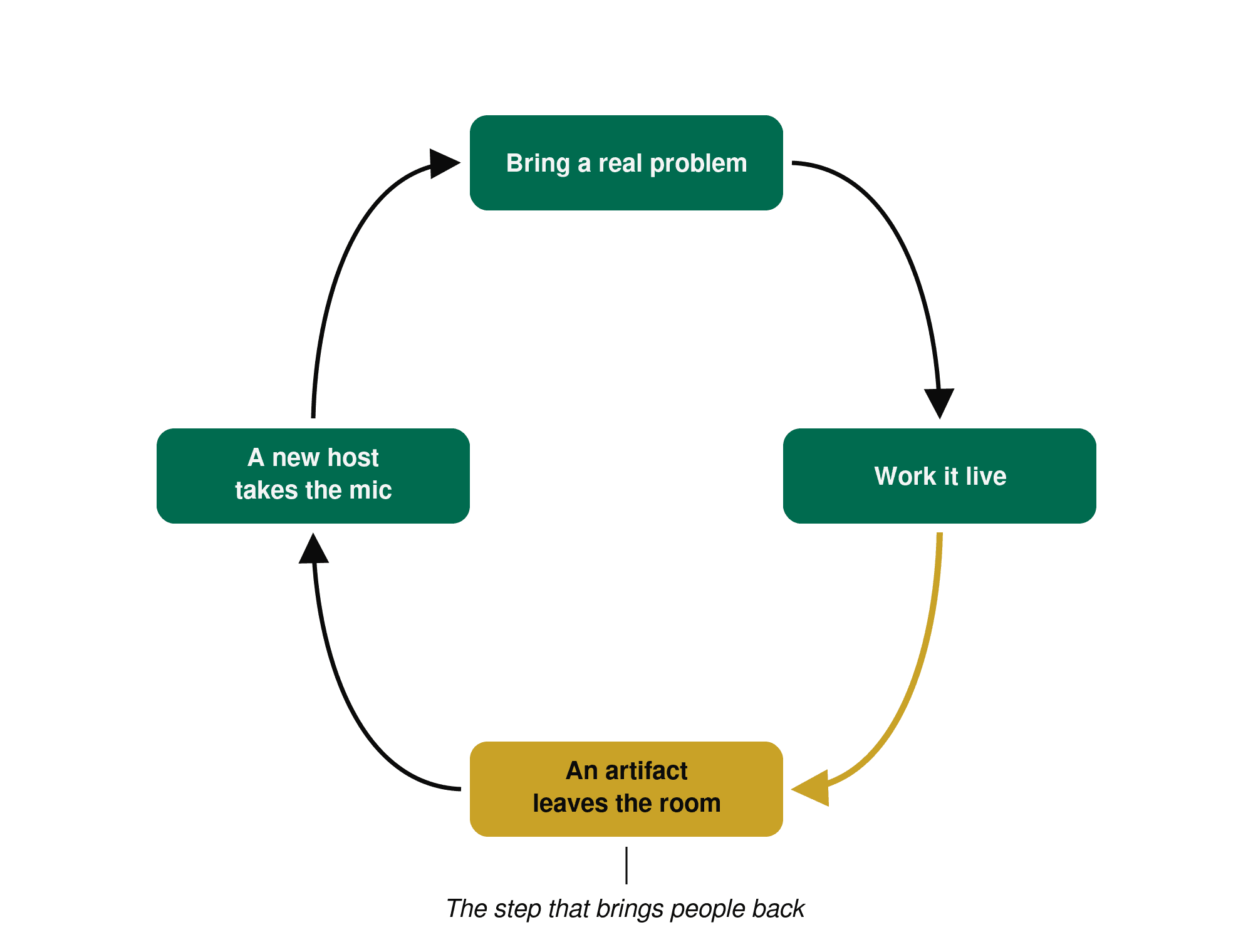
Two quieter things held it up. It had sponsor air cover without a sponsor agenda. A delivery director paid for the hour, defended it when capacity conversations got sharp, and never once asked the group to present anything back. Protection without ownership is rare, and it's worth requesting out loud. And it stayed small and steady instead of big and occasional. Forty-five minutes, every second week, eight to twelve people, not a monthly all-hands with a guest speaker. Communities compound the way habits do. Frequency beats scale.
The month it nearly turned back into a webinar
I want to be honest about the good one, because it wasn't a fairy tale. Around month eight, it drifted. Two strong sessions on estimation got people excited, someone offered to prepare a deeper walkthrough for next time, and suddenly we'd had three sessions of slides in a row. Attendance slid from eleven to seven to five. The same decay curve as the dead guild, just slower, in a room that should have known better.
What saved it wasn't a strategy. One of the regulars opened the next session with a sentence I still quote: "I think we've become the thing we left." That was the whole intervention. The invite went back to one line, bring a real problem or come help with someone else's, and attendance recovered within two sessions.
That's the maintenance truth no kickoff deck mentions. The drift toward presentations never stops, because presenting is easier than working and safer than showing your mess. Guilds rarely die of murder. They die of politeness. Someone has to be willing to name the drift, every time, forever.
Hold the two agendas next to each other
If you keep nothing else from this, keep the contrast. You can test any community you're part of against it this week.
The dying agenda: updates from the group, a presentation someone felt obligated to prepare, and any other business. Fifty-five minutes of content, five minutes of life.
The alive agenda: one ugly board. Twenty minutes working it together. Five minutes writing the playbook page before anyone leaves. That's the entire thing.
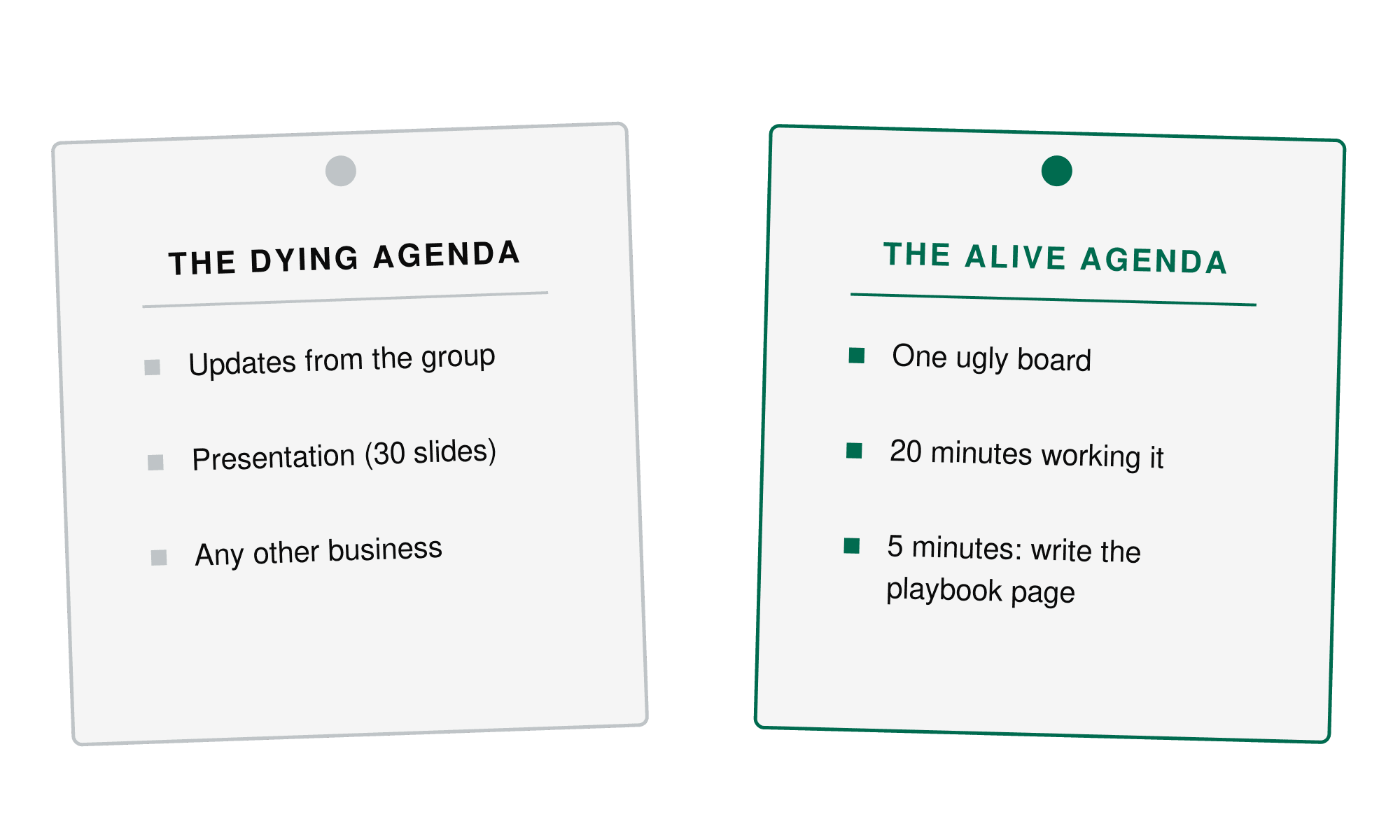
The first agenda asks, what will we cover? The second asks, who's stuck? People skip coverage without guilt. Almost nobody skips the room that helped them last month.
The leadership line you can claim with a straight face
Now the part I most want career switchers and new Scrum Masters to hear.
Hosting a community of practice is real leadership experience. Not adjacent to it. The thing itself. You designed a format people voluntarily kept attending. You facilitated sessions where a senior engineer and a brand-new coordinator disagreed in front of each other and both came back. You persuaded a sponsor to protect an hour of ten people's time without handing over the steering wheel. You shipped artifacts a team still uses. That's facilitation, agenda design, and real stakeholder work, and nobody had to grant you a title first.
If you're trying to break into delivery work and don't have a team of your own yet, this is one of the truest doors available, because starting one needs nobody's permission. Three testers who keep hitting the same handoff problem. Four people from your cohort preparing for the same interviews. A shared doc and a recurring forty-five minute slot. You don't need forty invitees, and you definitely don't need a deck. You need one real problem and a repeating calendar entry.
Then, in an interview, you get to say: I started a community of practice, rotated hosting across eight people, and we built a playbook the group still uses. Every word true, every word checkable, and every follow-up question lands on something you actually lived. That's the difference between building experience and borrowing it. One survives scrutiny. The other is a countdown to the first question you can't answer.
Start with three people and one honest problem
Start smaller than feels impressive. Skip the logo, skip the mission statement, skip the mass invite. Find three people who share your craft, pick the problem that hurts most, and send a one-line invite that promises work instead of content. Let something leave the room every time, even if it's one ugly paragraph in a shared doc. Hand the mic to someone else by session three.
And when it drifts toward presentations, because it will, be the one who says so out loud. I've sat in the silence of a room where nobody did. Build the kind where nobody has to.

Subscribe to the Newsletter
Join our growing community and get alerted first on our every article.
*By subscribing, you agree to send your information to our Company who agrees to use it according to their Terms and conditions and Privacy Policy
About the author
With 20 years guiding high-stakes Agile transformations, I turn theory into action at Oaktreeuni—mentoring aspiring Scrum Masters to think critically, adapt fast, and lead beyond frameworks. The payoff? You step into a high-paying Scrum Master or Agile PM role already equipped to excel.
What is a community of practice?
A group of practitioners who meet regularly to work real problems in their shared craft and get better together. The term comes from Etienne Wenger. In delivery work it usually shows up as a Scrum Master guild, an agile chapter, or a PM roundtable.
Why do most communities of practice fail?
They drift into status meetings, present content at people instead of working problems with them, lean on one exhausted host, and reward performative attendance. When nothing useful leaves the room, people stop defending the hour.
How do you start a community of practice without authority?
You don't need permission. Find three people who share a real problem, book a recurring forty-five minute slot, work one problem live per session, write down what you decided, and rotate the host from session three.

← Previous post
How to deliver bad news in a project update (and build trust doing it)
Next post →
How a paramedic became a delivery lead: an interview

Keep reading
Newest on the blog


Comments