How to deliver bad news in a project update (and build trust doing it)
ESTIMATED TIME
12
mins

Written by
Shikha Prasad
Published on
Softening the status feels kind in the moment. Two weeks later it reads as hiding. Here's how to say the hard thing and keep their trust.
Early in my career I spent a full minute staring at a dropdown.
It was a Tuesday afternoon, week three of a payments integration, and the weekly report had a field called Overall Health. The honest answer was red. The vendor's test environment had been down for four days. My lead developer had just been pulled onto a production issue. The milestone wasn't going to hold, and I knew it the way you know these things: not from the burndown, but from how quiet the team channel had gone.
I picked amber.
I had a story ready while I did it. Amber with a plan, I told myself. The environment would come back, my developer would come back, and we'd quietly make up the time. A red felt dramatic. Why alarm everyone about a fire I could probably put out myself?
Two weeks later the fire introduced itself. The vendor's account manager mentioned the new dates on an email thread my director was copied on. She called me that afternoon, and she didn't ask about the slip. She asked, "How long have you known?"
I didn't have a good answer. The slip cost the project three weeks. That question cost me a year of having my greens double checked.
Here's what I'd tell the version of me still hovering over that dropdown: bad news, delivered early and plainly with a plan attached, builds trust. It's the delay that burns it.
The story I told myself about protecting them
I wasn't lying, exactly. I was softening. And softening always arrives wrapped in a generous story: I don't want to worry them before I'm sure. I need more information first. They have enough on their plates. It felt considerate. It even felt professional.
Underneath it sat something simpler. Most of us learn, somewhere along the way, to treat bad news as a confession. If the project has a problem, then I have failed, and saying it out loud feels like standing up and admitting fault. So we wait, hoping for a rescue that would make the confession unnecessary. The rescue rarely comes. The news just gets older.
And while it ages, your stakeholder is building on it. That's the part I missed. My director wasn't filing my amber away; she was passing it upward. A customer pilot got scheduled off dates I'd implied were safe. My softened status didn't sit quietly in a report. It became someone else's promise.
A slip they hear about on day two is a planning problem. The same slip on day thirty is a promise they've already broken to someone else, in your handwriting.
So this is the belief worth dropping: that softening the status protects the relationship. It doesn't. It protects you, briefly, and it bills the relationship later, with interest.
What a hedge sounds like on their side of the table
The update I did send that week used a sentence I'd seen in a dozen status reports: "Some risk has emerged around the vendor integration timeline. We are monitoring closely."
Read that as a stakeholder for a second, someone skimming eleven updates between meetings. Here's the real translation. "Some risk has emerged" means normal project weather, nothing to act on. "Monitoring closely" means handled. The sentence was technically true and communicated nothing. I hadn't written it to inform her. I'd written it so that later, if things went wrong, I could point at it and say I mentioned the risk. A hedge isn't communication. It's an alibi with a timestamp.
And when the truth surfaces anyway, the translation flips on you. A late red never reads as news. It reads as a decision you made not to tell them. From that day forward, your updates get audited. Extra check-ins appear on the calendar. Questions get more detailed. Your team starts getting pinged directly. We usually call that micromanagement. A lot of the time it's just the invoice for a surprise.
The same news, written twice
Now put two versions of that same week side by side.
The first buries it: two paragraphs of progress, a milestone table, and the slip tucked into paragraph four wearing its "some risk has emerged" costume. No number, no owner, no ask. A reader in a hurry, which is every reader, files it under fine.
The second one leads with the headline. The vendor integration has slipped three weeks. The pilot moves from Oct 12 to Nov 2. Priya owns the workaround, and it's in test by Friday. We need your call on scope by Thursday. Next update Friday at 3pm.
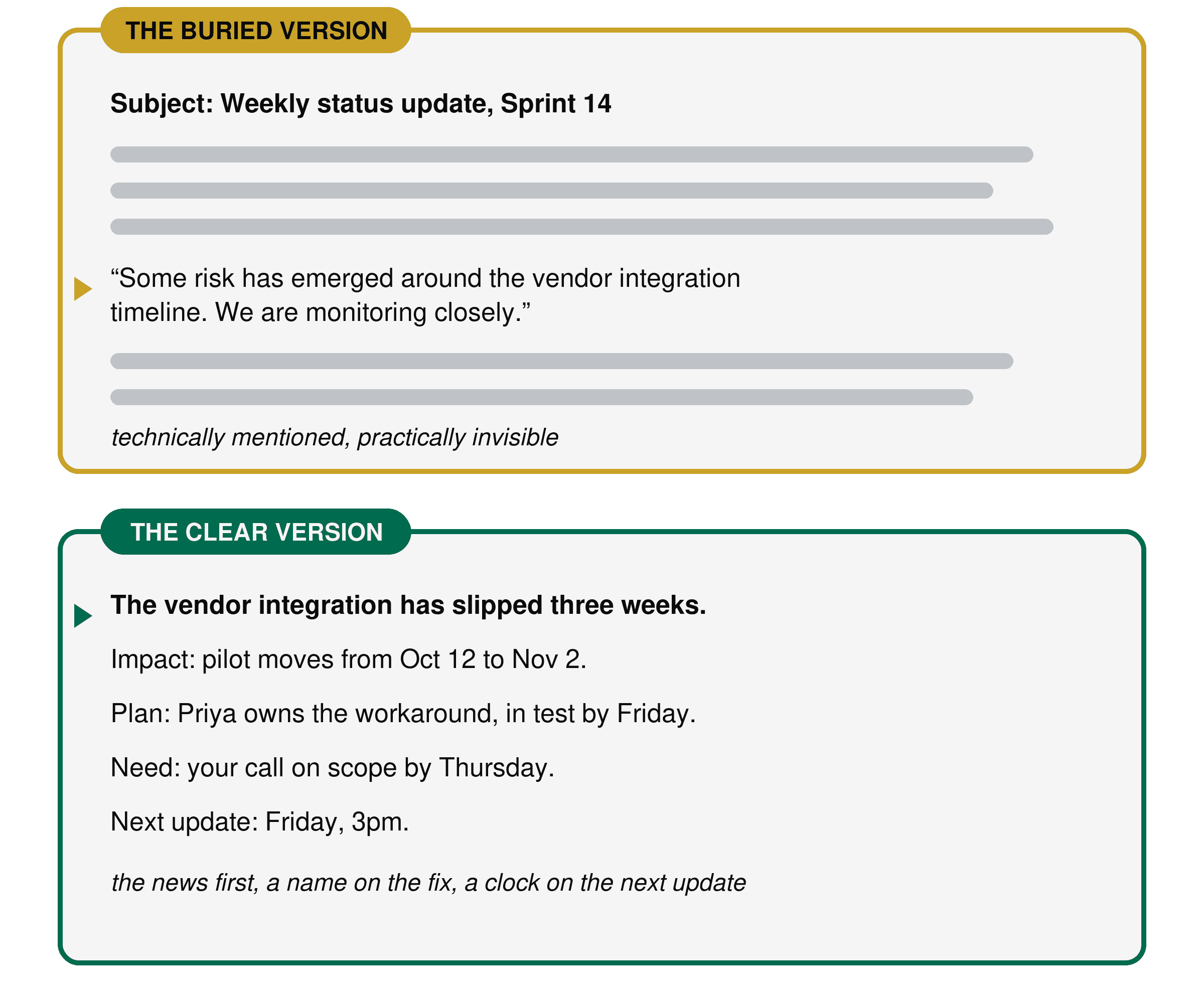
Notice what the second version does. It answers the three questions every stakeholder is silently asking: how bad, who's on it, when do I hear more. It puts a name on the fix, which makes the plan real instead of rhetorical. It makes one clear ask, which tells them what their job is now. Five lines, no adjectives, no apology tour.
The counterintuitive part is how it lands. The clear version reads as more competent, not less. Bad news with no plan is panic. Bad news with a plan and a date is a professional doing their job. You don't lose authority when you say it slipped. You lose authority when someone else says it first.
A shape that holds when your stomach drops
That second update wasn't talent. It was a shape, and shapes are what hold when your stomach drops and your writing wants to hide. Mine has five moves, small enough to fit in an email or thirty seconds of a call.
Say what changed, first line, as a fact. Then what it means, in their currency: dates, money, scope, customers, not story points. Then what we're doing, with a person's name attached. Then what we need from them, even if the honest answer is nothing right now. And finally, when they'll hear from you next. A named day and time.
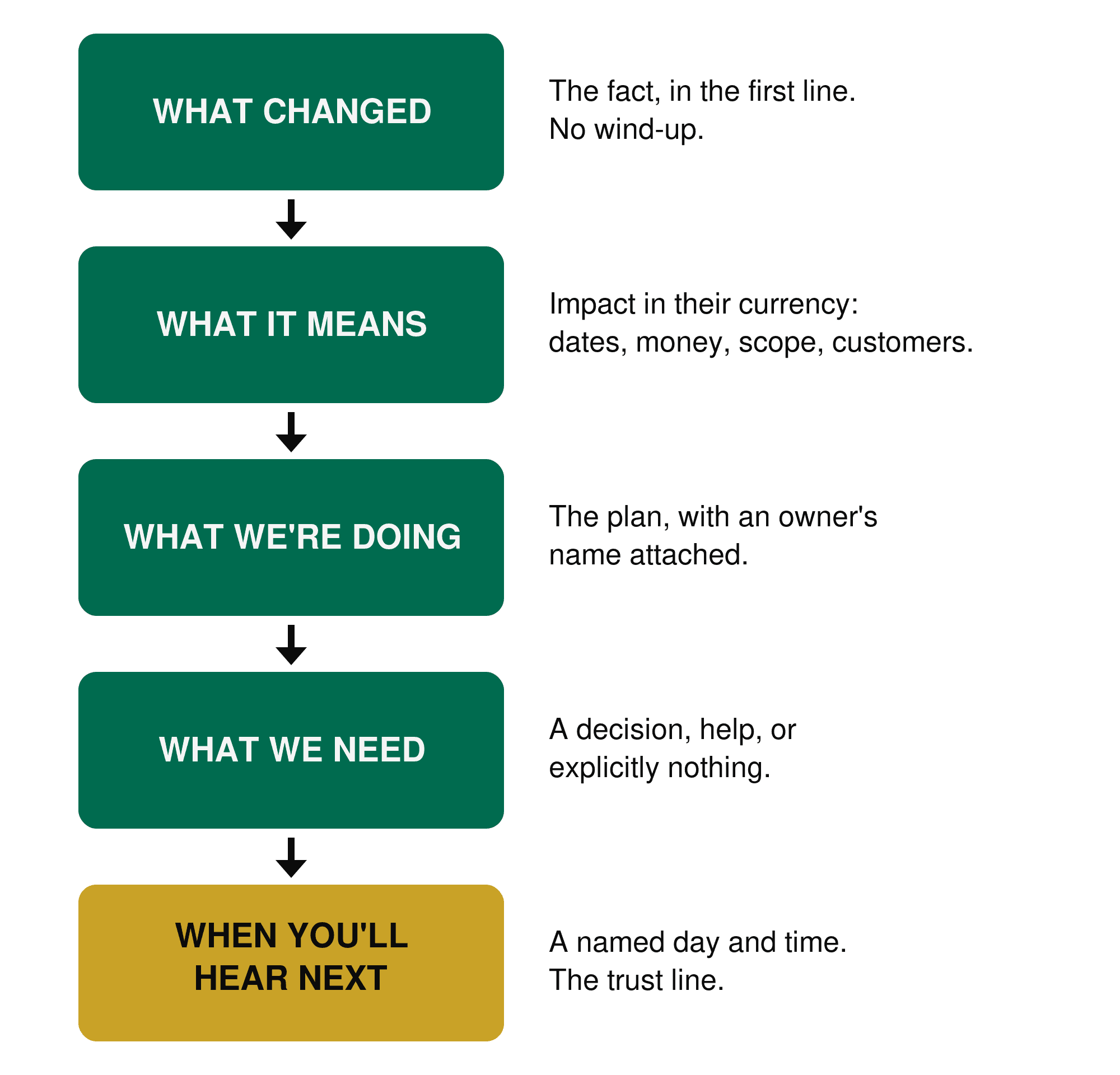
That last line looks like the small one. It's the trust line. What makes stakeholders escalate isn't bad news; it's open-ended uncertainty, not knowing whether more is coming or whether they'll have to chase it. "Next update Friday at 3pm" gives the worry somewhere to sit. It turns a shock into a managed process. People can wait for news. They can't wait for silence.
One warning: the shape only works at the speed of honesty. Fill it in the day you're confident the problem is real, not the day the recovery plan is airtight. Waiting for the perfect plan is just a more sophisticated way of sitting on a red.
Day two news and day thirty news are different products
Here's the strange economics of a slip: the facts can be identical and the story completely different, depending on one variable. Who says it first.
Announce it on day two and the news is small. Options are still open: descope, resequence, move people, warn the customer while the warning still helps. You're the person who caught it early and showed up with a plan. Stakeholders remember that longer than they remember the slip itself.
Let it be discovered on day thirty and the same facts arrive as a surprise wearing your name. The options are mostly spent. And the conversation is no longer about the project. It's about you. What else don't I know? Nobody audits the person who tells them early. Everybody audits the person they had to find out about.
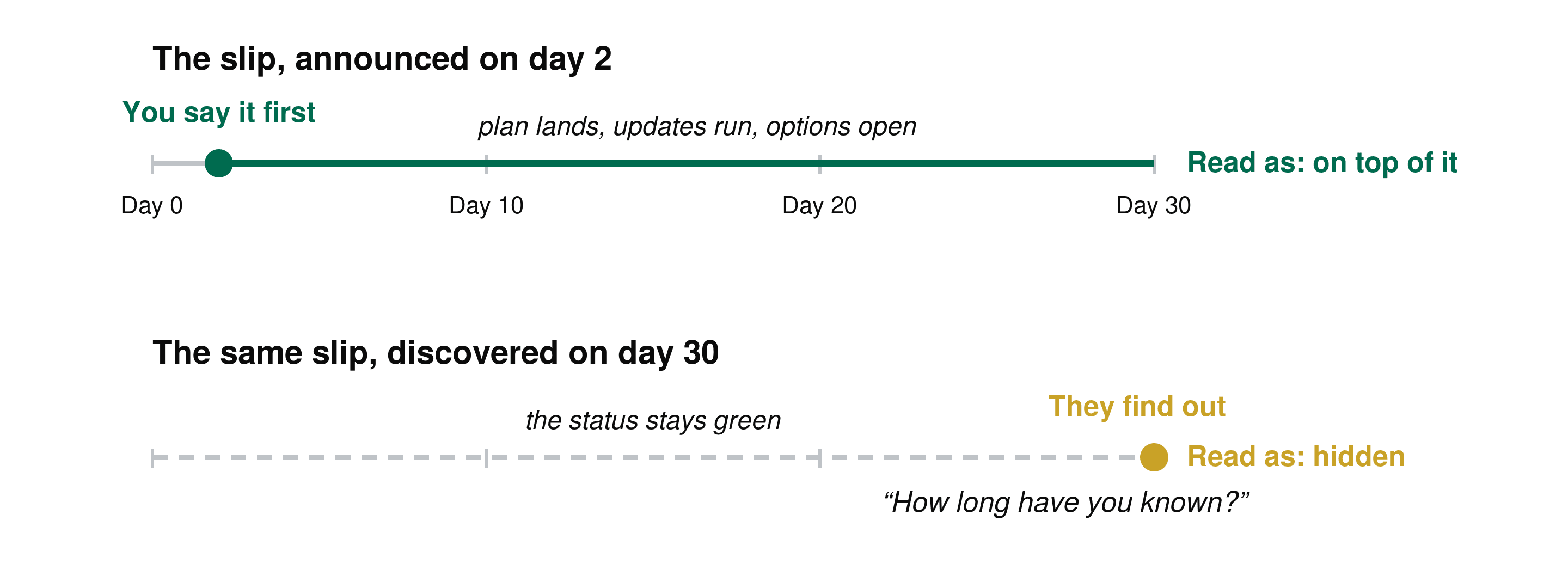
The slip didn't change. The dates didn't change. The only thing that changed was who owned the telling, and that one variable turned the same event into two different products: one builds trust, the other spends it.
Say it while it's still small
I'd love to tell you I never hovered over that dropdown again. The truth is I have, on every slipping project since, because the pull to soften never fully goes away. What changed is what I do with the minute. I write the five lines. I hit send while the news is still small enough to be useful.
If you're working toward Scrum Master or project manager roles, it's worth knowing that "tell me about a time you delivered bad news" is one of the most revealing interview questions there is. The interviewer isn't collecting stories. They're deciding whether your updates will be worth believing. A candidate who describes catching a slip on day two, naming the impact, and setting the next update sounds like someone who has carried a project. Because that's exactly who talks that way.
You can't always control whether the project slips. You control whether they hear it from you. Some weeks, that's most of the job.
And if you've softened a status before, you're not dishonest. You were taught that green is the only safe colour. It isn't. Bad news, delivered early and plainly, is how a stakeholder learns what your word is worth. That's not a confession. That's the work.

Subscribe to the Newsletter
Join our growing community and get alerted first on our every article.
*By subscribing, you agree to send your information to our Company who agrees to use it according to their Terms and conditions and Privacy Policy
About the author
I believe the strongest tool and flex each of us has is our belief. When we truly believe in something, we align our mindset, energy, and actions with the right effort and guidance. That is when achieving almost anything becomes possible. This is how I help mentees at OAKKTREEUNII move into Software and Project Management careers for better pay, better confidence, and better work-life balance.
How do you deliver bad news to stakeholders?
Lead with what changed as a plain fact, state the impact in their terms, name the owner and the plan, make one clear ask, and commit to a next update time. Early and plain beats polished and late.
When should you tell stakeholders about a project delay?
As soon as you're confident the delay is real, even if the recovery plan isn't finished. News on day two leaves everyone options. The same news discovered on day thirty reads as concealment.
Does delivering bad news hurt your credibility?
Not when it arrives early with a plan attached; that reads as competence. Credibility is lost to surprises: statuses that stayed green until the truth arrived from someone else.

← Previous post
Line up your references before you need them
Next post →
How to build a community of practice people actually show up to

Keep reading
Newest on the blog


Comments