How a paramedic became a delivery lead: an interview
ESTIMATED TIME
11
mins

Written by
Shikha Prasad
Published on
Eleven years on an ambulance taught her triage, handoffs, and calm under pressure. It turns out that's most of the job.
The first time I talked to Dana, she described a cardiac arrest and a production incident in the same sentence, and she didn't notice she'd done it. We were twenty minutes into a mentorship call, she was a few months into a new delivery role, and she was telling me about a go-live that had fallen over badly. "It felt like a cardiac call," she said. "Everyone looks at you, everything is beeping, and your whole job is to make the next minute calmer than the last one."
I've sat with a lot of career switchers over the years, and I've learned to listen for that kind of sentence. Not the certifications. The instincts.
Before we start, I owe you some honesty about who you're meeting. Dana is a real story wearing a borrowed name; she's fine with me sharing it, and the name is hers to keep. She's also a composite. I've stitched her together from a few real mentees who made this same switch, so no single person is on display here. Every detail below comes from a real road someone walked; only the seams are mine. If you're a paramedic, a nurse, a dispatcher, or anyone whose job runs on adrenaline and checklists, and you've been quietly wondering whether a career change to project management is possible for someone like you, this conversation is yours.
Eleven years on the truck
Take me back to the ambulance. What did an ordinary shift look like?
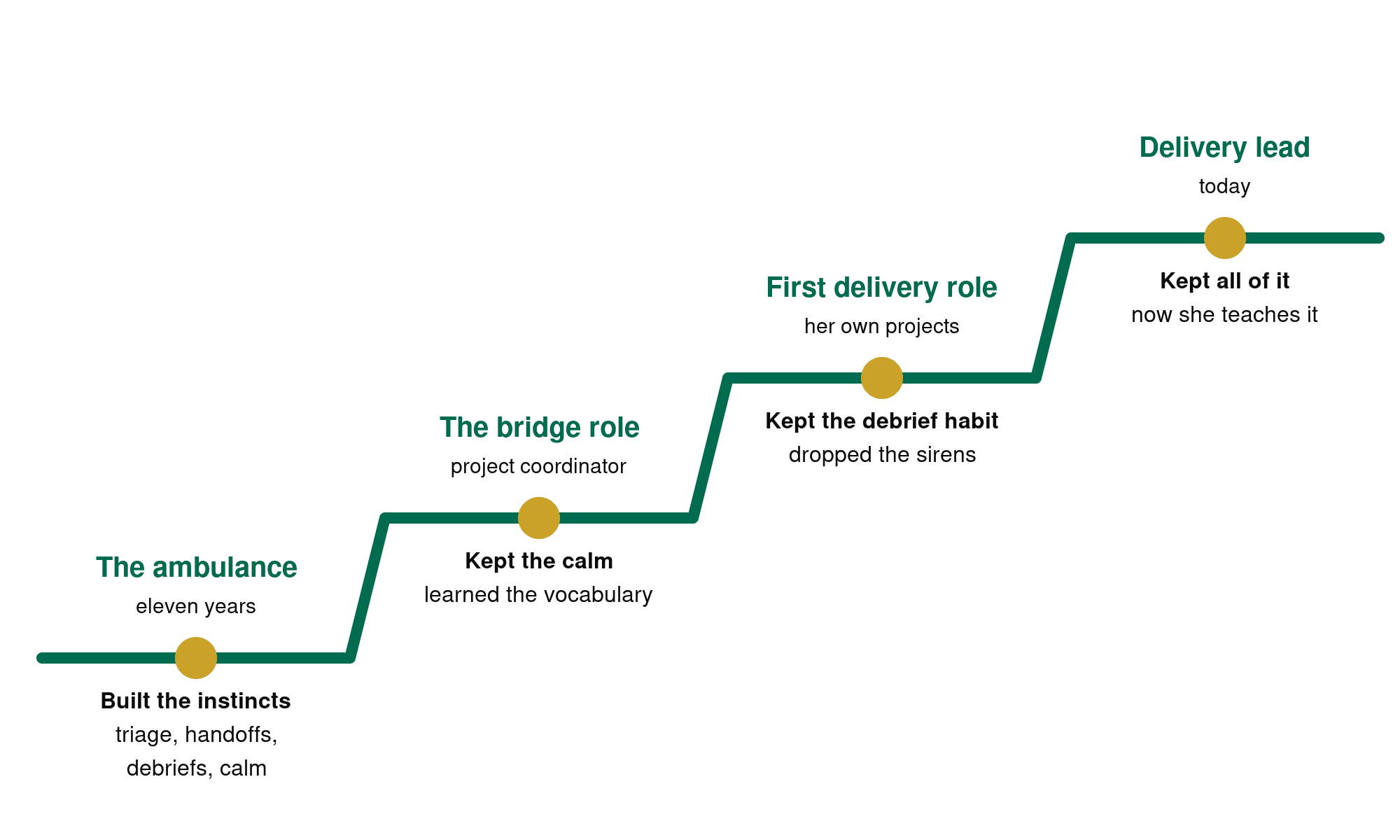
There's no ordinary shift. That's the first thing the job teaches you. You'd start with a lift assist for an elderly gentleman, then a suspected stroke, then three quiet hours, then a highway call that used up everything you had. Twelve hours of that, four days in a row, for eleven years. By the end I was the senior medic on the truck, which mostly means you're the one everybody looks at when a scene goes sideways.
When did you first think about leaving?
Slowly, then all at once. I didn't fall out of love with the work. I fell out of love with what it cost. My back had opinions about stretchers. Night shifts were wrecking my sleep even on days off. I tried to picture myself doing it at fifty and couldn't finish the picture. The part that took longest was the guilt. Leaving felt like quitting on something that mattered, and it took me most of a year to admit that a job can matter and still be finished with you.
Why delivery work? Of all the places a paramedic could land next.
I made two lists: everything I wanted to keep and everything I wanted to lose. Keep: the team, pressure with a purpose, days that have a shape. Lose: the nights, the lifting, the part where somebody's worst day is my normal shift. Then a friend watched me run a community fundraiser, the volunteers, the schedule, the vendor who didn't show, and said, you know you just managed a project, right? You do it on every call too; yours just last twenty minutes. I laughed. Then I couldn't stop thinking about it.
The resume that said paramedic
You started applying for project roles while you were still on shift. How did that go?
Honestly? Nothing happened, and the nothing was the worst part. I sent out a resume with paramedic at the top and my certifications underneath. I applied to coordinator roles and junior project roles for about two months and got zero callbacks. Not rejections. Silence. Recruiters saw the word paramedic and had no shelf to put me on. I remember thinking, I've run scenes with four agencies and a helicopter, and I can't get a fifteen-minute phone screen.
What changed?
Someone made me rewrite the resume line by line, with one rule: no medical words unless I translated them in the same breath. So "ran point on multi-agency scenes" became "coordinated four teams with competing priorities against a hard clock." "Wrote patient care reports" became "documented decisions under time pressure so the next team could act on them." Same facts, different language. It felt like spin for about a day, until I noticed nothing in it was inflated. It was just the first time my experience was written in words a hiring manager could use. The callbacks started after that. The work hadn't changed. The translation had.
Did the interviews feel different once you were finally in the room?
Easier than I expected. The stories were the same ones I would have told anyway; I'd just stopped apologizing for where they happened. My best answer about conflict was still two medics disagreeing over a transport decision while a family watched. My best answer about learning from failure was still a call review that changed how we did handovers. I learned to end every story with what changed afterward, because that's the part interviewers lean in for. Nobody ever asked me to pretend the ambulance was an office. They asked what I'd do on day thirty, and the ambulance had answered that too.
Triage is a Tuesday
People say transferable skills and it sounds like a poster in a guidance office. Make it concrete for me. What actually transferred?
Four things, and I use every one of them weekly.
Triage is the big one. Triage means deciding who gets treated first when you can't treat everyone, with incomplete information, out loud, and owning it. That's ruthless prioritization under pressure, which is exactly what a delivery lead does when five urgent asks land on a team with capacity for two. Most people find prioritization emotionally hard. I find it Tuesday.
Handoffs. Every patient I ever transported ended with a structured handoff to the hospital team. Here's who this is, here's what happened, here's what I did, here's what to watch for. If information dies in a handoff, the patient pays for it. In delivery, work dies in handoffs constantly, between teams, vendors, and time zones. So I treat every dependency like a patient transfer. Who's receiving this? What do they need to know? Did they confirm they heard it?
Debriefs. After a hard call, you debrief. Nobody asks whose fault it was. You ask what the system did and what changes before the next call. The first retrospective I ever sat in, I thought, oh, this is a debrief with sticky notes. I already knew the hard part, which is talking about failure without hunting for a villain.
And radio updates. On a radio you learn to say what's happening, what you're doing, and what you need, in ten seconds, with no panic in your voice, because panic is contagious and so is calm. That's a status update. That's stakeholder communication. An executive under pressure is just a quieter dispatch channel.
Actually, there's a fifth. On a bad scene you're directing firefighters, police officers, and bystanders, and not one of them reports to you. Tell me that isn't a delivery lead's ordinary morning.

The bridge year nobody glamorizes
Your first job off the truck wasn't a delivery lead role. What was it?
A project coordinator seat on a systems implementation. Scheduling, minutes, chasing updates, keeping the risk log honest. A big step down in adrenaline and, for that year, a real step down in pay. I went in with my eyes open. I needed the vocabulary, the tools, and reps in rooms where the stakes were dashboards instead of sirens. I kept telling myself it was a bridge, not a demotion. Most days I even believed it.
What did the switch actually cost you? Be honest.
The pay cut year was real. We planned for it, trimmed things back, and it still stung every payday. And the imposter feeling, which nobody warns you comes on a schedule. For my whole first quarter I sat in meetings translating in my head, convinced everyone could smell how new I was. I'd been the most experienced person on every scene for years, and suddenly I was the one quietly googling burndown charts. What pulled me out was a go-live that started slipping while the room spiraled. I did the only thing I knew. What do we know, what are we doing, what do we need, who needs to hear it. The room went quiet and got to work. That was the day I stopped feeling like a tourist.
What did you have to unlearn?
Treating everything like a cardiac arrest. In emergency medicine, over-responding is the safe direction. In an office it burns people out and makes the real emergencies invisible. I had to learn that most things are not emergencies, and that what I actually brought from the ambulance was never urgency. Urgency was the context. Calm was the skill.
Make the next hour calmer
You're a delivery lead now. What does the job feel like on a good day?
Like running a scene where nobody's hurt. I mean that. The job hasn't changed shape. Make the next hour calmer than the last one, and let nothing die in a handoff. I just get to do it sitting down, with coffee, and everyone goes home fine.
What would you tell someone reading this on a break between shifts?
Start translating before you feel ready, because ready arrives late. Take one shift and write down what you actually did, in plain words. Then ask which of those things a project team pays for. Prioritizing with incomplete information. Structured handoffs. Debriefs without blame. Calm updates to worried people. You don't have zero experience. You have hundreds of reps filed under a different name. Then find a bridge role and respect it while you're standing on it. And plan for the dip, the smaller paycheck and the imposter quarter, because both are real and both end.
What I want you to steal from Dana
Here's what I keep turning over since that first call. Dana didn't get hired in spite of the ambulance. She got hired because of it, the moment her experience started speaking the hiring manager's language. The eleven years were never the problem. The missing piece was the translation.
So steal her exercise. Tonight, take one week from the job you already have and write it twice. Once in your industry's words. Then again in delivery words. What did you prioritize? What did you hand off? What did you learn from a debrief? Who did you keep calm? That second page is your first interview story, and every line of it is true.
A career change to project management doesn't ask you to start over. It asks you to notice what you've been practicing all along and say it in a language the next room understands. You're not at zero. You've been training in a harder gym than most of us will ever visit.

Subscribe to the Newsletter
Join our growing community and get alerted first on our every article.
*By subscribing, you agree to send your information to our Company who agrees to use it according to their Terms and conditions and Privacy Policy
About the author
I believe the strongest tool and flex each of us has is our belief. When we truly believe in something, we align our mindset, energy, and actions with the right effort and guidance. That is when achieving almost anything becomes possible. This is how I help mentees at OAKKTREEUNII move into Software and Project Management careers for better pay, better confidence, and better work-life balance.
Can a paramedic become a project manager?
Yes. The core skills transfer directly: triage is prioritization under pressure, patient handoffs are dependency management, incident debriefs are retrospectives, and radio updates are stakeholder communication. Most switchers take a bridge role, often project coordinator, to learn the tools and vocabulary first.
What transferable skills do first responders bring to project management?
Prioritizing with incomplete information, running structured handoffs, holding blameless debriefs, communicating calmly under pressure, and leading people who don't report to them.
Do you take a pay cut when you change careers into project management?
Often there's a leaner first year, especially entering through a coordinator role. Many switchers plan for it while they build delivery experience, then progress from there.

← Previous post
How to build a community of practice people actually show up to
Next post →
Big-room planning, explained: what actually happens in the two days everyone dreads

Keep reading
Newest on the blog


Comments