Where resumes actually die: the recruiter, the ATS, and the hiring manager
ESTIMATED TIME
10
mins

Written by
Shikha Prasad
Published on
Your resume is one story, read by three very different people in a row. It can die at any of them, for reasons that have nothing to do with how hard you actually worked.
A mentee sent me her resume last spring with one line above it: "I think it's good. So why is nothing happening?"
She wasn't wrong. It was good. Clean, honest, three years of coordination work she'd quietly turned into real delivery experience. She'd sent it to more than thirty roles. Nothing came back. Not even a no. Just silence, which is somehow worse, because you can't learn anything from it.
We spend so long polishing the resume that we skip the strangest question about it. Who actually reads this thing? Because "the company" doesn't read your resume. Three different readers do, one after another, and they don't want the same thing. Your resume can be alive for one of them and already dead for the next.
Here's the part nobody tells you. Most of us write for one imaginary reader who studies every line. That reader doesn't exist. The real ones are a piece of software, a rushed recruiter, and a hiring manager, in that order, and each can end your application for a completely different reason. So let me walk you through the three doors. Once you can see them, you stop guessing about why it's quiet.
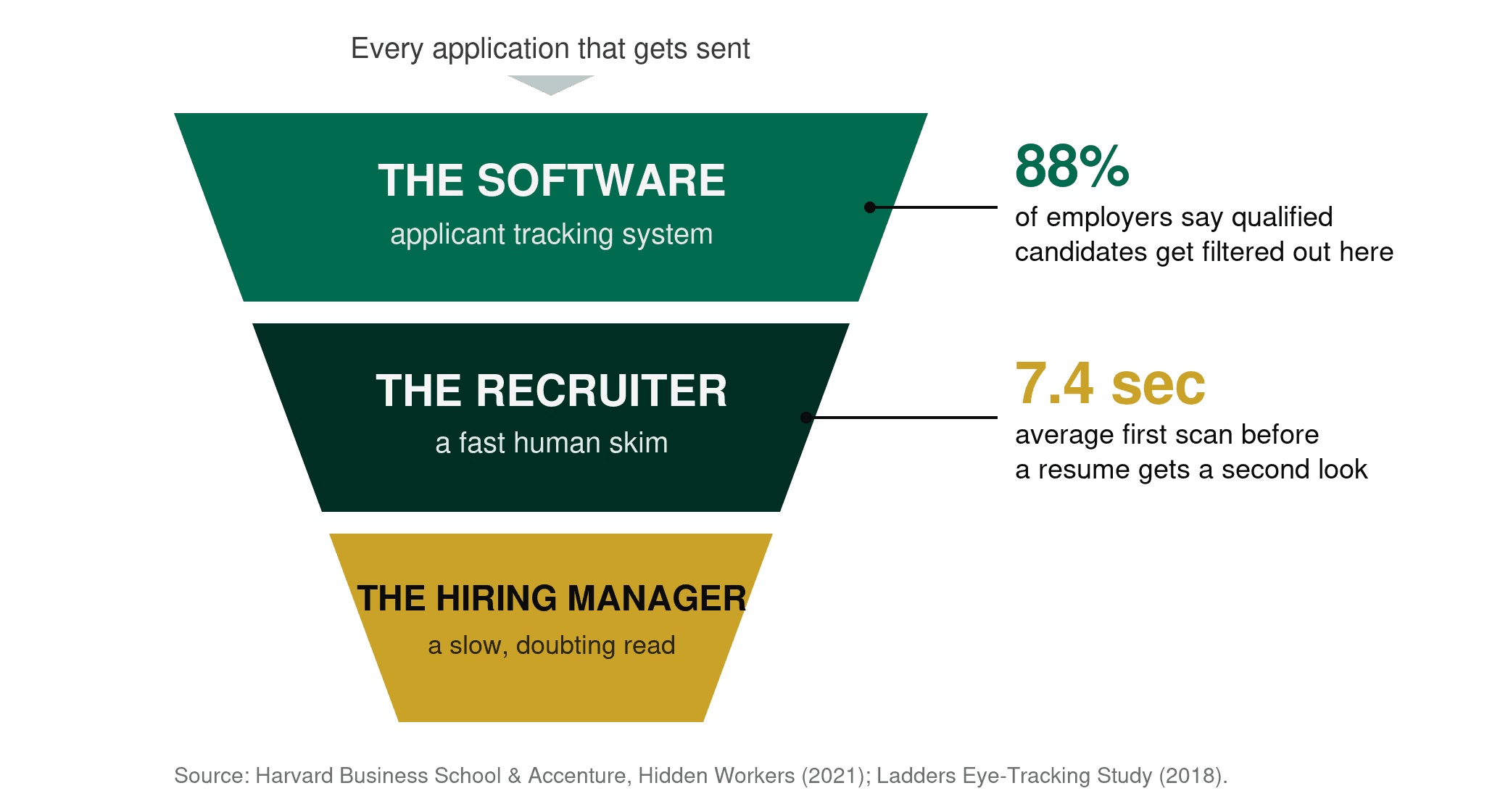
First, a machine has to be able to read you
Most of the time, before a single human sees your resume, software has already sorted it. Applicant tracking systems file and rank applications at scale. They're not judging whether you're talented. They're checking whether what you wrote lines up with the criteria someone loaded in.
This is where capable people vanish without a sound. In a Harvard Business School study of hiring, 88% of employers agreed that qualified, high-skilled candidates get screened out of the process because they don't match the exact terms of the job posting {Harvard Business School and Accenture, Hidden Workers: Untapped Talent, 2021}. Not because they couldn't do the work. Because the resume didn't say the thing in the words the filter was looking for.
I want to be careful here, because a lot of fear gets sold about this stage. The machine isn't a villain auto-rejecting everyone. A human still sets the rules, and a human still reads what surfaces. But the practical truth holds: if your resume isn't readable by something that can't infer, you're gambling.
So make it readable. If the role says "stakeholder management" and you wrote "kept everyone in the loop," you've described the same work in words the search will miss. Use the real terms for what you actually did. Skip the two-column designer layout that looks lovely to you and parses like alphabet soup to a machine. None of this is gaming the system. It's translating your real work into the language the room is already using. And no, you don't paste the job description in white text. That trick gets caught, and you're better than it.
Then a human skim decides if you're relevant
Say you clear the software. A person picks you up now, and they are moving fast. Eye-tracking research found recruiters spend about 7.4 seconds on the first pass of a resume before deciding whether to keep reading {Ladders, Eye-Tracking Study, 2018}.
Seven seconds isn't reading. It's a pattern match. In that glance, the recruiter is answering one question: does this person obviously do the job we're hiring for? If the answer isn't sitting near the top of the page, the resume doesn't earn a slower second look. It gets set down, gently, and forgotten.
This is the death most people never feel, because it's so quiet and so unfair. Your best project is on there. Your strongest line is on there. It's just on line nineteen, under a paragraph about a job from six years ago, and the recruiter never reached it.
So lead with the signal. The top third of page one should answer "what are you, and can you do this role" before the reader has to dig. A clear title. A one-line summary that names the role you're going for. Then your most relevant, most recent proof. Chronology is a habit, not a rule. Put the relevant thing where the eye actually lands.
Last, someone has to believe you
Clear the machine, survive the skim, and you finally reach the person who has the problem you'd be hired to solve. The hiring manager reads differently from the other two. Slower. And doubting, in a useful way. They've been burned before by resumes that read beautifully and people who couldn't do the job once they arrived.
They're not scanning for keywords anymore. They're reading for evidence. Can I trust this person when the sprint is on fire and the stakeholder is upset and nobody has a clean answer? This is where even strong resumes, the ones that made it this far, tend to fall apart. They list duties. "Facilitated daily standups. Managed the backlog. Coordinated stakeholders." That tells the manager which chair you sat in. It says nothing about whether you were any good in it.
A duty says you were present. A result says you changed something. "Facilitated standups" becomes "cut a recurring two-day handoff delay by surfacing the blocker pattern in standup." Same job. One version sounds like a person who noticed, decided, and made things better. That's the one who gets the call.
This is the storytelling part, and it's why this post lives where it does. A resume isn't a list. It's the shortest story you'll ever tell about your own judgment, and every strong line has the same quiet shape. Here's what was happening. Here's what I did. Here's what changed.
Three readers, three different questions
Lined up, the gauntlet is almost reassuring, because each door has a clear job and a clear way to fail it. The machine wants the right words in plain text. The recruiter wants instant relevance. The manager wants believable evidence. Miss any one and you stop there, no matter how strong you are on the other two.
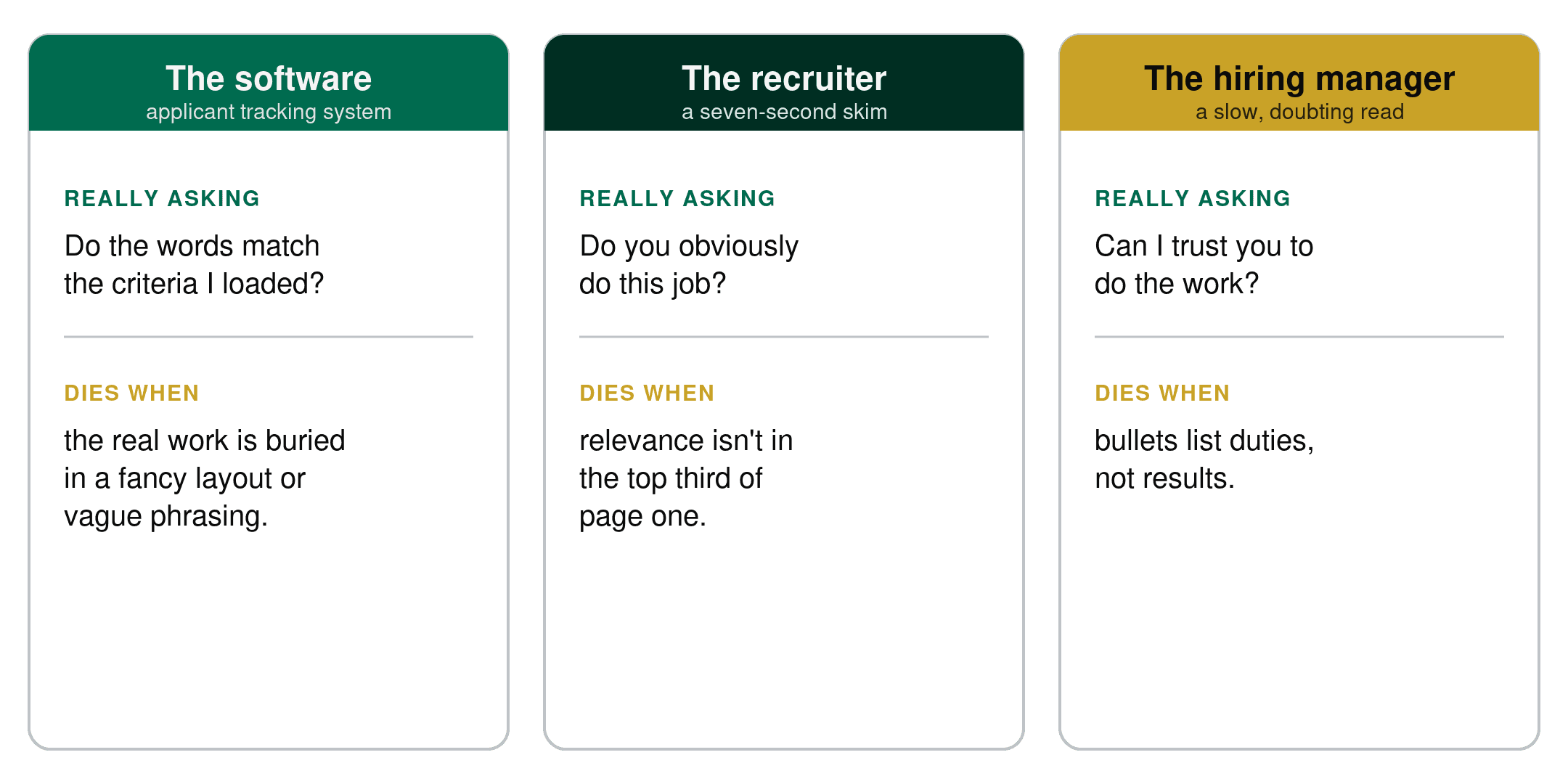
The mistake my mentee was making, the one I made for years, is editing the resume as if a single perfect version would satisfy all three. It won't, and you don't need three resumes either. You need lines that survive all three at once.
One line that survives all three
A line that survives the machine uses the real words for the real work. A line that survives the recruiter puts the relevant thing where the eye lands in seven seconds. A line that survives the hiring manager carries a result, not a description. Write one bullet that does all three and you've built something that holds up the whole way down.
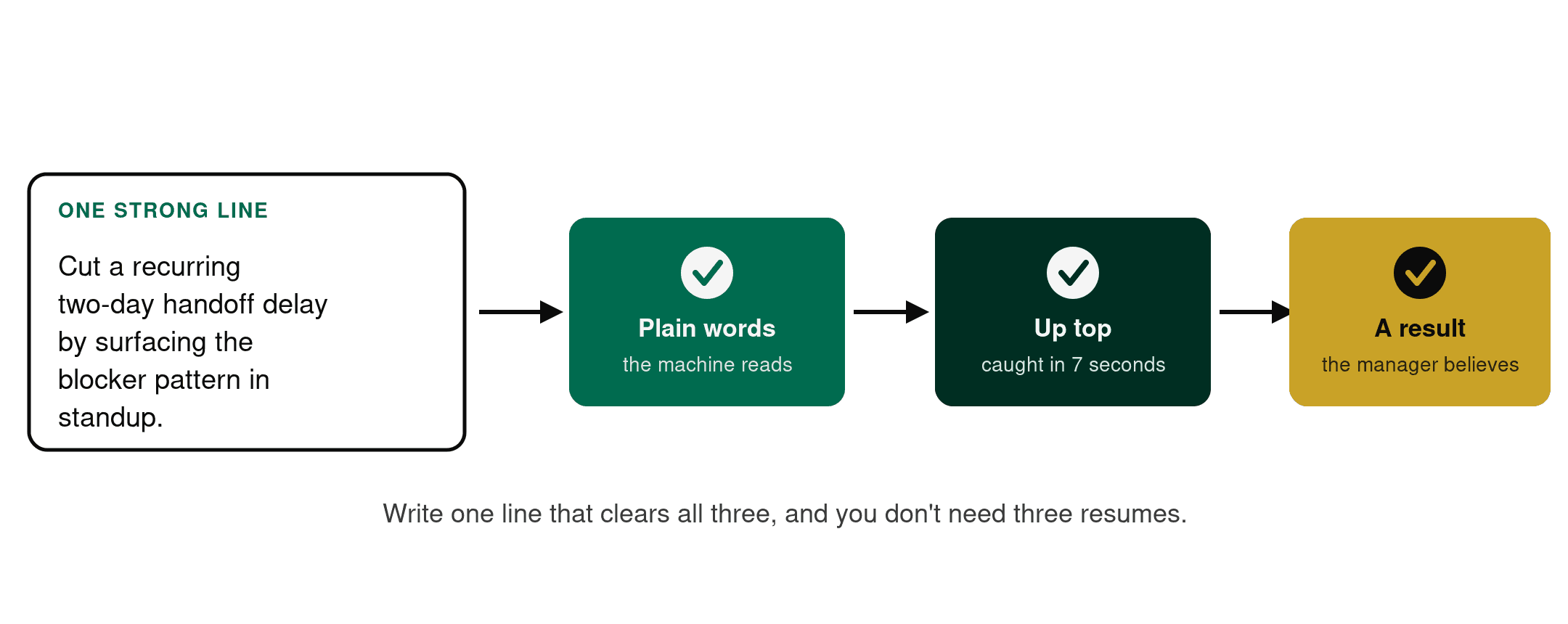
So before you send the next application, read your own top third three times, once as each reader. As a parser: are the actual role words here, in plain text, not trapped in a graphic? As a rushed recruiter: in seven seconds, is it obvious what I am and that I can do this? As a tired hiring manager: do I believe this person did the work, or just sat near it? If a line fails one of those reads, that's your fix, and it's usually a small one.
When the honest answer is “I haven't done that yet”
Sometimes you do all of this and hit a wall. The relevant proof isn't there, because the experience isn't there yet. That's not a writing problem, and no amount of clever phrasing solves it. The answer is also not to invent it. A resume that stretches the truth gets exposed the moment the hiring manager starts asking follow-up questions, and that is a worse room to be in than the one where you never got the call.
The real answer is to go get a small, true version of the work. Run one real project with a real backlog and real stand-ups. Offer to facilitate for a nonprofit or a friend's early startup. Own one dependency at your current job, without waiting for the title. A few honest weeks of that gives you a line that survives every door: the real words for the machine, the real relevance for the recruiter, and a real "what changed" for the manager.
You don't fake the experience. You build a small piece of it for real, then you learn to say it plainly. That, in the end, is the whole job. Noticing what matters, doing something about it, and being able to explain it to the person in front of you. Your resume is just the first place you get to prove you can.
If yours has been disappearing into silence, please hear this: it isn't a verdict on you. It's a sign your story is stalling at one of three specific doors. Find the door. Most of the time, it's fixable in an afternoon, and the work you put into the line is the same work that makes you ready for the room it gets you into.
Sources
Harvard Business School and Accenture, “Hidden Workers: Untapped Talent” (2021).
Ladders, Inc., “Eye-Tracking Study” (2018)", as reported by HR Dive.

Subscribe to the Newsletter
Join our growing community and get alerted first on our every article.
*By subscribing, you agree to send your information to our Company who agrees to use it according to their Terms and conditions and Privacy Policy
About the author
I believe the strongest tool and flex each of us has is our belief. When we truly believe in something, we align our mindset, energy, and actions with the right effort and guidance. That is when achieving almost anything becomes possible. This is how I help mentees at OAKKTREEUNII move into Software and Project Management careers for better pay, better confidence, and better work-life balance.
Do applicant tracking systems automatically reject resumes?
Not exactly. An ATS sorts and ranks applications against criteria a human sets, and qualified people get filtered out when the resume doesn’t use the job’s real words in plain text.
How long do recruiters spend reading a resume?
About 7.4 seconds on the first pass, so lead with role relevance in the top third of page one.
How do I get my resume past the ATS?
Use the exact terms for the work you actually did, in plain text, and avoid multi-column or graphic-heavy layouts the parser can’t read.
Comments