Opportunity cost: the economics idea that makes you sound senior
ESTIMATED TIME
6
mins

Written by
Rajveer Prasad
Published on
Every yes your team gives spends capacity you can only spend once. Seniors are the ones who say the hidden no out loud.
The meeting where nothing ever loses
Sit in enough prioritization meetings and you'll notice something strange. Nothing ever loses.
A feature gets pitched. Someone asks if it's valuable. Of course it's valuable. Somebody wanted it, which is how it got on the list in the first place. Heads nod, it gets a yes, and the room moves to the next item. Which also gets a yes. Also valuable. An hour later the quarter is triple booked and everyone leaves feeling productive.
Here's the uncomfortable truth: "is this worth doing?" is a question almost anything can pass. The bar is on the floor. Nearly everything a serious person proposes has some value, which is exactly why the question filters nothing.
Economics has a two-word name for what's missing from that room: opportunity cost. You don't need the textbook. You need one sentence from it. The real cost of anything is the best alternative you gave up to get it.
That sentence, used out loud, is one of the fastest ways I know to sound senior. Not because it's fancy. Because it changes what the room is arguing about.
One pot of capacity, and every yes spends from it
Your team can build a fixed amount per quarter. Call it capacity, bandwidth, throughput, whatever your org likes. The label doesn't matter. What matters is that it's finite, and it doesn't roll over.
Which means the real cost of building X was never the salaries or the story points. The real cost of building X is Y: the best thing those same people would have built instead. The money was spent the day you hired the team. The only decision left is what the spend turns into.
Once you see it that way, the difference between junior and senior arguments gets obvious.
A junior argues about whether the thing is worth doing. That framing is the thing versus nothing, and nothing always loses.
A senior asks what the thing displaces. That framing is the thing versus the next best thing, and now it's a real fight. Two options, one slot, pick.
Juniors debate value. Seniors debate trades. Same meeting, different sport.
The no that nobody wrote down
Here's a version of this I've watched play out more than once. Details changed, dynamic real.
A platform team gets a request from a VP: a partner-branded checkout page. Five weeks of work, visible, exciting. The team says yes, because the request came from a VP and because the page is genuinely valuable.
Nobody says the quiet part. The same six people were halfway through retiring a legacy invoicing service that had been paging someone awake every other week. The retirement slips a quarter. In month two of that slip, the old service falls over during billing week, and the team spends days it doesn't have cleaning up.
Now watch what the org records. The checkout page got a launch email. The outage got a postmortem. No document anywhere connects them, because the no was never written down. The yes has a name, a demo, and a small celebration. The no it hid has nothing. It doesn't even have a sentence.
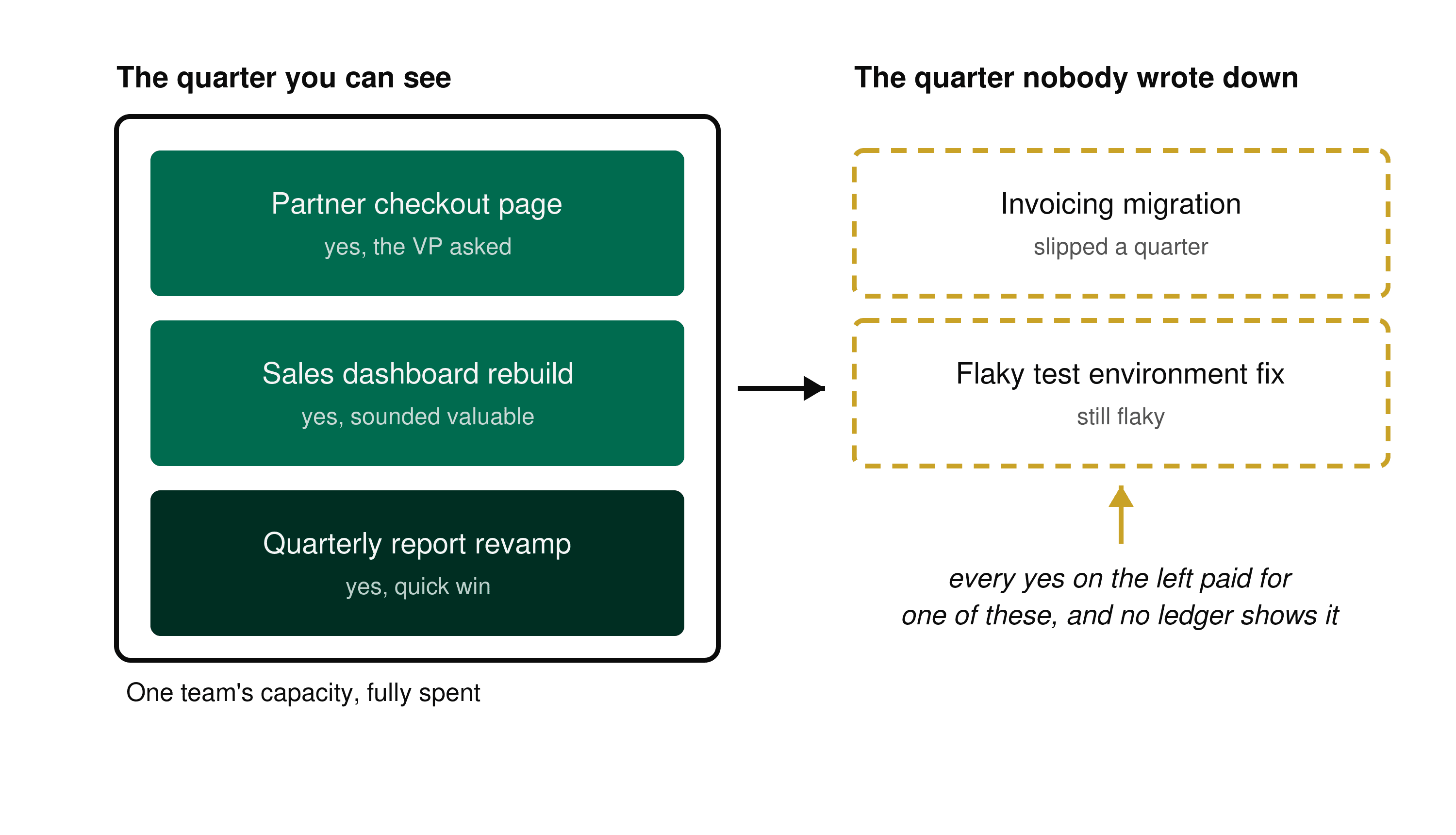
Every yes is a hidden no. The dangerous ones are the ones that stay hidden.
Put the displaced thing in the sentence
You don't need authority to fix this. You need one habit: when you accept work, name what it displaces, in the same sentence.
Weak: "We're pretty stretched, but we can probably squeeze it in."
Strong: "We can take this. If we do, the invoicing migration slips two weeks. Do you want that trade?"
Look at what the strong version does. You're not saying no, so there's no fight to have. You're pricing the yes. The person asking usually has context you don't, and now they get to make a real decision instead of a free one. Sometimes they'll say "don't touch the migration." Sometimes they'll take the trade knowingly, and when the slip lands, it lands as a decision made in the open instead of a failure you get to own alone.
One more push. "Squeeze it in" is never true. Teams don't have crawl spaces. The work fits because something else quietly got smaller, and "squeeze" is just the word we use for not saying what.
Price the wait in plain words
The other place opportunity cost earns its keep is sequencing. When everything on the list is worth doing, the question isn't which items to do. It's which order. And the tool for order is cost of delay, which sounds like a formula but doesn't need to be one.
Ask one question of every item: what does each week of waiting cost us, in plain words?
Some items bleed daily. A checkout bug is losing orders every day it waits. Some items are date locked: a renewal-season feature costs nothing to delay in June and a fortune to delay past September. Some items are chronic but mild: a clunky report annoys people forever but never gets worse. And some items cost nothing to delay, because nobody is actually waiting.
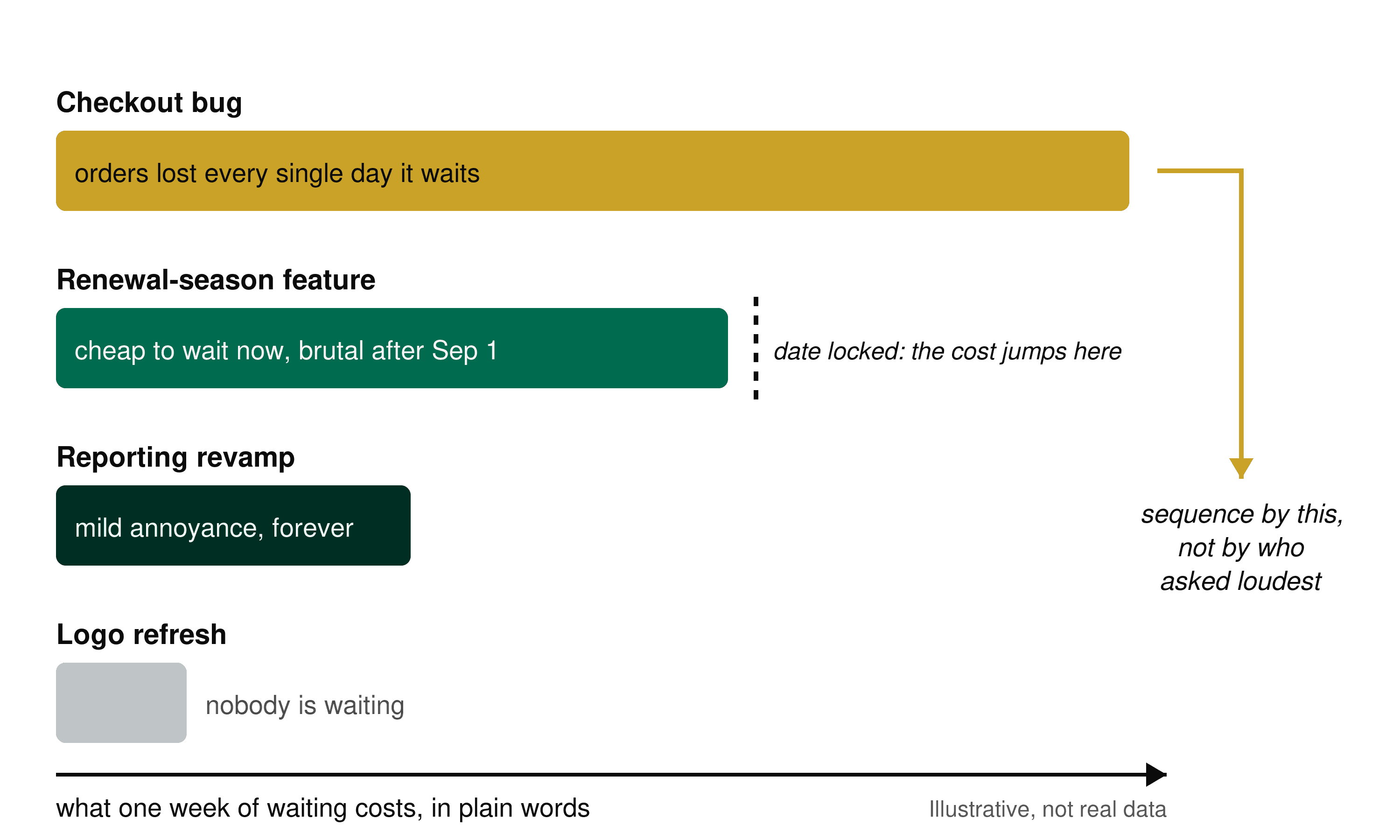
Sequence by that answer, not by who asked loudest or most recently. You don't need numbers. "This one bleeds daily, this one's fine until September, this one's an annoyance" is enough precision to get the order right. And saying it in plain words means the room can actually argue with you, which is the point.
The scoreboard only counts what you did
Now the trap, and it's the one that keeps whole teams busy and mediocre at the same time.
Everything you did is measurable. It's in the demo, the release notes, the dashboard. Everything you displaced is invisible. There's no artifact anywhere for the thing you didn't build. So every system your org uses to judge work quietly rewards saying yes, and punishes nobody for the hidden no.
Which means teams optimize for the visible column. More yeses, more launches, more motion. The displaced list grows in the dark, and once a quarter it sends up a flare: an outage, a missed renewal, a migration that's somehow eighteen months old.
The countermeasure is cheap. When your team accepts something mid-quarter, add one line somewhere visible: what it pushed. At the retro, read the list. Ten quiet minutes of "here's what our yeses cost us" will change the next quarter's decisions more than any framework rollout I've watched.
You can't manage what you measure only half of.
Say it in the rooms that count
Where does this make you sound senior? Two rooms.
The prioritization meeting
The person who says "before we add this, what's it displacing?" changes the meeting without holding a title. Watch the senior people in these rooms: they rarely argue an item's value. They ask what slot it takes and what was already in the slot. That question can't be hand waved, because the answer is checkable.
The interview
When they ask how you prioritize, most candidates recite an acronym. RICE, MoSCoW, WSJF. That's a framework answer, and frameworks are the floor. The answer that lands sounds like this: "I make the trade visible. Taking one thing means delaying another, so I name the displaced item, put the cost of waiting in plain words, and let the person who owns the outcome pick." That's not vocabulary. That's judgment, and judgment is what they're actually hiring.
One sentence this week
Don't build a system. Say one sentence.
The next time work arrives at your team sideways, and it will, this week, say the displaced thing out loud: "We can do it, and here's what moves." That's it. No pushback, no process, no slide deck.
Then watch the conversation change. Some requests evaporate the moment they have a price. The ones that survive were worth doing, and now everyone knows what they cost.
The teams that look decisive aren't the ones that say yes fastest. They're the ones that know what every yes costs, and say it.

Subscribe to the Newsletter
Join our growing community and get alerted first on our every article.
*By subscribing, you agree to send your information to our Company who agrees to use it according to their Terms and conditions and Privacy Policy
About the author
With 20 years guiding high-stakes Agile transformations, I turn theory into action at Oaktreeuni—mentoring aspiring Scrum Masters to think critically, adapt fast, and lead beyond frameworks. The payoff? You step into a high-paying Scrum Master or Agile PM role already equipped to excel.
What is opportunity cost in project management?
It’s the value of the best alternative your team gave up by choosing the work it did. Because a team’s capacity is finite, the real cost of building one thing is the next best thing those same people didn’t build.
How do I use cost of delay without a formula?
Ask of each item: what does one week of waiting cost us, in plain words? Some work bleeds daily, some is date locked, some is a mild forever-annoyance. Sequence by that answer, not by who asked loudest.
How do I push back on new work without saying no?
Price the yes instead of refusing it. Name what the new work displaces in the same sentence, for example: "We can take this, and the migration slips two weeks. Do you want that trade?" Then let the requester decide.
Comments