Fixed deadline, fluid scope: stop calling it a planning problem
ESTIMATED TIME
6
mins

Written by
Rajveer Prasad
Published on
The date was set in a board meeting you weren't in. A regulator, a conference, a customer contract, a marketing campaign already booked. It is not moving. Everyone agrees it is not moving.
Three weeks in, the scope is still moving. A new must-have from sales, a compliance item nobody scoped, a stakeholder who 'just remembered' something. And around the room, the same diagnosis: we have a planning problem. We need to estimate better. We need to plan harder next time.
No. You have a physics problem you keep mislabeling as a planning problem. The date is fixed and the scope is not, and the only question that actually matters is which one you're willing to say out loud is the variable.
The triangle nobody wants to look at
There are really three dials on any piece of delivery: time, scope, and the quality of what you ship. Resources sit behind them, but you can't hire your way out of a deadline three weeks away, so park that. The rule is old and boring and true: you can fix any two of these, but the third has to give. Pick what's fixed, and you've picked what flexes, whether you say so or not.
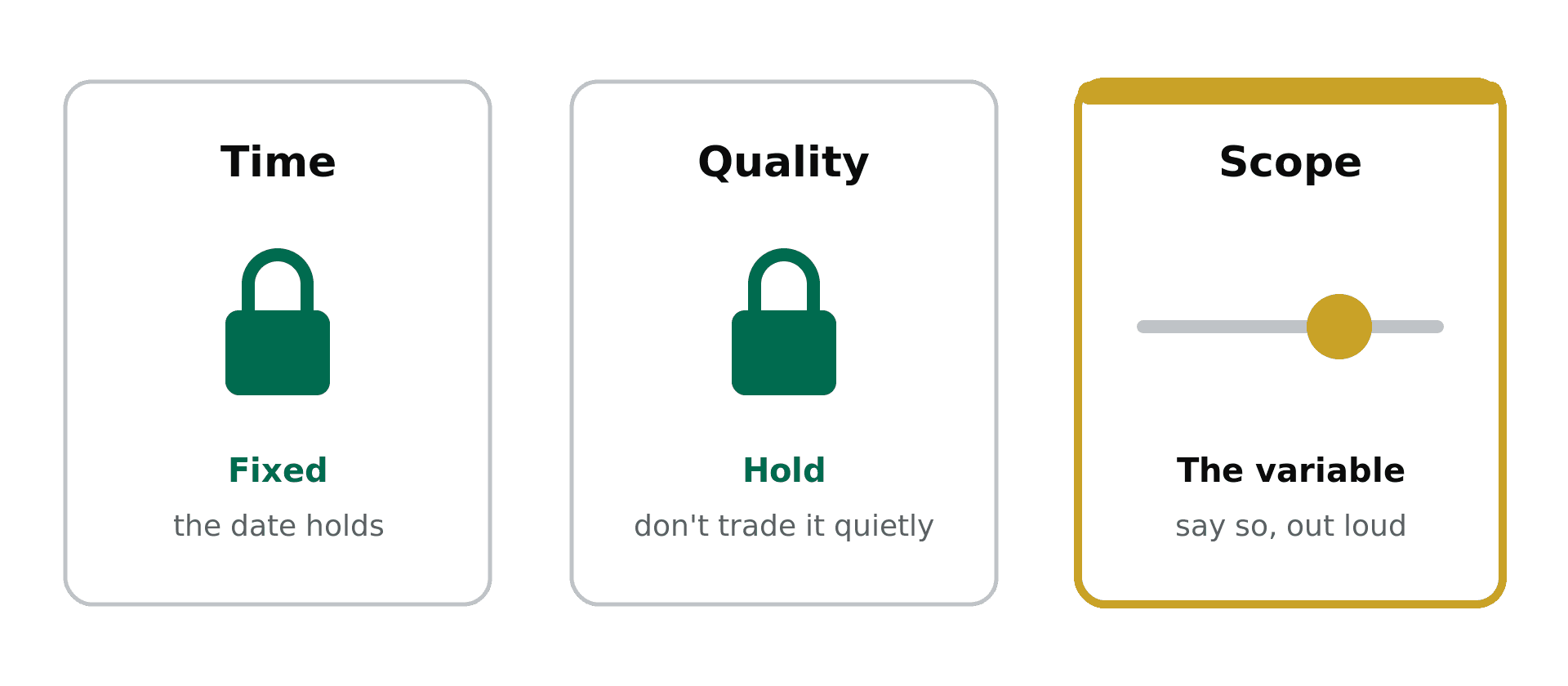
So here's the trap. The date is fixed, you refuse to flex scope because dropping anything feels like failure, and you tell yourself quality is non-negotiable. Three fixed dials. That math doesn't close. Something gives anyway, and since you refused to choose, the work chooses for you.
It always chooses quality, because quality is the one nobody is watching in week three. The tests get thinner. The edge cases get a shrug. The 'we'll clean it up later' pile grows. You hit the date with something that technically shipped and quietly broke, and the bill arrives a month later as a string of incidents nobody connects back to the crunch.
I watched this play out on a release pinned to a regulatory date. Every requirement was treated as mandatory, the date as sacred, and quality as a given. Nobody chose, so the choosing happened in the dark. Regression testing got squeezed from a week to two days, three 'minor' edge cases were waved through, and the release went out on time to a round of applause. The applause lasted about five weeks. Then came the incidents, the emergency fixes, and a postmortem that somehow never used the word 'scope.' The team didn't ship faster. They borrowed speed from quality at a punishing interest rate, and the bill came due right after everyone had stopped paying attention.
Why 'plan harder' is the wrong fix
Estimating better is good advice for a different problem. It assumes the thing you're estimating holds still. It doesn't help at all when the list itself keeps changing, because you can't estimate your way to a moving target. A flawless plan for a scope that's already out of date is just a more detailed fiction.
Be fair to the other side for a second. Plenty of teams genuinely do estimate badly, padding here, wishful thinking there, and tighter forecasting would help them. Discovery and planning are real skills, not busywork. But notice what even perfect estimation can't do: it can't hold a scope that everyone has silently agreed is allowed to grow. If the real driver is undeclared scope creep, a better burndown chart just measures the leak more precisely. It doesn't plug it.
And no, you can't add people to close the gap either, not this late. Drop fresh people onto a team three weeks from a deadline and you get a slower team for a while, not a faster one, because someone has to stop delivering to bring them up to speed. There's a tell worth watching for, too: if your retrospectives keep producing the same action item, 'improve estimation,' and the same crunch keeps happening anyway, then estimation was never the bottleneck. A problem that survives its own fix was misdiagnosed.
A more accurate estimate of the wrong, expanding list is precision pointed at the wrong thing.
Make scope the declared variable
The senior move is almost embarrassingly simple: say out loud, early, that scope is the relief valve, and then rank it before you need to. Sort the work into what must ship, what should, and what's a nice-to-have, and agree what falls out first if anything slips. Not in the panicked final week, when every cut is a fight. Now, while it's calm and nobody's bleeding.
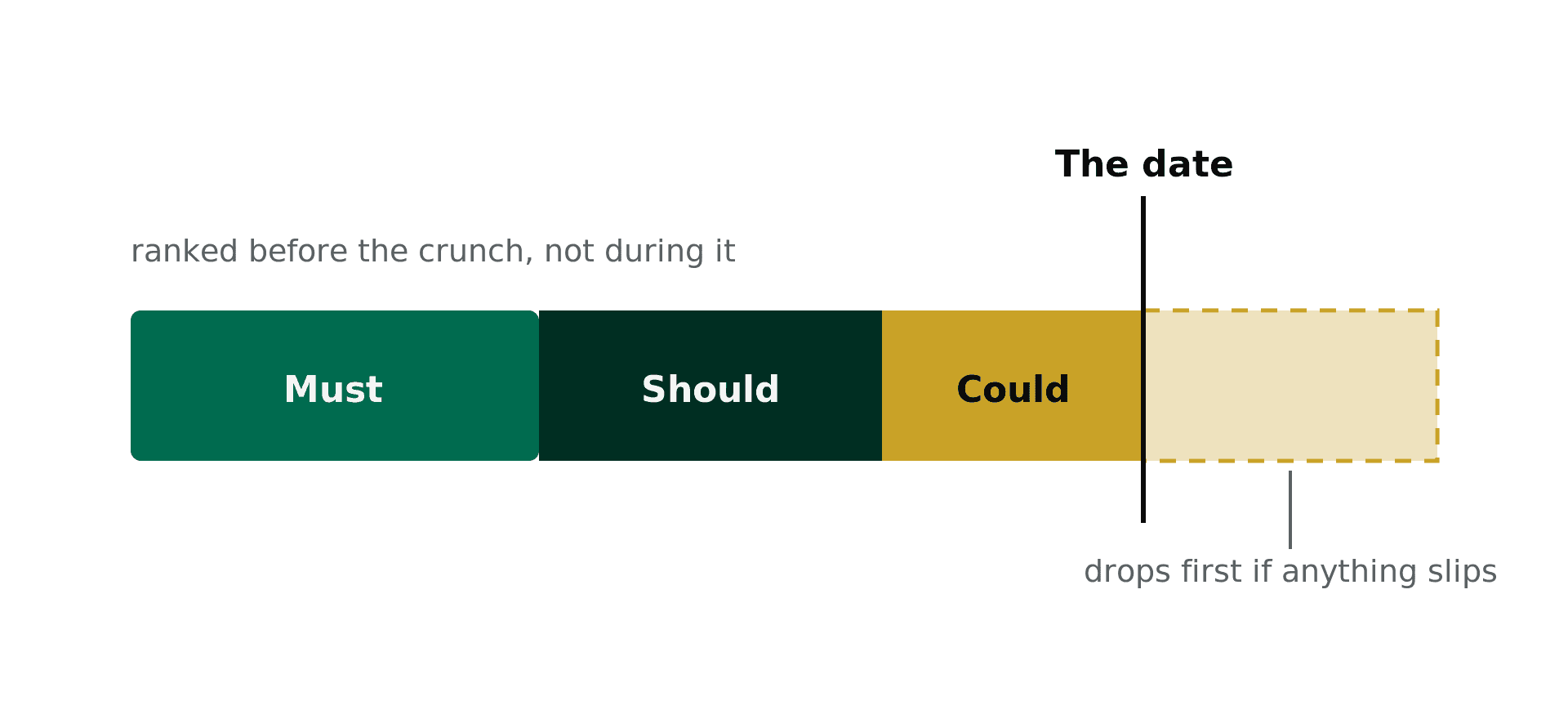
Ranking isn't a one-time sort, and it isn't yours to do alone. Every item earns its place by one question: if this were the only thing that slipped, would anyone outside the team actually notice or care? The things a customer or a regulator would feel are musts. The things only the team would feel proud of are coulds. And the stakeholder who owns the outcome has to put their name on the order, because the entire point is that when something slips, the cut was agreed in advance, not invented under pressure by whoever happened to be in the room at six on a Friday.
When you do that, the deadline stops being a promise to deliver a fixed list and becomes what it actually is: a container of a known size. You fill it with the most valuable work that fits at full quality, and the lowest-ranked items wait. A date is a container, not a contract for everything on the wish list.
The conversation that actually de-risks it
This all lives or dies in one conversation, and the timing of it is the whole game. The weak version protects both the full scope and the date right up until the last week, then ambushes everyone with a miss or a quietly degraded release. The strong version trades scope in daylight, early, when there's still room to choose well.
It sounds like this: 'The date holds. Here's what fits with quality intact. Here's what's sitting right at the edge. Here's what falls out first if anything slips, and I'd like your read on which of the edge items matters most to you.' That isn't you failing to commit. That is the only honest form a commitment can take when the scope is genuinely fluid. You're not asking permission to do less. You're handing the stakeholder the trade-off while it's still cheap to make.
Most people avoid that conversation for an understandable reason. It feels safer to promise everything and quietly hope than to admit out loud that something might not make it. But hope isn't a plan, and the silence doesn't make the bad news go away. It just moves it from a calm week three to a frantic final Friday, where it costs more and lands worse. Early honesty looks like risk. It's actually the cheapest insurance you can buy.
And this is where it stops being a delivery tactic and starts being a career signal. Naming the real constraint, choosing the variable on purpose, and making the trade where everyone can see it: that is what thinking like a leader actually sounds like in a room. It reads as senior precisely because most people don't do it. They keep all three dials 'fixed,' let quality leak in the dark, and call the wreckage a planning problem.
If you want one test to carry into your next planning meeting, it's this. Before you promise a date, ask which dial is allowed to move, and get the answer on the record. If the honest answer is 'none of them,' you don't have a plan yet. You have a wish with a deadline attached, and a quality leak waiting to open.
Fixed date, fluid scope isn't a failure to be planned away. It's the normal weather of real delivery. The job was never to predict the weather perfectly. It's to decide, out loud and early, which dial you'll turn when it changes. Turn scope on purpose, or quality turns itself.

Subscribe to the Newsletter
Join our growing community and get alerted first on our every article.
*By subscribing, you agree to send your information to our Company who agrees to use it according to their Terms and conditions and Privacy Policy
About the author
With 20 years guiding high-stakes Agile transformations, I turn theory into action at Oaktreeuni—mentoring aspiring Scrum Masters to think critically, adapt fast, and lead beyond frameworks. The payoff? You step into a high-paying Scrum Master or Agile PM role already equipped to excel.
What do you do when the deadline is fixed but scope keeps changing?
Treat scope as the declared variable. Rank the work into must, should, and could, agree what drops first, and fill the fixed date with the highest-value work at full quality.
Is a fixed deadline with changing scope a planning problem?
No. It’s the normal condition of most delivery. Better estimates can’t hold a scope everyone has agreed is allowed to grow. Choosing the variable can.
What gives when time and quality are both fixed?
Scope. If you refuse to flex scope, quality flexes quietly instead, usually as thinner testing and a growing cleanup pile.
Comments