A case for boring delivery
ESTIMATED TIME
10
mins

Written by
Rajveer Prasad
Published on
There's a team at your company nobody talks about in the all-hands.
They don't save projects at 11 PM. They don't get standing ovations in the sprint review. Their names don't come up in the post-mortems because they're never in the post-mortems. They ship. Every sprint. On time. And they go home.
Nobody writes Medium posts about them.
They should.
The heroics trap
Most delivery organizations quietly celebrate the firefighter. The person who jumped in at midnight to recover a failed deployment gets a shoutout in Slack. The team that spent three days heroically unblocking a critical dependency gets called out in the CEO's update.
Nobody asks the obvious question: why was the house on fire in the first place?
Heroics are a symptom. They mean something in the system is structurally broken. And a culture that rewards firefighting quietly incentivizes arson.
The first time I saw this clearly was watching two teams side by side. Team A had a legendary reputation. They pulled rabbits from hats. They were the ones leadership called when things went sideways. Everyone wanted to be on Team A.
Team B was boring. They committed to eight story points and delivered eight story points. Sprint after sprint. They never made headlines.
Over eighteen months, Team A shipped two major features. Team B shipped eleven.
What the data says about boring
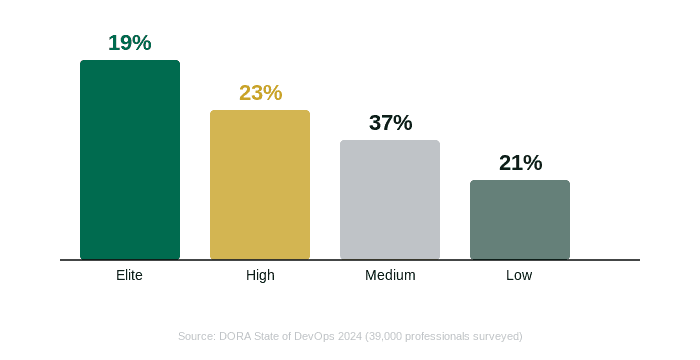
{The 2024 DORA State of DevOps report, drawing on 39,000 professionals, found that only 19% of surveyed teams qualified as elite performers. Elite teams deploy multiple times a day and recover from failures in under one hour.}
Here's what that 19% looks like from the outside: boring. Calm. Methodical.
They don't recover from failures faster by being smarter in a crisis. They recover faster because they've built systems that contain failure before it spreads. Small deployments. Automated rollbacks. Tight feedback loops. None of that is exciting. All of it is deliberate.
{A 2026 industry analysis found that enterprises are explicitly shifting toward demanding predictable delivery over heroic effort, citing chronic unpredictability as the number one barrier to scaling delivery teams.}
Predictability is the actual senior signal
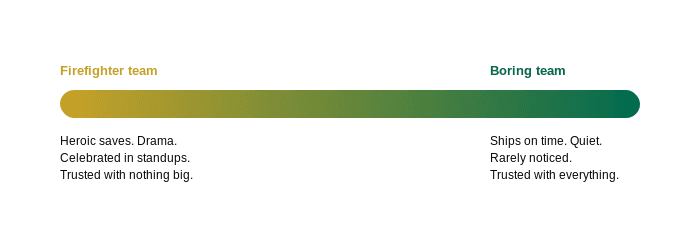
If you're a Scrum Master or delivery lead building your reputation, here's what I want you to hear: stakeholders don't remember who saved the day. They remember who never needed to.
When executives decide which team gets the next critical product launch, they don't ask, 'Who handled the last crisis well?' They ask, 'Who do I trust to not have a crisis?'
Predictability is how you answer that question without saying a word.
This doesn't mean boring teams are passive. The boring team works harder than anyone. They do the unglamorous work of:
Running retrospectives that actually change something
Refining the backlog before it becomes a pile
Saying no to scope creep before it becomes a fire
Flagging dependencies before they become blockers
Tracking WIP limits before the queue collapses
None of that gets a shoutout. All of it compounds.
How to build boring on purpose
If your team is in firefighting mode right now, it won't feel like you can choose boring. Here's how you shift:
Shrink the sprint commitment until you can hold it.
Consistently shipping 80% of a smaller commitment is more valuable than heroically shipping 100% of an oversized one every third sprint. Velocity is useless if it's a lie.
Make blockers visible before they become crises.
The daily standup isn't for status. It's for surfacing impediments while they're still manageable. If your team is using it to report progress, you're using it wrong.
Track lead time, not just velocity.
Velocity tells you how much your team claims to do. Lead time tells you how long work actually takes from start to done. That gap is where predictability lives or dies.
Celebrate things that didn't happen.
Did your team ship on time this sprint without a single escalation? Call it out. Build a culture where the absence of drama is the thing to celebrate. It's a harder sell than a crisis recovery. It's also the one that compounds.
The uncomfortable truth
Some organizations can't be fixed from the inside. If the culture structurally rewards firefighting, boring teams get defunded and their members get moved to support the heroes.
That's information. It tells you something about where you're working.
But most teams aren't in that situation. Most teams are somewhere in the middle, capable of becoming more boring, more predictable, and ultimately more trusted, if someone takes the time to make the case.
That case is yours to make. Start with one sprint where you commit to less than you think you can do and you deliver exactly that. Do it three times in a row.
Watch what happens to the conversations in the room.
Sources
DORA State of DevOps Report 2024
Easy Agile Research Insights 2026: Collaboration, Planning, and Delivery
Planisware: Agile Delivery Predictability in the Enterprise

Subscribe to the Newsletter
Join our growing community and get alerted first on our every article.
*By subscribing, you agree to send your information to our Company who agrees to use it according to their Terms and conditions and Privacy Policy
About the author
With 20 years guiding high-stakes Agile transformations, I turn theory into action at Oaktreeuni—mentoring aspiring Scrum Masters to think critically, adapt fast, and lead beyond frameworks. The payoff? You step into a high-paying Scrum Master or Agile PM role already equipped to excel.
Comments