Signal or noise: how to read one bad sprint without overreacting
ESTIMATED TIME
10
mins

Written by
Shikha Prasad
Published on
One rough sprint is a data point. Here is how leaders decide what it actually means before they change anything.
The Sunday night email I never sent
Sprint 14 closed on a Friday afternoon with a little under half the forecast done. I know it was sprint 14 because I kept the email draft for a long time afterwards, as a reminder.
I wrote that draft on Sunday night. It had three process changes in it: a daily check-in with the two senior developers, a mid-sprint forecast review, and a hard cap on story size. All of it sounded reasonable. I was the delivery lead, the sprint was bad, and I was going to do something about it.
Monday morning I showed it to the program manager I trusted most in that building. He read the whole thing, handed my phone back, and asked one question.
“What did the last eight sprints look like?”
I didn't know. Not precisely. I knew this one felt terrible.
So we pulled the numbers together. Sprint 14 was the lowest of the year, but not by much, and it sat inside the range the team had been bouncing around for months. Two people had been out sick. There was a stat holiday. One integration story had quietly swallowed four days and carried over. Sprint 15 arrived, I changed nothing, and the team went back to normal without ever knowing how close they came to three new meetings.
I had come within one click of taxing a healthy team for having a normal week.
Healthy systems wobble
Here's what nobody tells you when you step into a delivery role: every healthy team has bad sprints. Not occasionally, as an exception to be investigated. Regularly, as a property of how work behaves.
A sprint's output isn't produced by effort alone. It's produced by a system: the people available that week, the mix of work, the dependencies, the environments, the calendar itself. And every system has variation baked in. Someone gets sick. A ticket that looked like a two turns out to be an eight. A vendor delivers late. The build breaks on Wednesday. None of that is failure. It's bounce.
Statisticians call the bounce noise: the normal variation of a stable system doing its normal thing. Signal is different. Signal means the system itself changed, and the numbers are trying to tell you.
Noise is weather. Signal is climate. And a lot of leaders set policy by looking out one window, once.
One dot can't make a trend
The discipline is simple to describe and genuinely hard to practice: never read a sprint on its own. Read it against the run.
Pull the last eight or ten sprints and look at the shape of them. Not the average, the spread. Every team has a band it naturally bounces inside, and until you know where that band sits, you can't say anything intelligent about a single sprint. A number that would be alarming for one team is a normal Tuesday for another.
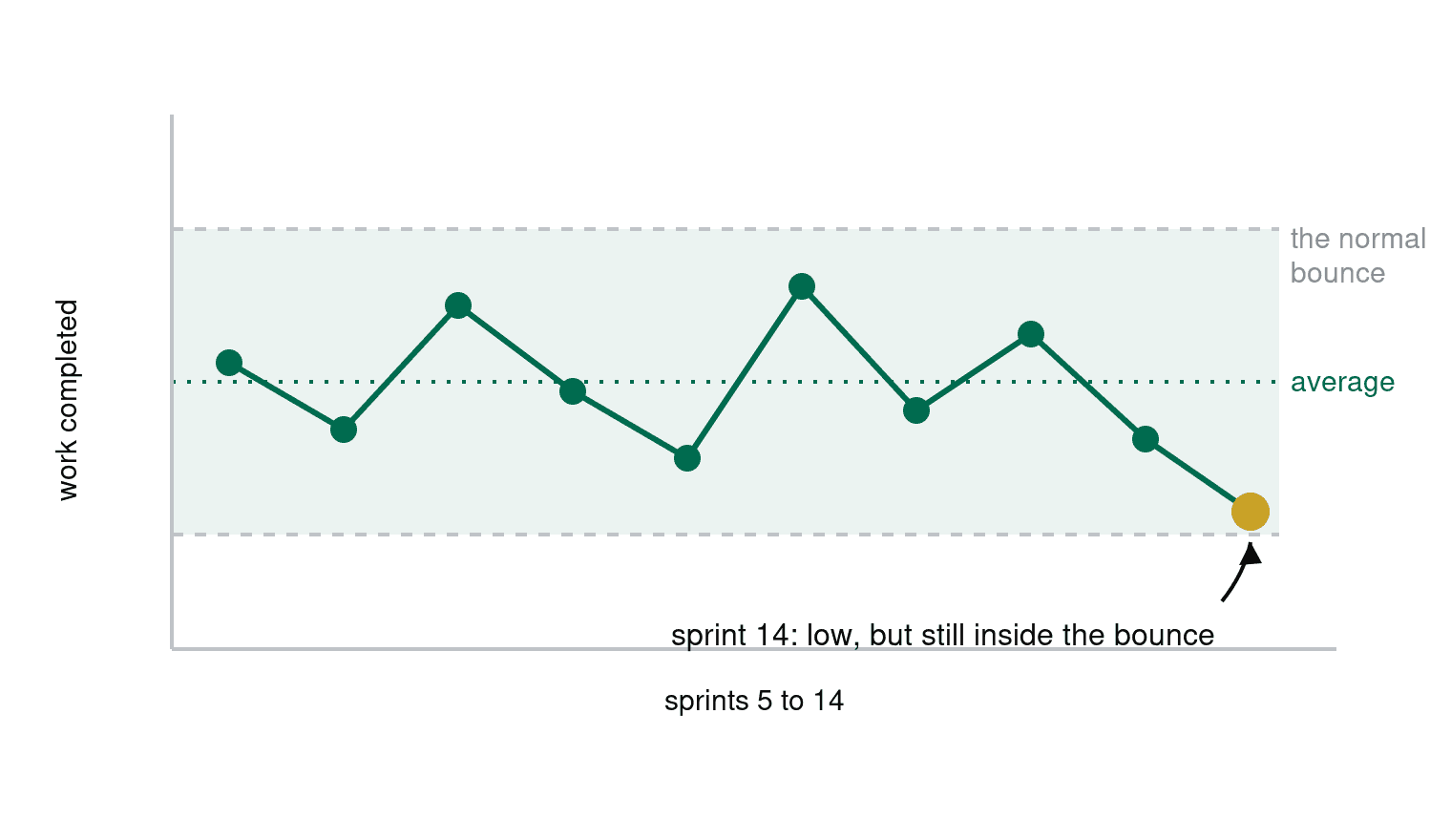
If the bad sprint lands inside the band, you've learned almost nothing new. You've learned the system is still the system. That can be disappointing when you're itching to act, but it's the truth the data supports.
And here's the translation that matters for your career. When your manager asks what happened this sprint, they aren't really asking for the story of the sprint. They're asking whether you understand your system. “It came in low, but inside our normal range, and here's the run” is a leader's answer. “We had a bad sprint so I've introduced three new check-ins” sounds decisive, and quietly tells them you're steering by one data point.
Three shapes that actually mean something
So when should a low sprint make you sit up? When the numbers stop looking like bounce and start making a shape. Three shapes are worth your attention.
An outlier. One point far outside the band. Not slightly low. Far. Something specific happened, and you should find out what, because systems don't usually leave the band on their own.
A run. Four or five sprints on the same side of your average. Any single one of them would be unremarkable. Together they're a message: the middle of your system has moved.
A drift. Each sprint a little lower than the last. No single drop big enough to trigger alarm, which is exactly why drifts are dangerous. They're how a team slides for a quarter while every individual sprint gets explained away.
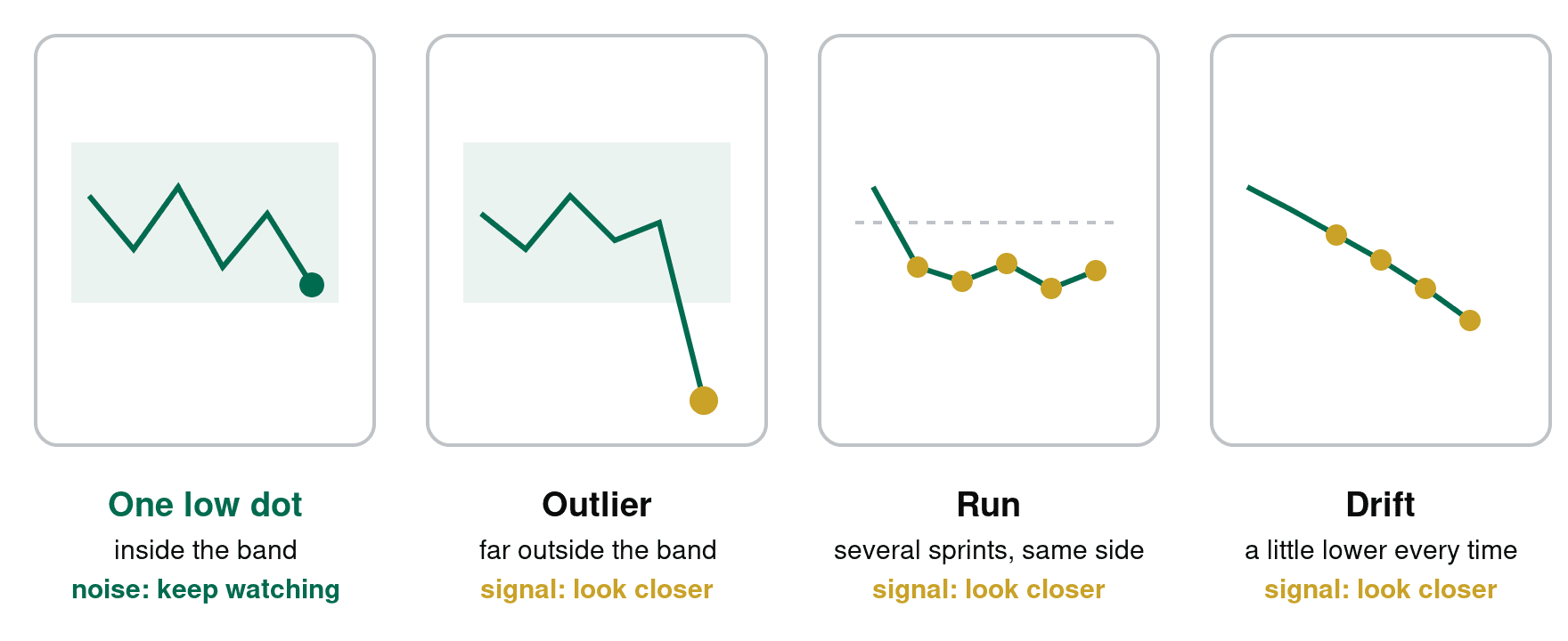
One low dot inside the band is none of these. It's the system breathing.
There's a fourth situation worth naming: a step change right after something you already know about. A senior developer left. A new vendor dependency arrived. The platform migrated. If the ground moved and then the numbers moved, that's not a mystery, and pretending the old band still applies is its own mistake.
The overreaction tax
Here's the part I had to learn the slow way: reacting to noise doesn't just waste your energy. It actively makes the system worse, and it does the damage in three ways.
First, the process cost. Those three changes in my Sunday email would have consumed real hours from a team whose system hadn't changed. Capacity drops, the next sprint dips, and the dip confirms the fear that caused it. You can chase that loop for months.
Second, the reading cost. The moment you intervene, you add your own variation to the system. Now the next sprint reflects the team plus your changes, and you can no longer tell what any of it means. W. Edwards Deming had a name for adjusting a stable system in response to noise: tampering. His demonstration of it showed the same thing every time. Tampering doesn't reduce variation, it amplifies it.
Third, and worst, the trust cost. Teams learn fast. If one bad sprint brings scrutiny, they'll make sure there are no bad sprints, and they won't do it by delivering more. They'll pad estimates. They'll slice work to look safe. They'll carry risk quietly instead of surfacing it early. The numbers get smoother and the information gets worse, which is the exact opposite of what you needed.
Four questions before you touch anything
The takeaway I now hold myself to is a 48-hour rule: no structural change inside 48 hours of a bad sprint. In that window, I answer four questions instead.
What does the run say? Lay the sprint against the last eight or more. Inside the band, or genuinely outside it?
Did anything change underneath? People, work type, dependencies, environments, calendar. A sprint with two sick days and a holiday isn't evidence, it's arithmetic.
Is there a shape? An outlier, a run, a drift, or just one dot doing what dots do?
What does the team say happened? Ask before you decide what it means. The retro comes before the mandate, always. Your team knows things about the sprint that no chart will surface, and asking first is also how you signal that a low number leads to curiosity, not blame.
If the answers come back inside the band, nothing changed, no shape, and the team's account holds together, then the right move is the hardest one available: do nothing, visibly and calmly. Doing nothing on purpose is not the same as ignoring it. One is judgment. The other is neglect. The difference is whether you looked.
When it really is signal, move
I want to be careful here, because this cuts both ways. Variance literacy isn't a licence to never react. Some leaders hide inside “it's just noise” the way others hide inside busywork, and a drift explained away for a quarter is a much bigger failure than one overcooked email.
A year after sprint 14, a different team of mine drifted down three sprints in a row, right after a new vendor integration entered the picture. That time the shape and the underlying change pointed the same way, so I moved fast. But notice what moving meant. It didn't mean watching people more closely. It meant getting the vendor a dedicated test environment and pulling the integration work forward where we could see it. When the numbers are signal, the fix lives in the system. Nobody needed more supervision. Something needed to be repaired.
That's the whole discipline, really. Noise gets patience. Signal gets action. And the action goes at the system, not the people standing nearest to it.
Read the run, not the dot
If you're interviewing for delivery roles, listen for how often this exact judgment gets tested. “Tell me about a time delivery slipped” isn't fishing for a heroic rescue. The strong answer sounds like someone who checked whether the slip was a trend before treating it like one, and who can say what they deliberately didn't do. Calm, on purpose, with the run in hand.
And if you're in the seat now, the next time a sprint lands short, notice the itch. The one that wants to send the Sunday email, add the check-in, cap the stories. Hold it for 48 hours and pull the run instead.
One bad sprint is a data point. What you do next is the trend.

Subscribe to the Newsletter
Join our growing community and get alerted first on our every article.
*By subscribing, you agree to send your information to our Company who agrees to use it according to their Terms and conditions and Privacy Policy
About the author
I believe the strongest tool and flex each of us has is our belief. When we truly believe in something, we align our mindset, energy, and actions with the right effort and guidance. That is when achieving almost anything becomes possible. This is how I help mentees at OAKKTREEUNII move into Software and Project Management careers for better pay, better confidence, and better work-life balance.
Is one bad sprint a problem?
Usually not on its own. Compare it against your team’s last eight or more sprints. If it sits inside the range the team normally bounces in and nothing changed underneath, it’s normal variation, not a trend.
When should a drop in sprint output worry you?
When it makes a shape: a point far outside your normal range, four or five sprints on the same side of your average, or a steady downward drift. Also after a known change, like losing a senior developer or adding a new dependency.
Should you change your process after one failed sprint?
No. Hold structural changes for at least 48 hours, run the retro first, and check the run of recent sprints. Reacting to normal variation adds process cost, muddies your data, and teaches the team to hide bad news.
Comments