The judgment AI can't do, where a delivery pro becomes irreplaceable
ESTIMATED TIME
7
mins

Written by
Rajveer Prasad
Published on
Will AI replace project managers? Here's the straight answer almost nobody gives: it will replace most of what project managers do, and almost none of what they're for.
That sounds like a consultant's dodge. It isn't. It's the most precise thing anyone can tell you about the next decade of delivery work, and if you hold onto the distinction, you'll stop preparing for the wrong threat.
Start with what's true, because the automation case isn't hype. Gartner's research on the future of the PMO puts it flatly: by 2030, smart machines and AI will take on project work like data collection, analysis and reporting, and much of the work of today's project management office will be eliminated {Gartner, PPM and the PMO by 2030}. PMI's global survey shows where the water is already coming in. The top three ways project managers use AI right now are reporting, decision support and communication, and 82 percent of senior leaders say AI will have at least some impact on how projects are run at their organization over the next five years {PMI Global Survey, 2023}.

Status reports that write themselves. Minutes that take themselves. Dashboards that assemble overnight without you. If that list reads like your calendar, this is an uncomfortable year to be paying attention.
Here's the hard truth: if your week can be exported to a CSV, it can be imported by something else.
But read the research everyone quotes to scare you, because it says something more interesting. McKinsey's global automation work found that fewer than 5 percent of occupations consist of activities that can be fully automated, while in about 60 percent of occupations, at least a third of the activities can be {McKinsey Global Institute, Jobs Lost Jobs Gained, 2017}. Automation eats task components. It almost never swallows whole jobs. And what survives isn't a smaller version of the old job. It's a different job, concentrated around whatever the machine can't hold.
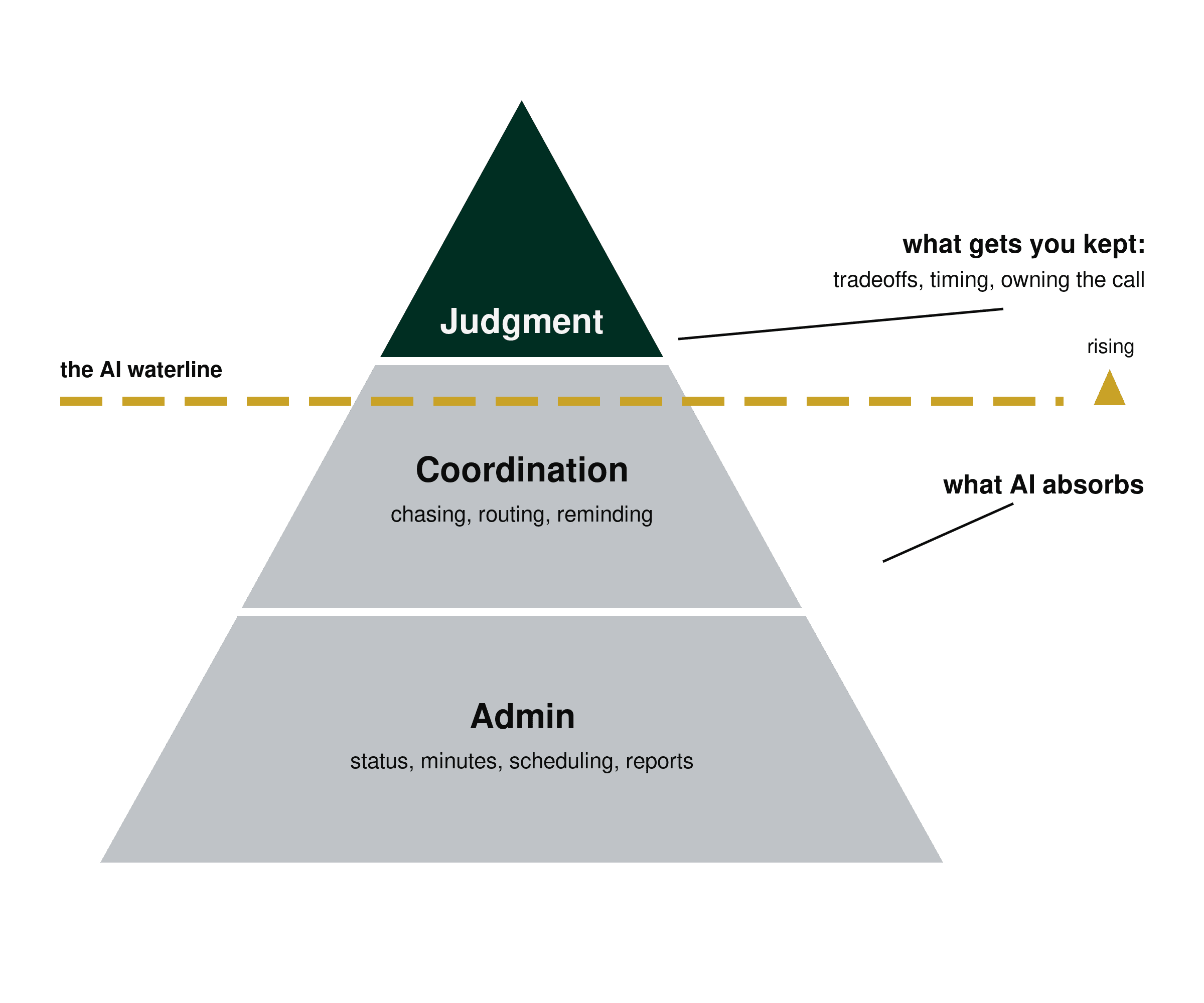
In delivery work, what the machine can't hold is judgment. Deciding under ambiguity. Weighing people and politics. Choosing what not to do. Owning the consequences once the call is made. AI is stripping away everything that used to surround judgment, which means judgment stops being ten percent of your week and starts being the entire reason you're on payroll.
The tasks were never the job. They were the visible part of the job. So the delivery pro who is only a task router should be nervous, because routing is precisely what's being automated. The one who exercises judgment is about to become very hard to replace.
What the org chart says you do, and what actually gets you kept
Read any project manager job description. Builds the plan. Tracks milestones. Maintains the risk register. Coordinates across teams. Reports status to stakeholders. It describes a very conscientious router: information comes in, gets sorted, goes out on schedule.
Now think about why any specific PM survives a reorg. Nobody in that room says “her minutes were immaculate.” They say she knew the launch date was fiction before anyone admitted it out loud. They say he talked the sponsor out of a scope change that would have sunk the quarter. They say she escalated the vendor problem two weeks before it became unfixable, to the right person, in the right tone, without burning the relationship down.
Nobody gets kept for the minutes. People get kept for the calls.
Watch the two versions of the job come apart in one moment. Two weeks before a payments go-live, UAT throws a defect spike. The dashboard is unambiguous: at this defect rate the quality gate fails, so recommend a two-week delay. A good model can generate that recommendation today, and as far as the data goes, it's correct.
But the data doesn't know the go-live date was promised to a regulator. It doesn't know the sponsor spent political capital defending this program at the last budget review and can't go back for more. It doesn't know the defects cluster in a reconciliation flow the ops team has quietly handled with a manual workaround twice before, or that the engineering lead saying “we're fine” is the same one who said it the last time they weren't. So the real decision isn't “delay or don't.” It's this: ship on the promised date with a scoped workaround and a named rollback trigger, or delay and spend credibility the program will need later. Someone has to weigh all of that, pick one, say it to the sponsor's face, and stand behind whatever happens next.
That's the job. That was always the job. The reporting was just what it looked like from the outside.
The strongest version of the robot argument
Essays like this usually prop up a cardboard robot and knock it over. Let's not. The automation case deserves its strongest form, so here it is.
Judgment, the argument goes, is just prediction plus preference. Models get better at prediction every quarter. They already flag slippage earlier than tired humans, draft risk responses, and score tradeoffs without ego or politics. Everything this essay calls judgment is pattern recognition over context, and context is data. Give the model the tickets, the documents, the chat history and ten years of delivery archives, and it will make your go-live call too. People have bet against machine capability, profession by profession, for decades, and they keep losing.
Concede what honesty requires. AI will do more of judgment's inputs than most PMs expect. Option generation, forecasting, trade-off tables, pre-reads, even a first draft of the difficult message. The thinking-adjacent work is being absorbed along with the admin. If your survival plan is to hide behind the word “strategic” while a model does your analysis, that isn't a plan. It's a delay.
But the argument breaks in two places, and both are structural, not technical. Better models don't fix structural.
First, context. A model reasons over the record: whatever got written down. An organization runs, to a degree nobody likes to admit, on what never gets written down. Who actually decides, versus who signs. Which dates are real and which are political. What the sponsor is afraid of. Which favors are owed and which are burned. What nearly got someone fired last year and is therefore missing from every document the model will ever ingest. The record is what the org admits. Judgment runs on what it won't write down. Wider context windows and deeper integrations will narrow that gap, and they should. They won't close it, because the missing information isn't unindexed. It's unwritten, on purpose.

Second, and harder: accountability. A decision isn't a selection between options. It's ownership of what happens next. When a go-live fails, the steering committee doesn't want the model's confidence interval. It wants a person who chose, who can explain why, take the heat, hold the team together and make the next call better. “The model decided” has never survived contact with a steering committee. You can't fire a model, and more to the point, firing one wouldn't make anyone whole. As long as organizations answer to customers, boards and regulators, a named human will own the call. The human who owns the call is exercising judgment: informed by machines, not replaced by them.
Scope that claim carefully, because overreach is how arguments like this one embarrass their authors. Nothing here says a model will never reason better than a human at 6 pm on a Friday. On plenty of inputs it already does. The claim is narrower and firmer: deciding and owning stay human for structural reasons, and those reasons don't move when the benchmarks do. Even McKinsey's automation researchers, hardly romantics about human specialness, expect the durable work to sit in managing people, applying expertise and social interaction, where machines still can't match human performance {McKinsey Global Institute, Jobs Lost Jobs Gained, 2017}.
Judgment isn't the residue AI leaves behind. It's the load-bearing wall.
Move your week above the waterline
So the useful question was never “will AI replace project managers.” The useful question is which side of the waterline your week lives on.
Run an honest audit tonight. List everything you produced in the last two weeks. Sort it into three piles: admin (status, minutes, scheduling, formatting), coordination (chasing, routing, reminding), and judgment (calls you made under ambiguity, with your name attached). Most working PMs find the third pile embarrassingly thin. That's not an insult. It's an inventory, and it tells you exactly what to build next.
• Automate your own admin before someone does it for you. The PM who walks in having already cut their reporting load in half reads as the future. The one guarding their status deck reads as the past.
• Collect decisions the way you once collected certifications. Keep a decision log: the situation, the ambiguity, the options, what you chose, what you weighed, what happened. Ten entries in, you own interview answers no course can sell you.
• Volunteer for ambiguity. The messy vendor call. The scope fight. The date nobody wants to own. Judgment only grows under load, and because most people run from ambiguity, the reps are always available.
• Practice saying tradeoffs out loud to power. “We can protect the date or the scope, not both. Here's what I recommend, and why.” One calm sentence like that, delivered to a sponsor, does more for your career than a quarter of flawless dashboards.
And when an interviewer asks how you feel about AI in project management, hear the question underneath: are you a router or a judge? Routers should worry. Judges should send the machines a thank-you note, because every task AI takes off your plate is the job promoting you into the only part of it that was ever going to last.
Take the promotion.
Sources
Gartner. Digitalization's Impact on PPM Practices and the PMO by 2030. Research summary, accessed August 2026.
Project Management Institute. Demand Increases for Project Professionals with AI Skills, Yet PMI Research Finds Only 18% Have Practical Experience (findings from the PMI Annual Global Survey on Project Management). 2023.
McKinsey Global Institute. Jobs Lost, Jobs Gained: What the Future of Work Will Mean for Jobs, Skills, and Wages. 2017.

Subscribe to the Newsletter
Join our growing community and get alerted first on our every article.
*By subscribing, you agree to send your information to our Company who agrees to use it according to their Terms and conditions and Privacy Policy
About the author
With 20 years guiding high-stakes Agile transformations, I turn theory into action at Oaktreeuni—mentoring aspiring Scrum Masters to think critically, adapt fast, and lead beyond frameworks. The payoff? You step into a high-paying Scrum Master or Agile PM role already equipped to excel.
Will AI replace project managers?
It's replacing project management tasks fast: reporting, tracking, scheduling, data collection. Research consistently finds very few occupations get fully automated, and the surviving core of delivery work is judgment: deciding under ambiguity and owning outcomes. PMs who only route tasks are at risk. PMs who make and own decisions aren't.
Which project management tasks can AI already do?
PMI's 2023 global survey found project managers mainly use AI for reporting, decision support and communication. Status assembly, meeting minutes, scheduling and risk-log upkeep are moving to AI fastest.
What project management skills can AI not replace?
Judgment under ambiguity, weighing stakeholders and politics, choosing what not to do, and accountability. Organizations still need a named human who owns the call and its consequences.

← Previous post
A short history of the Scrum Master role, and where it's actually heading
Next post →
Why great delivery people struggle to ship a B+

Keep reading
Newest on the blog


Comments