Why great delivery people struggle to ship a B+
ESTIMATED TIME
8
mins

Written by
Shikha Prasad
Published on
At 11pm on a Monday, a mentee of mine sent me a message. I'll call her Meera. One line: "Is 'slippage' too negative? Should I say 'variance'?"
She was on slide seven of a status deck. The deck was for her Tuesday sync, the same routine fifteen-minute check-in her program had run every week for six months. She'd been polishing since nine. Realigning icons that were two pixels off. Rebuilding a table because the columns felt uneven. Rewriting one sentence four times because slippage sounded like blame and variance sounded like hiding something.
Here's what that deck was actually for. Her sponsor would open it on her phone between two other meetings and scan it for one question: does anything here need me? Two slides would get read, the summary and the asks. Slide seven was an appendix. In six months of Tuesday syncs, nobody had ever opened it.
I want to be clear about who Meera is, because it matters. She isn't weak and she isn't slow. She's one of the most careful, most conscientious delivery people I've mentored. That's exactly why she was still awake.
Your deck is not the product. The decision is
Almost nothing you produce in delivery work is a finished product. The status deck, the risk log, the sprint summary, the requirements doc, the RAID register. Every one of them is an input to someone else's decision. The sponsor reads the deck to decide whether to step in. The product owner reads the summary to decide what to cut. Your manager reads the risk log to decide whether to escalate now or wait a week.
Which means your work has a shelf life, and the shelf life is the decision date. A B+ that arrives before the decision gets to shape it. An A+ that arrives after the decision is trivia. Beautifully formatted, thoroughly reasoned trivia.
Sit with that reframe for a second, because it quietly rewrites the definition of quality. If the artifact exists to feed a decision, then "did it arrive in time to matter?" isn't a nice-to-have. It's the first quality bar. Miss it and nothing else on the rubric counts.
Fear wears the costume of standards
"But I just have high standards." I hear this a lot on mentoring calls, and I used to say it too. So let's be precise, because the research here is genuinely freeing.
Psychologists who study perfectionism split it into two parts. Strivings: holding yourself to high standards. Concerns: the fear of mistakes, the harsh self-criticism, the dread of being judged. A meta-analysis of 43 studies covering nearly 9,800 people found that perfectionistic concerns showed medium-to-large links with burnout, while strivings on their own showed small negative or non-significant ones, with signs that the concerns side bites hardest in the work domain {Hill and Curran, Personality and Social Psychology Review, 2016}.
Read that again, slowly. The standards were never the damage. The fear was.
Which is what slide seven at 11pm actually was. The first pass on that deck was standards. The eleventh pass was insurance. Insurance against an imagined moment where someone senior looks at her work and quietly decides she's not good enough. Here's the uncomfortable truth: past a certain point, the polish isn't for the reader anymore. It's for the voice in your head.
And while you're paying that premium, your manager is reading something else entirely. Most delivery managers I've sat beside don't look at chronic over-polish and think "impressive standards." They think scoping problem. Someone who spends an hour on an appendix nobody opens is someone who can't yet tell which work deserves an hour. That's the cruel part of the trap: the habit you're using to look flawless is quietly reading as a judgment gap.
You were trained for a game that ended
Before you turn any of that on yourself, look at where the wiring came from.
School graded the artifact. The essay was the product, the deadline was printed on the syllabus, and timing was never the test. Polish was. For sixteen years, the extra hour of tidying bought real marks. You didn't develop a strange habit. You developed an accurate one, for that game. Then work changed the game and nobody sent a memo. The deadline moved from "printed on the syllabus" to "whenever the decision happens," and the grade moved from the artifact to the outcome it enabled.
The pressure side of this isn't your imagination either. A meta-analysis of 41,641 college students found that between 1989 and 2016, self-oriented perfectionism rose by 10 percent, other-oriented by 16 percent, and socially prescribed perfectionism, the sense that the people around you demand perfection, rose by 33 percent {Curran and Hill, Psychological Bulletin, 2019}.

The steepest rise is the one that comes from outside. If you feel this pull more than the generation before you did, that isn't a character flaw. The water got heavier. Naming that matters, because you can't put down a weight you keep mistaking for your personality.
Two Tuesdays, same deck
Let me show you the trade concretely, because "done is better than perfect" is a poster, and posters don't change behaviour.
The A+ that misses. Meera polishes Monday night, then Tuesday morning, then decides the QA numbers need one more confirmation. The deck doesn't go out before the sync; she talks through it live and promises to circulate after. Her sponsor makes the resourcing call Wednesday morning from memory. The QA capacity risk Meera had documented so carefully never comes up. Three weeks later it surfaces the hard way, as a slipped release. The deck, sent Thursday, was flawless. It was also an autopsy.
The B+ on time. The deck goes out Monday at 4pm. One table is slightly misaligned. The QA number has a note beside it: "unconfirmed, final count Wednesday." The first slide says Draft. The sponsor reads it Tuesday at 8:40, sees the ask, and moves a tester by lunch. The risk dies quietly, the way well-run risks do.
The late A+ described the problem beautifully. The on-time B+ prevented it. That's the whole argument, in one Tuesday.
Agree on "done enough" before you open the file
So let's make this practical. Perfectionism loves vague standards, because a vague standard can never quite be met. The fix is to make the standard external, explicit, and agreed before you start. Three questions, asked of whoever consumes the work:
Who reads this, and how much time will they give it?
What decision does it feed?
When is that decision being made?

Ask them out loud. "This is for your Tuesday scan, it feeds the staffing call, it has to land Monday afternoon. Summary, asks, risks, rough edges allowed?" I've almost never seen anyone answer "no, I need it flawless." What you usually get is relief.
Then two habits that keep you honest. Timebox the polish: the version that exists at 4pm is the version that ships, and letting the calendar make that call means your fear doesn't get a vote. And label drafts as drafts. "Draft, numbers as of Monday 3pm" isn't an apology. It resets how the reader grades the page, and more usefully, it resets how you write it.
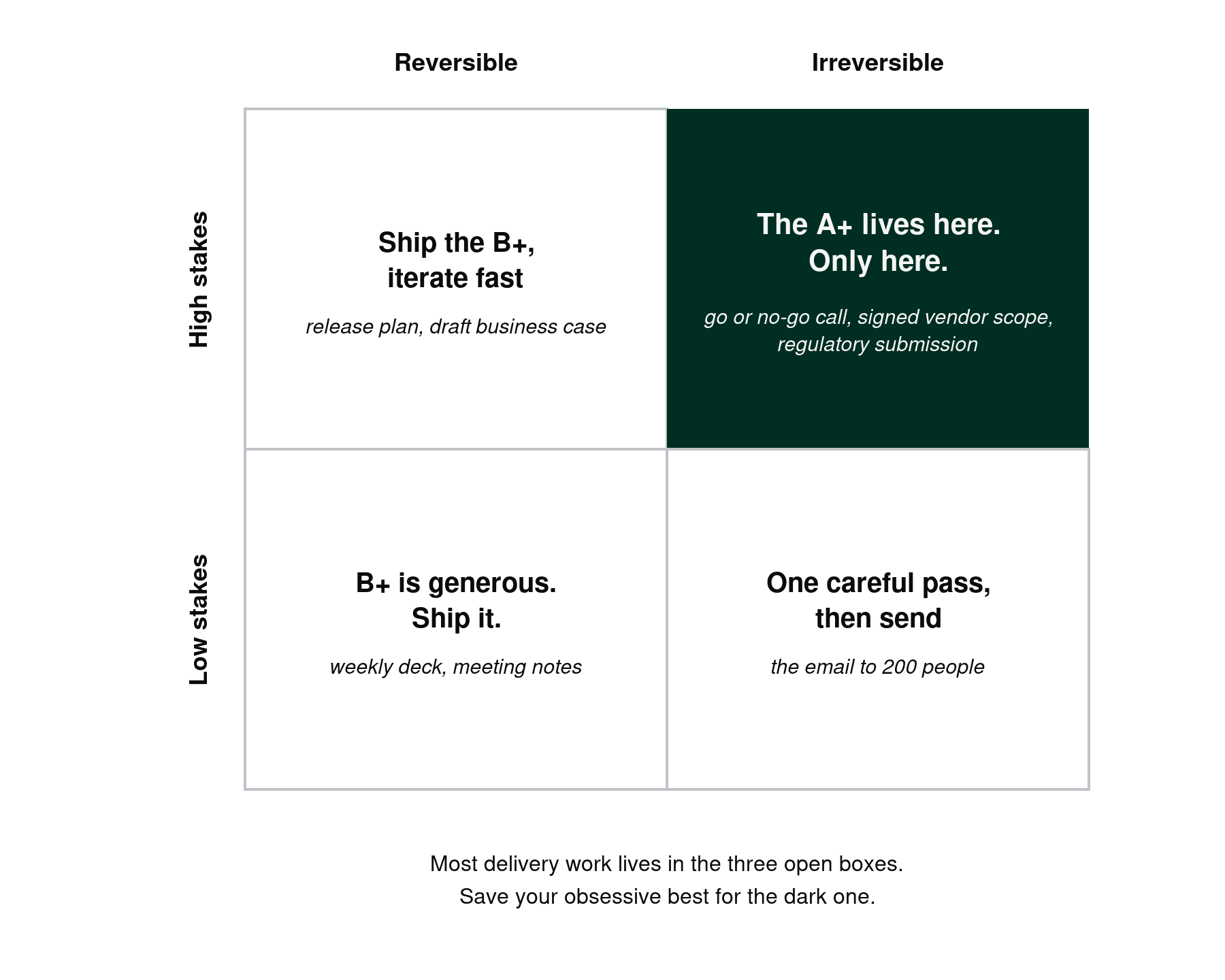
One thing this is not: permission to ship everything sloppy. Some artifacts genuinely deserve your obsessive best, and part of delivery judgment is knowing which. The test is stakes and reversibility. A weekly deck is low stakes and endlessly reversible; there's another one in seven days. A go or no-go recommendation, a signed vendor scope, a regulatory submission: high stakes, and hard or impossible to unwind. That small set earns the true A+. Spending it there is what makes it affordable everywhere else.
What Meera does now
The Tuesday deck goes out Monday at 4pm, labeled Draft, numbers as of that afternoon. Nobody has ever commented on the fonts. Her sponsor has answered the asks slide the same day twice this quarter, which had never happened before, because the asks used to arrive after the moment they were about.
Her standards didn't drop. They moved to where they earn something.
That's what I'd offer you, if you're the one still up at 11pm. You don't owe every artifact your best work. You owe the decision it feeds a fair chance to be made well. Ship the B+ on time, say plainly what's rough about it, and guard the true A+ for the few calls that can't be undone. That isn't lowering the bar. It's finally reading the room the bar is in.
Sources
Curran, T., and Hill, A. P. Perfectionism Is Increasing Over Time: A Meta-Analysis of Birth Cohort Differences From 1989 to 2016. Psychological Bulletin, 2019.
Hill, A. P., and Curran, T. Multidimensional Perfectionism and Burnout: A Meta-Analysis. Personality and Social Psychology Review, 2016.

Subscribe to the Newsletter
Join our growing community and get alerted first on our every article.
*By subscribing, you agree to send your information to our Company who agrees to use it according to their Terms and conditions and Privacy Policy
About the author
I believe the strongest tool and flex each of us has is our belief. When we truly believe in something, we align our mindset, energy, and actions with the right effort and guidance. That is when achieving almost anything becomes possible. This is how I help mentees at OAKKTREEUNII move into Software and Project Management careers for better pay, better confidence, and better work-life balance.
Is perfectionism at work the same as having high standards?
No. Researchers split perfectionism into strivings, which are high standards, and concerns, which are fear of mistakes and judgment. The concerns side is what links to burnout, not the standards themselves.
How do I stop being a perfectionist at work?
Make the standard external: agree with whoever receives the work on who reads it, what decision it feeds, and when that decision happens. Then timebox polish and label drafts as drafts.
When is perfect actually worth it?
For high-stakes, irreversible work: a go or no-go recommendation, a signed vendor scope, a regulatory submission. Most other delivery artifacts feed a decision and should ship on time at B+.

← Previous post
The judgment AI can't do, where a delivery pro becomes irreplaceable
Next post →
What a restaurant kitchen knows about flow that your sprint board doesn't

Keep reading
Newest on the blog


Comments