Writing is the delivery skill compounding fastest right now
ESTIMATED TIME
11
mins

Written by
Shikha Prasad
Published on
In distributed, AI-heavy delivery, your written trail is the interface of the job. No other skill you practice compounds faster right now.
Two teams, the same production risk, the same week. The first team's version lived in paragraph four of a status update:
“Testing is progressing well overall, with 34 of 41 planned cases complete. Some concerns were raised around the vendor sandbox, which may not fully reflect production behaviour in all scenarios, including possibly around rate limiting, which we may want to keep an eye on going forward. Next week we will continue UAT and close out remaining cases.”
The second team wrote the same risk in three lines:
RISK: The vendor sandbox doesn't enforce production rate limits. Our retry logic has never faced a real throttle.
IMPACT: Checkout fails quietly at peak traffic. Launch week is peak traffic.
OWNER: Priya. Load test against production limits by Thursday. Result feeds Friday's go decision.
The first team shipped on schedule. Eleven days later, checkout started failing at peak, exactly the way the sandbox never showed them. Three days of incident calls. One very quiet retro. The risk had been raised, technically. It just hadn't been written to be acted on.
The second team found the retry bug on Wednesday, fixed it on Thursday, and launched to no applause at all. Nobody tells stories about that team. That's the point.
Same risk. Same week. The difference was sentences.
Your documents attend meetings you're not in
Somewhere in the last few years, writing quietly stopped being a soft skill and became the interface of the job. Think about who actually forms an opinion of your work. Your manager reads your status notes. Their manager reads a summary of them. The engineer who inherits your service reads your handoff eight months after you wrote it. The sponsor deciding whether your project keeps its funding reads one decision doc, on a phone, between other meetings. Most of the people who matter to your career will never watch you work. They'll read you.
Distributed work finished the job. When your stakeholders sit in three time zones, writing isn't the record of the work anymore. For every reader who wasn't in the room, it is the work. The shift is measurable: 72 percent of knowledge workers say they're communicating asynchronously more than they did a year earlier, and time spent on written channels rose 18 percent in a single year {Grammarly and The Harris Poll, State of Business Communication}.
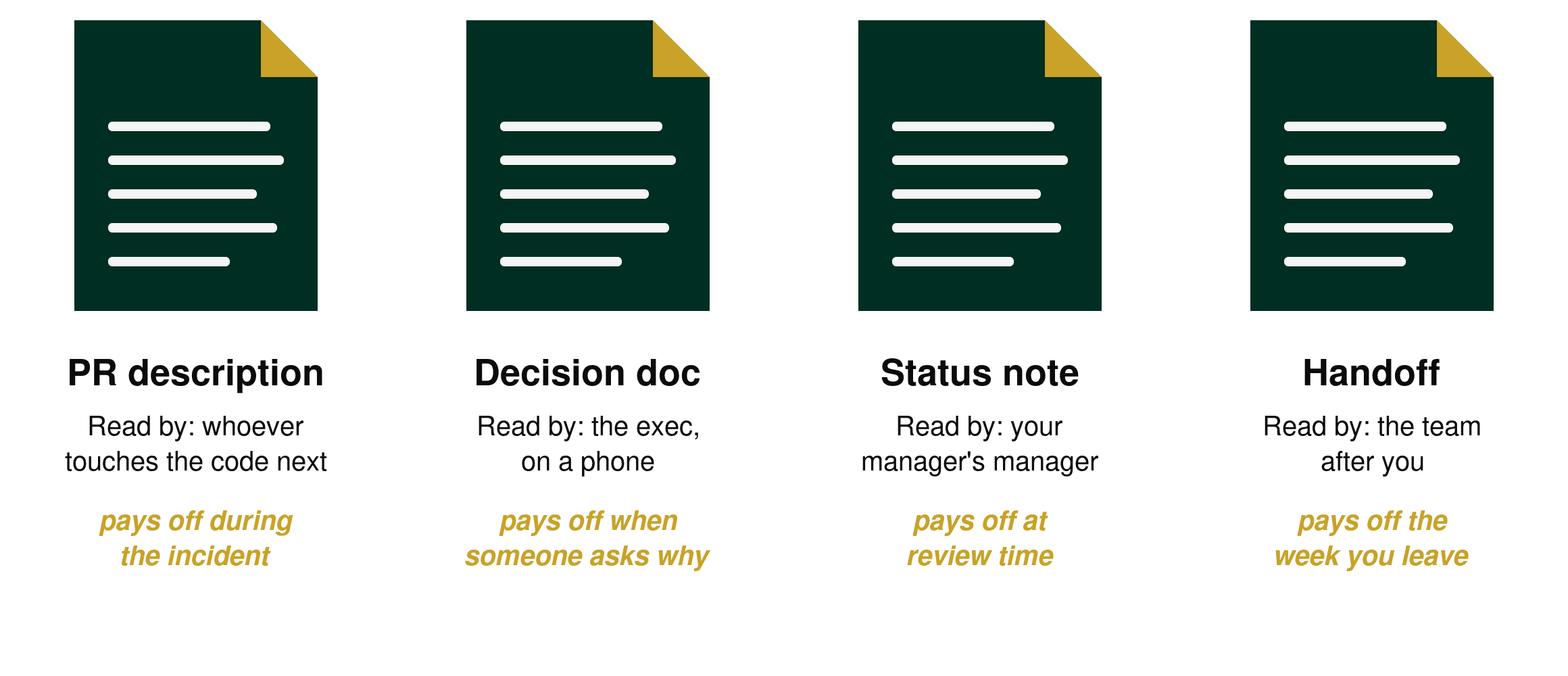
So the trail you leave, the PR description, the decision doc, the status note, the handoff, isn't paperwork around the job. To most people who matter, your written trail is you. It gets forwarded, quoted, and judged by people you'll never meet, months after you stopped thinking about it. Which is why the two notes above split so cleanly: a clearly written risk gets mitigated. A mumbled one gets rediscovered in production.
The job ad undersold it politely
Every job ad you've ever skimmed says “excellent communication skills,” somewhere below “team player,” and you skipped it because it's wallpaper. That's the framework version: communication as a personality trait, filed next to punctuality. Reality is blunter. The written trail is the performance review. It decides which risks get resourced, which projects keep their people, and whose name comes up when a bigger role opens.
The market has stopped being subtle about this. When LinkedIn ranked the most in-demand skills on its platform for 2024, communication came in at number one overall, ahead of every technical skill on the list, and project management sat at number four {LinkedIn, Most In-Demand Skills 2024}. When NACE asks employers what they want evidence of on a candidate's resume, written communication lands in the top three, behind only problem solving and teamwork {NACE, Job Outlook survey}. And the downside carries a price tag: poor communication drains an estimated $1.2 trillion a year from US businesses, roughly $12,506 per employee {Grammarly and The Harris Poll, State of Business Communication}.
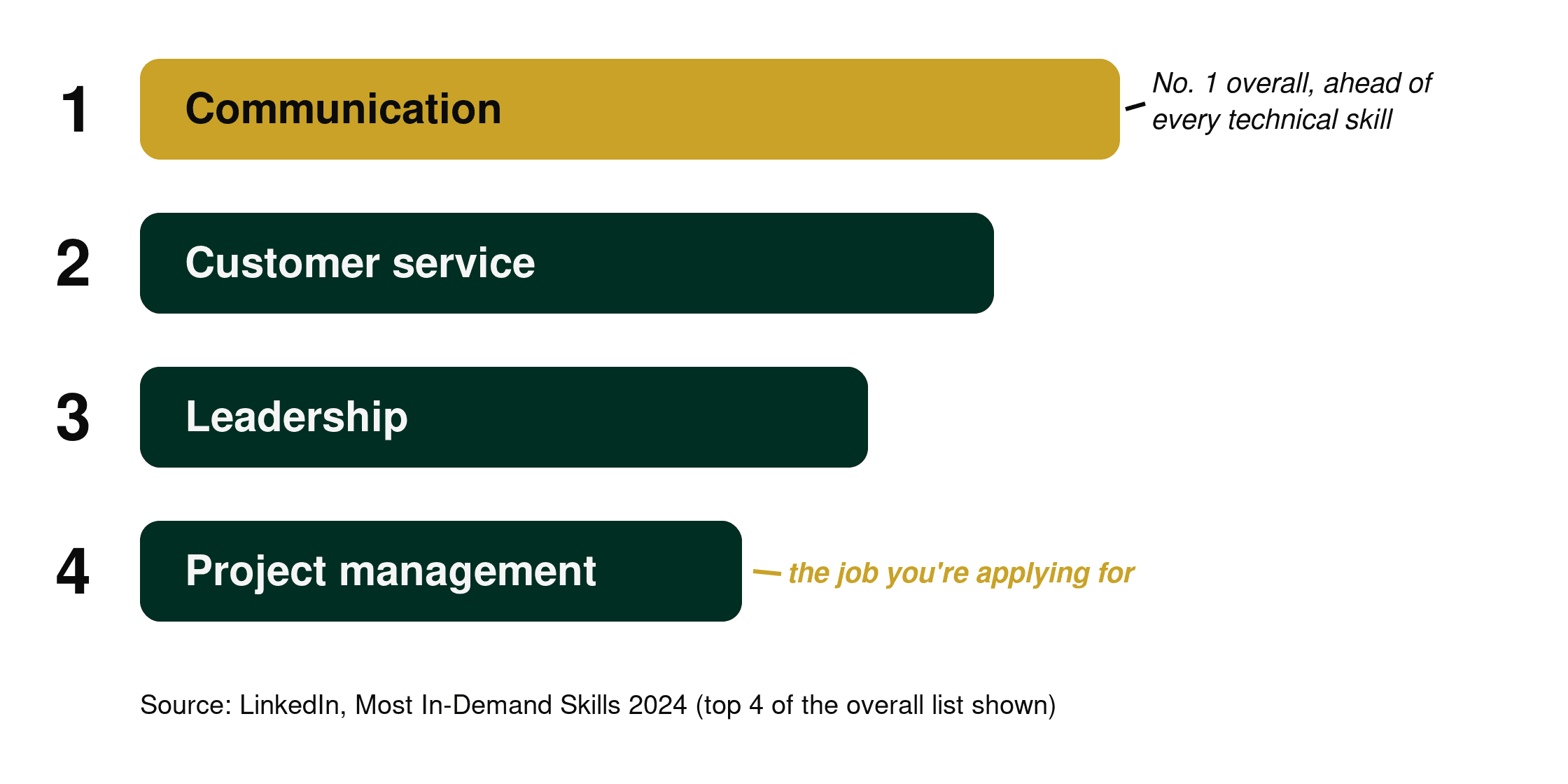
Read those together and the polite bullet point looks different. Companies aren't asking for pleasant prose. They're pricing a risk. Somewhere in every org, right now, a paragraph like team one's is quietly aimed at a launch.
AI made average writing free. Good.
Here's the part people get backwards. The models didn't make writing skills worthless. They made average writing free, which is a different event entirely.
When any update, doc, or summary can be generated in seconds, competent-sounding prose stops being a signal. It's the floor. Everyone's sentences are grammatical now. Everyone's updates have headings. The generic layer costs nothing, so nobody gets credit for it anymore. The premium moved to the one thing a model can't supply: knowing which three facts matter, which risk is real, what the reader has to decide, and what to cut. Call it judgment on paper. It was always the scarce part of writing. AI just stripped off the packaging that used to hide who had it.
And it compounds, which is why “fastest right now” isn't hype. A clear decision doc settles one decision, then becomes the template for the next five. A good handoff saves every future person who touches that system. A risk note with an owner trains a whole team to expect owners on risks. Trust builds the same way: after the third note that meant exactly what it said, people start acting on your word without a meeting. Compound interest, paid out in autonomy.
Mush compounds too, in the other direction, and it now gets generated faster than ever, with more confidence. The gap between the two trails doesn't hold steady. It widens every quarter.
Two objections, both half right
“Nobody reads long documents.” Correct. Nobody should have to. If your risk flag needed four hundred words, that wasn't the reader failing you. Writing well is writing short. The second team's note was three lines, and it moved a load test, a bug fix, and a go decision. Brevity isn't the excuse for skipping the writing; brevity is the writing. The four-hundred-word mumble and the empty bullet list are the same failure in different clothes. Both let the author avoid deciding what matters. The reader's minute is the scarcest resource in a distributed org. A tight note respects it. A bloated one spends it, and readers remember who keeps spending theirs.
“AI writes my updates now.” Also fine, mostly. A model can phrase your update better than you can on a tired Tuesday, and there's no shame in letting it. But it can only phrase what you chose to tell it. It didn't sit in Wednesday's call. It doesn't know the sandbox lies, that Priya's load test is the only thing between you and launch week, or that Friday is the last day the answer is useful. Choosing the three facts is the job. Delegate the phrasing all you want. Delegating the choosing is delegating the job, and fully delegated jobs have a habit of not staying jobs.
The writing sample is the work sample
Now the career part, because that's why half of you are here. Interviews and promotions are converging on the same quiet test. Take-home briefs. Async case exercises. “Draft the update you'd send in this scenario.” Promotion packets that are, literally, documents. A hiring manager can't watch you carry six months of delivery pressure, but they can read three paragraphs you wrote and see how you think under it. Walk in with two real artifacts, a risk note and a decision summary written the way the second team writes, and you're showing the job instead of describing yourself.
So practice the smallest version today. Take the last risk you raised and rewrite it in three lines: what's true, what it costs, who does what by when. The format scales to status notes, decisions, and handoffs, and it's harder than it looks, which is exactly why it's worth the reps.
Then hold one standard from here on: nothing leaves your keyboard that a stranger couldn't act on. Not your teammate, a stranger. If someone with zero context can read the note and know what's true, what it costs, and who owns it by when, you wrote it well. If they'd need to book a call with you first, you didn't.
Careers in delivery aren't decided in rooms much anymore. They're decided in documents, read by tired people, on phones, at 4pm. Write like the decision depends on the sentence. It usually does.
Sources
LinkedIn, The Most In-Demand Skills of 2024, 2024.
Grammarly and The Harris Poll, The State of Business Communication: New Threats and Opportunities, 2023.
National Association of Colleges and Employers (NACE), Press Room: Frequently Asked Questions (Job Outlook survey findings).

Subscribe to the Newsletter
Join our growing community and get alerted first on our every article.
*By subscribing, you agree to send your information to our Company who agrees to use it according to their Terms and conditions and Privacy Policy
About the author
I believe the strongest tool and flex each of us has is our belief. When we truly believe in something, we align our mindset, energy, and actions with the right effort and guidance. That is when achieving almost anything becomes possible. This is how I help mentees at OAKKTREEUNII move into Software and Project Management careers for better pay, better confidence, and better work-life balance.
Why are written communication skills important in project management?
Because most delivery decisions are made by people reading, not watching. Status notes, risk flags, and decision docs are how sponsors, stakeholders, and future teammates judge the work, often months later.
How do I improve written communication skills at work?
Practice compression. Take one real risk or update and rewrite it in three lines: what's true, what it costs, who does what by when. Repeat until strangers can act on your notes without a meeting.
Do writing skills still matter now that AI can write updates?
More than before. AI made average prose free, so the value moved to judgment: choosing which facts matter, which risk is real, and what to cut. A model can phrase your update; it can't choose for you.

← Previous post
Big-room planning, explained: what actually happens in the two days everyone dreads
Next post →
The vendor is not your team, and pretending otherwise costs you the release

Keep reading
Newest on the blog


Comments