Sunk cost is running your roadmap, and you can't see it
ESTIMATED TIME
12
mins

Written by
Shikha Prasad
Published on
The projects that survive quarterly planning aren't always the ones worth finishing. They're the ones nobody can face killing.
There's a project on your roadmap right now that everyone privately agrees should die.
You know the one. It's had three names, two "strategic resets," and a sponsor who left the company last spring. The business case cites a market condition from two budget cycles ago. When it comes up in the quarterly review, people study their laptops. And every quarter, a room full of smart, experienced people votes to keep it alive.
Nobody's lying. Nobody's incompetent. That's exactly what should worry you.
If zombie projects survived because someone was careless, you could fix the problem with a sharper analyst or a better template. They survive because of something far more respectable: the money already spent sits in the room like a stakeholder. It has no future value, no vote, and no pulse. It still outranks half the list.
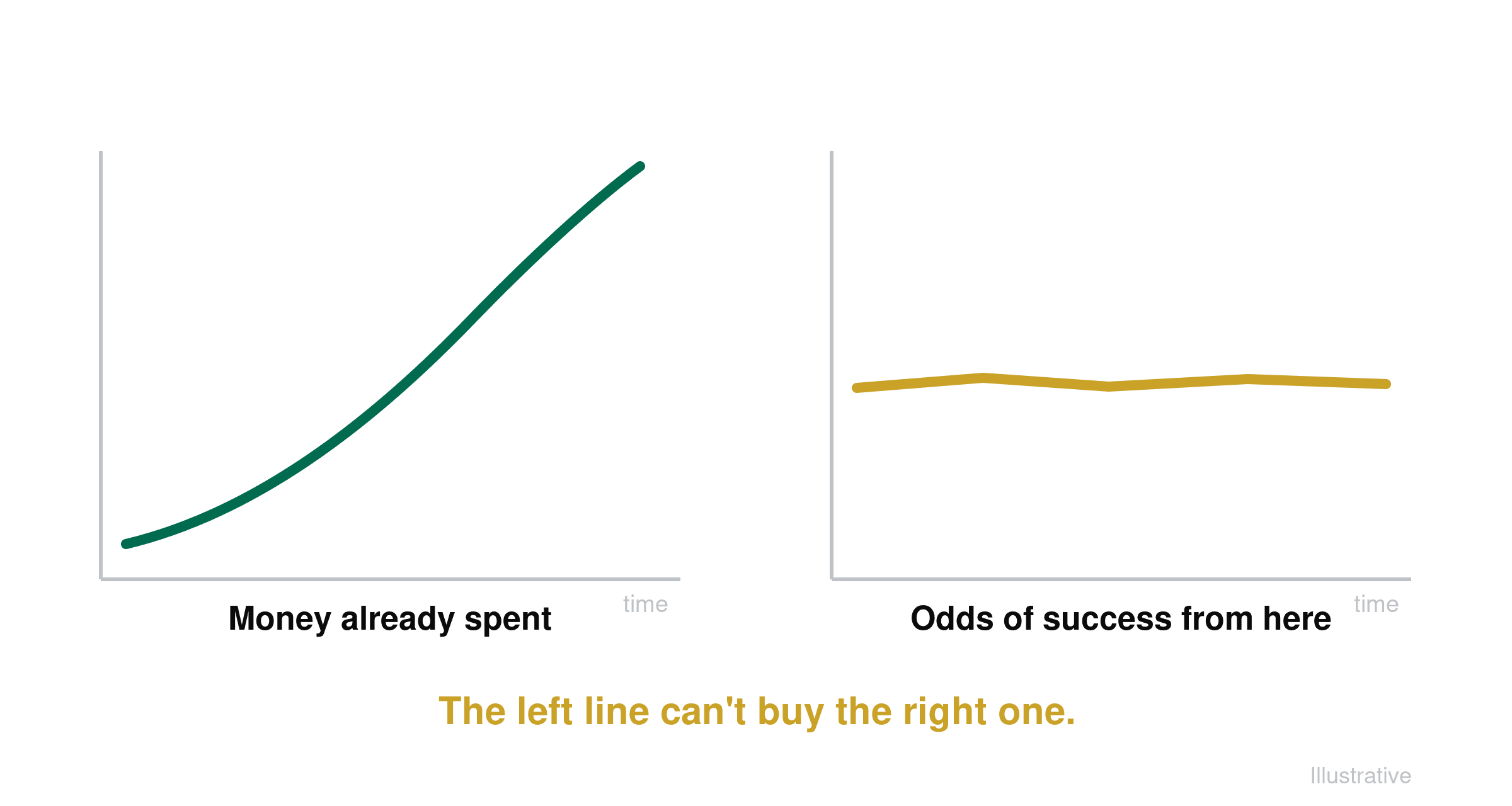
So here's the claim, stated plainly. Most roadmaps aren't ranked by what remains to be earned. They're ranked by what has already been spent. That's the sunk cost fallacy in project management, and it's not a knowledge problem. It's a visibility problem. You can't see it running your portfolio, even while you're the one operating the spreadsheet.
The most respectable sentence in the building
Sunk cost doesn't show up to planning wearing a name tag. It shows up dressed as stewardship.
"We've come too far to stop now." "Phase two is where the value lands." "We have to protect our investment." Each of those sentences sounds like responsibility. Translate them honestly and they all collapse into the same sentence: the money is gone either way; we're deciding whether to lose more.
That translation isn't cynicism. It's arithmetic. "Protecting our investment" isn't a thing that can be done, because the investment is already spent. There's nothing left to protect. There's only the next dollar, and the next dollar doesn't care what happened to the last one.
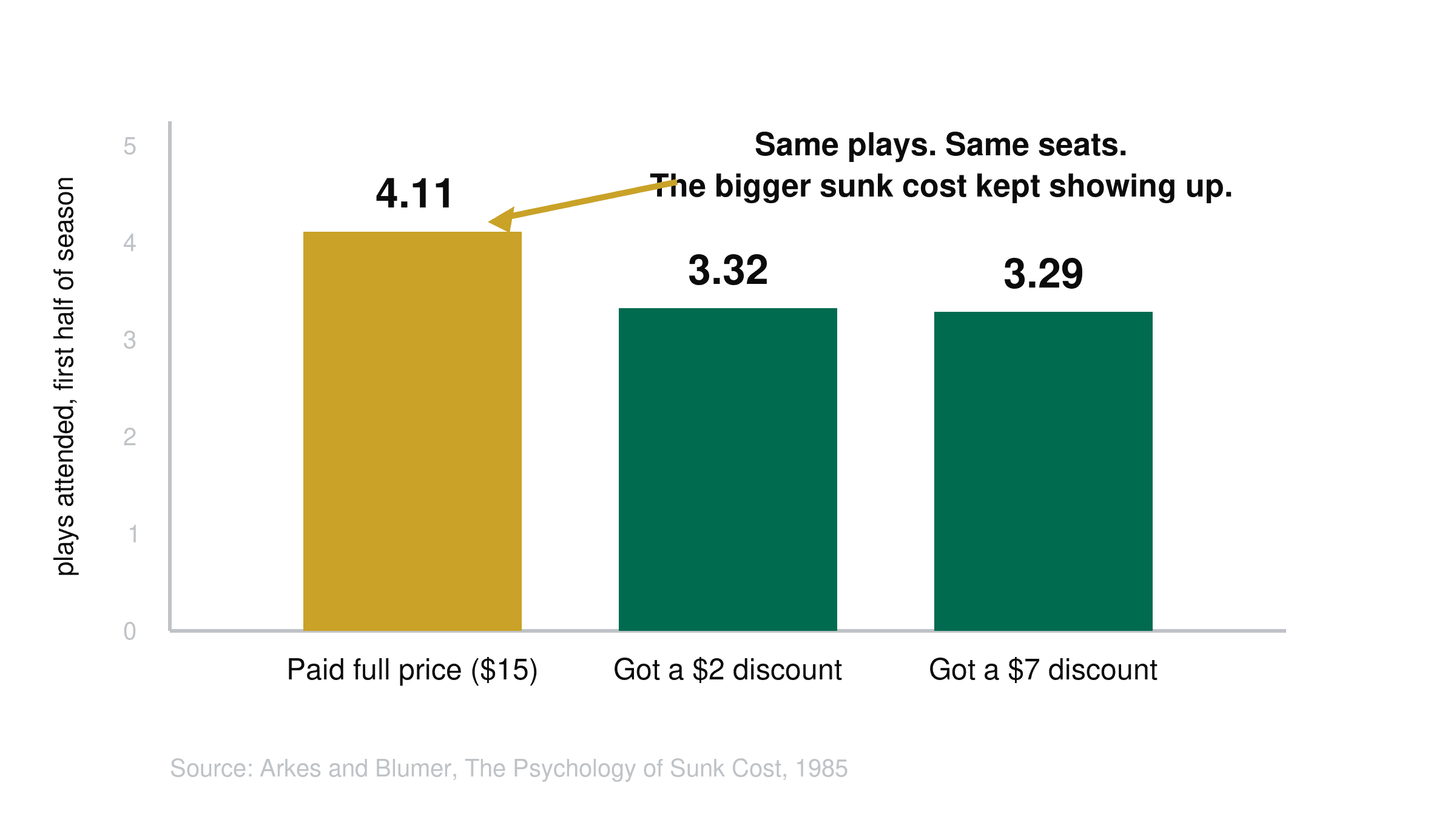
You'd hope trained professionals see through this. The evidence disagrees, cheerfully. In a 1985 field experiment, researchers randomly discounted season tickets at a university theater box office. Same plays, same seats, different prices paid. People who paid full price attended an average of 4.11 of the first five shows. The two discount groups showed up 3.32 and 3.29 times {Arkes and Blumer, 1985}. The plays didn't change. The only thing that changed was the size of the unrecoverable spend, and that was enough to drag people through winter evenings to performances they'd otherwise have skipped.
With theater tickets, this is charming. With a delivery portfolio, it compounds, because the effect doesn't stop at "keep paying." It rewrites your forecast. In the same research program, people who had already sunk money into a doomed project rated its chance of success at 41 out of 100, on average. People evaluating the identical project with no history said 34. Prior economics courses made no measurable difference {Arkes and Blumer, 1985}. Hold that against your status reports. The project's odds never improved. Your exposure inflated your estimate of them. Sunk cost doesn't just spend your money. It edits your confidence column.
It also picks its defenders predictably. In the classic escalation study, 240 business students worked through a simulated investment decision, and the people who committed the most new resources to a previously chosen course of action were the ones personally responsible for its negative consequences {Staw, 1976}. Read that twice. The worse the bet performs, the harder its author fights for it. So the loudest voice defending the zombie is usually its parent, and the volume tells you nothing about the project. It tells you about the parenting.
Listen to how a project dies
Weak rooms and strong rooms kill projects differently, and you can hear the difference inside one meeting.
The weak version sounds like this. "We're eighteen months in." "We've spent 1.4 million." "The integration is nearly finished." "If we stop now, all of that was for nothing." Notice the tense. Every argument faces backward. The future appears only as an assumption that slipped in quietly, usually wearing the words "phase two."
The strong version sounds different. A senior director I watched do this needed about four minutes. "The 1.4 million is gone whether we continue or not, so it doesn't get a seat in this decision. From today: finishing costs another 900 thousand and two more quarters, and the value case assumed a client who churned in March. If this walked in the door right now as a new proposal, we wouldn't fund it. So we stop. We write down what we learned, we keep the two components that work, and the team moves to the item we've been starving all year." Then the line that let everyone in the room breathe: "Starting it was a defensible bet. The world changed. Changing with it isn't failure."
No autopsy. No blame theater. The past got treated as tuition, and the future was the only thing still for sale. Juniors defend the spend. Seniors defend what's left of the future.
Sometimes the zombie is actually alive
Now the honest part, because the counterargument deserves its strongest form: continuing is often correct, and a leader who reflexively kills anything carrying sunk costs isn't being rational. They're running a different bias with better branding.
Continuing is right when the remaining cost is small and the remaining value is real. A project that's genuinely 95 percent done, with a customer waiting on the other side, is usually worth the last five percent. Continuing is right when the work has option value the original business case never captured, like the unglamorous platform that three future products quietly depend on. And it's right when switching costs are real, because killing a half-migrated system can leave you paying for two stacks plus a second migration later, which can genuinely cost more than finishing the first one.
Here's the test that separates all of that from sunk-cost theater. Every legitimate reason to continue lives in the future. Remaining cost, remaining value, option value, switching costs: forward-looking, all of it. Sunk cost is the only argument that lives in the past. So delete the history and see if the case survives. If this exact work, at today's remaining cost and today's remaining value, arrived as a brand-new proposal, would you fund it? If yes, continue with a clear conscience. If the case needs the words "already" and "so far" to stay standing, it isn't a case. It's a eulogy asking for a budget.
Rank the future. Only the future.
Notice what the fix is not. It isn't awareness. Everyone in your steering committee has heard of the sunk cost fallacy, and naming it has saved approximately zero projects. It isn't willpower either. Willpower is what "one more quarter" is made of.
The fix is a decision rule, agreed before the emotional moment and applied mechanically during it. Two parts.
First: rank every item, new or in flight, on remaining cost versus remaining value. Money already spent appears nowhere in the model. Not as a tiebreaker, not as context, not as a line item with a sad face next to it. Nowhere.
Second: make one question a standing agenda item in every planning review, asked out loud of every carry-over initiative. "If we were starting today, would we start this?"
The question works because it deletes the past politely. Nobody has to confess a mistake, because it never asks whether starting was wrong. It asks whether continuing is right. Those are different questions, and the second one is the only one a roadmap can act on. The research even measured the flip. When people were told they'd already sunk 10 million dollars into a nearly finished plane that a competitor's faster, cheaper model had just made pointless, 41 of 48 voted to spend the final million finishing it. Offered the identical plane as a fresh proposal with no history, 10 of 60 said yes {Arkes and Blumer, 1985}. Same plane. Same million. Opposite room.
If you're the project manager or Scrum Master in that meeting, you don't need permission to ask the question. Start with your own backlog, where the stakes are small: the report nobody reads, the recurring meeting that outlived its decision, the "temporary" dashboard approaching its second birthday. Practice saying "spent money doesn't get a vote" where it costs nothing, so you can say it calmly where it costs something. People who hold that line in a portfolio review sound senior years before anyone hands them the title.
Because a roadmap is not a memorial. Nothing on it earns a future by having a past.
Sources
Arkes, H. R., and Blumer, C. The Psychology of Sunk Cost. Organizational Behavior and Human Decision Processes, 35(1), pages 124 to 140, 1985.
Staw, B. M. Knee-Deep in the Big Muddy: A Study of Escalating Commitment to a Chosen Course of Action. Organizational Behavior and Human Performance, 16(1), pages 27 to 44, 1976.

Subscribe to the Newsletter
Join our growing community and get alerted first on our every article.
*By subscribing, you agree to send your information to our Company who agrees to use it according to their Terms and conditions and Privacy Policy
About the author
I believe the strongest tool and flex each of us has is our belief. When we truly believe in something, we align our mindset, energy, and actions with the right effort and guidance. That is when achieving almost anything becomes possible. This is how I help mentees at OAKKTREEUNII move into Software and Project Management careers for better pay, better confidence, and better work-life balance.
What is the sunk cost fallacy in project management?
It's ranking or continuing projects because of the money and effort already spent instead of what's left to spend versus what's left to gain. Spent money is unrecoverable, so it says nothing about whether the next dollar is worth spending.
How do you avoid the sunk cost fallacy on a roadmap?
Use a decision rule instead of willpower: rank every initiative on remaining cost versus remaining value, and ask "if we were starting today, would we start this?" of every carry-over item at each planning review.
When is continuing a troubled project the right call?
When the forward-looking case still holds: a small remaining cost against real remaining value, genuine option value, or switching costs that outweigh the cost to finish. If the case leans on money already spent, it isn't a case.

← Previous post
Who owns the bug the AI agent wrote?
Next post →
Follow-the-sun delivery: leading a team split across three time zones

Keep reading
Newest on the blog


Comments