Running a project when nobody on the team reports to you
ESTIMATED TIME
11
mins

Written by
Shikha Prasad
Published on
You can't assign work and you can't set priorities. You can still be the reason it ships.
Week one. You ask the integration developer to pick up your API task next, because the vendor's test window opens Friday and this sits square on the critical path.
He’s friendly about it. “Sure, after the things my manager gave me.”
Nothing rude just happened. Nothing wrong, either. He's doing exactly what he's paid to do: working the priorities of the person who writes his performance review. That person isn't you.
This is the moment a lot of new project managers wait for authority to arrive and fix. It doesn’t arrive. It was never coming. The org chart routes every “must” through someone else, and you just felt the routing for the first time.
Good. Now you get to learn how delivery actually works.
The plan calls them your team. The org chart disagrees.
The project plan is a confident document. It lists five names under “resources,” draws them inside your box, and schedules their hours like you own them.
The org chart tells the truth. Those five people report to five different managers, carry goals you didn't set, and get reviewed on work you'll never see. When your priority collides with their manager's priority, the org chart wins the tie. It wins every tie.

So stop trying to win ties. Your job is to stop the collisions from happening in the first place, and to make helping you the easiest good decision in each person’s week.
That isn't soft-skills garnish. It's the actual mechanism. Matrix delivery runs on influence, and influence isn't charm. It's currency, and you can bank it.
Four currencies you can bank without a title
Clarity. The person who makes the work make sense gets followed. When a developer can look at your board and know exactly what's needed, why it matters, and what done looks like, you've removed the tax every other project charges them. Write every ask so it survives being read at 4:55 on a Thursday: the task, the why, the date, what done means. Four lines. People drift toward the project that doesn't confuse them. Be that project.
Unblocking. Remove one real obstacle. Chase the firewall rule, get the test data loaded, corner the architect for the decision that's been floating for a week. Do it once and you've made a repeat customer. Nobody forgets the PM who cleared the thing their own manager wouldn't touch.
Credit. When someone delivers, their name goes to their boss, in writing, while it’s fresh. Not “the team did great.” Their name, the specific thing, sent to the person who reviews them. It costs you two minutes and it shows up in their next performance conversation. Earned credit only. Praise inflation devalues the currency.
Legibility. Make each person's contribution visible on the project, every week. Invisible work gets deprioritized first, because a manager pulling their people back cuts what they can't see. If your status shows exactly what Priya shipped and what it unblocked, then cutting Priya's hours has a cost somebody has to own out loud.
Four currencies. None of them needs a title. All of them compound.
The kickoff contract: agree before you need it
Here's the move almost everyone skips, and it's the highest-value hour of your first week.
Go to each team member’s actual manager, in week one, and agree on what this project gets of their person. Three things, said out loud:
Time. How many days a week, which days, until when.
Decision rights. What you can hand their person directly, and what routes through them.
Escalation path. When priorities collide, who talks to whom, and how fast.
That's a contract. Not a legal one. A social one, and managers honour social contracts they helped write.
The timing is the whole trick. In week one this costs a coffee, because nothing is on fire and agreeing is cheap. In week nine, with a milestone slipping and a vendor idle, the same conversation is a negotiation held inside a burning building. Negotiating during a fire is how projects burn.
And if a manager won't commit to numbers? That's not a failed conversation. That's intel. You've just learned the allocation is soft while the plan can still absorb it, which beats discovering it in week nine. The projects that get hurt worst by fuzzy commitments are the ones that never asked out loud.
Escalation is a service, not a threat
New PMs treat escalation like pulling a fire alarm: loud, shameful, career-limiting. So they nag instead. Ask, ask again, ask louder, cc the boss for visibility, collect resentment. Look at that chain closely. There's no decision in it anywhere.
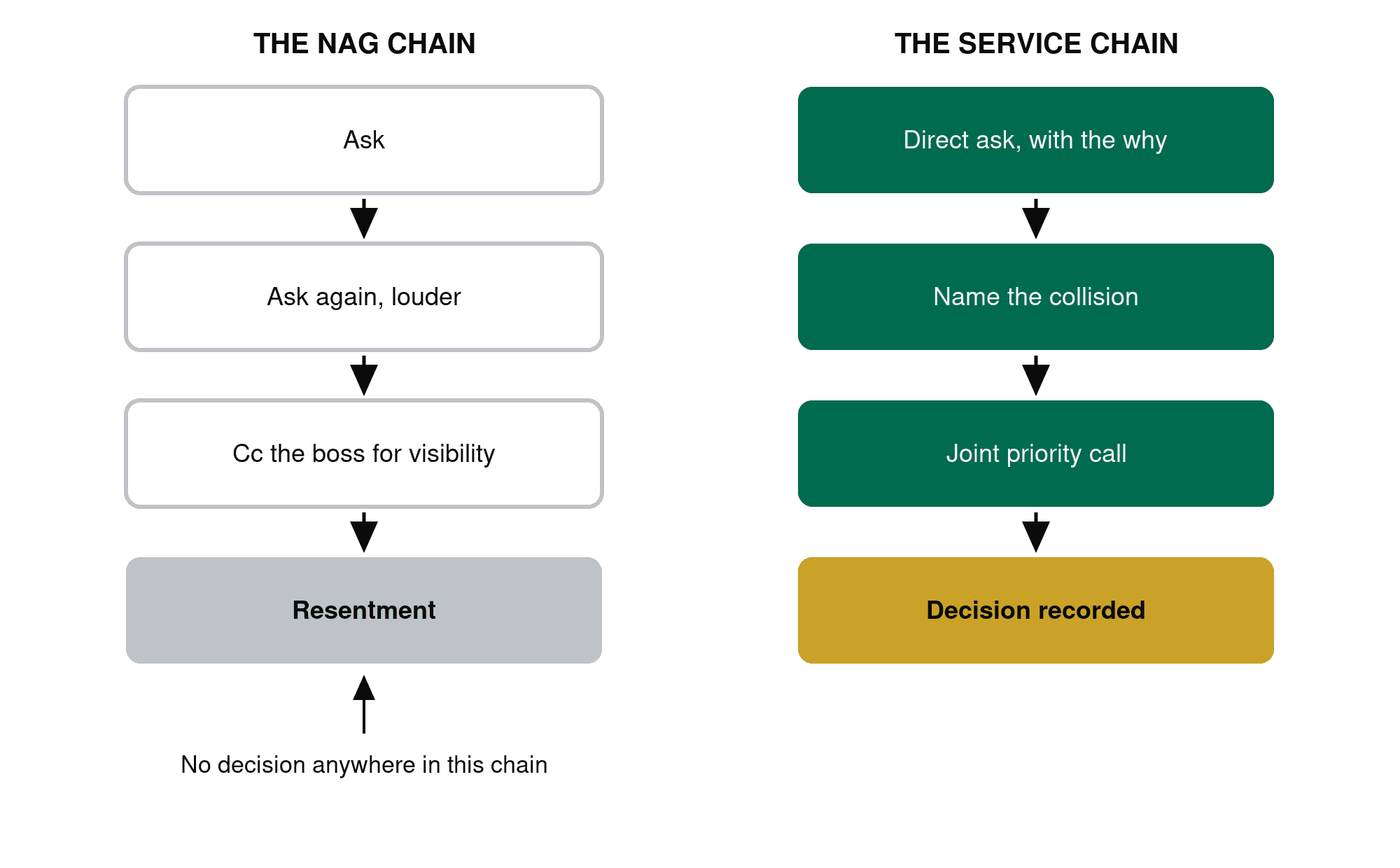
Strong PMs escalate earlier and it lands softer, because of what they actually say. Compare the two lines out loud.
Weak: “I need to flag that Dev’s tasks aren’t getting done and it’s hurting my timeline.”
Strong: “You’ve both got a claim on Dev’s week and I don’t think either of you knows it. Can we take fifteen minutes and pick an order? I’ll live with whatever you two decide.”
The first line reports a person. The second names a priority collision between two managers who didn't know they had one, and offers to host the fix. You're not telling on anybody. You're providing a service: surfacing a conflict that already exists, and getting it decided while it's still cheap. Then write the decision down where both managers can see it. A decision nobody recorded is a rumour with good posture.
One rule keeps it honest. Escalate only after the direct route has failed once, cleanly. One real ask, to the person, with the why attached. If that doesn't move it, the collision is real and it belongs to the managers. Skip the direct ask and you look political. Repeat it five times and you become furniture.
Sponsor air cover is borrowed money
If your sponsor carries weight in the building, you're holding borrowed authority. Spend it like money somebody lent you.
Rarely, so it keeps its value. Visibly, so people connect the intervention to the project and not to your mood. And only on things that matter: a milestone at risk, a decision blocking three people. Never on getting your meeting moved. A sponsor who intervenes weekly stops being air cover and becomes background noise, and you become the PM who cried wolf in someone else’s voice.
When someone quietly deprioritizes you
Every matrix project has one. They agree in every meeting, and then your tasks just age.
The tempting read is character. Flaky. Doesn't care. It's almost never character. It's incentives. Their manager has them on something you can't see, their review lands in six weeks, and your project appears nowhere in it. They're not defying you. They're obeying someone else, and from inside their week those two things look identical.
So don’t try to fix the person. Fix the incentive conversation, with the manager you contracted with in week one: “Ali’s down to about a day a week on us in practice. If that’s the new allocation, I’ll replan around it honestly. If it isn’t, what’s competing?” No blame, no drama. Either answer helps you, and both beat another one-on-one where Ali apologizes and nothing changes.
The interview question hiding inside all of this
“Tell me about a time you delivered through people who didn’t report to you.” Every PM, Scrum Master, and delivery lead interview carries a version of it, usually inside the first three probes, because the entire job lives in that question.
The weak answer: “I built relationships and kept communication open.” That’s not an answer. That’s a horoscope. It’s true of everyone and describes no one.
The strong answer names mechanisms: “Nobody on that team reported to me, so in week one I agreed time, decision rights, and an escalation path with each of their managers. I made everyone’s work visible weekly so it couldn’t be quietly cut, sent credit upward in writing when it was earned, and when two managers collided over our developer, I hosted the priority call instead of nagging him. The integration shipped two days early.”
Same project. The first answer sounds like someone who got lucky with nice colleagues. The second sounds like someone who understands how organizations actually move, and can repeat it on purpose with worse colleagues. Practice naming your mechanisms out loud before you're asked. If you can't say what you did, the interviewer files your delivery under luck.
Authority is what the org chart lends managers. Influence is the version you build yourself, and it transfers to every job you'll ever hold. That developer in week one wasn't blocking you. He was handing you the syllabus.

Subscribe to the Newsletter
Join our growing community and get alerted first on our every article.
*By subscribing, you agree to send your information to our Company who agrees to use it according to their Terms and conditions and Privacy Policy
About the author
I believe the strongest tool and flex each of us has is our belief. When we truly believe in something, we align our mindset, energy, and actions with the right effort and guidance. That is when achieving almost anything becomes possible. This is how I help mentees at OAKKTREEUNII move into Software and Project Management careers for better pay, better confidence, and better work-life balance.
What does influence without authority mean in project management?
Delivering through people who don't report to you. You can't assign work or set priorities, so you earn cooperation with clarity, unblocking, credit, and visible contributions, and you agree time and escalation paths with each member's real manager.
How do you get work prioritized by people who don’t report to you?
Agree a kickoff contract with each person's manager in week one: days per week, decision rights, and an escalation path. Then make each person's work visible every week so it can't be quietly cut.
When should a project manager escalate?
After one clean direct ask has failed. Frame it as helping two managers resolve a priority collision they didn’t know they had, ask for a fifteen-minute joint decision, and record what they decide.

← Previous post
The PMO that survived the budget review: ninety days, three changes
Next post →
How to coach a team that knows more than you do

Keep reading
Newest on the blog


Comments