The teammate who’s technically right and impossible to work with
ESTIMATED TIME
11
mins

Written by
Shikha Prasad
Published on
Organizations never stop valuing correctness. They stop buying it from people who make it expensive.
The architecture review runs forty minutes over. The staff engineer, the sharpest person in the room and visibly aware of it, has just taken the proposed design apart. He’s right, and everyone knows he’s right. The event bus won’t survive the traffic projections. He’s also called the design “amateur hour,” answered a junior engineer’s question with a sigh, and re-explained a point nobody misunderstood, slower the second time, in case slowness helped. The meeting ends. He wins.
Three weeks later there’s another meeting about the same system. Smaller. Six people instead of fifteen. He isn’t in it. That’s the meeting where the decision actually gets made.
I’ve watched a version of this play out at more than one company, with different names on the door and different systems on the whiteboard, and the shape never changes. Being right is a skill. Being workable-with is a different skill. Organizations pay full price for the first only while it comes attached to the second, and when it stops, nothing gets announced. Nobody demotes the difficult expert. Nobody sends a memo. They just stop inviting him to the moment where being right would’ve mattered.
The reroute nobody announces
Organizations handle a painful node the way networks do: they route around it. The big review still happens, because the big review is theater and he’s excellent theater. But the real path of the decision bends. Pre-meetings appear. Threads he’s not on. A “quick sync” that somehow settles the thing before the meeting that was supposed to settle the thing. His input gets reclassified from ingredient to risk: something to be timed, managed, and scheduled late enough that it can’t change the outcome.
Here’s what makes this fatal instead of just sad: every part of the reroute is invisible from inside it. Meetings you’re not invited to don’t show up on your calendar as absences. Arguments people decline to have with you feel exactly like winning them. The difficult expert experiences all of it as the org finally coming around: fewer fights, faster nods, a strange new smoothness. Silence isn’t agreement. Sometimes it’s the sound of decisions leaving the room you’re in.
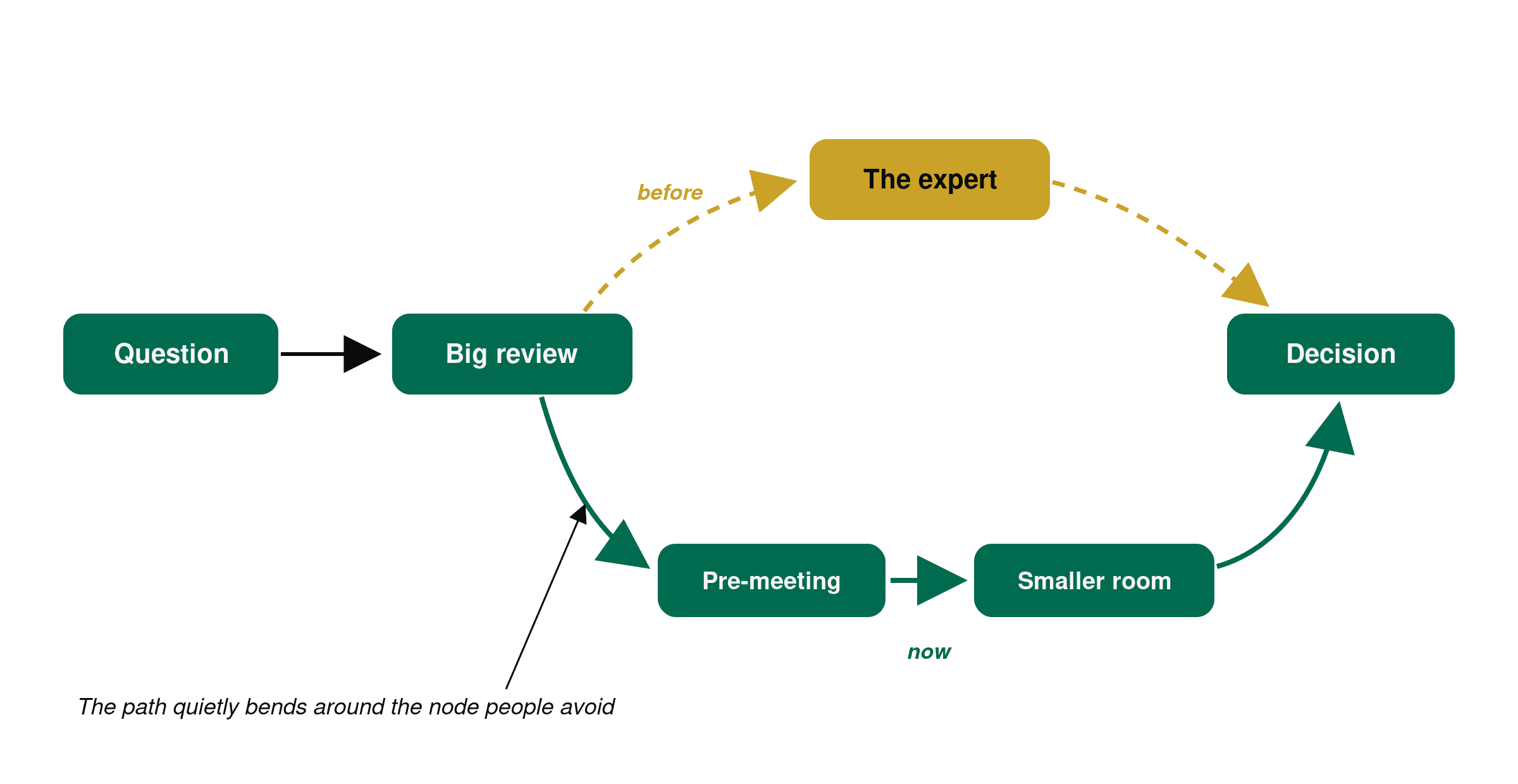
And once the path bends, his correctness stops mattering. Not because correctness lost value. Because correctness that arrives after the decision is trivia.
Teams don’t die from arguments
The lazy diagnosis is “too much conflict on that team.” Wrong. Healthy teams argue constantly; argument is how a design gets load-tested before production runs the test for real. If your team never fights about architecture, your architecture is being chosen by whoever speaks last.
Teams don’t die from arguments. They die from what the argument implies about respect.
Run the same objection through two mouths.
“That will fall over at scale. This is amateur hour.”
“At 10x load this breaks. Can we spike it before we commit?”
Identical technical content. Same risk, same rightness, same seniority behind it. The first sentence carries a second message riding under the first: you are beneath me, and so is this review. The second keeps the full voltage of the disagreement and drops the verdict on the people. One of them costs the team an afternoon of spiking. The other one, repeated for a year, costs the team him.
So be precise about the line, because the coaching depends on it. Disagreement says your idea is wrong. Dismissal says your idea isn’t worth engaging. Contempt says you aren’t. Keep the first forever; it’s the whole point of putting smart people in one room. Somewhere past dismissal, the objection stops describing the design and starts describing the people. No retro fixes that.

But brilliant jerks ship
Two objections deserve a straight answer, because together they’re the strongest case for leaving this person alone.
First: brilliant jerks ship. Some famous systems were built by people you’d never want at dinner. True. But look at the shape of those stories: they’re mostly stories of solo work, one person with their hands directly on the thing. Abrasiveness is cheap when the output doesn’t have to pass through other people. Team delivery is the opposite case. On a team, correctness only becomes software by transferring through other humans: reviewers, implementers, the QA engineer who has to care, the PM who has to sequence it. The brilliant jerk doesn’t have a rightness problem. He has a transmission problem. And notice who gets counted: we remember the jerks who shipped, never the teams that quietly dissolved around the ones who didn’t.
Second: you need truth-tellers, not diplomats. Also true, and the fear underneath it is legitimate. Organizations really do rot from comfortable silence, and a room of pleasant nodders will politely agree its way into an outage. But measure truth-telling by what it’s for. The job of a truth is to end up inside other people’s heads, changing what they build. Truth delivered undeliverably doesn’t transfer, so it fails at the only job truth has. The contemptuous expert doesn’t make the org more honest. He makes honesty more expensive, so the org buys less of it: from him first, then from everyone who watched what happened to him. A truth-teller nobody can receive is just a man being loud near the problem.
And the cruelest detail sits under both answers: he can’t see any of it happening. The evidence that people have stopped listening is made entirely of things that no longer happen near him.
Bring a ledger, not an adjective
Which is why, if you lead this team, most advice on how to deal with a difficult team member bounces straight off this particular one. “Work on your tone” sounds subjective, and you’re saying it to someone whose entire identity is built on being objectively right. He’ll file your adjective as noise. Yours specifically.
So don’t bring adjectives to the 1:1. Bring a ledger.
Walk the record like an incident review, because that’s what it is. You were right in March about the retry logic; the way it landed is why the platform team built their workaround without asking you. You were right in April about the vendor’s rate limits; that’s why the integration review happened while you were out, and it wasn’t a scheduling accident. You were right in May about the migration order; that one’s why we’re having this conversation. Three months. Three correct calls. Three invoices. You can’t argue a person out of contempt with adjectives. You can show him what being right has been costing him.
Then say the frame out loud, because the frame is the coaching: I’m not asking you to be less right. I’m not even asking you to be nice. I’m asking you to stop paying retail for influence you could have at cost. Delivering a hard truth so it actually transfers is a skill, and it’s a smaller skill than the ones you’ve already mastered. You just haven’t treated it as one, because until today nobody itemized the bill.
One guardrail, and it’s absolute: challenge the behavior, never sneer at the person. The moment he feels like the team’s villain instead of its most expensive asset, you’ve done to him exactly what he did to that junior engineer, and you’ll get what contempt always gets. Nothing transfers.
How you’d know if it’s you
Some people reading this don’t manage the difficult expert. They’re him. And because the mechanism is invisible from the inside, feeling sure it isn’t you is not evidence. Here’s the uncomfortable truth: you can’t feel this happening to you. You can only detect it. So instrument for it:
Rooms go quiet when you weigh in. Not persuaded-quiet. Done-quiet. The thanks arrive faster than being convinced would actually take.
Decisions show up pre-made. You’re being informed, carefully, by people who seem slightly braced.
Your reviews praise your technical work and keep circling the word “communication” like it’s a load-bearing euphemism. It is.
You keep winning arguments against people who, you’d notice if you checked, stopped arguing back months ago.
Two or more familiar? Run your own ledger before someone runs it for you. Take the last argument you won and ask what it cost. Ask one person you trust the question you’d rather not: when I push back, what’s it like on the other end? Then convert one objection this week from verdict to question. “This breaks at 10x. Can we spike it before we commit?” The disagreement survives intact. The only thing you’ve dropped is the part that was never doing engineering work anyway. And if you could learn distributed systems, you can learn this. It’s a much shorter curriculum.
The staff engineer was right about the event bus, by the way. The fix that shipped was his, roughly: re-derived three weeks later by six people in a smaller room, at twice the price. Nobody in that company was against the truth. They’d just stopped being willing to collect it from him. So take the argument in one line. Never make a room choose between your correctness and their dignity. People choose dignity, then re-derive your correctness later, in a meeting you’re not in.

Subscribe to the Newsletter
Join our growing community and get alerted first on our every article.
*By subscribing, you agree to send your information to our Company who agrees to use it according to their Terms and conditions and Privacy Policy
About the author
I believe the strongest tool and flex each of us has is our belief. When we truly believe in something, we align our mindset, energy, and actions with the right effort and guidance. That is when achieving almost anything becomes possible. This is how I help mentees at OAKKTREEUNII move into Software and Project Management careers for better pay, better confidence, and better work-life balance.
How do you deal with a difficult team member who is usually right?
Separate the correctness from the delivery. Keep the disagreement, coach the contempt: run a cost-ledger 1:1 that lists the moments they were right and exactly what each one cost them in influence.
What is the difference between healthy conflict and a toxic team dynamic?
Healthy conflict attacks ideas. Contempt attacks people. Teams need hard arguments about designs; they can’t survive verdicts about each other.
What are the signs a difficult team member is losing influence?
Rooms go quiet when they speak, decisions arrive pre-made from smaller meetings, and reviews keep pairing praise for technical work with the word “communication.”

← Previous post
The vendor is not your team, and pretending otherwise costs you the release
Next post →
The takeover: your first two weeks on someone else’s failing project

Keep reading
Newest on the blog


Comments