AI made everyone's interview answers polished. Here's what they test now.
ESTIMATED TIME
12
mins

Written by
Rajveer Prasad
Published on
When every candidate sounds prepared, prepared stops being the signal. The interview is quietly rebuilding itself around what can't be scripted.
A few months ago I sat in on a hiring panel for a delivery lead role, as the friendly outside voice. Three candidates in four days. And by the third one, I had the strangest feeling of having been in the same conversation all week.
All three opened their conflict story the same way. A context sentence, a neatly named tension, two actions introduced with "first" and "then," a resolution with a percentage in it, a tidy lesson at the end. The structure was flawless every time. Even the pauses landed in the same places. One of the panelists wrote a note and tilted it toward me: "same answer, different font."
None of them was lying, I think. They'd all just prepared the same way, with the same tools, against the same question banks. And that's the thing I want to talk about, because if you're job hunting right now, the ground has moved under your prep.
Polish used to be information. Now it's wallpaper.
Ten years ago, a crisp, structured answer told an interviewer something real. It meant you'd done the work: gathered your stories, shaped them, rehearsed until the nerves had somewhere to go. Preparation correlated with seriousness, and interviewers leaned on that correlation, maybe more than any of us realised.
That correlation is now broken, and the numbers say how thoroughly. In Gartner's 2025 candidate research, 39 percent of job seekers said they used AI during the application process, and among those who did, 54 percent used it on their resume, half on their cover letter, and 29 percent on assessment answers {Gartner, 2025}. That's just the people who said so. Every career coach, every outplacement service, every university careers office now teaches AI-assisted prep as the default.
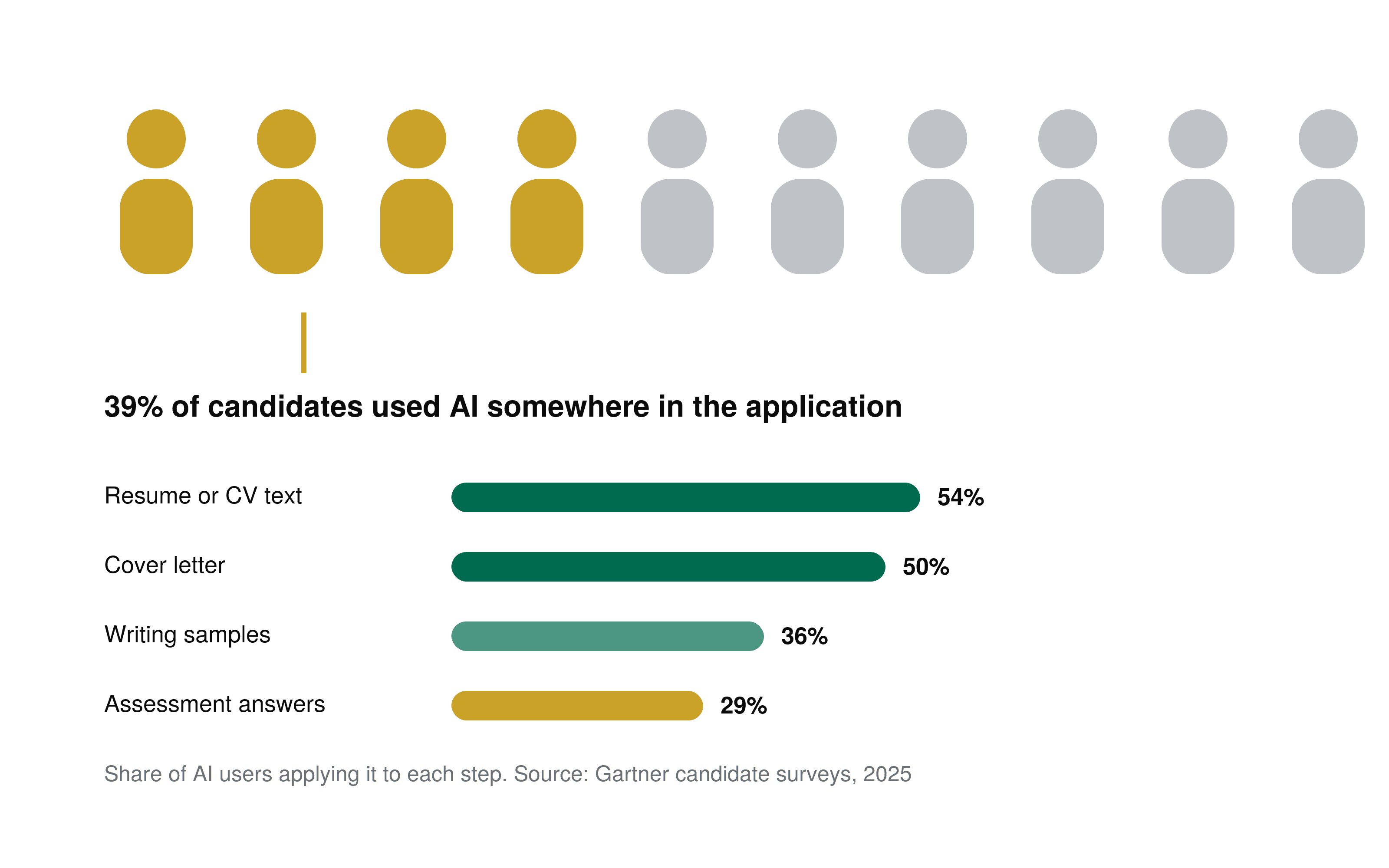
I want to be careful here, because I don't think using AI to prepare is cheating. I'd worry about any candidate who ignored the most capable preparation tool ever built. The problem is different: when everyone's first draft of themselves is excellent, excellence in the first draft carries no information. The interviewer still has a decision to make. So the decision moves somewhere else.
Where the signal went
Watch what experienced interviewers actually do now, because it's changed, even when the question list hasn't.
They let you give the prepared answer. They nod. And then they pull one thread in it, almost casually. "You said the QA lead disagreed with the rollback. What exactly did she say?" Then another. "What would you have done if the client had refused?" By the third follow-up, there's no script left in the room. There's just you, remembering or not remembering what it was like to be there.
This is the part I wish someone would tell every nervous candidate: the follow-ups aren't a trap. They're the real interview. The first question just buys the interviewer a starting point. When they ask what the team's reaction was, they're not testing your memory for trivia. They're listening for the texture that only comes from having lived something: the name you almost say, the detail that's slightly messy, the moment you admit what you got wrong before the part you got right.
A scripted answer survives one question. Experience survives five. That gap is now the whole game.
Back on my panel, the candidate who got the offer wasn't the smoothest of the three. She was the one who, on the second follow-up about her slipped release, laughed a little and said, "honestly, my first plan made it worse," and then walked us through what she'd noticed too late, what she changed, and the slightly awkward conversation she had to have with her sponsor afterwards. Her answer had a scar on it. Scars don't come out of a prompt.
And I watched the panel lean in, all of us, at exactly that moment. Not because she'd failed at something, but because for the first time all week we were hearing a memory instead of a performance. The irony is that two years ago, a coach might have trained that rough patch out of her.
The loop is physically changing too
It's not just technique. The structure of hiring is visibly reorganising itself around trust. Gartner predicts that by 2028, one in four candidate profiles worldwide will be fake {Gartner, 2025}. Against that backdrop, companies including Google, Cisco and McKinsey have reinstated in-person interview rounds, and 72.4 percent of recruiting leaders told Gartner they now run interviews in person specifically to counter fraud {Gartner, via Computerworld, 2025}.
Here's the gentler reading of that shift: it's good news for real candidates. Interestingly, Gartner also found 62 percent of candidates said they'd be more likely to apply somewhere that requires in-person interviews {Gartner, 2025}. People who actually did the work want a format where that's visible.
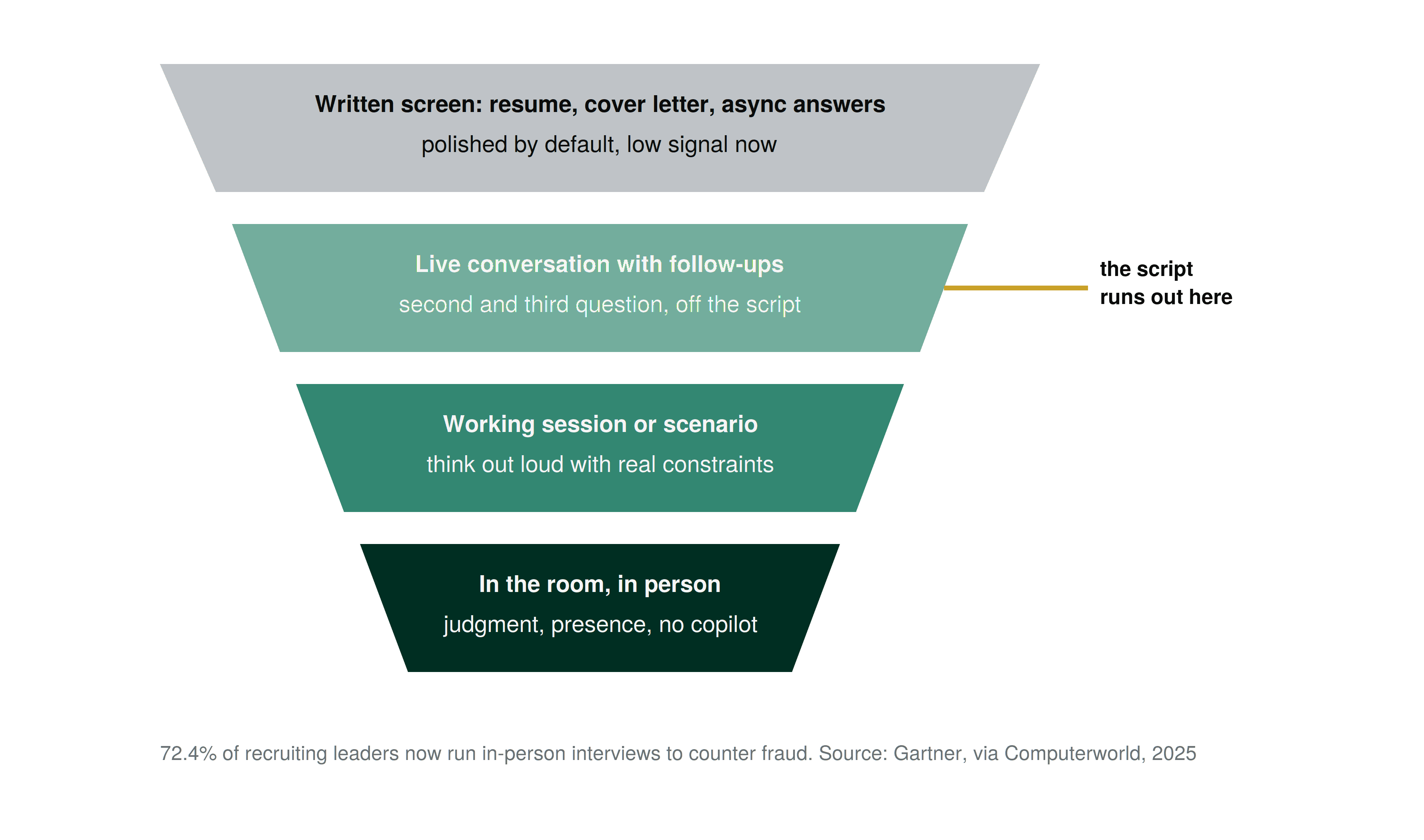
So expect loops that look like this: a written screen that's now mostly a formality, a live conversation built around follow-ups, some kind of working session where you think in real time, and an in-person final. Each stage is a step further from anything a model can hold for you.
How to prepare when the script is worthless
So what do we do with this, practically? Not less preparation. Different preparation.
Build a story bank, not an answer bank. Before you script a single word, write down eight to ten real moments from your work: a conflict, a slipped date, a stakeholder you won over, a call you got wrong. For each one, capture the messy specifics: who, what was said, what you felt, what broke, what changed after. Specifics are the one asset AI can't generate for you, because it wasn't there. You were.
Rehearse the follow-ups, not the opening. Take your best story and have a friend, or honestly, the AI itself, grill you three layers deep. What did the developer say exactly? Why not escalate earlier? What would you do differently? If you can answer the third follow-up comfortably, the first answer will take care of itself. This is where I'd spend 80 percent of prep time now.
Practice thinking out loud. Working sessions reward visible reasoning: here's what I'd check first, here's what worries me, here's the trade-off I'm weighing. That's a muscle, and it's trainable. Pick any scenario from your real work, set a timer, and narrate your thinking for five minutes. It feels silly. It works.
Let one rough edge stay. This one is hard for anxious perfectionists, and I say it with love, as one of them. The lesson that didn't resolve neatly, the number you only half remember, the honest "I'm not sure I handled that part well": in a world of synthetic smoothness, those small imperfections read as credibility. Don't manufacture them. Just stop sanding them all off.
A note for career switchers especially
If you're moving into delivery from another field, you might read all this and feel your stomach drop: everyone else has years of "real moments" to draw on, and your stories come from customer service, teaching, retail, operations. Please hear this clearly: your stories count. The follow-up test doesn't ask whether your experience happened in a sprint. It asks whether it happened at all.
The switcher who describes the morning two angry customers and a system outage collided, what she triaged first and why, survives the third follow-up beautifully, because she was there. What you need isn't borrowed Scrum stories. It's your true ones, translated into delivery language, plus a few genuinely new reps: a volunteer team whose standups you ran, a community event you planned properly, a real backlog you built. Small, true, and yours beats big, polished, and borrowed, in exactly the rooms that matter now.
The quiet advantage
Here's what I'd want you to take home. For years, the interview rewarded performance, and people with real experience but modest polish lost out to people with great scripts. The tools that made everyone polished have, almost by accident, pushed interviews back toward the one thing that was always supposed to matter: whether you've actually done the work, noticed what happened, and grown from it.
If you've been building real experience, running real projects, sitting in real messy rooms, this shift is in your favour. The script stopped mattering. You never needed one.
Sources
Gartner, "Gartner Survey Shows Just 26% of Job Applicants Trust AI Will Fairly Evaluate Them," (candidate surveys, 1Q25 and 2Q25), July 2025.
Computerworld, "To counter AI cheating, companies bring back in-person job interviews," 2025.

Subscribe to the Newsletter
Join our growing community and get alerted first on our every article.
*By subscribing, you agree to send your information to our Company who agrees to use it according to their Terms and conditions and Privacy Policy
About the author
With 20 years guiding high-stakes Agile transformations, I turn theory into action at Oaktreeuni—mentoring aspiring Scrum Masters to think critically, adapt fast, and lead beyond frameworks. The payoff? You step into a high-paying Scrum Master or Agile PM role already equipped to excel.
Is it cheating to use AI to prepare for a job interview?
Using AI to organise your stories and rehearse is normal preparation, and most serious candidates now do it. Having AI feed you answers live in an interview is misrepresentation, and interviewers are actively redesigning loops to catch it.
Why are companies going back to in-person interviews?
Because AI has made remote answers easy to script and candidate fraud is rising. Gartner found 72.4 percent of recruiting leaders now run in-person interviews partly to counter fraud, and firms like Google, Cisco and McKinsey have restored in-person rounds.
What should I practice most for interviews now?
The second and third follow-up questions on your real stories. Interviewers let the prepared answer pass, then pull threads: exact words, reactions, what you'd do differently. Specifics from lived experience are what survive that.
← Previous post
Review the AI's work the way you'd review a junior's
Next post →
You're accountable for things you don't control. Put that in writing.

Keep reading
Newest on the blog


Comments