You’re not behind. You’re early.
ESTIMATED TIME
10
mins

Written by
Shikha Prasad
Published on
The feeling that everyone got a head start is almost universal. Here is what it is actually telling you, and what to do with it.
A woman I mentored last year, I'll call her Priya, opened our first call with an apology. She was thirty-eight. Twelve years in operations at a logistics company, halfway through a Scrum certification, and she said it almost in a whisper. “I think I've left this too late.”
I asked her what “too late” meant. She couldn't really answer. She just knew the feeling. Everyone on LinkedIn looked younger, more certified, three titles ahead. The bootcamp grads were twenty-six. Every job post wanted experience she didn't have yet. And somewhere in her head sat a timeline she had never actually written down, but was somehow already failing.
I knew that feeling, because I had my own version of it once.
The schedule no one actually wrote
We all carry an invisible timetable. By this age you should have the title. By that year you should be senior. Nobody handed it to us on paper. We absorbed it from somewhere, and then started measuring a real, messy life against a schedule that was never real to begin with. Comparison does the rest. It is a quiet thief, and it almost always steals from the person who is doing fine.
Here is what the timetable ignores. Careers stopped being straight lines a long time ago. In the United States, the median worker has been with their current employer just 3.9 years, and for people between twenty-five and thirty-four it drops to 2.7 years {U.S. Bureau of Labor Statistics, 2024}. People are not climbing one ladder for thirty years. They move, switch, and restart. The person who looks three steps ahead of you will probably change direction twice more before they are done.
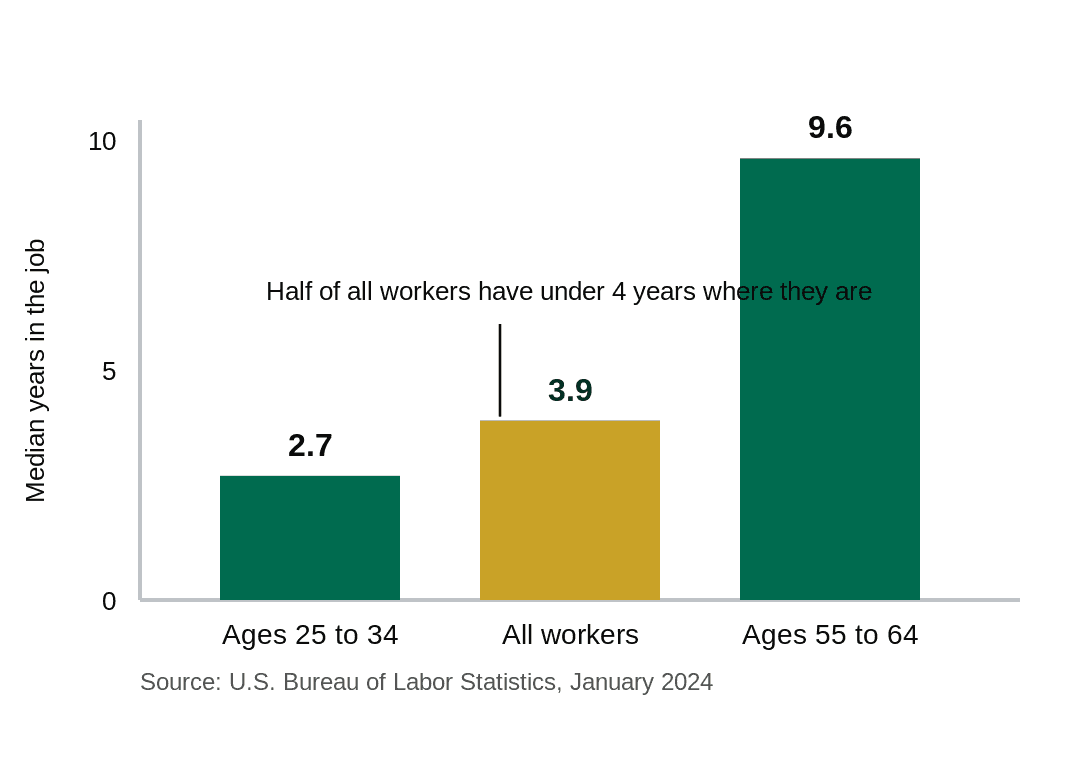
So the picture of everyone marching ahead of you on a single track is built on a version of work that doesn't exist anymore. You're not late to a race. There isn't one track to be late on.
The fraud feeling is real, but it isn't evidence
Then there's the other half of feeling behind, the quieter half. Not “I started late,” but “I don't really belong here yet.”
If you've felt that, you are in enormous company. A review of sixty-two studies covering more than fourteen thousand people found that impostor feelings show up in anywhere from 9 percent to 82 percent of people, depending on the group {Bravata et al., 2020}. Read the top of that range again. In some groups, about four out of five people privately believe they are faking it. It was first noticed in people who were, by every outside measure, doing well.
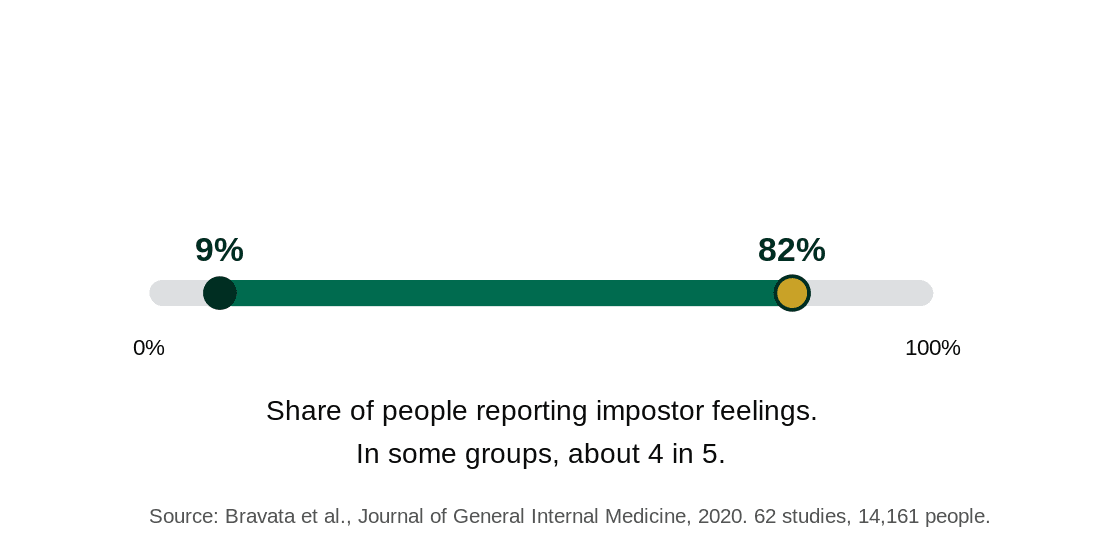
That number did something useful for me the first time I read it. It moved the feeling from a private verdict about me to a normal response to doing something new and visible. The fraud feeling is real. It is also not data about your ability. It's the tax you pay for caring about something you haven't done for twenty years yet. Nothing more.
The trap is treating the feeling as a fact, and quietly stepping back because of it. The work is to feel it and keep moving anyway.
There's a cost to getting this wrong, and it shows up in interviews. The candidate who secretly feels like a fraud walks in and shrinks. They hedge. They call twelve real years “just operations.” They let the panel set the bar low because they arrived believing it belonged low. An interviewer's whole job is to read confidence against competence, and steady self-doubt reads as a thin track record even when the record is strong. Believed, the feeling doesn't just sting. It hides the very evidence that would have landed the role.
What coming to this later actually buys you
Now the part the timetable gets completely backwards.
When Priya called her operations years “the time I wasted,” I stopped her. Twelve years in operations is twelve years of the exact muscles this job runs on. She had chased a late shipment across three teams who each blamed the other two. That is managing cross-team dependencies and conflict. She had sat in the morning call where everyone said the numbers were fine while the backlog said otherwise. That is reading the gap between what a team reports and what is true. She had given an angry client the honest version and kept the relationship. That is stakeholder management under real pressure.
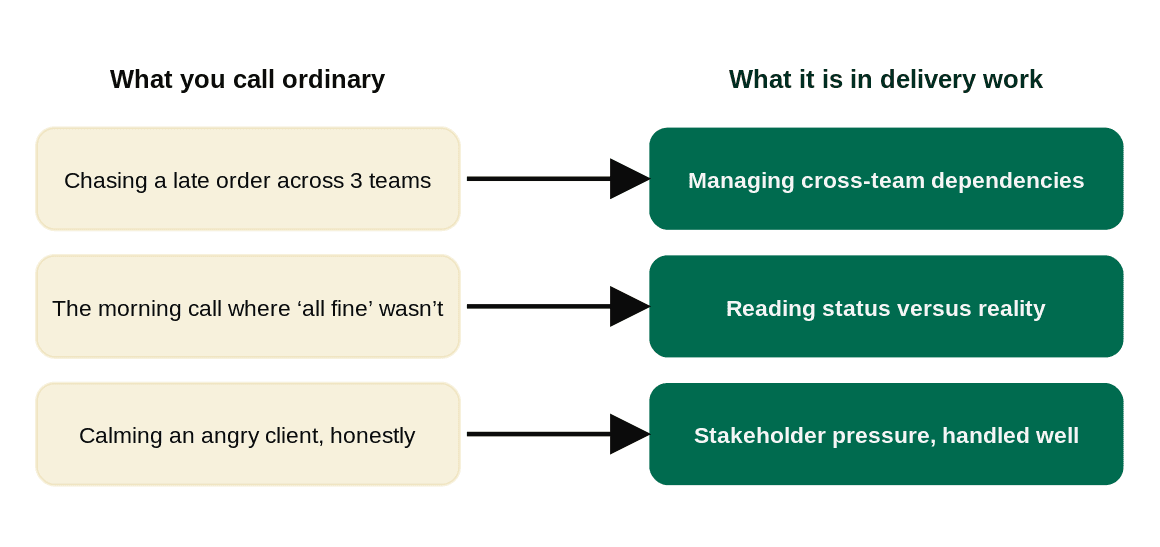
She didn't lack experience. She lacked the language to claim it, and the confidence to believe it counted.
Here's the difference language makes. In a mock interview, Priya first told me she had “helped sort out delays between departments.” Forgettable. We reworked it into what actually happened. “Three teams were blaming each other for a missed shipment, so I pulled them into one room, mapped the dependency, and we agreed who owned the handoff. It stopped happening after that.” Same event. One version vanishes, the other sounds like a delivery professional. Nothing was invented. We just stopped underselling the truth.
That's the quiet advantage of arriving here later. You aren't starting from zero. You're starting from a pile of real situations a twenty-four-year-old simply hasn't lived through yet. The framework is the floor, and you can learn the floor in a few months. Judgment, the kind that only comes from having been in hard rooms with something at stake, is the ceiling. You already have a head start on the part that's harder to teach.
Early only counts if you build on it
Here's where I'll be straight with you, because warm is not the same as soft.
“You're early” is not a permission slip to wait. Feeling reassured and then doing nothing is just a gentler way to stay stuck. Early is only an advantage if you spend the time building something real.
And be honest with yourself about which gaps are real. Feeling behind is not the same as being unprepared. If you have never run a retro, that's a real gap, and the fix is to go run one, not to worry about it. Sort the feeling from the gap. The feeling you can ignore. The gap you close. They need opposite responses, and people who stay stuck usually mix the two up.
So build small, true reps you can point to:
Offer to run the standups, planning, and retro for a team that already exists around you. A nonprofit, a friend's startup, a volunteer group, a side project with real people. Real blockers, real reps.
Take one recurring meeting at your current job and actually facilitate it. Surface the blocker nobody is naming. You don't need the title to do the work.
Keep the artifact. The board, the risk list, the retro notes. In an interview, evidence beats adjectives every single time.
None of this asks you to invent experience you don't have. It asks you to go and get a small, real version of it, the kind you can describe in an interview without flinching, because it actually happened.
What I told Priya, and what I'll tell you
Priya is eight months into a delivery coordinator role now, the step just before the title she wanted. Nothing magic happened. She stopped arguing with a timeline that was never real, translated the experience she already had, and built two small reps to cover the gaps. The fraud feeling didn't vanish. She just stopped letting it cast a vote.
If you're reading this with that same low worry that you've missed your window, be clear about what the worry actually is. It isn't proof that you're behind. It's the feeling of standing at the start of something that matters to you. That feeling is not a stop sign. It's a starting line.
You're not behind. You're early. Now go and use the time.
If the gap you feel is “I don't have the experience yet,” the next move isn't more waiting or another certificate. It's building one small, real rep this month, and learning to talk about it like the professional you're becoming.
Sources
U.S. Bureau of Labor Statistics. “Median tenure with current employer was 3.9 years in January 2024.” 2024. bls.gov
Bravata, D. M., et al. “Prevalence, Predictors, and Treatment of Impostor Syndrome: a Systematic Review.” Journal of General Internal Medicine, 2020. link.springer.com

Subscribe to the Newsletter
Join our growing community and get alerted first on our every article.
*By subscribing, you agree to send your information to our Company who agrees to use it according to their Terms and conditions and Privacy Policy
About the author
I believe the strongest tool and flex each of us has is our belief. When we truly believe in something, we align our mindset, energy, and actions with the right effort and guidance. That is when achieving almost anything becomes possible. This is how I help mentees at OAKKTREEUNII move into Software and Project Management careers for better pay, better confidence, and better work-life balance.
Comments