What senior Scrum Masters get measured on now
ESTIMATED TIME
8
mins

Written by
Rajveer Prasad
Published on
Clean ceremonies get you through year one. After that the scoreboard changes, and nobody sends a memo.
A Scrum Master I mentor walked out of her year-end review confused. Her facilitation got named the best in the program. Stand-ups tight. Retros people actually talked in. Planning that planned. Then the rating came back: meets expectations.
She asked her director what was missing. His answer is worth framing:
“The ceremonies are great. I just can’t tell if anything ships faster because of you.”
That sentence is the entire gap between junior and senior, delivered politely.
In your first year or two, people judge the machinery. Did the events happen. Did they start on time. Was the board tidy. Did the notes go out. Operator work. It matters, and it has a hard ceiling, because once you’re competent at it, everyone stops noticing. Well-run meetings become the weather. Meanwhile, the question being asked about you quietly changes: not “are the ceremonies happening” but “is the work moving.”
Most Scrum Masters never notice the question changed. They keep polishing the meetings while the scoreboard gets moved to a different wall.
The question changed and nobody sent a memo
There’s no announcement. No email goes out saying “effective this quarter, you’ll be evaluated on flow.” You find out the way she did, in a review. Or worse, in an interview for the senior role you want, when someone asks “how did you improve delivery on your last team” and your honest answer is a list of meetings you ran on time.
Ceremonies are attendance. Flow is the grade.
The framework set you up for this, a little. Your certification taught you the events: what they’re for, how long they run, who attends. It never handed you a scoreboard for what the events are supposed to produce. So you defaulted to the thing you could see, the events themselves. Knowing the events gets you the job. Owning what they exist to produce, which is work that moves, gets you the next one.
Here’s the senior question in plain words: how long does work take from the moment someone starts it to the moment it’s in a user’s hands, where does it stall along the way, and what are you doing about the stalls?
If you can answer that for your team right now, off the top of your head, you can stop reading. If you can’t, you’re in good company. Almost nobody can the first time they’re asked. Learning to will do more for your career than a second certification.
Four numbers that quietly become your job
You don’t need a metrics platform, a consultant, or queueing math. You need to start watching four things.
Cycle time. From the day work actually started to the day it was actually done. Calendar time, not effort. Not the estimate, not the points. The clock a user would use.
Blocked time. Of that calendar time, how much was the item being worked on, and how much was it just waiting? Waiting for review. Waiting for an environment. Waiting for an answer. This is usually the ugly one, and it’s the one with the most room to improve.
Handoffs. How many times does a piece of work change hands before it ships? Every handoff is a place where work sits and context leaks. Count them. The number is almost always higher than anyone in the room would guess.
Predictability. Does similar work take a similar amount of time? Stakeholders will forgive slow. They will not forgive random. A team that reliably takes two weeks beats a team that takes anywhere between three days and two months, even though the second team is sometimes faster.
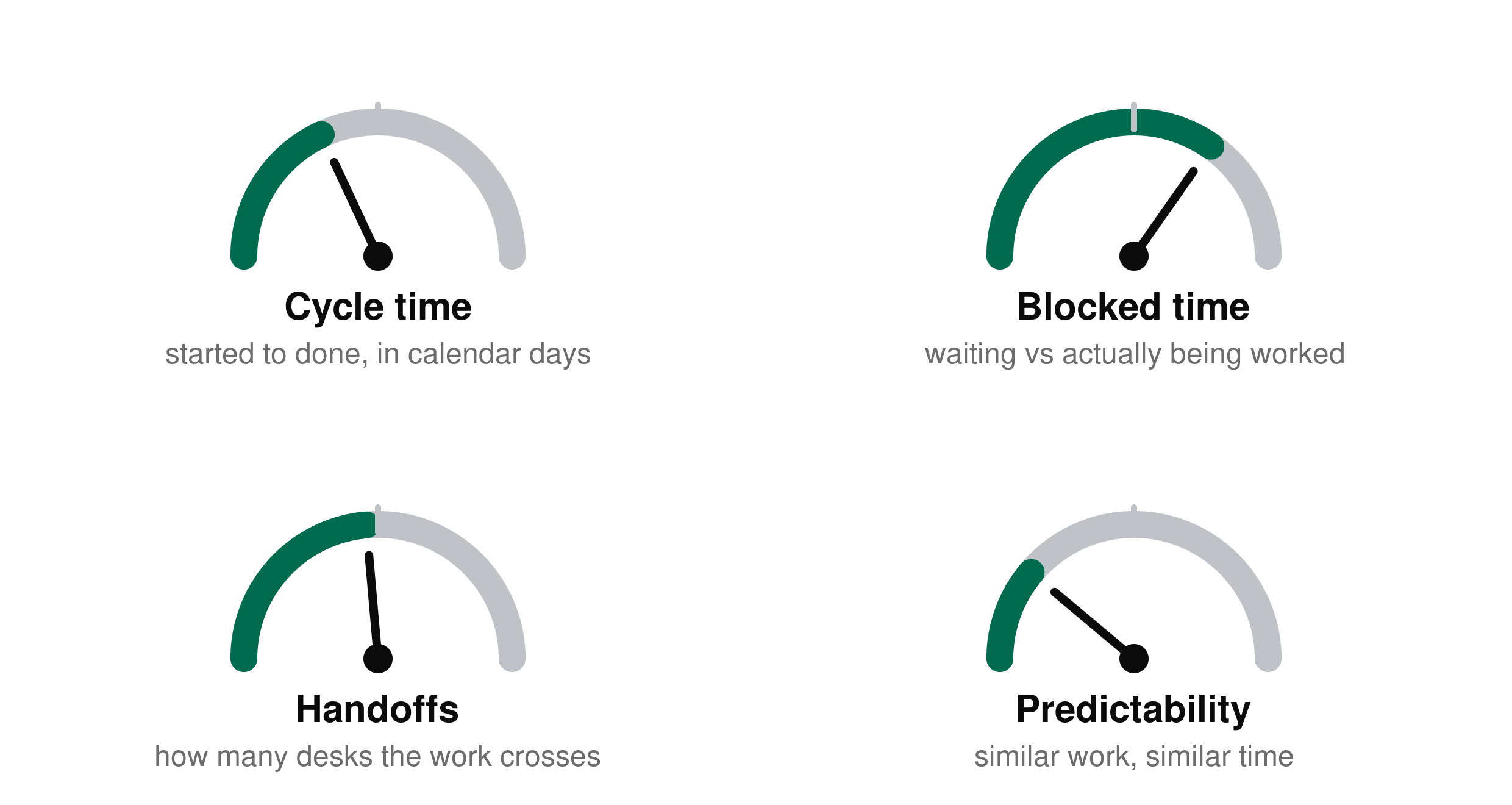
Notice what’s not on the list. Velocity isn’t, because it’s the team’s planning number, not a verdict on the system. Ceremony attendance isn’t, for obvious reasons. These four describe the system the work travels through. And the system, not the meetings, is what a senior Scrum Master owns.
Walk five finished tickets backwards
Here’s where to start. It costs one afternoon and zero permission.
Pick the last five items your team finished. Open each one’s history and write down three things: the day work actually started, the day it actually finished, and every place it sat waiting in between. Waiting for code review. Waiting for the QA environment. Waiting for a product answer. Waiting on another team. Then total up the waiting.
Most people go quiet the first time they do this. The work was hours. The elapsed time was weeks. The ticket didn’t take three weeks. It took six hours, three times, with long naps in between.
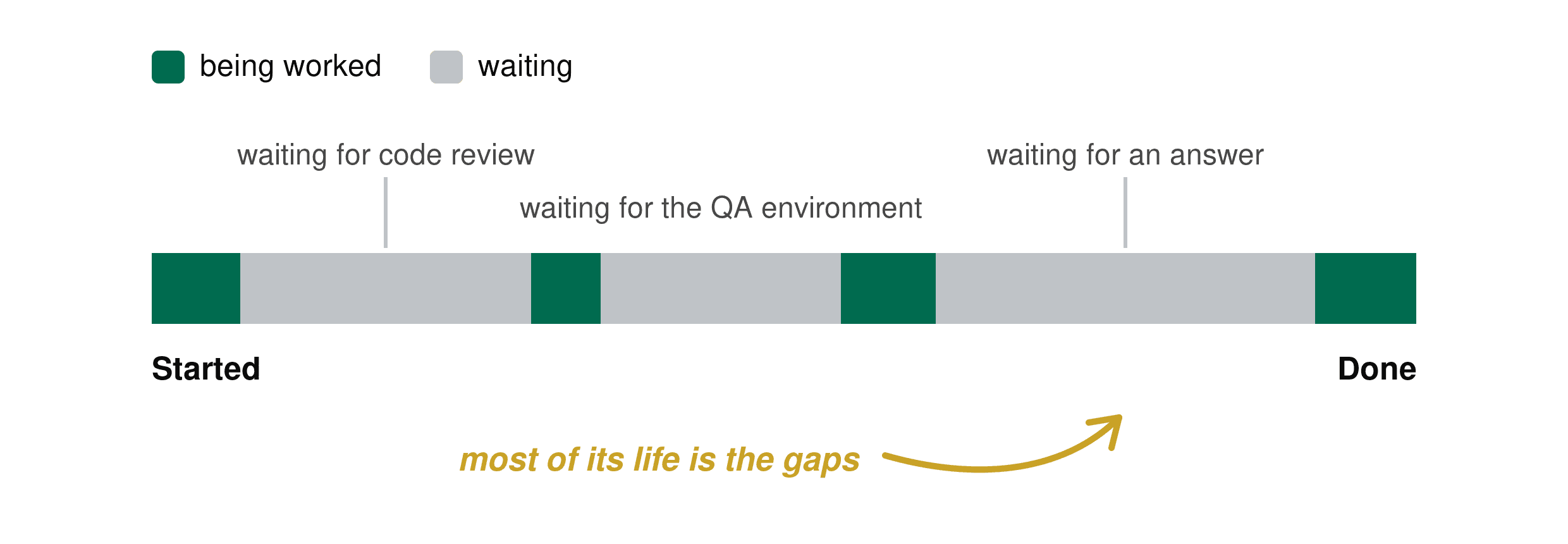
Now look at where the naps happen. They almost never happen mid-task. They happen at the seams, where work crosses from one person or one team to another. Dev to review. Review to QA. QA back to dev. Your delivery problem is rarely inside a column on the board. It lives between the columns.
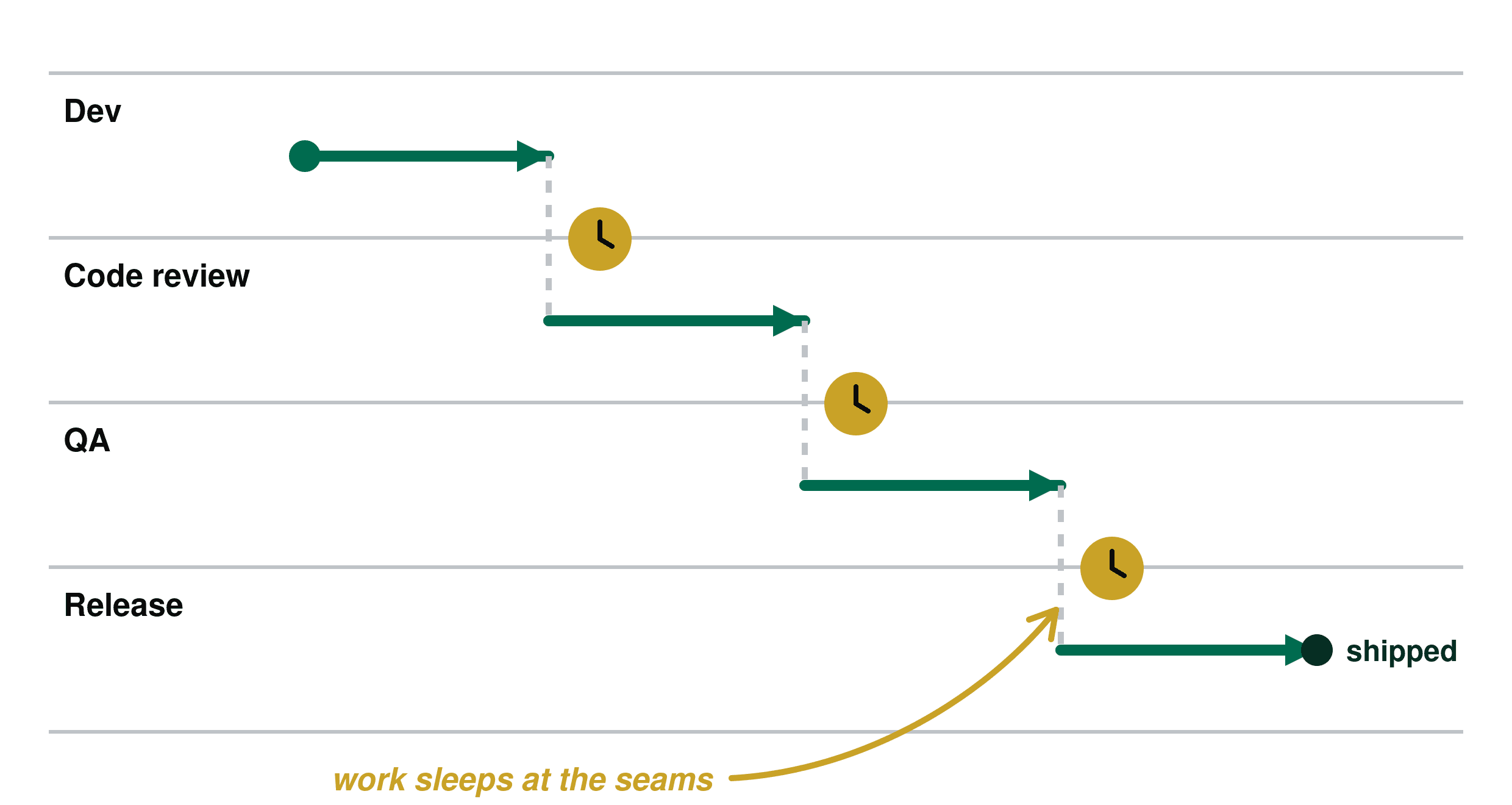
After that one afternoon, you know something about your team that probably nobody else knows, including your manager. You didn’t need a tool, a budget, or anyone’s blessing. That’s the real shape of the senior version of this role: it starts with looking where nobody else is looking.
Change what you report before they change what they expect
Knowing the numbers is half the move. The other half is three conversations.
With the team. In your next retro, swap one question. Instead of “what went well,” ask “where did our work wait the longest this sprint?” The first time, you’ll get silence. Then someone will say “review, obviously,” and the real retro will start. Your goal over the next few months is simple: anyone on the team can answer “where do things stall here” without looking at the board. A team that can name its own stalls starts fixing them. A team that can’t, won’t.
With your manager. Stop reporting ceremony health. Nobody above you celebrates that the retro happened, the same way nobody praises the elevator for arriving. Report flow instead: “Review wait doubled this month. Here’s what we’re trying.” You teach people how to measure you by what you report. Report meetings, get measured on meetings. Report flow, get measured like a senior.
With stakeholders. In the sprint review, add one sentence to the demo: “This feature took four weeks, two of which were waiting on an external signoff, and here’s what we’re changing about that.” That sentence builds more credibility than a flawless demo, because it tells the room you understand the machine and not just the calendar.
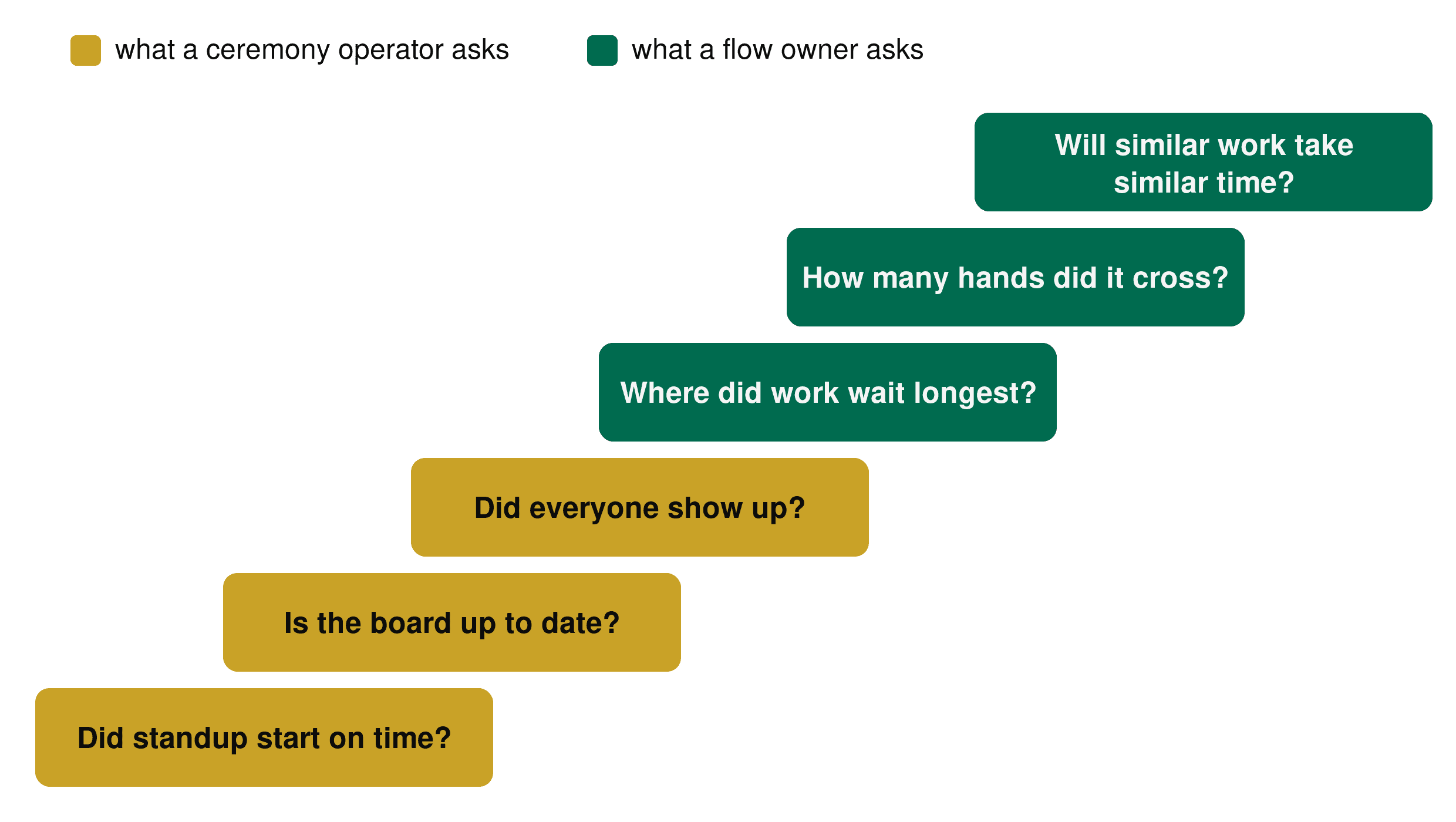
The answer that gets the senior title
Run the contrast. The interviewer asks: “How did you improve delivery on your team?”
The weak answer: “I ran all the ceremonies, kept the board clean, and removed blockers as they came up.”
Nothing in that answer is false. It’s just junior. It describes activity, and the interviewer still can’t tell whether anything got better.
The strong answer: “I walked our finished work backwards and found that items spent most of their life waiting on code review. We made reviews the first thing we staff every morning, before anyone picks up new work. Cycle time went from weeks to days, and our forecasts started coming true.”
Same role. Possibly the same team. The difference is the shape: something you noticed, something specific you did, something that visibly changed. That shape is what senior sounds like, in interviews and in reviews.
And if you don’t have that story yet, good news: the five-ticket walk is the first scene of it. Do the walk, pick the biggest stall, change one thing about it, and watch for six weeks. Whatever happens, you’ll own a true story about improving flow. True stories are the only kind worth telling.
Keep the ceremonies, but demote them
The ceremonies don’t go away. Run them well. Just run them as instruments, not deliverables. The standup exists to surface today’s stall. The retro exists to fix the system that caused it. The review exists to tell the truth about both. The meetings were never the job. They’re how the job gets done.
The day you start watching where work waits, you stop being the person who runs the meetings and become the person who owns the flow. One of those people is easy to replace.
The other one gets the senior title.
Subscribe to the Newsletter
Join our growing community and get alerted first on our every article.
*By subscribing, you agree to send your information to our Company who agrees to use it according to their Terms and conditions and Privacy Policy
About the author
With 20 years guiding high-stakes Agile transformations, I turn theory into action at Oaktreeuni—mentoring aspiring Scrum Masters to think critically, adapt fast, and lead beyond frameworks. The payoff? You step into a high-paying Scrum Master or Agile PM role already equipped to excel.
Comments