What a Scrum Master actually does all day
ESTIMATED TIME
7
mins

Written by
Shikha Prasad
Published on
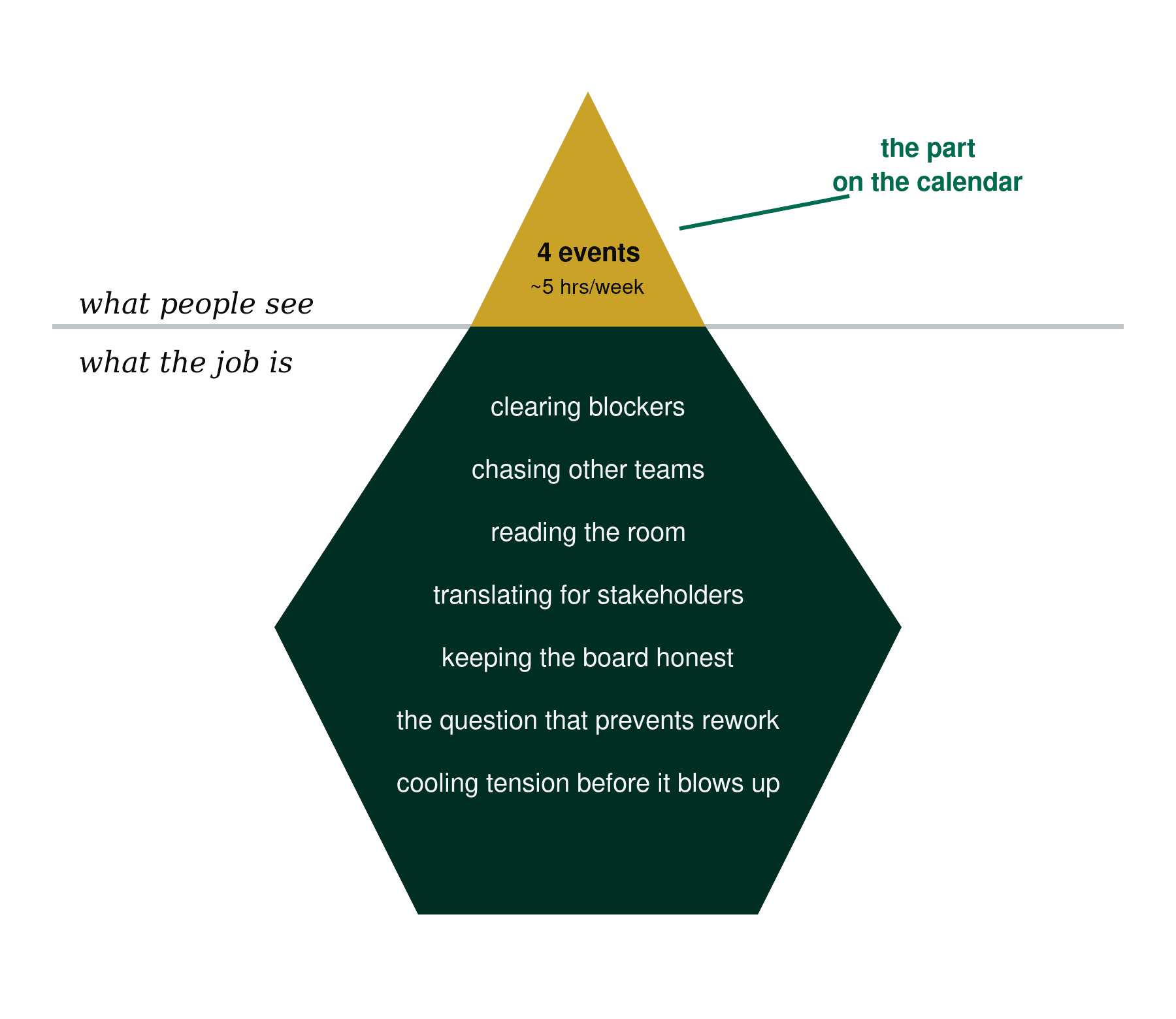
The role looks like four meetings on a calendar. The job is everything that happens between them.
A woman emailed me last month, a few weeks out from her certification, and asked a question I love because it's so honest. “I get the ceremonies,” she wrote. “Planning, standup, review, retro. But those add up to maybe five hours a week. What am I supposed to do with the rest of my time? What does a Scrum Master actually do all day?”
She wasn't being lazy. She was being careful. She'd looked at the calendar version of the role and noticed it didn't fill a day, let alone a week, and she was worried that either she was missing something or the job was thinner than the salary suggested.
She was missing something. Almost everyone is, at the start, because the part of the job you can see is the smallest part. Let me walk you through a real day, the way it actually goes, so you can decide if this is the work you want to do.
The calendar lies to you
Here's the thing nobody says out loud when you're studying. The events are real and they matter, but they're the tip of the role, not the body of it.
The Scrum Guide is precise about this if you read it closely. The Daily Scrum is “a 15-minute event for the Developers of the Scrum Team” {Scrum Guide 2020}. Fifteen minutes. For the developers. The Scrum Master isn't even the main character in it. You're there to make sure it happens and stays useful, then you get out of the way.
So if the standup isn't really your meeting, and it's fifteen minutes, what fills the other seven and a half hours?
The honest answer is the part the framework can't put on a calendar, because it's different every day. The Scrum Master's real job is to keep the team's path clear, keep the work visible, and keep the humans in it talking to each other. That work doesn't happen in a ceremony. It happens in the gaps.
A real Tuesday, hour by hour
Let me make this concrete. Not a perfect day, just a normal one. Names changed, but every beat of this happens somewhere every week.
8:40. I'm at my desk before standup, and I'm not drinking coffee in peace. I'm reading the board. One ticket has been sitting in “In Progress” since last Thursday. The developer marked himself busy all week. That's not a status. That's a flag. I'm not going to call him out in standup, because that's how you teach a team to hide things. I make a note to catch him after.
9:00. Standup. Fifteen minutes, like the book says. It goes fine, which is the point. The team talks to each other, not to me. I say almost nothing. The whole time I'm listening for the thing under the words. “Still working on the integration” said three days running is not a sentence. It's a quiet cry for help that nobody's labelled yet.
9:20. I catch the developer with the stuck ticket. Turns out he's blocked on access to a test environment, has been for days, and didn't want to make a fuss. This is the actual job. Not the standup. This. The Scrum Guide lists “causing the removal of impediments to the Scrum Team's progress” as a core Scrum Master accountability {Scrum Guide 2020}, and it sounds tidy on paper. In real life it means I now spend forty minutes chasing a person in another team who controls that environment, who does not report to me, who has their own fires, and who I have to make want to help me.
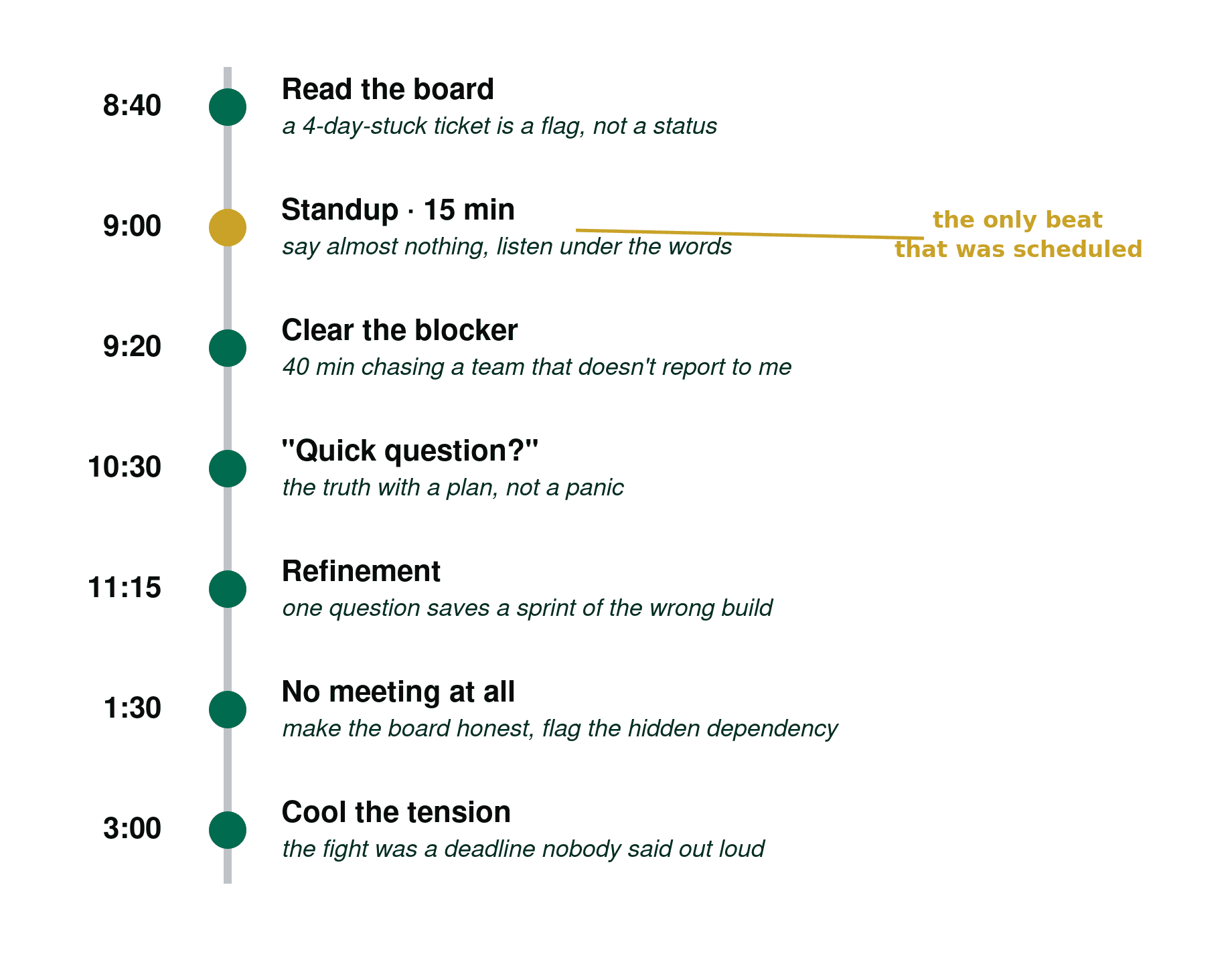
10:30. A stakeholder pings me. “Quick question, are we still good for the Friday demo?” It is not a quick question. What she's really asking is whether the thing she promised her boss is going to be there. I look at the board, look at the stuck ticket, do the math, and tell her the truth with a plan attached, not a panic. Managing that gap between what the team can honestly say and what the stakeholder needs to hear is half the role, and no one trains you for it.
11:15. Refinement. The Product Owner is trying to explain a new feature and I can see two developers nodding while clearly not understanding it. Nodding is dangerous. I slow it down. “Can we walk through what happens when the user has no saved address?” Suddenly the gap is in the open, and we just saved ourselves a sprint of building the wrong thing. Nobody will ever know I did that. There's no ticket for “asked the question that prevented the rework.” That's most of this job. Invisible saves.
1:30. After lunch I'm not in a meeting at all, and this is where a new Scrum Master panics, because it feels like you should be doing something visible. I'm updating the board so it tells the truth. I'm writing a three-line note to the manager who keeps asking for status so she stops pinging the team directly. I'm noticing that two tickets quietly depend on the same overloaded person and flagging it before it becomes next week's crisis. None of this is a ceremony. All of it is the job.
3:00. Two developers disagree about an approach, and it's getting a little warm. Not a fight, but the kind of tension that, left alone, turns into one of them going quiet for a sprint. I don't pick a side. I get them in a room and ask them to each explain what they're worried about, not what they want. The disagreement was never really technical. One of them was worried about a deadline he hadn't said out loud. Reading that room and defusing it is worth more than any artifact I'll touch all day.
4:30. I write tomorrow down. What's still blocked, who I'm chasing, what the demo needs, which conversation I'm dreading and therefore should have first. Then I go home, and the work keeps being invisible, which is the strange thing about doing it well.
The four jobs hiding inside the day
Step back from the hour by hour and you'll see the day wasn't random. Everything I did fell into four buckets. Once you can see them, the role stops being a mystery.
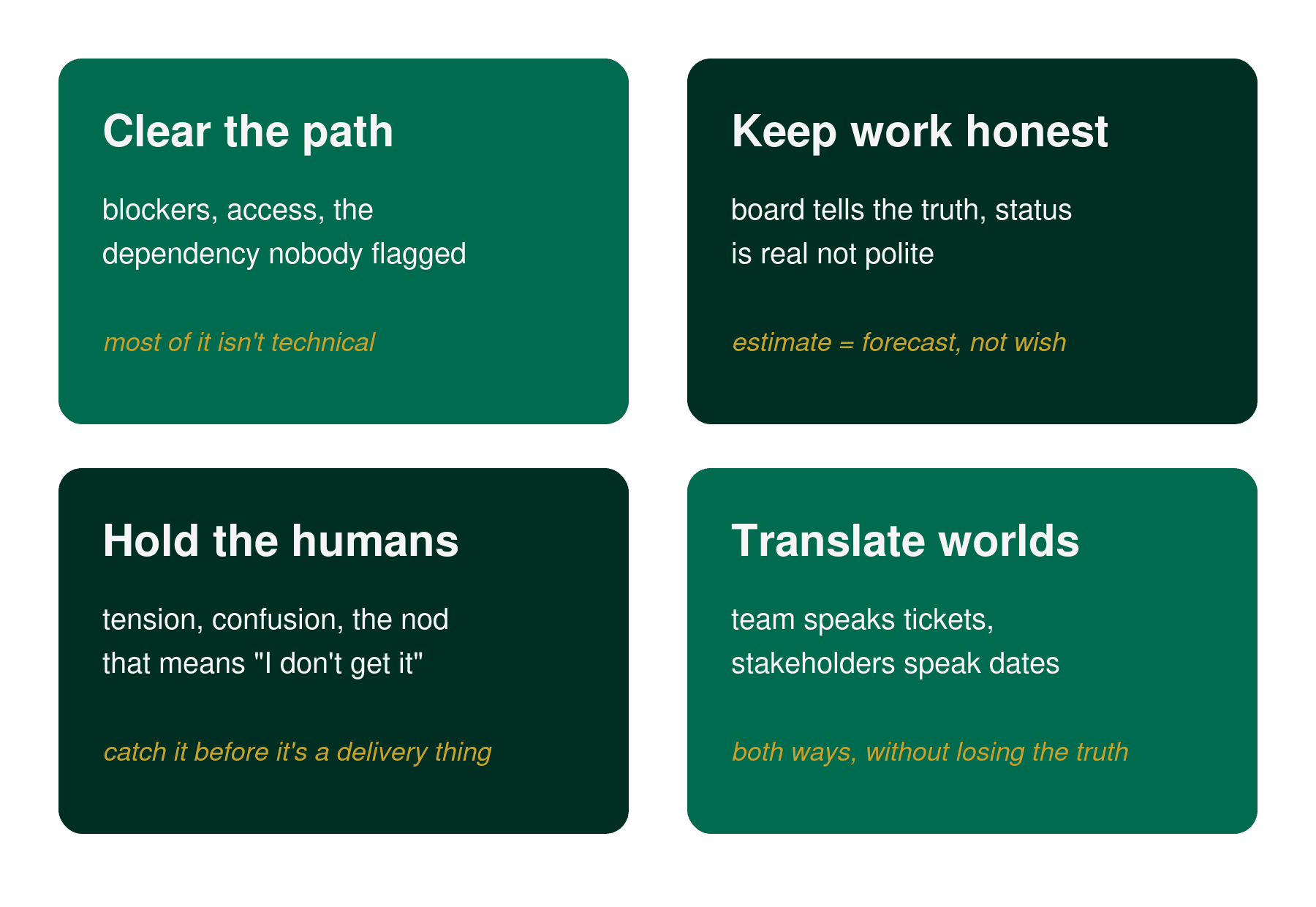
Clearing the path. Impediments, blockers, the test environment nobody owns, the dependency nobody flagged. You spend a real chunk of every day removing things that are in the team's way, and most of them aren't technical. They're a person who hasn't replied, a decision nobody's made, an access request stuck in a queue.
Keeping the work honest. The board should tell the truth. The standup should surface the real status, not the polite one. The estimate should be a forecast, not a wish. A lot of your day is quietly making sure the picture everyone's looking at matches what's actually happening.
Holding the humans. Tension, confusion, the nod that means “I don't get it,” the developer who's blocked but too proud to say so. The team is a group of people under pressure, and a big part of your job is noticing the human thing early, before it becomes a delivery thing.
Translating between worlds. The team speaks in tickets and the stakeholders speak in promises and dates. You stand in the middle and turn one into the other, both directions, without losing the truth on the way across.
None of those four have a fixed start time. That's why the calendar looked empty. The calendar can only show you the events. It can't show you the work.
So why does the role look so small from the outside?
Because the best version of it is quiet. When a Scrum Master is doing the job well, the standup is short, the blockers clear fast, the stakeholders feel calm, and the team just seems to be flowing. It looks like nothing's happening. It looks like the team is just good and you're along for the ride.
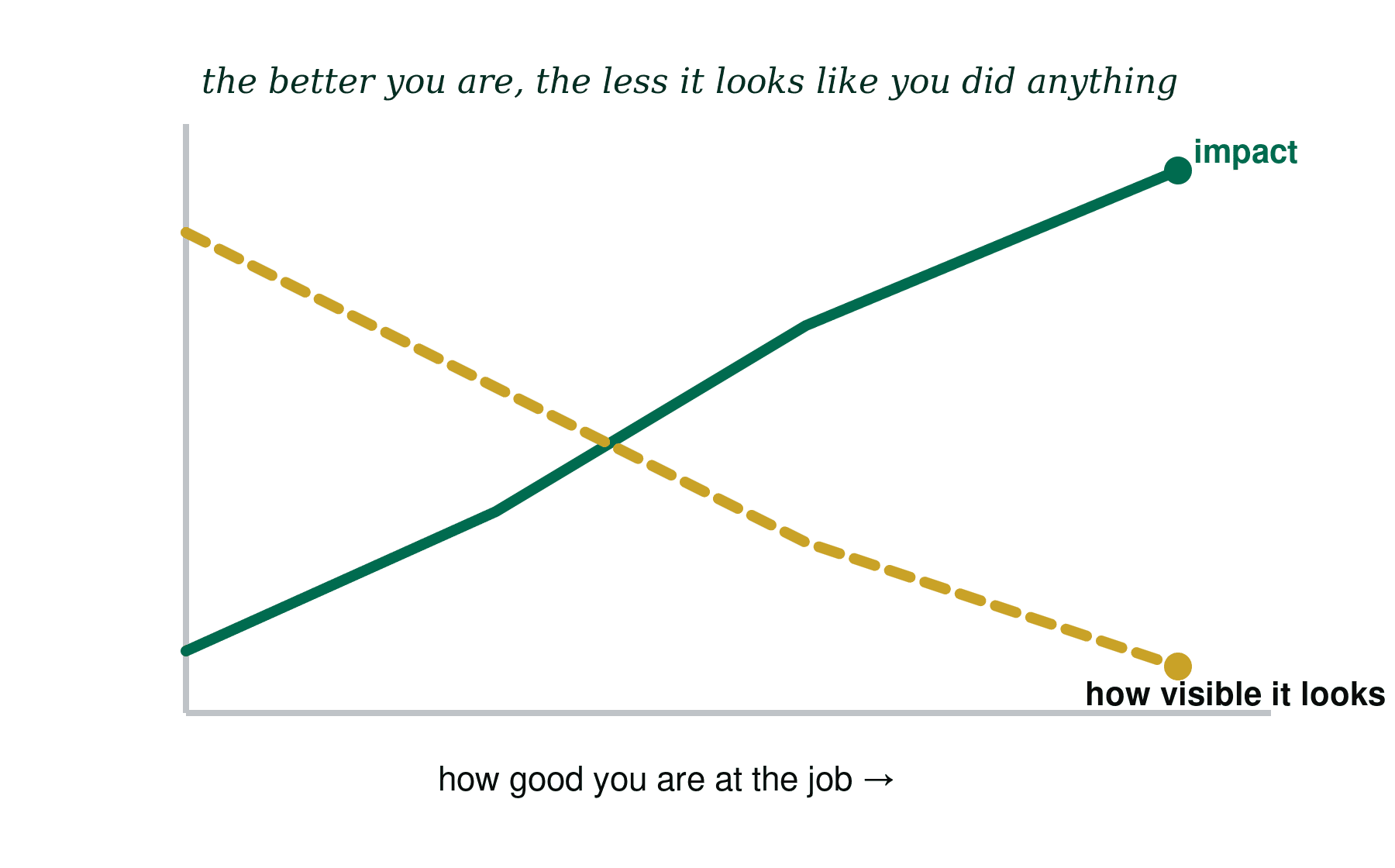
That's the cruel little trick of this role. The better you are, the less it looks like you did. The blockers you cleared at 9:20 never became the crisis they would have. The wrong feature you stopped in refinement never got built, so nobody mourns it. The tension you cooled at 3pm never blew up, so there's no story about it.
This is also exactly why it's hard to interview for when you're new. You can recite the ceremonies, but the ceremonies aren't the part that earns the salary. The part that earns it is judgment applied in the gaps, all day, where there's no script. Theory gets you the vocabulary. Knowing what to do at 9:20 when a quiet developer is stuck and won't say so, that's the part they're actually hiring for.
How to build the day before you have the title
If you're reading this trying to decide whether this is your job, or prepping to land it, here's the useful part. You don't have to wait for a title to start living this day. You can build a smaller, real version of it now.
Offer to run the standup for a volunteer team, a nonprofit, a friend's side project, a student group. Real people, real blockers, real fifteen minutes. Then do the actual job around it: chase the thing that's stuck, ask the question in refinement that nobody asked, notice the person who went quiet. Keep a simple board and make it tell the truth.
Do that for a few weeks and you'll have something most certified candidates don't. Not a definition of the Daily Scrum, but a true story that starts with “there was a developer who'd been stuck for days and wouldn't say so, and here's what I noticed and did.” That story is the whole job in miniature, and it's the thing an interviewer leans in for.
The role isn't four meetings. It's everything you do between them to make those meetings barely necessary. Go live one real day of it, even a small one, and you'll understand the job better than any course can teach you. Then you'll know whether it's the one you want.
If you're certified and still not sure what the day actually holds, the next step isn't another course. It's getting yourself into one real room, even an unpaid one, and living a Tuesday like this for yourself.
Sources
Scrum Guide 2020: Ken Schwaber and Jeff Sutherland, The 2020 Scrum Guide.
Subscribe to the Newsletter
Join our growing community and get alerted first on our every article.
*By subscribing, you agree to send your information to our Company who agrees to use it according to their Terms and conditions and Privacy Policy
About the author
I believe the strongest tool and flex each of us has is our belief. When we truly believe in something, we align our mindset, energy, and actions with the right effort and guidance. That is when achieving almost anything becomes possible. This is how I help mentees at OAKKTREEUNII move into Software and Project Management careers for better pay, better confidence, and better work-life balance.
Comments