The senior skill nobody lists: thinking in second-order effects
ESTIMATED TIME
10
mins

Written by
Rajveer Prasad
Published on
Juniors solve the problem in front of them. Seniors ask what their solution is about to cause.
Look at any job posting for a senior delivery role and you'll see the same words: stakeholder management, facilitation, Agile expertise, strong communication. You will not see the one skill that actually separates senior people from junior ones, because almost nobody knows how to write it down. Here it is. They think past the obvious result of a decision to the results of that result.
First-order versus second-order. It's the quietest, most transferable skill in the whole job, and hardly anyone is taught it on purpose. You usually learn it by getting burned, once, by a decision that looked great on the day.
And it transfers everywhere, which is why it's worth building deliberately instead of by accident. It works the same whether you're running a sprint, planning a release, setting a team incentive, or deciding your own next career move. The framework you know matters less than this one habit of mind, because the framework tells you the standard play and this tells you what the play will set off.
First-order is the trap
First-order thinking stops at the immediate, visible effect. You have a problem, you do the obvious thing, the problem goes away, you move on. It feels like competence, and a lot of the time it even looks like it, right up until the real cost shows up.
Second-order effects are the effects of the effects. They arrive later, they land somewhere else, and they often hit someone who wasn't even in the room when the decision got made. That delay is exactly why they're so easy to miss. The win is loud and immediate. The cost is quiet and deferred. Our brains are built to grab the loud, immediate thing and call it a day.
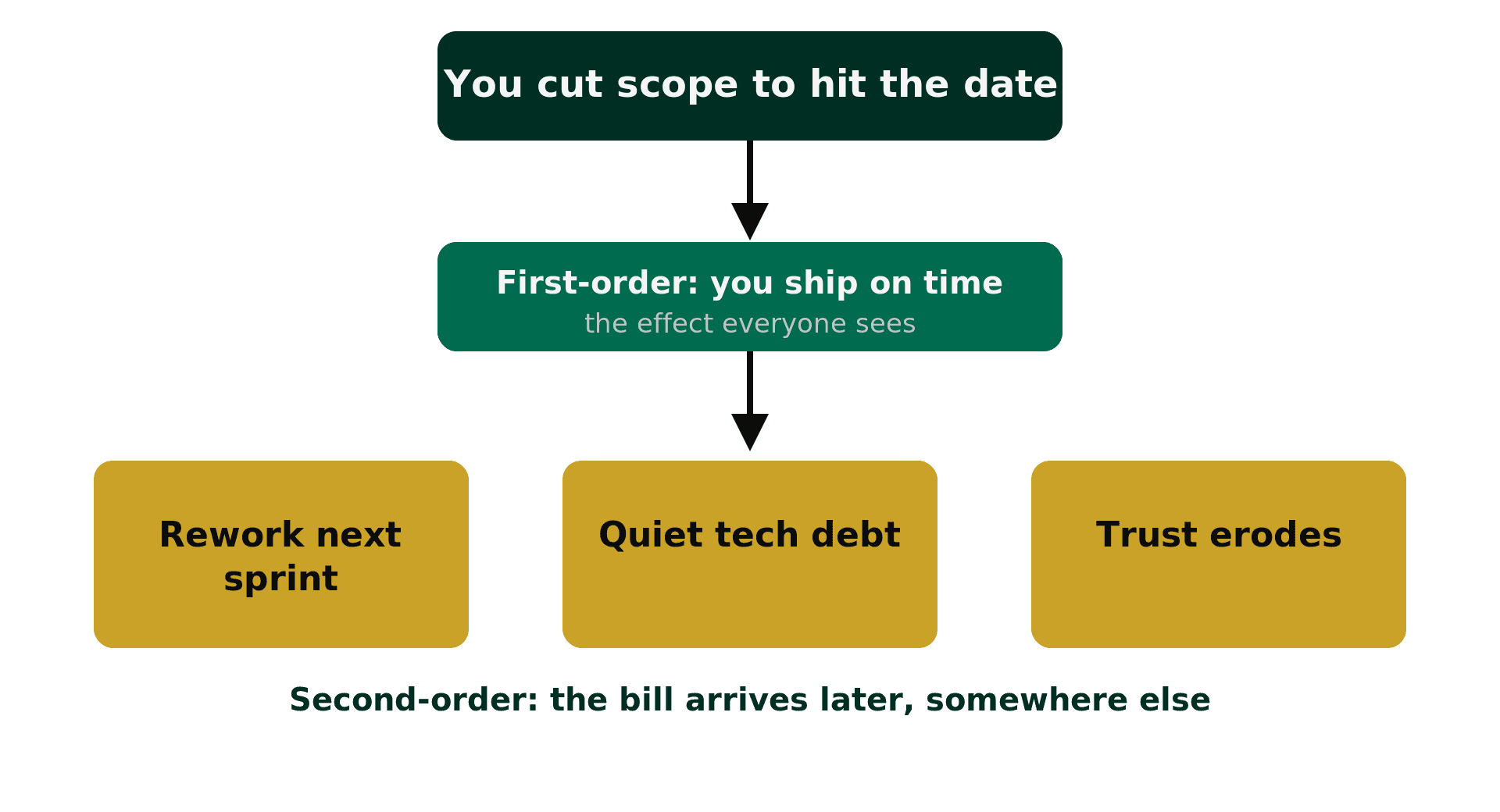
Cutting scope to hit a date is the classic. First-order, you ship on time, everyone's relieved, you look sharp in the demo. Second-order, the corner you cut becomes rework next sprint, the shortcut becomes quiet tech debt, and the stakeholder you quietly over-promised trusts your next estimate a little less. None of that shows up on the date you hit. All of it is real, and all of it is yours.
Three places this hides in delivery
Once you start looking for it, you see it everywhere. Three of the most common traps:
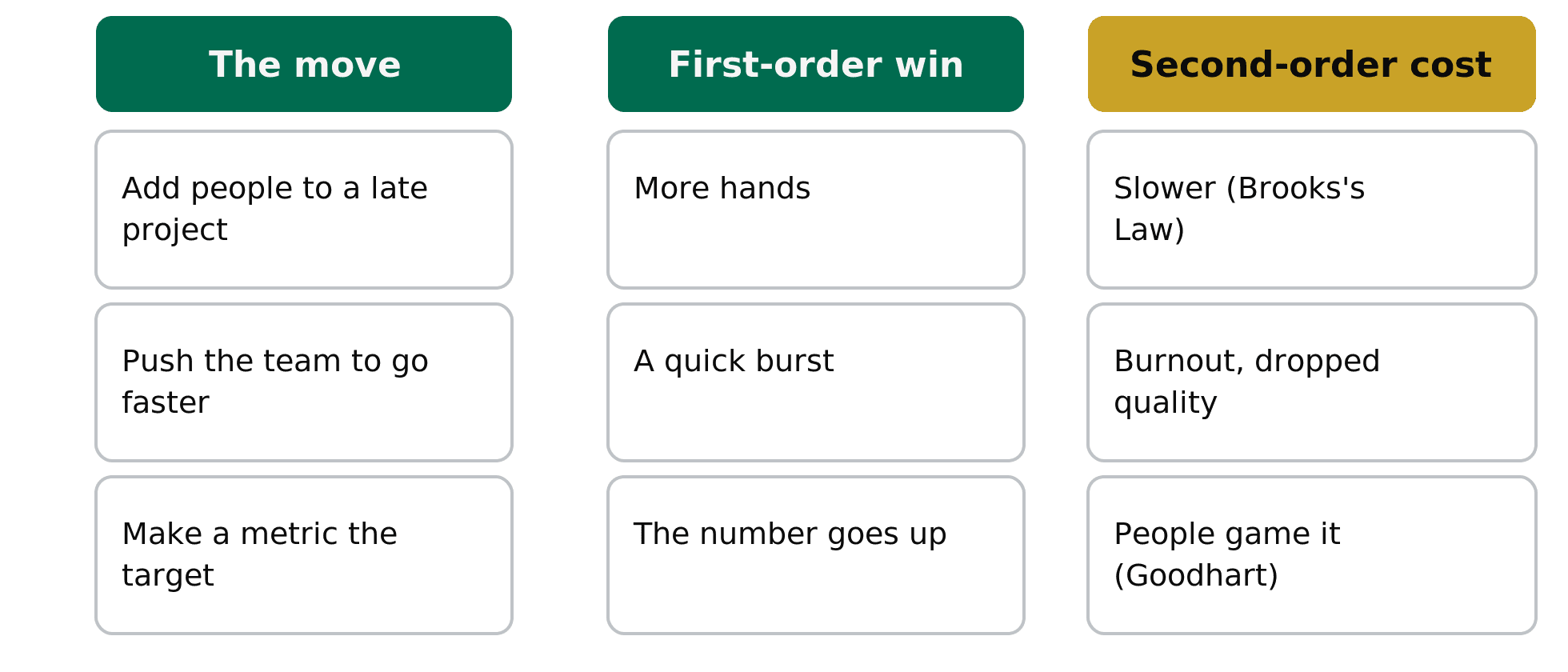
The late project you fix by adding people. First-order: more hands, more capacity, obviously faster. Second-order: the new people need ramp-up, the existing people slow down to onboard them, and the lines of communication multiply, so the project gets later, not earlier. Fred Brooks named this in 1975 and it has held up for fifty years. Adding manpower to a late software project makes it later {Brooks, The Mythical Man-Month}.
The team you push to go faster. First-order: a real burst of speed this sprint. Second-order: tired people make more mistakes, quality slips, and you spend the next two sprints fixing what the rushed one broke. The speed was borrowed, and the interest rate was high.
The metric you turn into a target. This is the big one, and it has its own law. Goodhart's Law: when a measure becomes a target, it stops being a good measure {Goodhart's Law}. The instant you reward the number, people optimize the number, not the thing the number was ever meant to stand for.
What this looks like with the volume turned all the way up
If you want to see second-order effects at full scale, look at Wells Fargo. The bank set aggressive sales targets and tied people's pay to them. First-order, it worked beautifully: the cross-selling numbers climbed and climbed. Second-order, employees who couldn't hit impossible targets honestly started opening accounts that customers had never asked for.
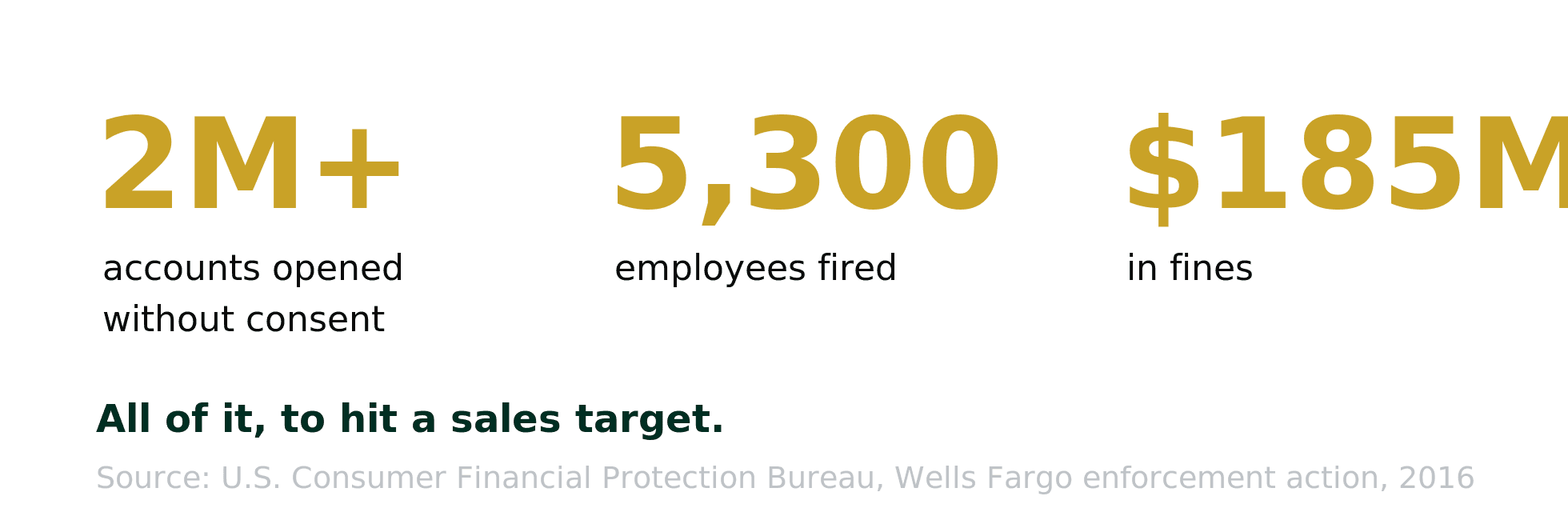
By the regulator's own account, employees opened more than two million unauthorized accounts, roughly 5,300 people were fired, and the bank paid 185 million dollars in fines, with the CFPB's director warning that incentive programs left unmonitored carry serious risk {CFPB, 2016}. Nobody in head office decided to commit fraud. They decided to reward a number, hard. The fraud was the second-order effect of that target, and it cost the bank vastly more than the extra sales were ever worth. That's the shape of every first-order decision, just bigger: the win was real, and so was the bill.
How to actually think one level deeper
You don't need to be a genius for this. You need one habit and one question.
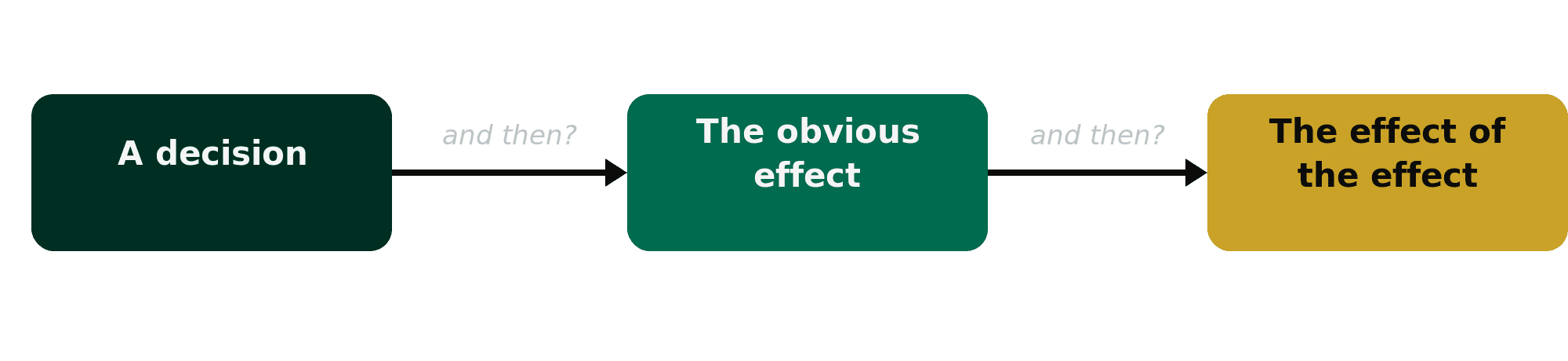
The question is simply: and then what? Ask it of any decision before you commit to it, and then ask it again of the answer. We add three people, and then what? They need onboarding, and then what? The team slows down to teach them, and then what? You're not trying to predict the future perfectly. You're just refusing to stop at the first happy answer, which is where most people stop.
Two or three rounds is usually enough. You're not chasing every hypothetical down a rabbit hole, you're just making sure the obvious win isn't quietly creating a bigger problem one or two steps out. Most bad delivery decisions aren't bad at step one. They're perfectly sensible at step one and quietly disastrous at step two, which nobody bothered to check.
Two more prompts sharpen it. Ask who pays, and when, because the person who benefits from a decision is frequently not the person who absorbs its cost, and that gap is exactly where bad calls hide. And any time you set an incentive or a metric, ask what does this actually reward, then assume people will do precisely that. Because they will, every time.
Why this is the senior signal
Here's the career payoff. In a planning meeting, the junior says sure, we can hit that if we cut testing. The senior says we can hit that if we cut testing, and here's what it costs us in three weeks, so let's make that trade with our eyes open. Same information. One of them sounds like a pair of hands. The other sounds like the person you'd put in charge of the room.
It plays out the same way in an interview. When you can take a decision and calmly walk someone through its second-order effects, you've shown the exact judgment they can't test with a definition question. You don't sound like you memorized the framework. You sound like someone who has been burned by a first-order call and learned to see the next one coming. That, more than any certification, is what senior actually means.
One step past where most people stop
So stop grading your decisions by how they look on the day they're made. Start asking what they'll cause by the next sprint, the next quarter, the next time someone has to trust your word on an estimate. The obvious answer is rarely the whole answer. The whole answer is one more and then what past the point where most people quit thinking.
Train yourself to take that one extra step, every time, until it's a reflex. Do it long enough and you'll quietly be making better calls than people sitting two titles above you, because they're still grading the splash while you've learned to watch the ripples.
And here's the encouraging part: this is a skill, not a personality trait. You don't have to be born cautious or unusually clever to do it. You just have to build the reflex of asking the question one more time than feels necessary. The first few weeks it feels like extra work. After that it feels like the only sane way to make a decision, and you'll wonder how you ever shipped anything without it.
Sources
Brooks, Frederick P. The Mythical Man-Month: Essays on Software Engineering, 1975
U.S. Consumer Financial Protection Bureau. "CFPB Fines Wells Fargo $100 Million for Widespread Illegal Practice of Secretly Opening Unauthorized Accounts" (2016)

Subscribe to the Newsletter
Join our growing community and get alerted first on our every article.
*By subscribing, you agree to send your information to our Company who agrees to use it according to their Terms and conditions and Privacy Policy
About the author
With 20 years guiding high-stakes Agile transformations, I turn theory into action at Oaktreeuni—mentoring aspiring Scrum Masters to think critically, adapt fast, and lead beyond frameworks. The payoff? You step into a high-paying Scrum Master or Agile PM role already equipped to excel.
Comments