Stop apologizing for your estimates
ESTIMATED TIME
6
mins

Written by
Rajveer Prasad
Published on
An estimate is a forecast, not a confession. Quit flinching and start communicating it like a professional.
You give an estimate, and then you ruin it. “It's maybe two weeks, but, you know, rough guess, don't hold me to it.” There it is. The apology. The little verbal flinch that tells everyone in the room you don't trust your own number, so why on earth should they?
Here's what the apology gets wrong, and it's not a small thing. An estimate is not a promise you're already failing to keep. It's a forecast under uncertainty. A weather forecaster doesn't apologize for saying 70 percent chance of rain. They state it, with the confidence the data supports, and move on. So should you.
What an estimate actually is
An estimate is your best current prediction of effort or time, given what you know right now, which is never everything. That last clause is the whole game. Early in any piece of work, you don't know the half of it: the dependency that isn't ready, the requirement that's secretly three requirements, the integration that looks trivial and absolutely is not.
Software people even have a name for this, and a shape. It's called the cone of uncertainty. At the very start of a project, your estimate can be off by a factor of four in either direction, a spread of sixteen times, and it only narrows as you actually do the work and learn what's really there {McConnell, Software Estimation}.
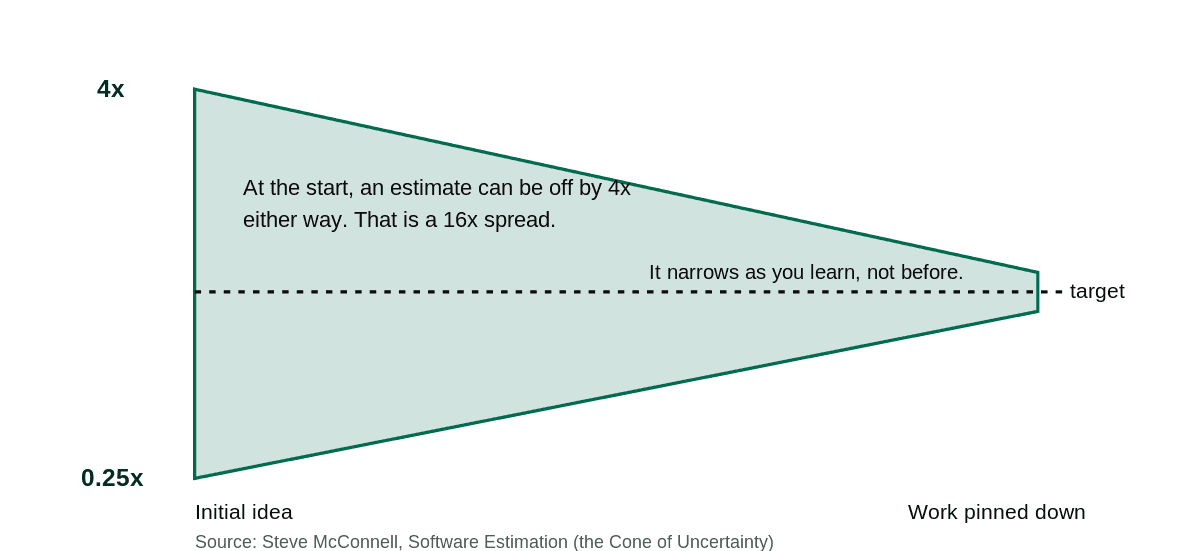
Read that shape honestly and the apology starts to look absurd. You're not apologizing for being bad at your job. You're apologizing for physics. The uncertainty is real, it's measurable, and it is not your personal failing. The genuinely amateur move is the opposite one: pretending you can collapse a 16x cone into a single confident date because saying a range felt uncomfortable.
Even the funded experts miss
If you suspect this is just a you problem, look up the food chain.
McKinsey and the University of Oxford studied more than 5,400 large IT projects. On average, they ran 45 percent over budget, 7 percent over schedule, and delivered 56 percent less value than promised {McKinsey and Oxford, 2012}. These are projects with real budgets, senior leaders, and professional estimators. They miss by enormous margins, routinely.
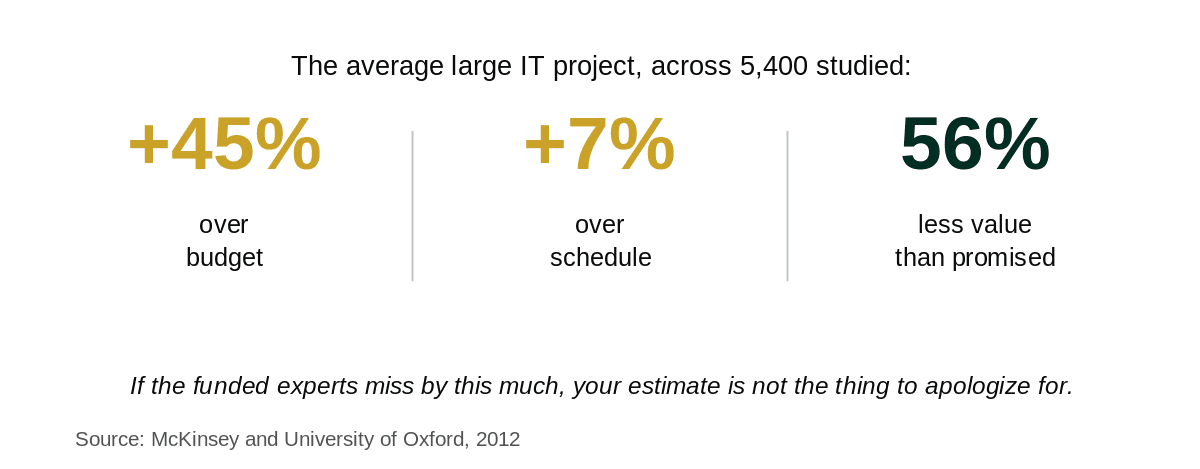
So when you stand there apologizing for a two-week estimate that might slip to three, be clear about what you're actually doing. You're holding yourself to a standard that billion-dollar programs with armies of experts cannot hit. That's not humility. It's a misread of the work, dressed up as modesty.
What to do instead of apologizing
The fix is not false confidence. Don't swing the other way and bark a single date you secretly know is a coin flip. That's how you get caught, and it's worse. The fix is to communicate the estimate like someone who actually understands uncertainty. Four parts.
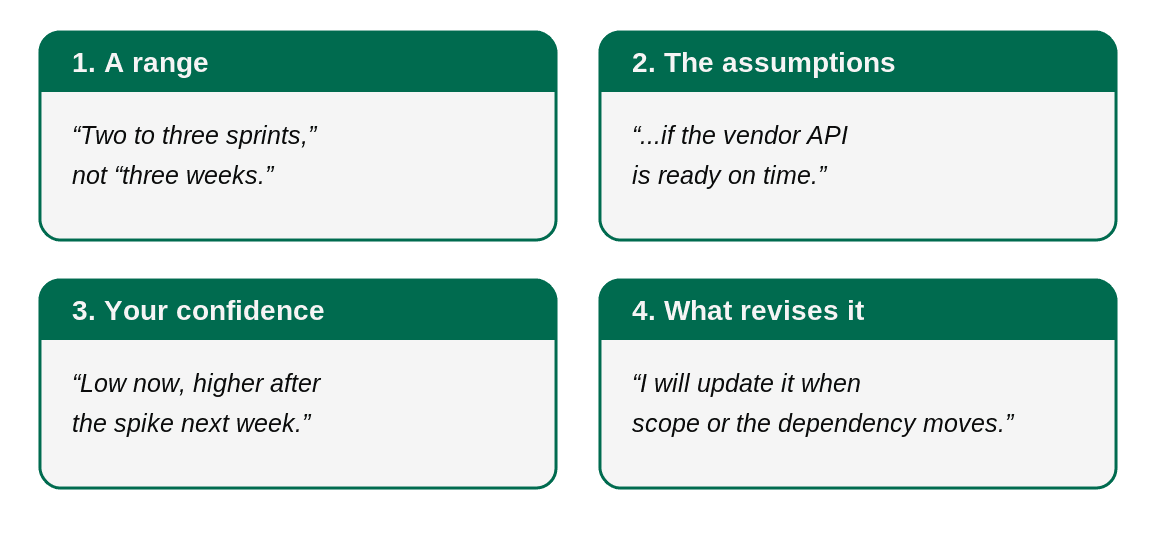
Give a range, not a point. “Two to three sprints” is honest. “Three weeks” pretends to a precision you do not have. State the assumptions out loud, because every estimate rides on them: “this assumes the vendor API is ready.” Name your confidence: “low right now, higher after we spike it next week.” And say what would change the number: “if scope grows or that dependency slips, this moves, and I'll tell you the moment it does.”
Notice what that does. It isn't weaker than a confident single date. It's stronger, because it's true, and because it puts you in charge of the conversation instead of bracing for the moment reality embarrasses you. Nobody can later accuse you of missing a promise you were careful never to make.
Here's the same moment, both ways. The apology: “Um, maybe two weeks? Hard to say, could be more, sorry, don't quote me.” The stakeholder hears nothing useful and trusts you a little less. The professional version: “Two to three sprints. That assumes the payments API is ready by Friday. Confidence is medium, and I'll tighten it after the spike. If that API slips, so does this, and I'll flag it the same day.” Identical uncertainty. One sounds like someone hiding. The other sounds like someone steering.
And a word on padding, since it's the usual escape hatch. Quietly doubling your number and saying nothing is not managing uncertainty. It's lying with a buffer, and it rots in both directions. Finish early and people learn your estimates are fiction. Finish late and you've burned the buffer and the trust at the same time. A visible range with stated assumptions does the honest version of what padding tries to do in the dark. Make the uncertainty explicit instead of smuggling it.
The stakeholder gap, and your real job
Here's the reality the neat framework leaves out. You can give a beautiful range with clean assumptions, and the stakeholder will still hear “two weeks” and quietly write down a deadline. That isn't them being dim. People convert uncertainty into certainty because certainty is easier to plan around. It's human.
So your job isn't only to estimate well. It's to manage that gap, on purpose. Repeat the range. Restate the assumptions when they shift. When the dependency slips in week one, you raise it in week one, not week three. An estimate you keep current stays a forecast. An estimate you go quiet on curdles into a broken promise. Same number, completely different outcome, decided entirely by whether you kept talking.
Why this shows up in interviews
This is one of those skills that quietly outs you in an interview, for better or worse. Ask a junior how they handle estimates and you get some version of “I try to be accurate,” or “I pad them a bit.” Ask someone who has actually run delivery and you get the real answer: ranges, assumptions, confidence levels, and keeping stakeholders updated as the picture sharpens. One sounds like a person hoping to be right. The other sounds like a person who knows estimates are forecasts to be managed, not promises to be feared.
So stop apologizing. Next time you give an estimate, give a range, name the assumptions, state your confidence, and say what would change it. Then stop talking. The flinch was never protecting you. It was just busy teaching the room not to trust the number you were about to stand behind anyway.
Sources
McKinsey and University of Oxford. “Delivering large-scale IT projects on time, on budget, and on value.” 2012. mckinsey.com
McConnell, Steve. “Software Estimation: Demystifying the Black Art” (the Cone of Uncertainty). Construx. construx.com

Subscribe to the Newsletter
Join our growing community and get alerted first on our every article.
*By subscribing, you agree to send your information to our Company who agrees to use it according to their Terms and conditions and Privacy Policy
About the author
With 20 years guiding high-stakes Agile transformations, I turn theory into action at Oaktreeuni—mentoring aspiring Scrum Masters to think critically, adapt fast, and lead beyond frameworks. The payoff? You step into a high-paying Scrum Master or Agile PM role already equipped to excel.
Comments