Sixty applications, no callbacks, and how to not lose yourself
ESTIMATED TIME
10
mins

Written by
Shikha Prasad
Published on
The silence isn't a verdict on you. But a long search can quietly chip away at who you are, and that's the part to protect.
There's a particular kind of quiet that settles in after the sixtieth application. You've stopped expecting the email. You refresh anyway. The number on the spreadsheet climbs, the replies don't, and somewhere around week ten a thought slips in that wasn't there at the start. Maybe it's me.
I want to talk you out of that thought, gently but firmly, because it's the most dangerous part of a long search. Not the rejection itself. The story you start telling yourself about what the rejection means.
Your timeline is normal. It just doesn't feel like it.
Start with the part almost nobody says out loud, because it genuinely helps. A long search is not a sign that something is wrong with you. It's the baseline.
In the United States, the average spell of looking for work runs about 26 weeks {U.S. Bureau of Labor Statistics, 2026}. Half a year. And more than one in four people currently searching have been at it for 27 weeks or longer {U.S. Bureau of Labor Statistics, 2026}. Read that again the next time week ten feels like proof of something. A quarter of the people in your exact situation are further down the same road, and it says nothing about their worth, or yours.
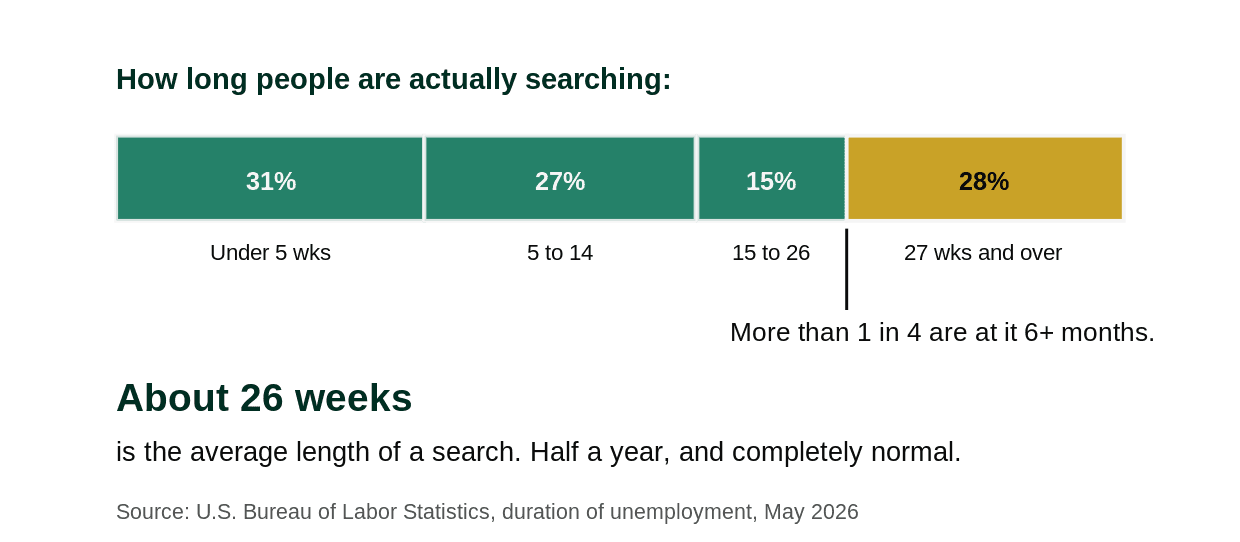
The silence isn't personal, either. A single corporate opening can pull in hundreds of applicants, most of whom never hear a word back, including plenty who would have been excellent. The funnel is brutal and largely automated, and it does not pause to tell you that you came close. So when you don't hear back, you aren't receiving a verdict. You're receiving the default.
The real risk isn't the rejection. It's the erosion.
Here's what I actually worry about for someone in a long search, and it isn't the job. It's what the search quietly does to them along the way.
When weeks of silence stack up, something shifts. You start to shrink. You apply with a little less belief each time, and it shows, in the cover letter, in the interview, in the way you talk about your own work. The search starts feeding on the exact confidence you need to end it. That's the loop worth breaking, and breaking it has almost nothing to do with applying harder.
I watched this happen to someone I mentored. Three months in, she was technically doing everything right, plenty of applications, a solid resume. But she'd started introducing herself in interviews with a small apology in her voice, a flatness, a “you probably have stronger candidates.” She was no less capable than she'd been in month one. She just believed it less, and a room feels that instantly. What finally turned it wasn't a better resume. It was getting her belief back first, and the callbacks followed that, not the other way around.
Spend your energy where you actually have power
One thing that has helped people I've walked through this is almost insultingly simple. Stop pouring energy into the parts you can't control, and move it to the parts you can.
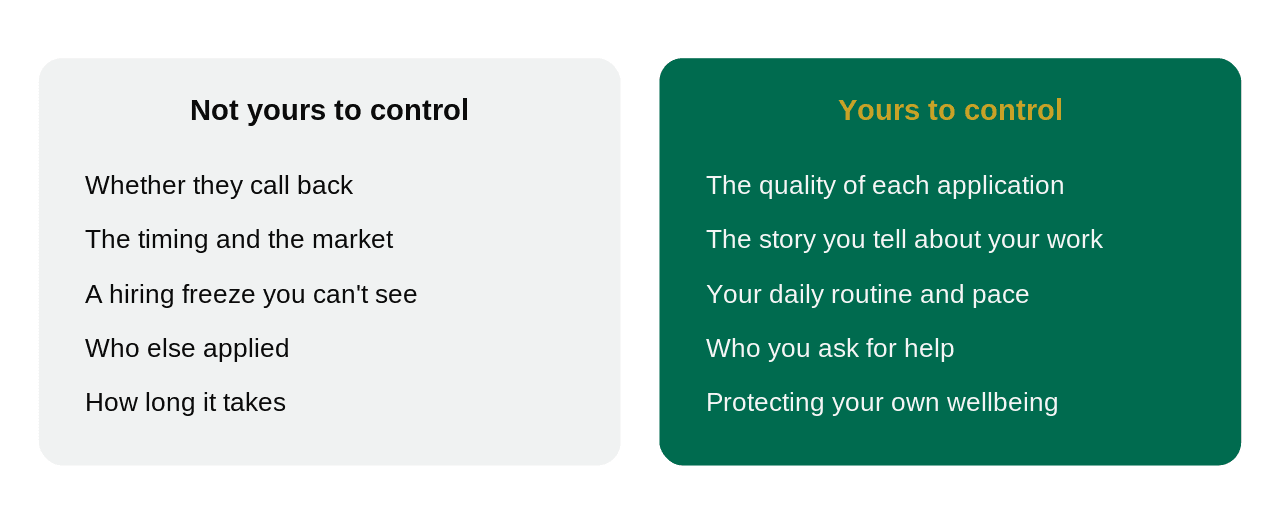
You can't control whether they call back, the timing, a hiring freeze you can't even see, or who else applied. Spend your emotional energy there and you'll exhaust yourself on a slot machine. What you can control is real, and worth all of it: the quality of each application, the story you tell about your work, your daily routine, who you ask for help, and how you treat yourself while you wait. Move your attention into that column. It's the only one that ever pays you back.
And it quietly improves your odds too. A few genuinely tailored applications, where you've translated your real experience into the language of that specific role, beat thirty sprayed ones every single time. Volume feels like progress because it's busy. It usually isn't. Fewer and better is both kinder to you and more effective.
How to not lose yourself while you wait
So the goal, alongside landing the role, is to come out the other side still recognizably yourself. A few things protect that.
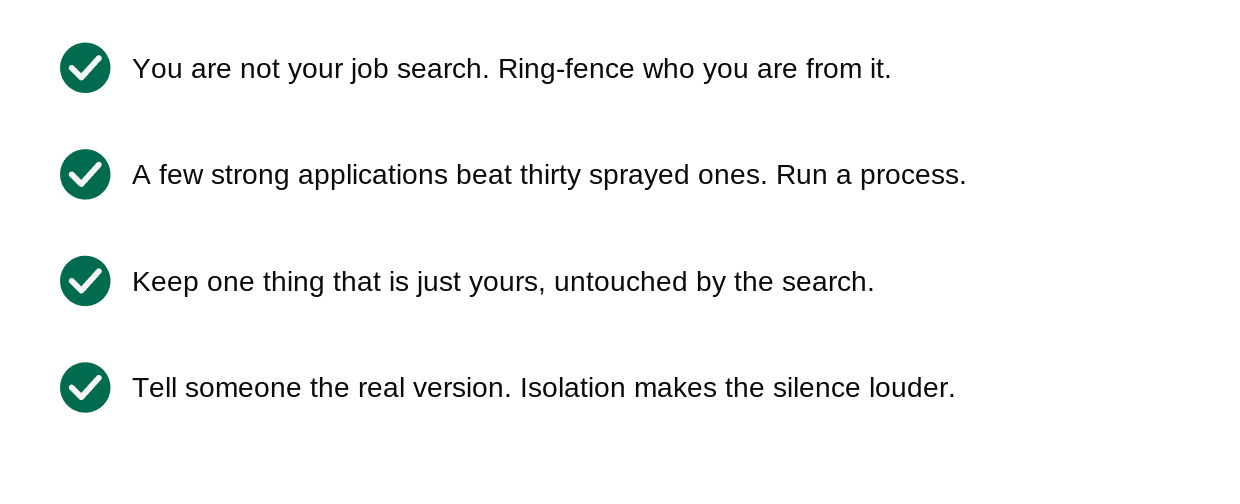
Ring-fence your identity from the search. You are a person who is currently looking for work. You are not “unemployable,” and you are absolutely not the number in your spreadsheet. Say that to yourself plainly, because the search will keep trying to blur the line.
Run it like a process, not a vigil. A simple version: two or three hours in the morning for focused, tailored applications and outreach, then a hard stop. After that, the laptop closes and you are off the clock. It feels lazy. It's the opposite. The people who search well are the ones who don't let it run around the clock, because the version of you that walks into an interview rested and intact will always beat the version that's been refreshing a job board since six in the morning. The all-day refresh does not find you more jobs. It just lets the search colonize every hour you've got.
Keep one thing that is entirely yours, untouched by any of this. A walk, a hobby, a standing coffee with a friend where the job hunt is a banned topic. You need at least one place where your worth isn't being assessed. And tell someone the real version of how it's going. The instinct in a long search is to go quiet and carry it alone, and isolation makes the silence so much louder than it needs to be.
I won't insult you with a guarantee. I can't promise the next application is the one, and anyone who does is selling something. What I can tell you is true: the sixty applications with no reply are not the measure of you, the search will end, and the version of you that walks out the other side matters at least as much as how fast you get there.
So protect that person. Apply with care to the roles that genuinely fit, translate your real experience honestly, and then go and be someone whose whole life is not this. The callback isn't in your hands. Staying yourself until it comes is, and that is the thing worth holding onto.
Sources
U.S. Bureau of Labor Statistics. “Table A-12. Unemployed people by duration of unemployment” (average about 26 weeks; 27.5% unemployed 27 weeks or longer). May 2026. bls.gov

Subscribe to the Newsletter
Join our growing community and get alerted first on our every article.
*By subscribing, you agree to send your information to our Company who agrees to use it according to their Terms and conditions and Privacy Policy
About the author
I believe the strongest tool and flex each of us has is our belief. When we truly believe in something, we align our mindset, energy, and actions with the right effort and guidance. That is when achieving almost anything becomes possible. This is how I help mentees at OAKKTREEUNII move into Software and Project Management careers for better pay, better confidence, and better work-life balance.
Comments