Most teams don’t fail at OKRs. They fail at what they bolt them onto.
ESTIMATED TIME
7
mins

Written by
Shikha Prasad
Published on
Someone on the leadership team read the book over the weekend. Now there's a shared spreadsheet, a deadline of Friday, and a polite request for three objectives and a handful of key results from every team, including yours.
Before you start typing, one question is worth more than the template: what do you actually want OKRs to do for you?
Because OKRs are not a productivity system. They're a focus argument, written down. They earn their keep when a team needs to agree on the two or three things that matter this quarter and find the nerve to drop everything else. They fall apart, almost every time, when they get pointed at a second job nobody admits to: grading the people who wrote them.
So the honest answer to 'should we run OKRs' isn't yes or no. It's: yes, if you want focus, and no, if what you actually want is a scoreboard for performance reviews. Same tool, two very different outcomes, decided almost entirely by what you attach it to.
The case for, with the hype removed
Start with what's actually true. Decades of goal-setting research keep landing on the same finding: specific, challenging goals produce better performance than vague encouragement to do your best {Locke & Latham, American Psychologist, 2002}. Not because a goal is magic, but because a clear, hard target directs attention, holds effort, and forces a team to pick a strategy instead of drifting.
OKRs are a tidy way to make a goal specific and slightly uncomfortable on purpose. An objective you'd actually be a little nervous to commit to, with key results measurable enough that nobody can argue later about whether you hit them. That's the whole mechanism. It isn't new, and it doesn't need to be.
The part people undersell is what OKRs do to a backlog. The hardest sentence in any delivery org is 'no, not this quarter.' Said by a person, it sounds like politics. Said against a goal the whole team already agreed to, it's just math. Google's own guidance puts it plainly: once everyone agrees what the most important objectives are, saying no stops being a political or emotional debate and becomes a rational response to a commitment already made {Google re:Work}.
An OKR's best day is the day it gives someone the standing to kill a project that should have died months ago.
There's a second quiet benefit that's easy to miss: everyone can see the same short list. A former Google and Twitter executive said the single hardest thing to scale in a growing company is communication, and that OKRs were the clearest way he found to tell an entire organization what mattered and how it would be measured {Google re:Work}. For a delivery team buried under requests from four directions at once, a public, agreed top three is oxygen. It also hands a newcomer a map: read the OKRs and you know what this place is actually trying to do this quarter, which is more than most onboarding ever tells you.
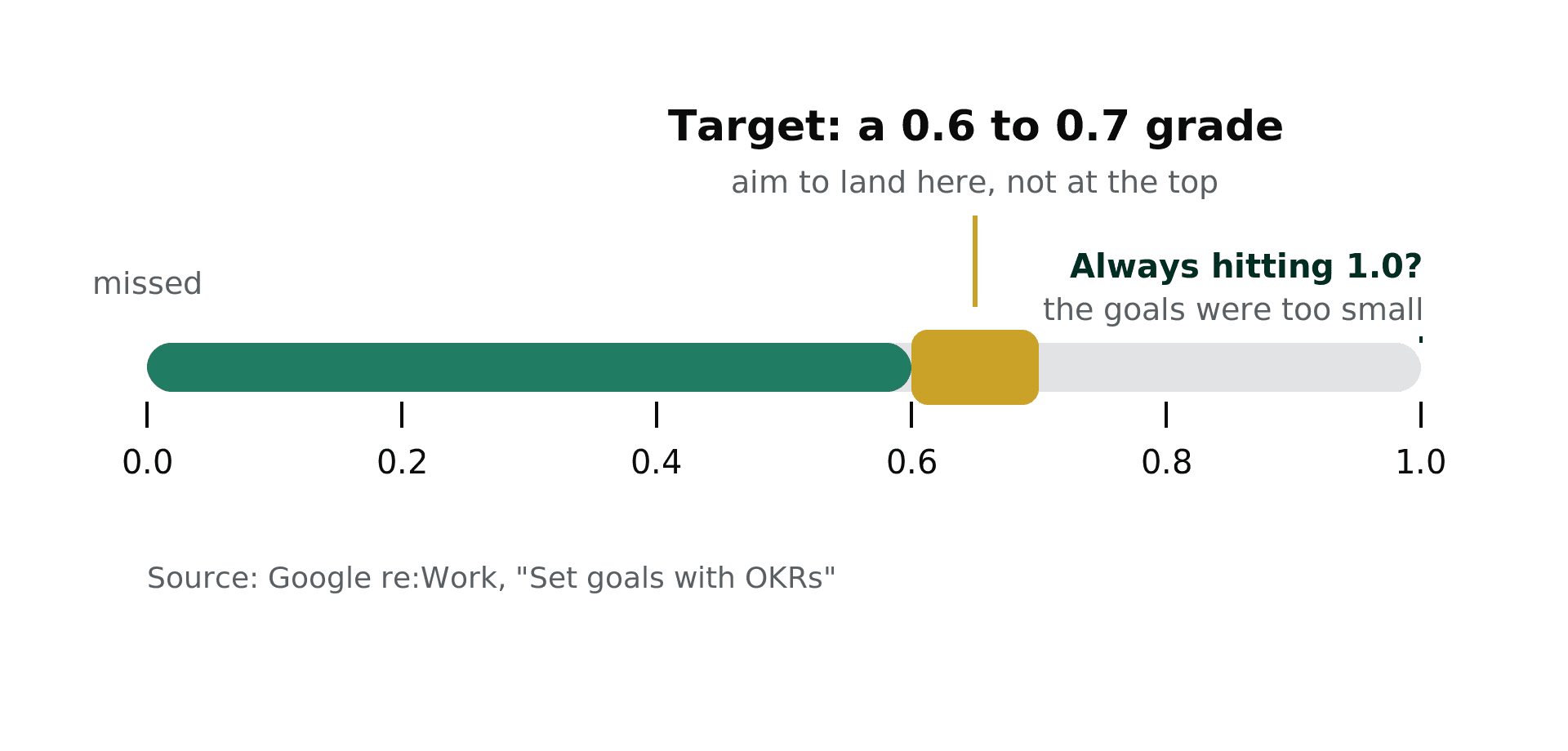
And the ambition is the point, not a side effect. Google sets OKRs it expects to miss, treats a 0.6 to 0.7 grade as the sweet spot, and reads a perfect 1.0 every quarter as a sign the goals were too small {Google re:Work}. A team that aims past comfortable and lands at 70 percent often ships more than a team that aimed safe and hit 100.
The case against, which is really one case
Now the other side, and it's worth taking seriously, because most teams that tried OKRs and hated them weren't wrong about their experience. They just misdiagnosed what went wrong.
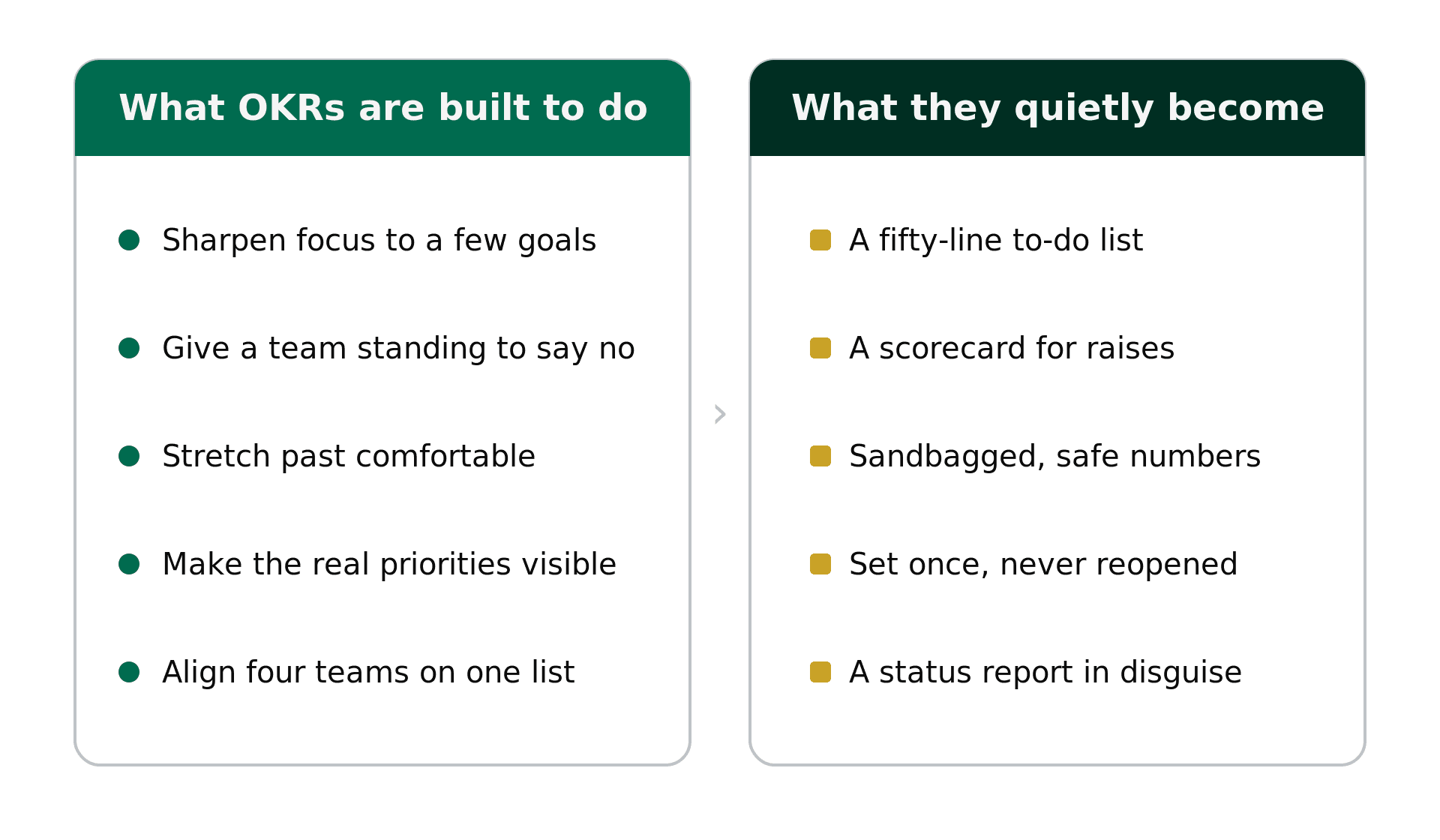
Here's the uncomfortable truth: almost every OKR horror story is not a goal-setting failure. It's an appraisal failure wearing a goal-setting costume. The moment a key result quietly decides someone's raise, the key result stops being honest. People aren't naive. If the number sets your bonus, you'll negotiate for a number you can beat and call it a stretch goal with a straight face.
This is just Goodhart's law showing up to work: make a measure a target and it stops measuring anything. Google saw it early and built a wall around it. OKRs are deliberately kept separate from performance evaluation and pay, because the instant people are judged on the goal, they sandbag it {Google re:Work}.
You can watch it happen in a week. Put 'cut average ticket resolution time below 24 hours' on the board, tie it to the bonus, and you won't get faster support. You'll get tickets closed early and reopened, the hard ones quietly left for the next person, and a beautiful green number that means nothing. The team didn't get worse. The measure did.
Tie OKRs to pay and you don't get ambition. You get a quarter of capable people setting goals they've already finished.
There's a smaller, fairer objection too. OKRs add overhead, and for a small, stable team that already knows its one job, they can be pure ceremony: a quarterly ritual of writing down what you were going to do anyway, then grading yourself on it. If your OKRs read like your to-do list with percentages bolted on, you don't have OKRs. You have a status report that takes longer to write.
What 'we tried OKRs and they didn't work' usually means
When a team tells me OKRs failed, it's almost always one of three things, and none of them is the goals.
They turned them into a to-do list. Fifty key results, every task someone was already doing, dressed up as strategy. OKRs are supposed to name the impact and let the team find the path. A checklist does the exact opposite.
They tied them to comp. Covered above, and it's the big one, usually invisible to the leaders who did it because they meant well. 'We should reward people who hit their goals' is a reasonable sentence with a poisonous effect.
They set them and never looked again. Written in week one, opened again at the grading meeting in week twelve. A goal you don't revisit isn't steering anything. It's decoration with a deadline.
Fix those three and the tool works. Leave them in and no framework on earth saves you, because the framework was never the problem.
If you're the one in the room when they roll out
Here's where this gets practical for a Scrum Master or delivery lead, because you usually don't get a vote on whether OKRs happen. You get something more useful: control over how they land on your team.
Keep them off the appraisal, out loud. If leadership won't separate goals from reviews, name that risk plainly and early, and at a minimum protect your own team from being graded on a stretch number. Keep the count brutal: three objectives, three key results each, and no more. Translate vague leadership objectives into key results your team can actually watch move. Then put the OKRs somewhere you'll open in week six, not just week twelve.
One more move that pays off later: when you grade at the end of the quarter, grade out loud and grade honestly. A 0.5 isn't a failure to bury. It's the most useful data the team has, because it tells you which goals were too big, which were mis-scoped, and which ones the org kept yanking around mid-quarter. Teams that treat a low grade as something to learn from set sharper goals next time. Teams that treat it as a mark on a permanent record quietly learn to aim low. You're choosing between those two cultures every time you react to a number.
Do that and you've quietly done the senior version of the job. Anyone can fill in the spreadsheet. The person who can tell the difference between a focus tool and a measurement stick, and steer the team away from the second one, is the person who sounds like they've watched this movie before. That judgment is what thinking like a leader actually looks like, and it's worth more in an interview than the ability to recite what the letters stand for.
So, should your team run OKRs? Run them if you want a sharper argument about what matters and the nerve to drop the rest. Skip them if what you really want is a number to judge people by. The framework can't tell those two apart. You have to.
Sources
Locke, E. A., & Latham, G. P. (2002). Building a Practically Useful Theory of Goal Setting and Task Motivation. American Psychologist
Google re:Work Editorial Team. Set goals with OKRs.

Subscribe to the Newsletter
Join our growing community and get alerted first on our every article.
*By subscribing, you agree to send your information to our Company who agrees to use it according to their Terms and conditions and Privacy Policy
About the author
I believe the strongest tool and flex each of us has is our belief. When we truly believe in something, we align our mindset, energy, and actions with the right effort and guidance. That is when achieving almost anything becomes possible. This is how I help mentees at OAKKTREEUNII move into Software and Project Management careers for better pay, better confidence, and better work-life balance.
Should OKRs be tied to performance reviews?
No. Once a goal sets someone’s rating or pay, people set goals they can already beat. Keep OKRs separate from appraisal.
What is a good OKR score?
Around 0.6 to 0.7 on a 0 to 1.0 scale. Consistently hitting 1.0 usually means the goals were not ambitious enough.
Why do most OKR rollouts fail?
Three reasons: they become a fifty-item to-do list, they get tied to comp, or they get set once and never revisited.
Comments