Scrum Master salary benchmarks: what the data actually shows
ESTIMATED TIME
7
mins

Written by
Rajveer Prasad
Published on
The number you quote in a negotiation should come from data, not a vibe. Here is the real spread, and how to read it.
A reader emailed me last month with a problem I hear constantly. He got a Scrum Master offer, the recruiter asked what he was looking for, and he froze. He'd seen "average Scrum Master salary" headlines ranging from the high seventies to over a hundred and fifty thousand. So he did what most people do under pressure. He guessed low, took the number, and found out three months later the guy two desks over made twenty grand more for the same work.
That's not a knowledge problem. He knew Scrum. It's a number problem. He walked into a money conversation without a number he could defend, so he let someone else pick one for him.
Here's the thing about salary data. Most of it is real, and most of it is also useless the way people use it. A single "average" tells you almost nothing, because the spread is enormous and you are not the average. So let's do this properly. Real sources, the actual ranges, and how to turn them into a number you can say out loud without flinching.
Why "the average Scrum Master salary" is a useless sentence
Start with the wide-lens number. The U.S. Bureau of Labor Statistics doesn't track "Scrum Master" as its own job. It folds the role into project management specialists, where the median wage was $100,750 in May 2024 {BLS, OOH}. That sounds clean. One number, done.
It isn't done. The same BLS report says the lowest ten percent earned under $59,830 and the highest ten percent earned more than $165,790 {BLS, OOH}. That's a hundred-thousand-dollar gap between the floor and the ceiling for the same broad role.
Now narrow it to Scrum Masters specifically. Glassdoor's February 2026 data puts the median total pay around $126,000, with most people landing between $99,000 and $161,000 {Glassdoor, via Coursera}. Higher than the BLS midpoint, because the Scrum Master title skews toward tech and finance, where pay runs hot.
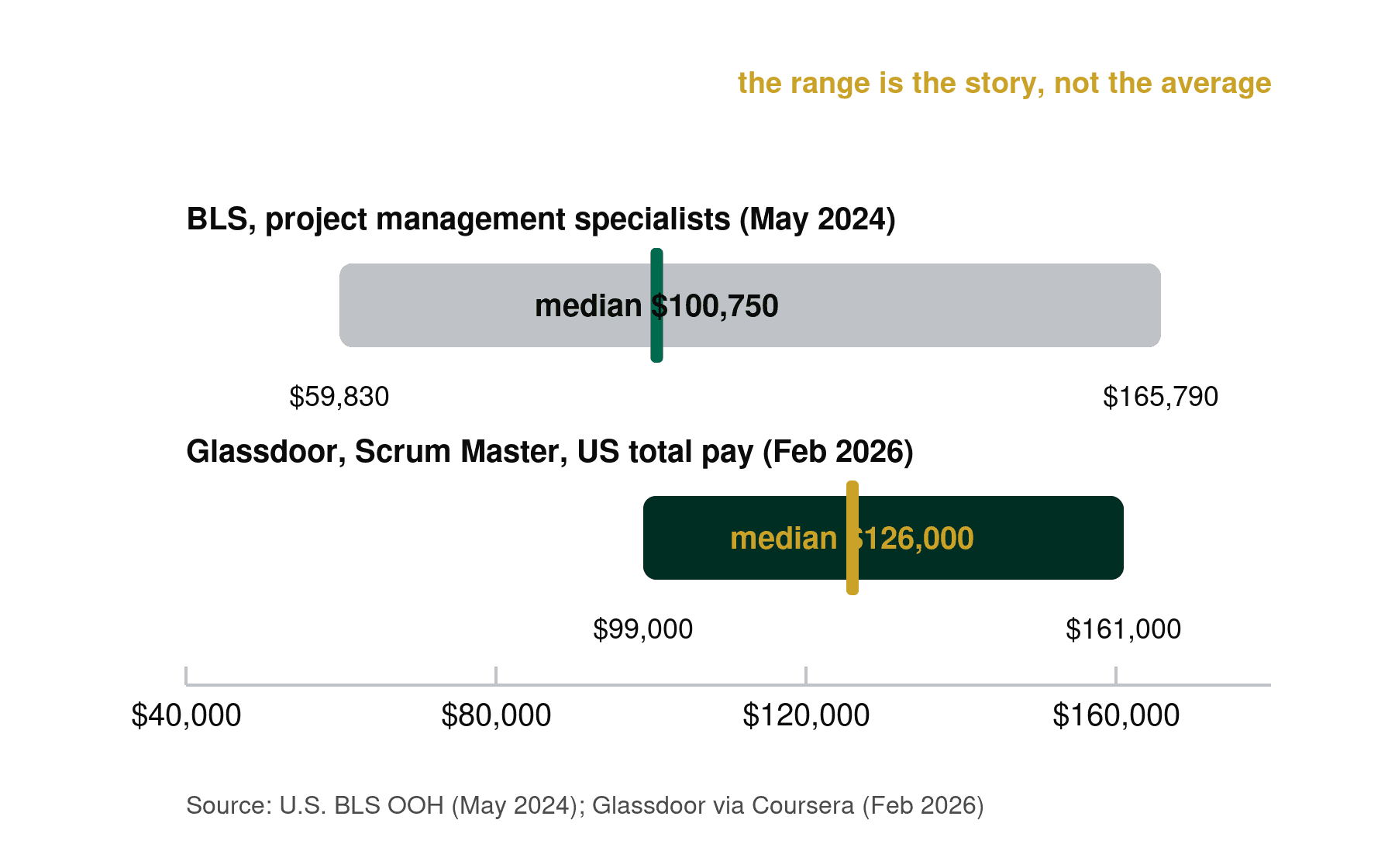
Look at those two bars. The medians are useful as a rough center of gravity. The ranges are where your actual paycheck lives. Quoting "the average" in a negotiation is like telling someone the average temperature of a country. Technically true, completely unhelpful for deciding what to wear.
Experience moves the number more than almost anything
If you only internalize one driver, make it this one. Pay tracks experience in a steady climb, not a step function. Glassdoor's February 2026 breakdown by experience reads like this: about $95,000 at zero to one year, $103,000 at one to three, $123,000 at four to six, $136,000 at seven to nine, $152,000 at ten to fourteen, and $164,000 at fifteen plus {Glassdoor, via Coursera}.
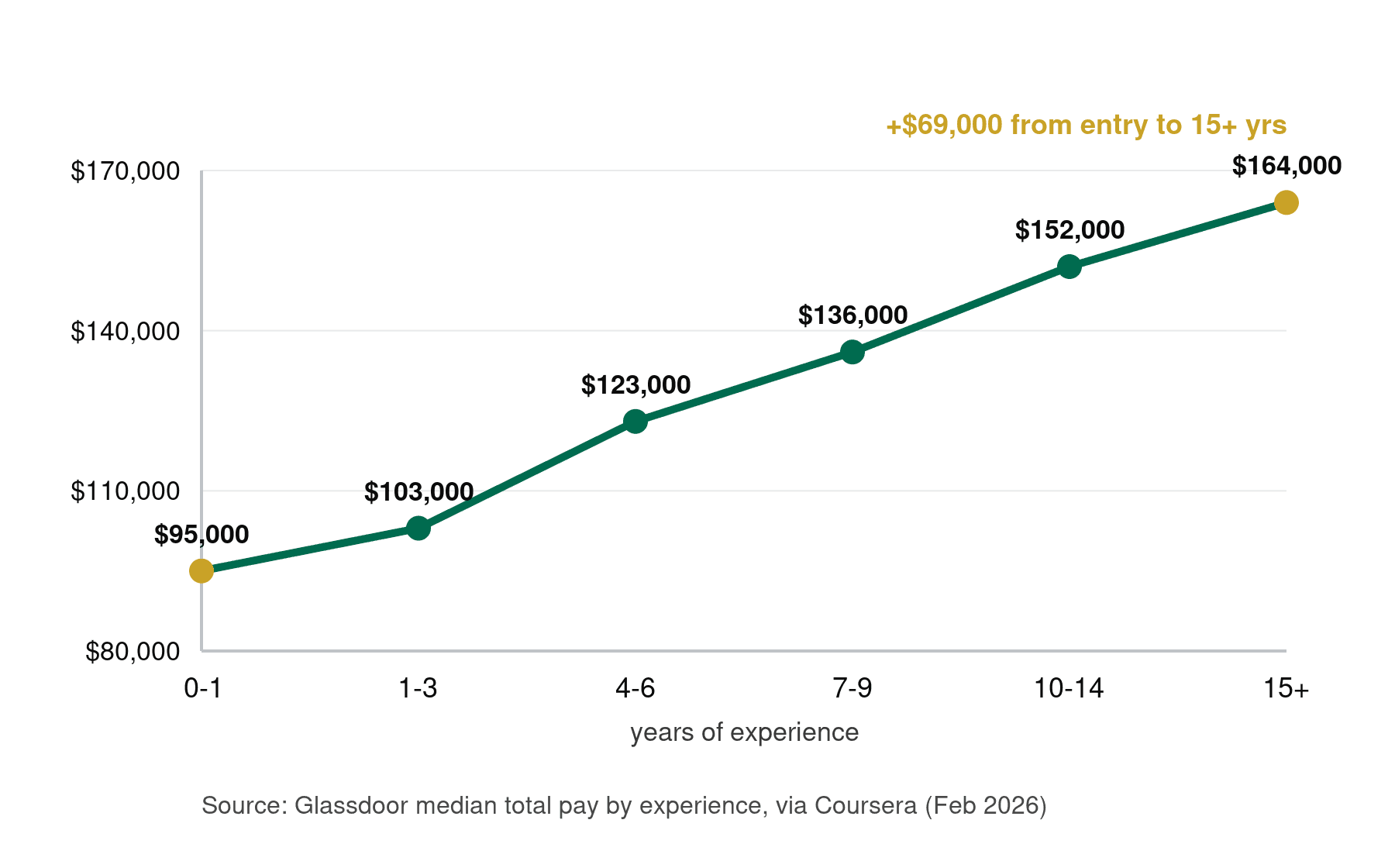
That's roughly $69,000 between a first-year Scrum Master and a fifteen-year veteran. The independent Scrum Master Salary Report 2024, a global survey of 1,114 practitioners, found the same shape from a different angle: a median gap of about $22,000 between junior-level and senior-level income {Scrum.org, Salary Report 2024}.
Here's the part the framework courses skip. Nobody pays you for the years. They pay you for what the years are supposed to have taught you. A senior number is a bet that you've handled a release that went sideways, a stakeholder who tried to bulldoze the team, a metric that started lying. If you have two years of calendar time but you can tell those stories like someone who lived them, you can negotiate up the curve. If you have eight years and still describe your job as "running the ceremonies," you'll get talked down it.
The curve doesn't pay for tenure. It pays for judgment that usually shows up with tenure. Bring the judgment early and you bend the curve.
Certifications pay, but not the way the sales page implies
Certs do move money. Just not the basic ones, and not as much as the people selling them suggest. Glassdoor medians by credential land around $121,000 for a Certified ScrumMaster (CSM), $109,000 for a Professional Scrum Master I (PSM I), and $136,000 for the advanced Certified Scrum Professional-ScrumMaster (CSP-SM) {Glassdoor, via Coursera}.
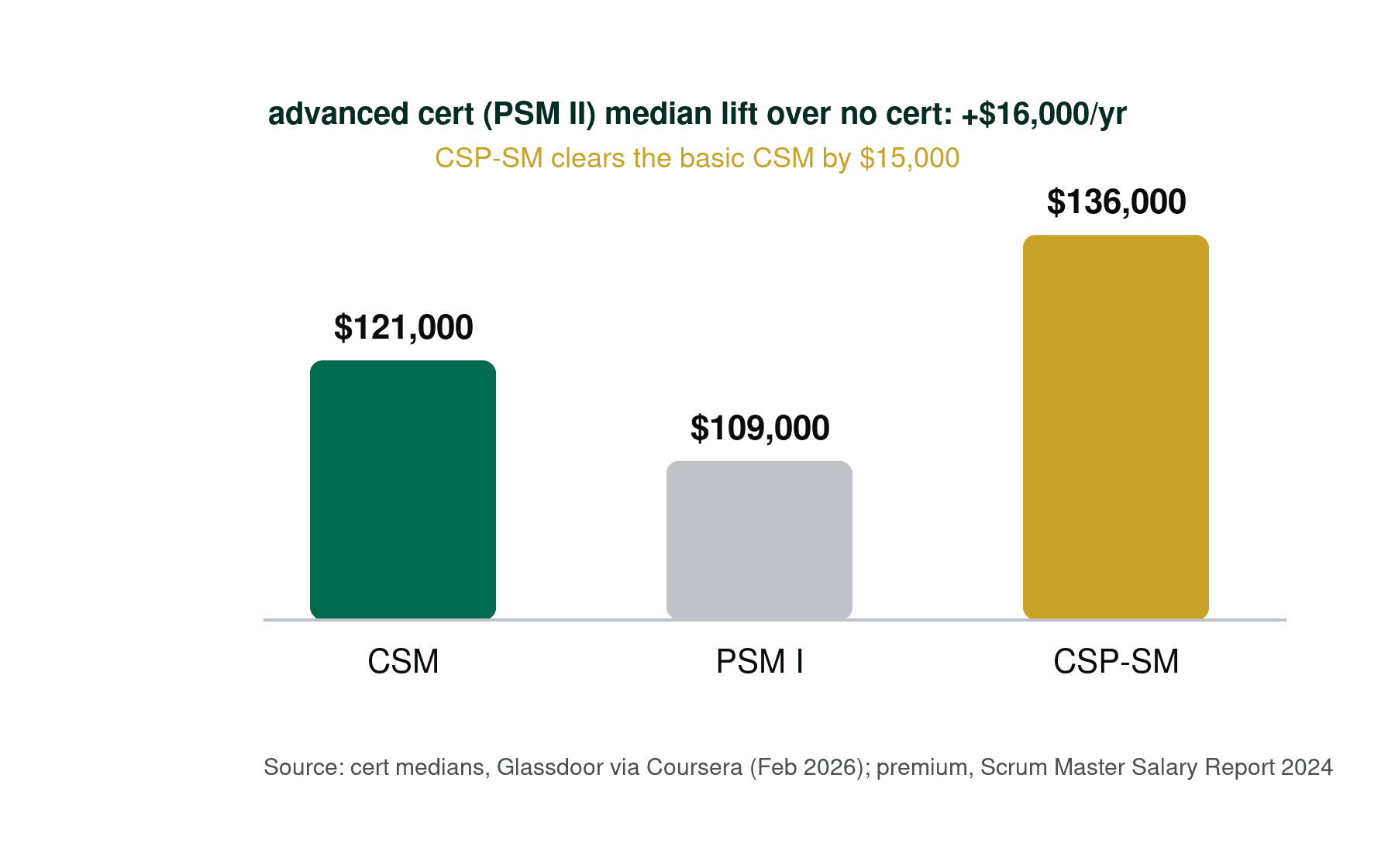
Notice the pattern. The entry certs cluster together. The jump shows up at the advanced level. The Scrum Master Salary Report 2024 makes this sharp: the median difference between holding no certification and holding an advanced cert like PSM II was about $16,000 a year, and stacking further specialist qualifications such as SCM, ICP-ACC, or PMI-ACP added up to roughly $35,000 more on top {Scrum.org, Salary Report 2024}.
Read that correctly. The first cert is table stakes. It gets your resume past the filter. It does not, on its own, command a premium, because everyone applying has it. The money sits with the advanced credentials, and even those correlate with pay because the people who earn them tend to have the experience and the scope to back them up. The certificate isn't the cause. It's a marker that usually travels with the cause.
So if you're early and broke, don't drain your savings stacking certs hoping the number jumps. Get the entry cert, then go build the experience that the advanced cert is really measuring. The experience is what you'll actually negotiate on.
Four websites, one job title, a $40,000 disagreement
Before you anchor on any single figure, understand why the figures fight each other. Coursera lined up four salary aggregators for the exact same role. Zippia said $86,329. Salary.com said $93,452. Payscale said $106,034. Glassdoor said $126,000 {Coursera}.
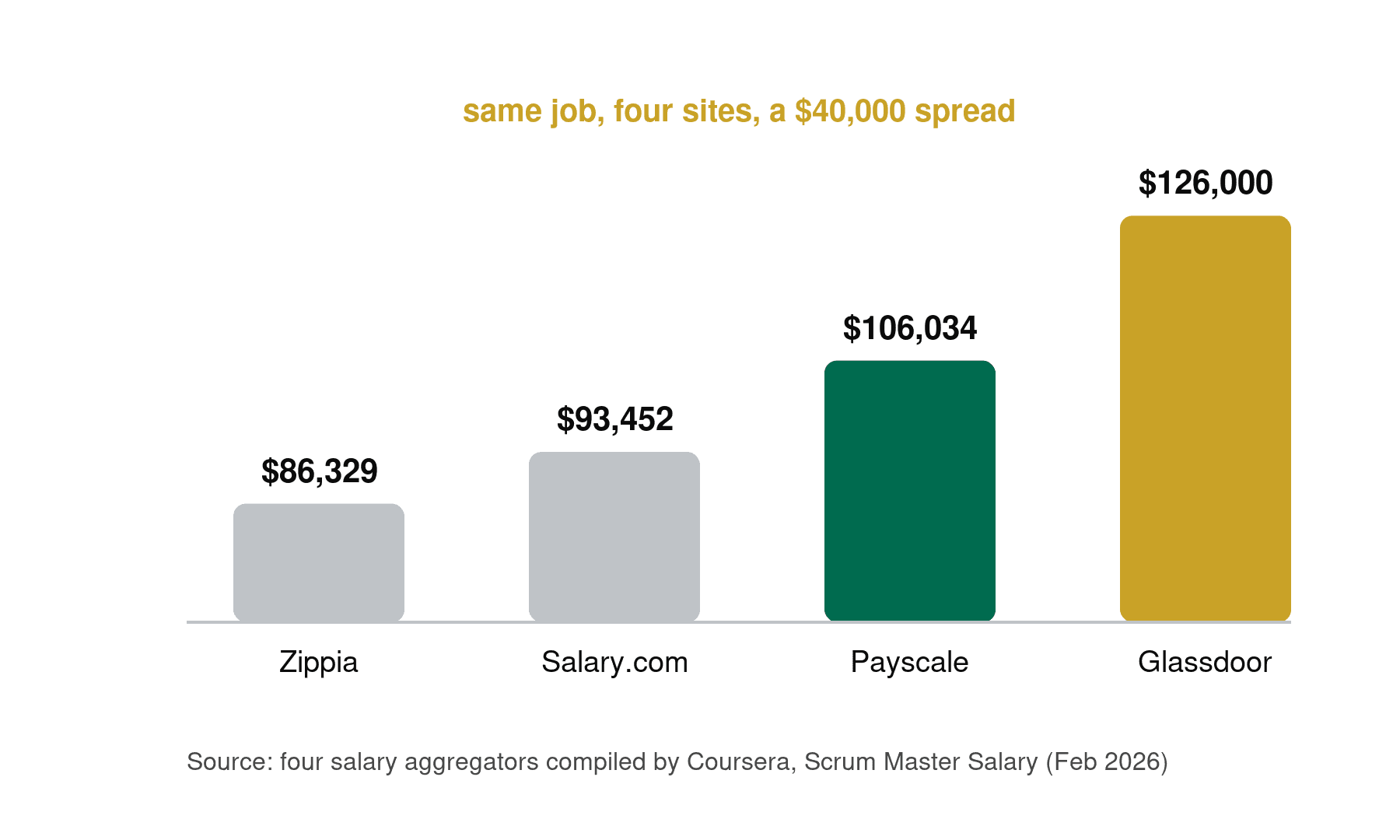
That's a forty-thousand-dollar disagreement about one job title. Not because anyone's lying. They're measuring different things. Some report base pay only, some report total pay with bonus and equity folded in. Some lean on self-reported submissions from people who chose to post, some model from job ads. The Glassdoor number runs high partly because it's total pay, including the bonus and additional compensation that base-only sites leave out.
The takeaway isn't "the data is garbage." It's "know what each number includes before you quote it." When a recruiter says the budget is a hundred and ten, ask whether that's base or total. When you state your target, be clear about the same. Half the bad salary conversations I've watched were two people using one number to mean two different things.
Where you sit changes the math: industry and region
Same title, same experience, different industry, very different check. Glassdoor's highest-paying industries for Scrum Masters all clear the mid-$130,000s in median total pay: aerospace and defense around $140,238, HR and staffing around $138,844, energy and utilities around $137,313, financial services around $134,408, and management consulting around $134,170 {Glassdoor, via Coursera}.
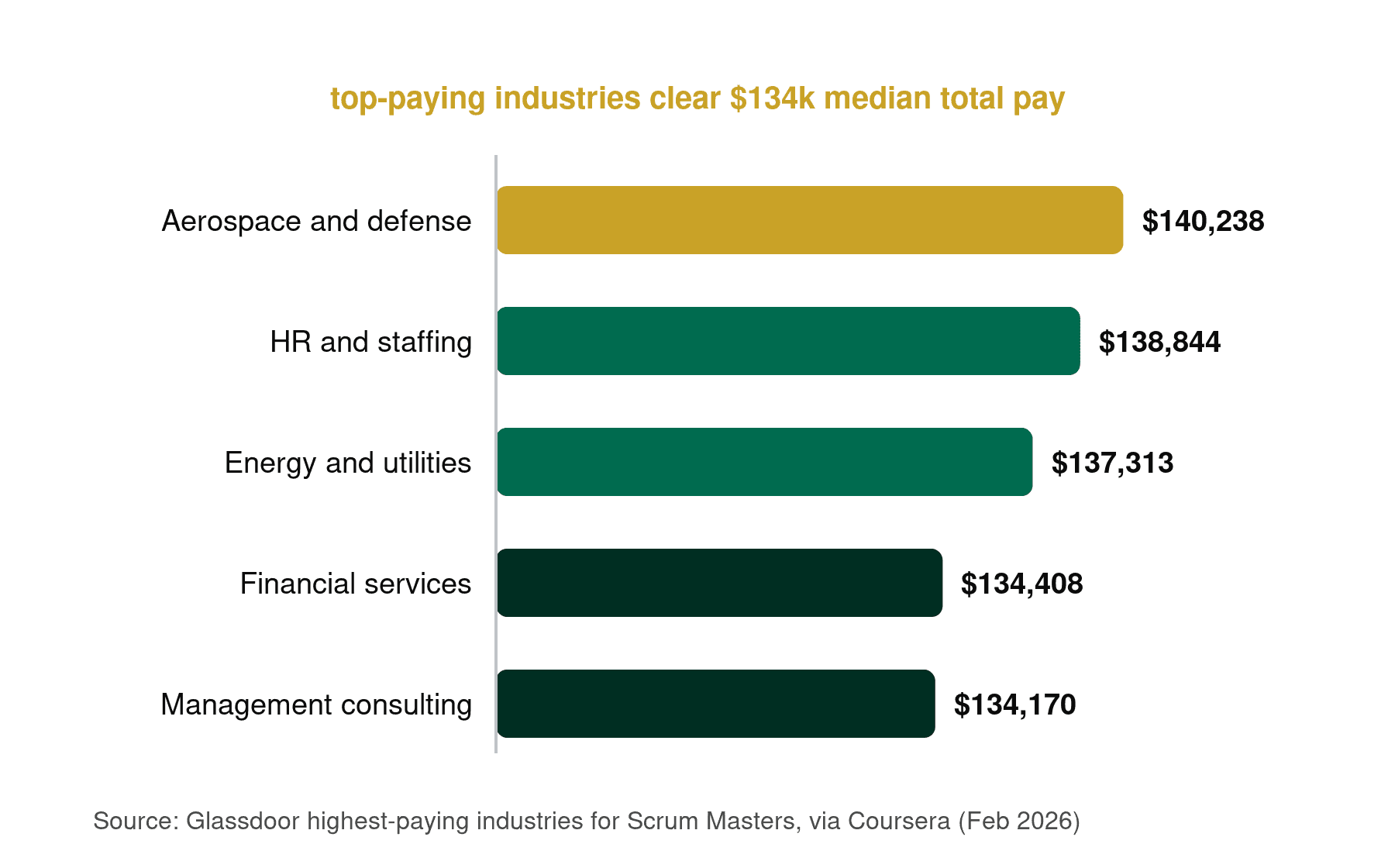
For comparison, the BLS shows the same industry effect in its broader project-management data: finance and insurance paid a median of $111,350, well above the construction median of $96,700 for the same occupation {BLS, OOH}. The lesson repeats at every zoom level. The industry you deliver in can be worth more than a promotion.
Region matters too, but be careful. A San Francisco number looks great until you price an apartment there. Use the BLS state and metro tables to compare like for like, and weigh the cost of living, not just the headline. A remote role paying a coastal band while you live somewhere cheaper is often the real win, not the office in the expensive city.
The ceiling is higher than the headlines admit
One more number, because aspiring readers rarely see it. The Scrum Master Salary Report 2024 identified its top ten earners and found their annual income spread evenly between $220,000 and $300,000 {Scrum.org, Salary Report 2024}. Those people share traits: agile-coaching scope, US employment, and experience across several industries.
You're not negotiating for that today. But it tells you the role has real headroom for people who grow into coaching and broad delivery leadership. This isn't a job that caps out at a hundred grand. The ceiling rewards range, and range is something you can deliberately build.
Turn the data into a number you can say out loud
Reading benchmarks is the easy part. Here's how to convert them into a number that holds up when a recruiter pushes back. Four moves.
Build your own band, not a single number
Pull three sources for your exact situation: BLS for the floor and the regional reality, Glassdoor for the title-specific total-pay range, and the Scrum.org report for the experience and cert lift. Land on a band, not a point. Something like "I'm targeting 115 to 130 total, based on my experience and the market for this title in this industry." A band sounds researched. A single number sounds like a wish.Place yourself on the experience curve honestly
Find your years on the curve, then adjust for evidence. Can you tell three real delivery stories where you changed an outcome, not just facilitated a meeting? Adjust up. Are you still describing the job as ceremonies? You're not ready to argue the senior band yet, so go build the proof first {Glassdoor, via Coursera}.Always ask base versus total
Before you react to any offer or quote any target, confirm what's inside it. Base only, or total with bonus and equity? The forty-thousand-dollar spread between sites is the same trap that wrecks live negotiations. Pin the definition down first {Coursera}.Aim the next year at the highest-leverage move
The data says the biggest levers are experience, an advanced credential, and a higher-paying industry. Pick the one you can move in the next twelve months. For most people early in the role, that's experience and the stories that come with it, because that's also what the advanced cert and the senior band are quietly measuring.
Know your number before they ask. The person who walks in with a researched band negotiates. The person who walks in with a guess gets negotiated.
That reader who took the lowball? He's fine now. He spent six months collecting real delivery stories, moved to a fintech team, and walked into the next conversation with a band and the receipts to back it. Same certification. Same person. The only thing that changed was that he stopped guessing and started quoting data.
You can do that this week. The numbers above are real and current. Build your band, place yourself honestly, and go into the next money conversation as the person who already knows the answer.
Sources
U.S. Bureau of Labor Statistics, Occupational Outlook Handbook, Project Management Specialists.
Coursera, "Scrum Master Salary: Your 2026 Guide".
Glassdoor, "Scrum Master Salaries, United States" (median total pay and range; accessed June 2026).
Stefan Wolpers, "The Scrum Master Salary Report 2024"

Subscribe to the Newsletter
Join our growing community and get alerted first on our every article.
*By subscribing, you agree to send your information to our Company who agrees to use it according to their Terms and conditions and Privacy Policy
About the author
With 20 years guiding high-stakes Agile transformations, I turn theory into action at Oaktreeuni—mentoring aspiring Scrum Masters to think critically, adapt fast, and lead beyond frameworks. The payoff? You step into a high-paying Scrum Master or Agile PM role already equipped to excel.
Comments