Saying no without becoming the difficult one
ESTIMATED TIME
6
mins

Written by
Rajveer Prasad
Published on
You think no makes you a problem. Saying yes to everything is the bigger one.
Here's the fear, said plainly. If you say no, you'll be the difficult one. Not a team player. The person who always pushes back. So you say yes. To the extra scope, the surprise request, the “quick favor” that is never quick. You say yes to all of it, and you tell yourself you're being helpful.
You're not being helpful. You're being unreliable in slow motion.
The yes you can't keep is worse than the no you can
Start with the math, because there is some. Every yes is a context switch, and context switches are not free. Research on task switching found that bouncing between tasks can eat up to 40 percent of your productive time {APA, Rubinstein, Meyer and Evans}. And after a single interruption, it takes the average person around 23 minutes to fully get back to what they were doing {Mark, UC Irvine}.
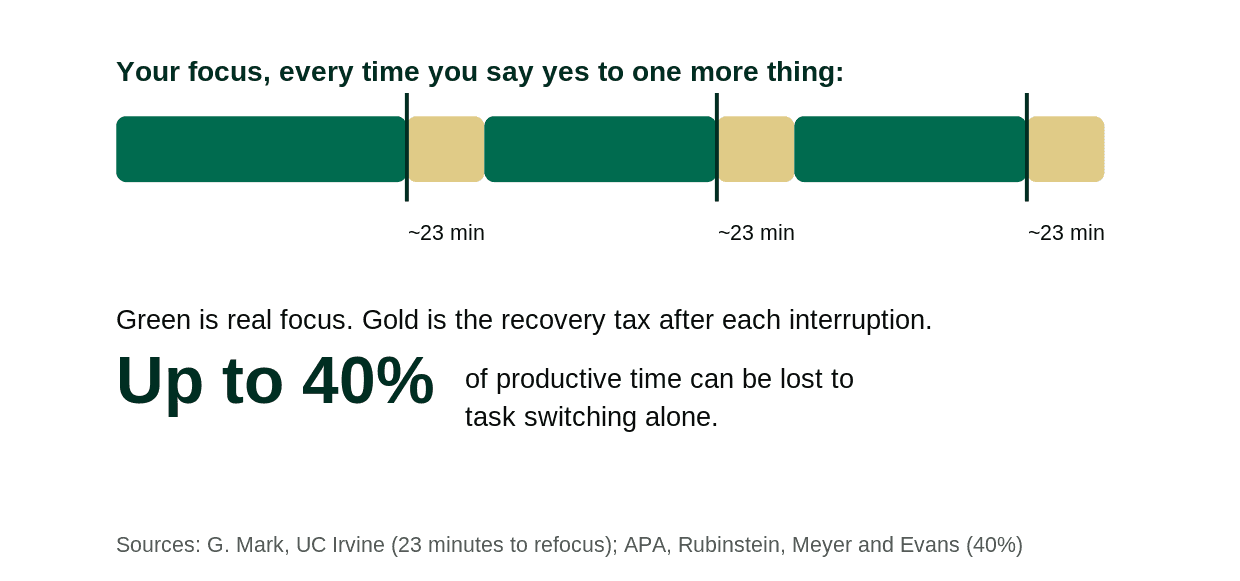
So when you say yes to one more thing, you aren't adding one task. You're fragmenting the focus you needed for everything you already committed to. Say yes enough times and you've quietly guaranteed that something you promised is going to slip. The team learns your yes doesn't mean much. That's the exact reputation you were trying to avoid, earned the long way around.
A no you keep builds more trust than a yes you break. People can plan around a clear no. They cannot plan around a yes that quietly turns into a miss.
The blunt no isn't the answer either
Now the overcorrection. Some people read this and swing to the far end: just say no, protect your time, let the relationship take the hit. That isn't skill either. That's trading one problem for another and calling it a boundary.
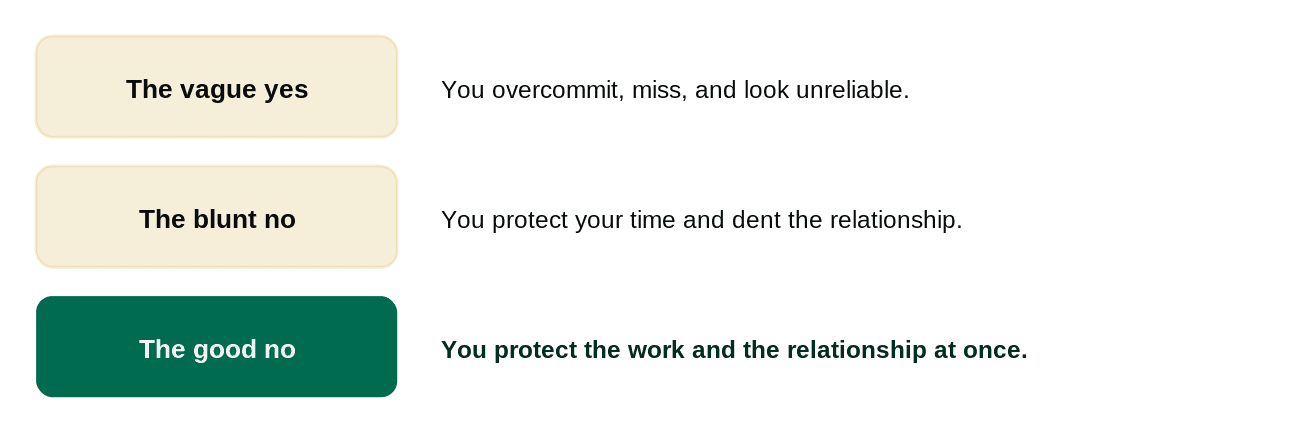
The vague yes makes you unreliable. The blunt no makes you a wall. What you actually want is the third thing: the no that protects the work and the relationship at the same time. That's the move that reads as senior, and it's a skill, which is the good news, because it means it can be learned.
How to say no without the damage
Here's the structure. Four moves, and you can run all four in about three sentences.
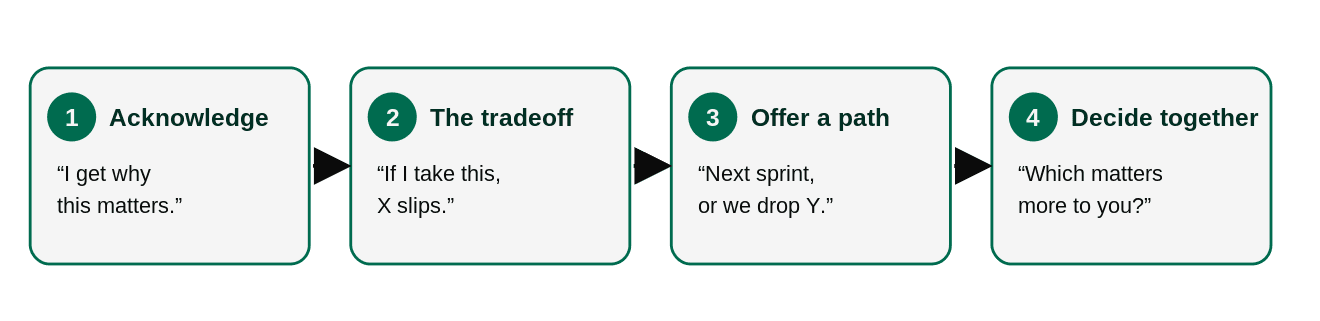
Acknowledge. Not fake enthusiasm. Just signal that you heard them and you get why it matters. “I can see why this is urgent for the client.” That one sentence is the whole difference between feeling dismissed and feeling heard, and it costs you nothing.
Name the tradeoff, out loud. This is the heart of it. You're not refusing, you're making the cost visible. “If I pick this up this sprint, the reporting work you asked for last week slips.” Now it isn't you being difficult. It's a real constraint, sitting on the table where they can see it.
Offer a path. Never just close the door, point at another one. “I can do it next sprint, or we drop the reporting and I start today.” You've turned a flat refusal into a choice.
Let them decide. Hand the tradeoff back to the person who owns the priority. “Which matters more to you?” Most of the time, once they're looking at the real cost, they re-prioritize themselves, and you never had to say the word no at all. You just made the tradeoff impossible to ignore.
Here's it working, on a real Thursday. A stakeholder pinged me: could the team add a “small” dashboard before the Friday demo? The reflex yes would have quietly torched the demo prep. Instead: “Totally get why you'd want it in front of the client” (acknowledge). “If we build it today, the two stories we already promised for the demo won't be ready” (tradeoff). “We can show it as a mockup tomorrow and build it properly next sprint, or swap it in for one of the committed stories” (path). “Which would you rather walk in with?” (decide). He picked the mockup in about four seconds. No conflict, no broken promise, and he left thinking I had it handled, because I did.
Why this is a leadership signal, not a soft skill
This is one of those things that quietly separates the people who get trusted with more from the people who stay stuck. Anyone can say yes. Anyone can say no. The person who can decline a request while keeping the requester on side, and protect the team's focus without becoming the office obstacle, is doing something genuinely hard, and senior people clock it instantly.
It shows up in interviews too. Asked how you handle competing priorities or a stakeholder demanding too much, the weak answers are “I try to fit it all in,” which translates to I overcommit and miss, or “I just tell them no,” which translates to I create conflict. The strong answer is the tradeoff: I make the cost visible and let the priority owner choose. One sounds like a people-pleaser or a wall. The other sounds like someone you could hand a hard room.
Two honest caveats, so you don't turn this into a reflex of its own. Not every request earns the full routine. Plenty of asks are small and reasonable, and the right answer is just “yep, on it.” Saving the tradeoff conversation for when there's an actual tradeoff is part of what makes your real nos land later. And sometimes the answer genuinely is a hard no, full stop: when someone is pushing the team to cut a corner that puts quality or people at real risk. The four moves are for the daily tug-of-war over priorities, which is most of it. They are not a way to avoid ever holding a firm line.
So stop equating no with difficult. The difficult one was never the person who protects the work with a clear, kind no. It's the person whose yes you can't trust. Next time you feel the reflex to just agree, run the four moves instead. Acknowledge, name the tradeoff, offer a path, let them choose. You'll protect the work, the relationship, and the thing a vague yes quietly costs you every time, which is your credibility.
Sources
American Psychological Association. “Multitasking: Switching costs” (Rubinstein, Meyer and Evans; up to 40% of productive time). apa.org
Mark, Gloria, et al. “The Cost of Interrupted Work: More Speed and Stress.” University of California, Irvine (about 23 minutes to refocus). ics.uci.edu
Subscribe to the Newsletter
Join our growing community and get alerted first on our every article.
*By subscribing, you agree to send your information to our Company who agrees to use it according to their Terms and conditions and Privacy Policy
About the author
With 20 years guiding high-stakes Agile transformations, I turn theory into action at Oaktreeuni—mentoring aspiring Scrum Masters to think critically, adapt fast, and lead beyond frameworks. The payoff? You step into a high-paying Scrum Master or Agile PM role already equipped to excel.
Comments