Run your job search like a delivery project
ESTIMATED TIME
12
mins

Written by
Rajveer Prasad
Published on
Most job searches don't fail loudly. They drift.
You know the shape. Sunday night, a spike of guilt, fourteen tabs open. You apply to six roles in two hours, feel briefly productive, then go quiet for four days. A recruiter calls about a posting you can't place. You tell people you're “actively looking,” but if you're honest, what you're actively doing is reacting.
Here's the part that should sting a little. You're applying for roles where the entire job is bringing order to messy, high-pressure work. Scope, priorities, flow, stakeholders, cadence. And the messiest unmanaged project in your life right now is the search itself.
So run it like the work you want to be paid for. Not as a slogan. Literally. Give the search a scope, a backlog, a WIP limit, a weekly cadence, a couple of honest metrics, and a retro. Each piece fixes a specific way searches quietly die, and every single one is a rep in the craft you're trying to get hired for.
Here's the build, piece by piece.
Scope it before you touch a job board
Ask a drifting job seeker what they're looking for and you'll usually hear some version of “honestly, I'm open to anything.”
Open to anything isn't a scope. It's a hope with a resume attached.
You'd push back instantly if a sponsor handed you “anything” as a project goal, so don't accept it from yourself. Write the scope down. One page, ten minutes:
Two role types, maximum. Scrum Master and IT project coordinator. Or project manager and delivery lead. Not five.
Your market. City, remote, hybrid, and the real radius you'd actually commute.
Your floor. The salary below which the answer is no, decided now, while you're calm.
Out of scope. The roles you'd only take out of panic. Naming them today is what stops one bad month from quietly rewriting your career.
Then write a definition of done for a single application, because “I applied” does a lot of dishonest work in most searches. Mine has three lines: the resume is tailored against the actual posting, I've found and tried to reach one named human connected to the role, and a follow-up date is sitting in my calendar. If those three aren't true, the application isn't done. It's just sent.
A backlog beats forty open tabs
Tabs aren't a plan. They're anxiety with bookmarks.
Pull everything into one ordered list. A plain spreadsheet is fine. One row per opportunity: company, role, link, the human you could reach, status, next action, date. That's your backlog, and like any backlog, the order is the strategy.
Prioritize the way you'd prioritize delivery work: by value and by access. A strong-fit role where you can reach a real person outranks a perfect-sounding posting with no way in. The spray-and-pray listings, the ones you'd apply to without reading twice, sink to the bottom or leave the list entirely. Cutting them isn't lost opportunity. It's scope discipline, and it frees the hours the top of the list deserves.
Five applications in play. That's the limit.
Run the work across a simple board: Backlog, Researching, Applied, In conversation, Closed. Then do the thing that feels wrong and put a WIP limit on the middle. No more than five applications in active play at once.
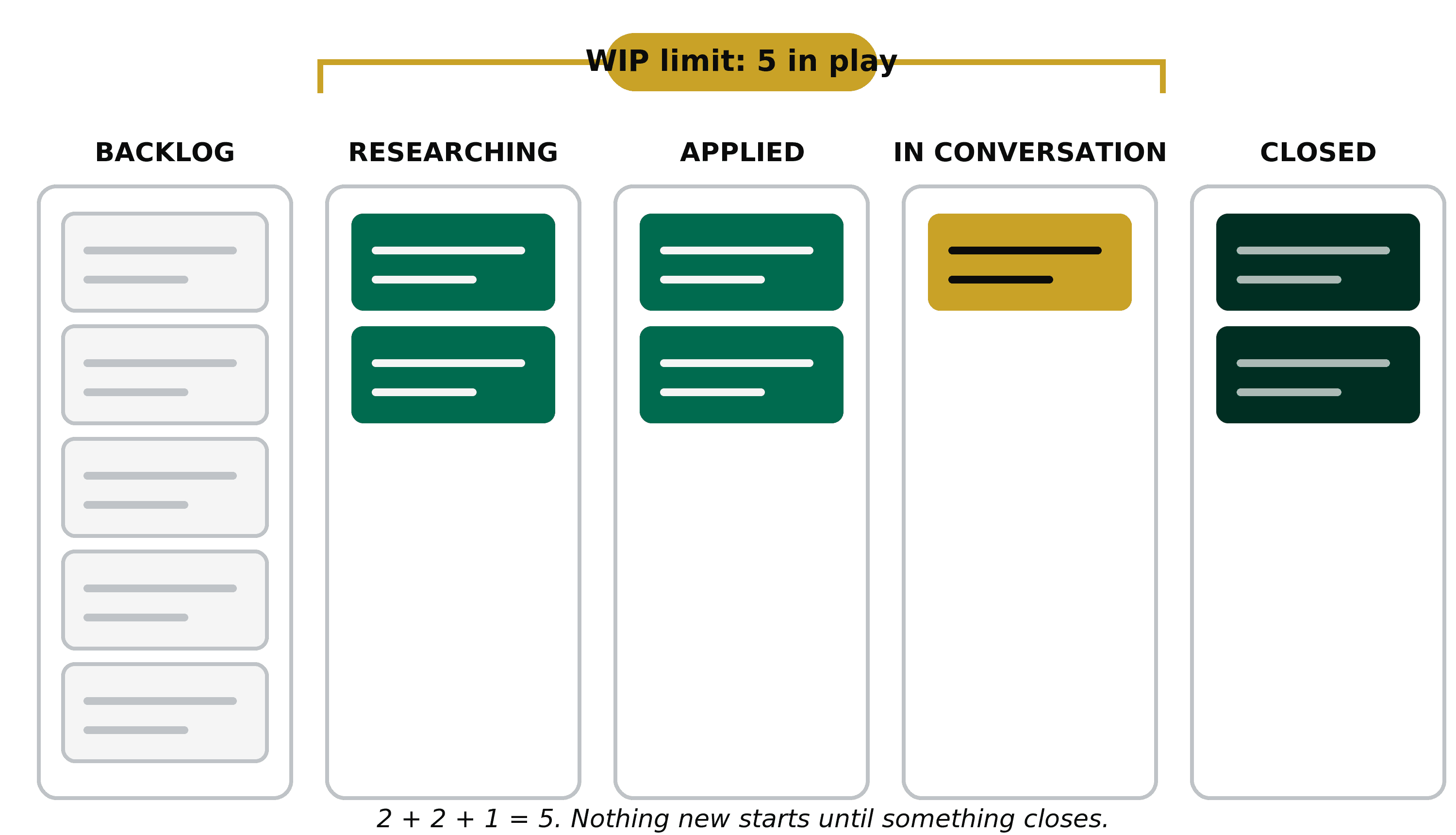
I can hear the objection, because it's always the first one: “a job search is a numbers game.” Partly true. Over the length of a search you do need volume. But unqualified volume converts at almost nothing, and you already know why: a rushed, untailored application looks exactly like the two hundred others in the pile. The limit isn't five per month. It's five at a time, each one done to your definition of done. You'll still push real volume through the system over a month. It'll just be volume that earns replies.
One of my mentees once applied to nineteen roles in a single weekend. Felt unstoppable. Two weeks later a recruiter called, and he couldn't remember which version of his resume she was holding, what the role paid, or why he'd wanted it. He'd built a pipeline he couldn't see into. The limit exists so that when the phone rings, you know exactly which conversation you're walking into.
A WIP limit looks like a constraint. It's a quality bar wearing different clothes.
The week is your sprint
A search without a cadence runs on mood, and mood is a terrible project sponsor. Motivated weeks produce a flurry, discouraged weeks produce nothing, and neither teaches you anything. Borrow the simplest cadence in delivery instead.
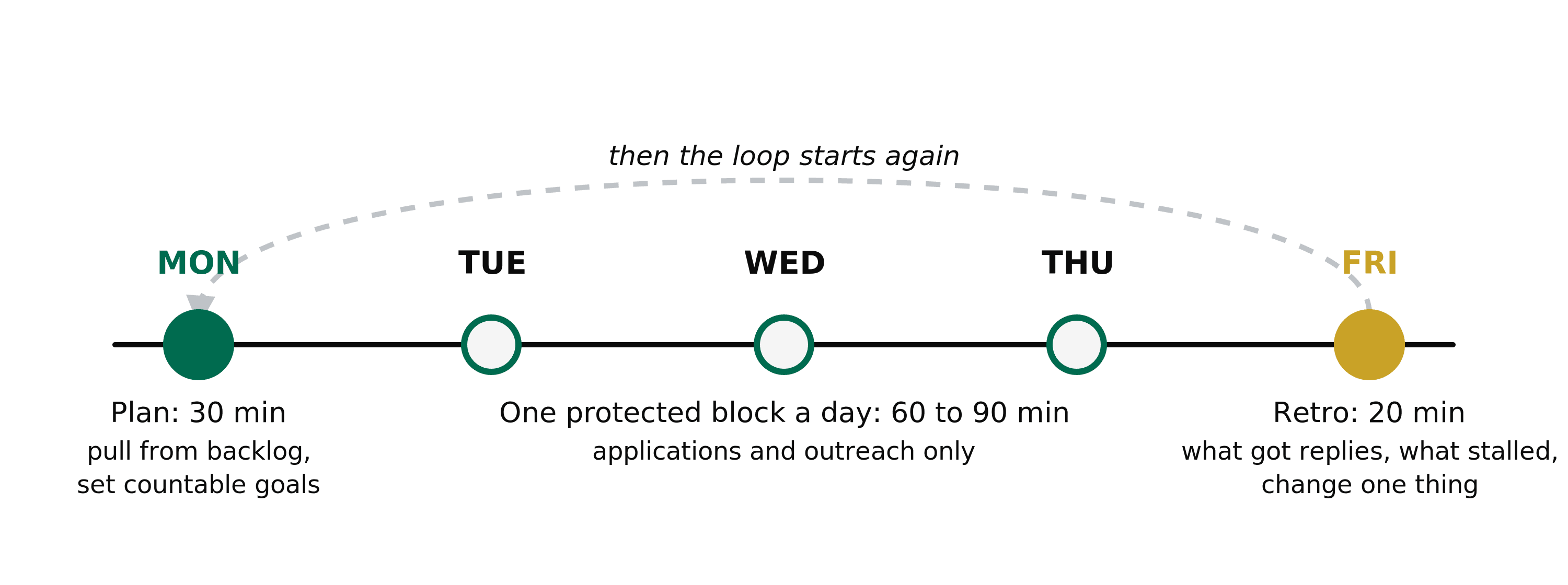
Monday, thirty minutes of planning. Pull from the backlog and set the week's goal in numbers you can count. Say: four applications taken to done, three new outreach messages, two follow-ups.
Tuesday to Thursday, one protected block a day. Sixty to ninety minutes, applications and outreach only, nothing else open. The search is a job with terrible hours. Give it decent ones: short, fixed, and protected.
Friday, twenty minutes for a retro. Three questions, the same every week. What got a response? What stalled? What one thing will I change next week?
One change. Not five. Change five variables at once and you'll learn nothing about any of them. That discipline, adjusting one thing and watching what moves, is the whole difference between a search that improves and a search that just repeats itself with worse morale.
Count replies, not applications
“I sent thirty applications this month” is the job seeker's version of a team bragging about how busy it is. It measures motion. It says nothing about whether anything is moving.
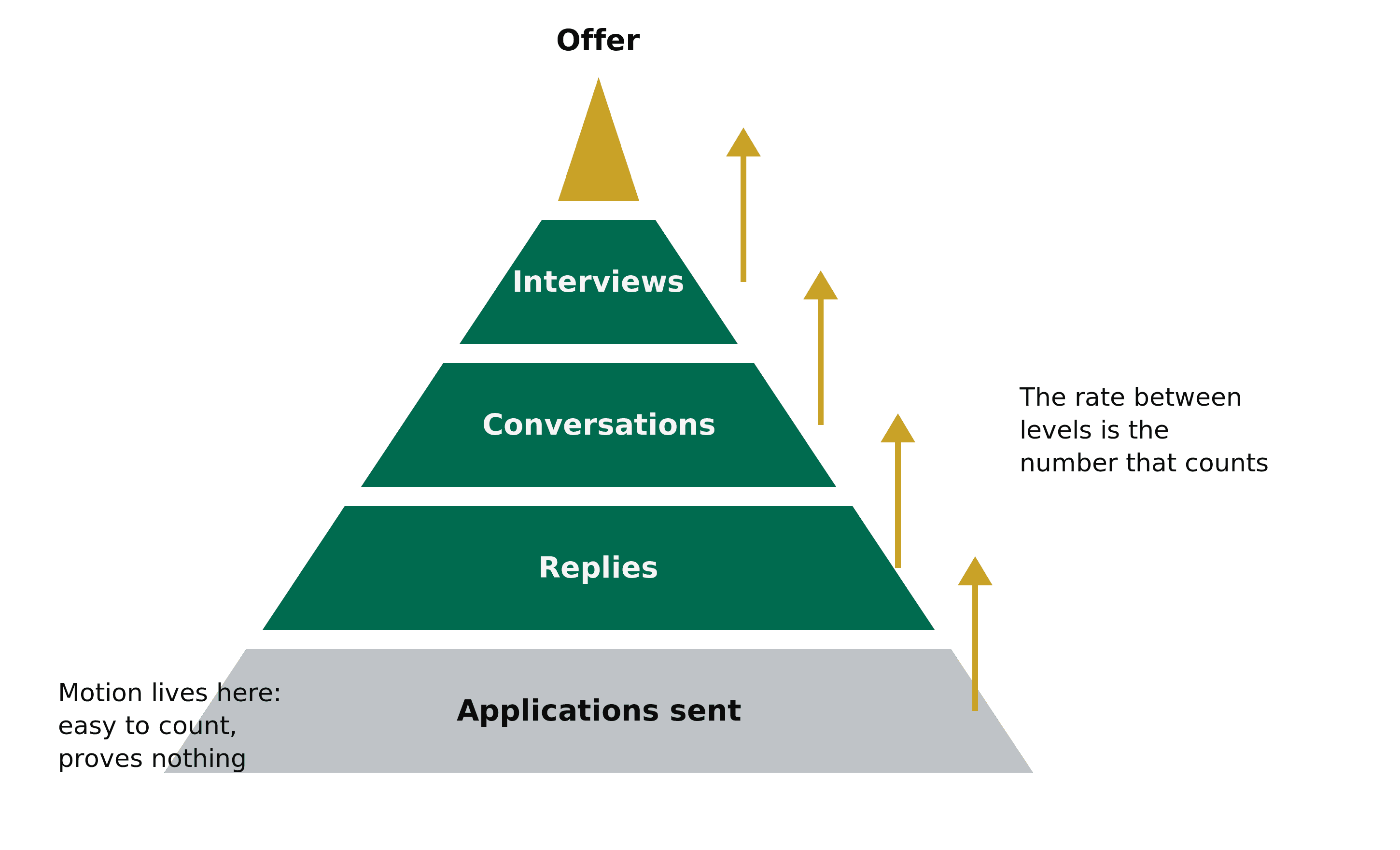
The numbers worth tracking are the conversions between levels: replies per ten tailored applications, conversations per ten outreach messages, second rounds per first interview. Small numbers, honestly counted, written down weekly.
They're not there to make you feel good. They're diagnostics. Plenty of applications and no replies? The leak is positioning: the resume, the targeting, or both. Plenty of first screens but no second rounds? Your materials work and your stories don't, so the fix is interview prep, not more applying. Each leak points at a different part of the system, which means each leak tells you exactly where Friday's one change should go.
Most people respond to silence by doing more of whatever produced the silence. The metrics are how you stop.
Work the people like a pipeline
Most networking is random acts of awkwardness. One message when you're desperate, then six months of nothing.
Treat people the way you'd treat stakeholders on a project: with stages and a cadence. A contact moves through four stages. Identified. Reached out. In conversation. Advocate.
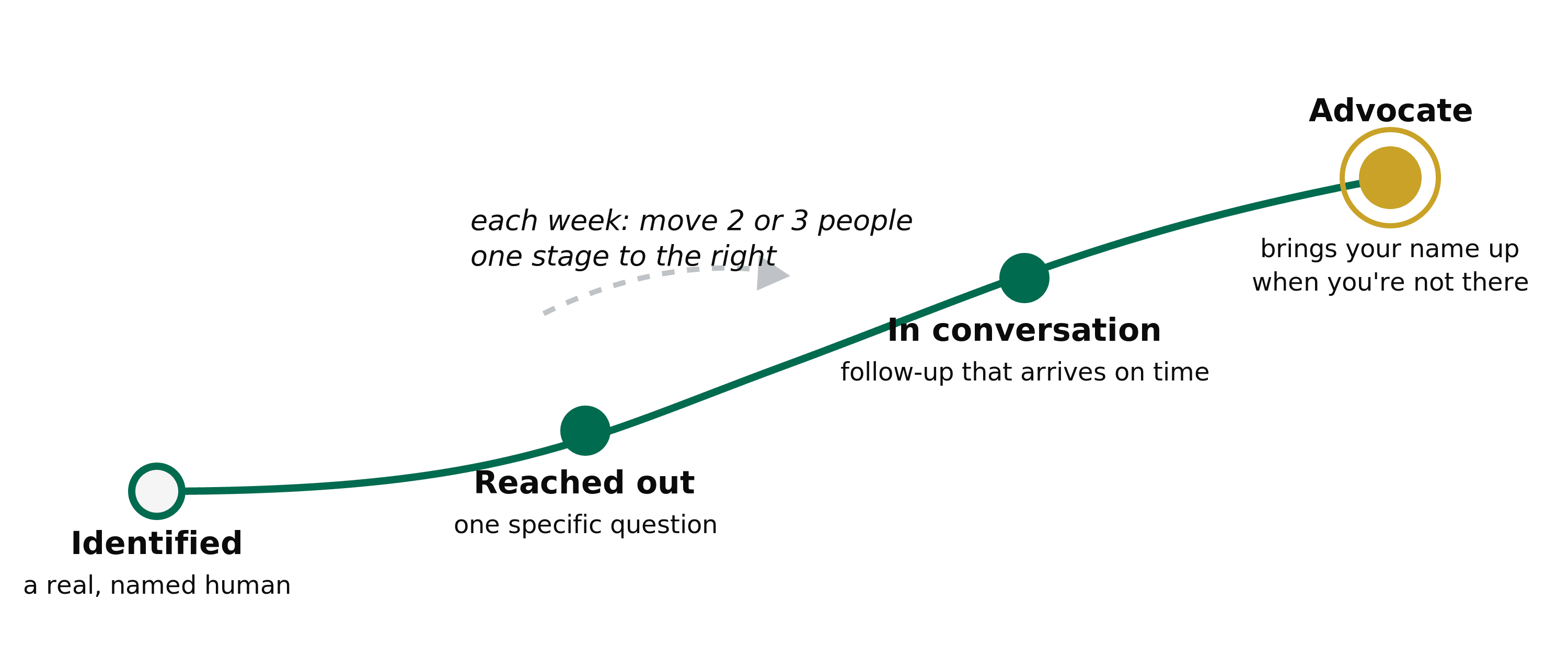
Your job each week isn't to “network more.” It's to move two or three specific people one stage to the right.
That takes small, specific asks. Not “let me know if you hear of anything,” but “you've worked with that delivery team, what's the one thing they care about that the posting doesn't say?” People answer specific questions. Almost nobody answers vague hunger.
And the follow-up lives in your calendar, not your memory, because memory always votes to avoid the awkward thing. None of this is gaming anything. Reaching a decision-maker through someone who trusts you is how stakeholder work has functioned forever. You're not skipping the line. You're practicing the actual job.
The delivery story you're building by accident
Now the part most people never notice.
Somewhere in your next round of interviews, a version of this question is coming: “Tell me about something you've planned and run end to end.” Candidates without the job title dread it. They reach for a group assignment from years ago, and everyone in the room can feel the stretch.
You'll have an answer that's three weeks old. You scoped a project with a clear goal and explicit exclusions. You built a backlog and ordered it on purpose. You limited work in progress to protect quality. You ran a weekly cadence with planning and a retro, tracked conversion instead of activity, found the leak, and changed one variable at a time until the numbers moved. You managed a pipeline of real stakeholders with specific asks and follow-up that arrived on time.
That's not a framing trick. It's true. You'll have actually done it, recently, under pressure, with stakes that were yours. Which has always been the honest answer to “I don't have delivery experience”: go run something real, then describe it plainly.
So don't apply to anything tonight. Open a blank page on Monday instead. Scope on one page. Backlog in one sheet. Five in play. Retro on Friday.
Run the search the way you intend to run projects, and you'll walk into the interview already doing the job.

Subscribe to the Newsletter
Join our growing community and get alerted first on our every article.
*By subscribing, you agree to send your information to our Company who agrees to use it according to their Terms and conditions and Privacy Policy
About the author
With 20 years guiding high-stakes Agile transformations, I turn theory into action at Oaktreeuni—mentoring aspiring Scrum Masters to think critically, adapt fast, and lead beyond frameworks. The payoff? You step into a high-paying Scrum Master or Agile PM role already equipped to excel.
Comments